1566·Basel, Swiss Confederation
Switzerland.Celestial Phenomenon · Basel
At dawn on 7 August 1566, many inhabitants of Basel (Switzerland) reported large black spheres crossing the sky swiftly in front of the sun, 'as if fighting', some turning red and burning up. The event joined other solar and lunar prodigies of that summer. The printer Samuel Apiarius published it in a broadsheet with a woodcut, with a text signed by Samuel Coccius, a student in Basel.
Tier B · IndicativeWhat do they mean? →
Limited evidence: a single witness, testimony gathered years later, or an account without contemporary primary documentation.
What it was
62%natural or human cause
Most likely explanation: natural phenomenon
See the split across the six explanations
Natural or human cause
No known cause
Read the full reasoning
Meteor showers, a bolide, cometary movements, an aurora borealis, optical illusions caused by uncommon atmospheric conditions, like Sahara dust, or some other rare astronomical event, like a singular arrangement of planets, have all been proposed as hypothetical explanations.' But the same text admits that 'Historians and scientists, nonetheless, are still left wondering what exactly caused the celestial event', and some of those candidates are astronomical: the class records the generic 'natural phenomena', without a detail.Primary documents
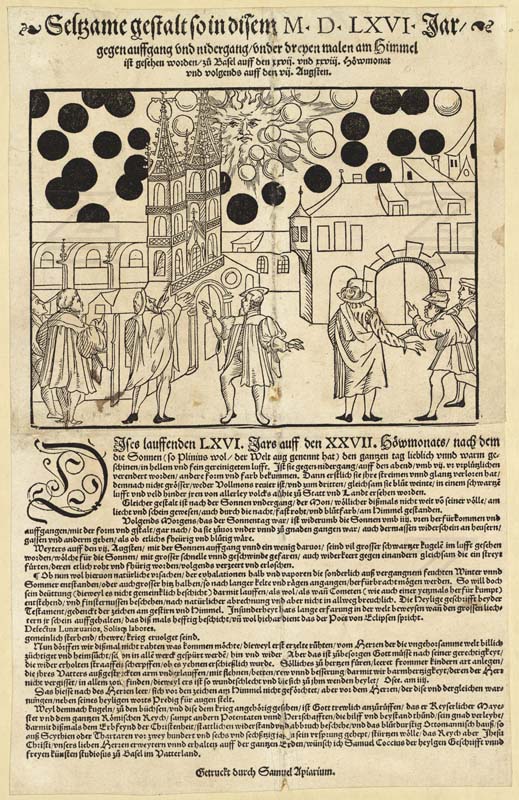
Basel broadsheet (1566) · «Seltsame Gestalt» — the celestial phenomenon over the city
Grabado de la época (Basler Chronik) vía Wikimedia Commons · Public domain · work published before 1928 · open original
The night in question
The Basel case belongs, like Nuremberg five years earlier, to the genre of celestial-prodigy broadsheets (Flugblätter) that flourished in Reformation Europe. According to the text of the sheet, signed by Samuel Coccius, "student of Holy Scripture and the liberal arts at Basel, in his fatherland", the inhabitants of Basel witnessed over several days (27 and 28 July and 7 August 1566) a series of strange phenomena in the sky. The first two are described as an anomalous sunrise and an episode involving the sun and moon tinged red; the third, the most famous, occurred at dawn on 7 August.
That day, according to the text, as the sun rose 'large black spheres' were seen coming and going before the solar disk with great speed and precision, as if engaged in combat. Some of those spheres, the chronicle recounts, turned red and fiery and seemed to consume or extinguish themselves. The scene (dark spheres whirling and colliding before an intensely bright sun) was captured in a woodcut illustrating the broadsheet, showing the sky filled with white and black orbs in apparent disorder around the star.
The sheet was printed in Basel that same year by Samuel Apiarius (c. 1530-1590), an itinerant printer active between Bern, Basel and Solothurn; in Hellmann's entry the sheet names only the printer and, as author of the text, Coccius. The leaflet, a folio sheet with a woodcut of about 23 by 18 centimetres and 35 lines of text, is held today in the Zentralbibliothek in Zurich, part of the famous Wickiana collection, the archive of prodigies, news and 'signs' assembled by the Zurich cleric Johann Jakob Wick. As in Nuremberg, the event was read providentially: a divine warning in a time of religious and political tension. Carl Jung cited it in 1958, alongside the Nuremberg woodcut, in his study of sky visions, and the meteorologist Gustav Hellmann, who catalogued the sheet in 1921, tentatively put the red sunrises and sunsets down to haze but wrote that he could not interpret the black balls flying past the sun. The most cited interpretation today is that the scene corresponds to atmospheric optical phenomena (halos, parhelia and solar-refraction effects at dawn) translated by witnesses into the martial and religious language of their time.
Why it matters
Basel 1566 matters for the same reason as Nuremberg 1561 and as its complement: together they form the historical anchor documenting how, long before photography and radar, European communities perceived, narrated and printed observations of objects in the sky organized as a meaningful 'event'. Two independent broadsheets, from different cities and workshops, five years apart, describing swarms of spheres 'fighting' before the sun at dawn, show that the phenomenon-as-account has deep, recurring cultural roots, not that there were craft. The preservation of the original in Zurich's Wickiana collection also gives it a solid documentary provenance uncommon for a 16th-century case.
As with Nuremberg, the prosaic reading dominates. The reference explanation is atmospheric optics, though scholars have also proposed meteor showers, a bolide, a comet or an aurora: solar halos, parhelia (multiple 'suns' and arcs) and refraction effects in ice crystals with the sun low produce exactly the discs, orbs and dark spots that a 16th-century observer, lacking a physical framework, would translate as spheres in combat; added to that are the printer's providential interpretive layer and the commercial incentive of a sheet that sold better the more portentous it was. The text does not say whether Coccius saw it himself (it speaks of what "was seen" in Basel), we cannot interrogate witnesses from four and a half centuries ago, and nothing in the sheet gives a basis to infer technology. Basel is the second witness to the longue durée (the one that confirms Nuremberg was not a unicum but part of a tradition) and, with it, a reminder that a tale's antiquity strengthens its historical value without turning it into proof of what was seen.
What's left on paper
Documented evidence
- Broadsheet (Flugblatt) printed in Basel in 1566 by Samuel Apiarius, with a woodcut of about 23 × 18 cm and a text signed by Samuel Coccius, a student in Basel
- Text dating the main phenomenon to dawn on 7 August 1566 and describing swift 'large black spheres' before the sun
- Mention of spheres turning red and burning up, alongside solar/lunar prodigies of 27-28 July
- Original held in the Wickiana collection of the Zentralbibliothek, Zurich
- Parallel and earlier Nuremberg case (1561), of the same celestial-prodigy broadsheet genre
Show 3 more items
- Dominant historiographic interpretation: atmospheric optics (halos/parhelia) translated into martial-religious imagery
- Coccius's text on 7 August, quoted by Jung: at sunrise "many large black balls were seen in the air", flying before the sun "with great speed", turning against each other "as if fighting a battle", some becoming red and fiery and then being "consumed and extinguished"
- Gustav Hellmann (1921), cataloguing the sheet (Zurich, Ms. F. 17): he could not interpret the black balls
Sources
- Wikipedia — 1566 celestial phenomenon over Basel
- Swiss National Museum blog — 'The celestial event over Basel in 1566'
- Zentralbibliothek Zürich — colección Wickiana (procedencia del pliego)
- Hellmann, Gustav — «Die Meteorologie in den deutschen Flugschriften und Flugblättern des XVI. Jahrhunderts» (Abhandlungen der Preußischen Akademie der Wissenschaften, 1921) (archive.org) — Bibliographic entry for the sheet: full title, dates of 27-28 July and 7 August, size of the woodcut, authorship of the text (Coccius, a student in Basel), Zurich shelfmark (Ms. F. 17) and the comment that he could not interpret the black balls.
- Wikimedia Commons — escaneo de la hoja volante «Seltsame Gestalt so in disem M.D.LXVI. Jar» — Reproduction of the original sheet held by the Zentralbibliothek Zürich (low resolution).
- Patrick Gross — «Basel 1566», con el pasaje de Coccius tal como lo cita Jung en «Ein moderner Mythus» (1958) — Secondary: reproduces in German Jung's quotation of Coccius's text on 7 August.