1966·Wanaque Reservoir, New Jersey
United States.Wanaque Reservoir · New Jersey
Between January and October 1966, police, municipal officials and many residents of Wanaque (New Jersey) reported lights over the state's largest reservoir. On the night of 11 January, a very bright, silent object was seen for hours; the press spoke of over 150 calls, and that night's military telex records six in one hour. The intelligence officer of the New York Air Defense Sector, who had missile batteries search for the object, rated it 'unknown'; Project Blue Book changed it to 'probable aircraft' without new data.
Tier A · AcceptableWhat do they mean? →
Institutional evidence: several identified independent witnesses, or contemporary official documentation, without an instrumental record to corroborate them.
What it was
54%natural or human cause
Most likely explanation: aircraft
See the split across the six explanations
Natural or human cause
No known cause
Primary documents
Project Blue Book · record card, memos and New York Air Defense telex (extract)
Eight pages of the Blue Book file "Wayne, New Jersey" (NARA). The record card for 11 January 1966 summarises a civilian witness who watched a blue-white light "resembling a burning magnesium" for 3 to 4 minutes and concludes "probable aircraft"; the evaluation cites the density of New York air traffic. A memo for record notes a New York reporter's call about the reservoir and proposes Saturn and Jupiter. The air defense sector telex records Nike fire unit 75, which saw an object moving at aircraft speed, and Major O'Connell's "unknown". A January 1967 memo records the inquiries to McGuire, Stewart and Willow Grove about the January and October episodes.
Project Blue Book, expediente «11 Jan 66, Wayne, New Jersey» (NARA), espejo en archive.org · pp. 1, 8–14 · Public domain · US Government work · open original
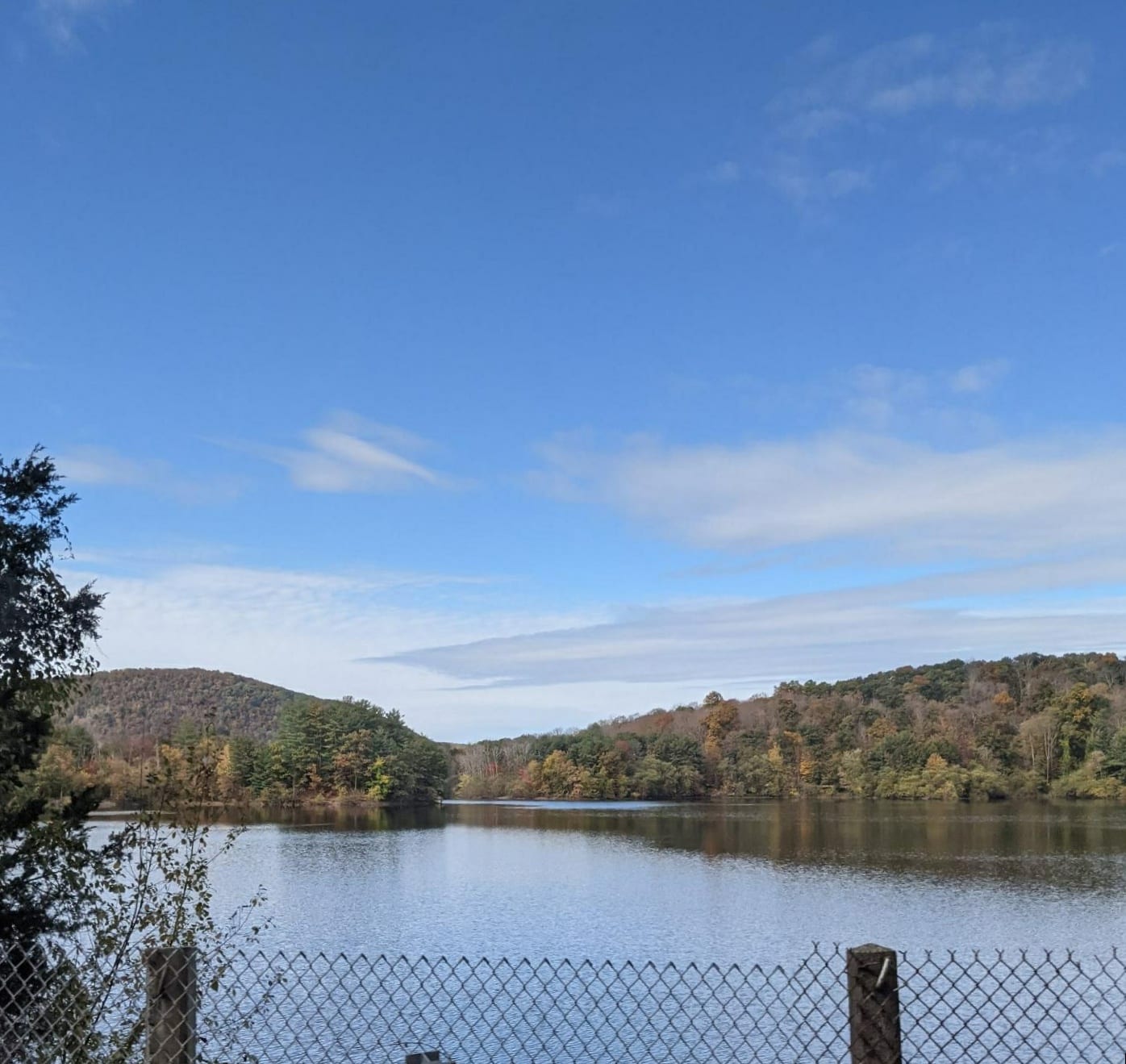
Context · the Wanaque Reservoir (New Jersey)
WanaqueReservoir.jpg · Wikimedia Commons · CC BY-SA 4.0 · open original
The night in question
Wanaque Reservoir, New Jersey's largest water reservoir, was in 1966 the scene of a wave of collective sightings. The most intense episode began on the night of 11 January 1966. At 6:20 PM a Pompton Lakes newspaper editor, Howard Ball, 36, saw from the intersection of Hamburg Turnpike and Colfax Road, in Wayne, a circular, pea-sized, blue-white light 'resembling a burning magnesium' and at times pulsing like a strobe light, which stopped, moved sideways and toward him, and went off at jet speed. According to the period press, as cited later by compilations, the Wanaque and Pompton Lakes police received more than 150 calls that night; the military telex, more cautious, notes that the Pompton Lakes and Ringwood police received six between 6:30 and 7:30 PM. A New York journalist who called Blue Book at 5:15 AM the next day, after speaking with the mayor, placed the object over the reservoir from 7:30 to 8:30 PM and again from 2:20 AM on 12 January until the end of the night.
The local testimony gathered by the newspapers, and later repeated by books and magazines, is not anonymous. Patrolman David Cisco (or Sisco) said the object appeared silently, 'glided, then streaked faster than a jet' and 'when it rose, it went straight up'. Reservoir guard and former policeman Charles Theodora went up to the Raymond Dam with him, and both described over the water a cylindrical shape rocking 'like a rocking chair'. Mayor Harry T. Wolfe, councilmen Warren Hagstrom and Arthur Barton and the mayor's son, on their way to oversee the borough's Christmas-tree burning, detoured to the dam to watch it. The next day Patrolman Jack Wardlaw spoke of a 'bright white disk' that moved sideways, stopped and rose vertically. These quotations do not appear in the official file, which documents only the Wayne report.
That file does record the military response. The New York Air Defense Sector, at McGuire, used two Nike missile batteries to scan the area: number 74 saw nothing, and number 75 saw an object moving at aircraft speed, a bright light that dimmed, northeast of the battery and heading east. There was no radar contact. The sector's intelligence officer, Major Harold J. O'Connell Jr., rated the sighting 'unknown'. Blue Book closed it as 'probable aircraft', citing the density of New York air traffic 'without additional information to eliminate' that possibility, and for the reservoir report it proposed from its office Saturn and, for the early morning, Jupiter. The activity returned in October: the file dates the main episode to 11 October around 9:00 PM, and the press quoted Sergeant Ben Thompson of the reservoir police describing an intensely bright light over Windbeam Mountain. According to a January 1967 memo, the officers claimed that after that sighting six or seven helicopters and ten to twelve jets came into the area; Stewart AFB said none of its aircraft were there, and McGuire that it had no helicopters and none of its aircraft were flying in the area. The officers also alleged that an Air Force officer gathered them in an auditorium to tell them they were crazy; McGuire replied that everything was done by phone and that no one interviewed the witnesses in person.
Why it matters
Wanaque is a mass sighting with institutional witnesses (police, a guard, the mayor and councilmen) sustained over time, in which the military file itself shows an internal discrepancy. Any explanation must cover the whole episode, including the two separate waves of January and October. The levels of evidence should, however, be kept apart: what the file documents is a detailed civilian report, a Nike battery that saw a moving light, six logged calls and an 'unknown' from the intelligence officer; the rest, including the mayor's and the patrolmen's quotations, comes through the press and later compilations that could not be checked against the original newspapers.
The prosaic explanations have concrete support. At 6:20 PM Venus, at magnitude -4.1 and the brightest object in the sky at that moment, was about 4 degrees above the west-southwest horizon, about to set; once it set, around 6:40 PM, Jupiter, at magnitude -2.5, was the brightest object for the rest of the night, 40 to 60 degrees up to the east and southeast; at 2:20 AM it was still about 34 degrees up in the west. A bright point light seen over frozen water, with reflections and no distance cues, 'rocks' and 'dances' through the autokinetic effect, and battery 75 described what it saw as a light moving at aircraft speed in the densest air corridor in the country. Against that, Saturn, Blue Book's first suggestion, was a magnitude 1 point that hardly explains an object 'much bigger than a star', and the 'probable aircraft' conclusion was written over an 'unknown' without new investigation. The jets and helicopters the officers reported in October are not an acknowledged fact: they are a witness claim that both bases denied, and they allow neither closing the case as military traffic nor reading them as a response to something anomalous. None of these pieces cleanly explains the whole, and no one interviewed the witnesses in person.
What's left on paper
Documented evidence
- New York Air Defense Sector telex from McGuire (13 January 1966): circular blue-white light seen at 6:20 PM from Wayne by a Pompton Lakes editor; intelligence officer's evaluation, 'unknown'
- Nike missile batteries used to scan the area: number 74 negative; number 75, a bright light moving at aircraft speed heading east; no radar contact
- Six calls logged by the Pompton Lakes and Ringwood police between 6:30 and 7:30 PM according to the telex; the press spoke of over 150 that night
- Blue Book changed the evaluation to 'probable aircraft' on the grounds of air-traffic density and proposed Saturn and Jupiter for the reservoir report
- Press testimony gathered later: Patrolman David Cisco, guard Charles Theodora (cylindrical shape 'like a rocking chair'), Mayor Harry T. Wolfe and councilmen, Patrolman Jack Wardlaw
Show 2 more items
- Second wave in October (11 October around 9:00 PM according to the file); the officers said they later saw helicopters and jets, and Stewart and McGuire denied they were theirs
- Ephemerides: Venus, magnitude -4.1, about to set in the west-southwest at 6:20 PM (it set around 6:40 PM); from then on Jupiter, magnitude -2.5, was the brightest object, high in the east and southeast for the rest of the night of 11 January
Sources
- Project Blue Book, expediente «Wayne, New Jersey», 11 de enero de 1966 (archive.org) — Primary source: 'probable aircraft' record card, New York Air Defense Sector telex with the 'unknown' evaluation and the Nike batteries, the witness questionnaire, the memo on the second-hand Wanaque report (Saturn and Jupiter) and January 1967 memos on the October episode
- Weird NJ — «UFOs Over The Wanaque Reservoir: The Roswell of the Ramapos» — Secondary source: reconstruction with quotations from the 1966 press
- UFO Casebook — «1966 - The Wanaque Reservoir Incident» — Secondary source: aggregator
- Think AboutIt — «1966: Wanaque Reservoir Incident» — Secondary source: aggregator
Related cases
same explanation · same country · same period
Exeter · low-altitude object seen by two police officers (USA, 1965)
1965 · Tier A
same explanation · same country · same period
USS Gyatt · the Puerto Rico radar contact and the classified Mach 3 jet
1964 · Tier S
same explanation · same country · same period
RB-47 ECM Encounter
1957 · Tier S
same explanation · same country · same period
Loring AFB overflights · SAC nuclear bases
1975 · Tier S