2009·Northern Norway sky (visible from Tromsø and Trøndelag)
Norway.Norwegian Spiral
On 9 December 2009, at dawn, an enormous grey spiral with a blue beam emerging from one end appeared over northern Norway, visible for about 10 minutes across thousands of square kilometres. The next day, the Russian Defence Ministry acknowledged it was a failed Bulava missile test: the third stage spun and the vented fuel, lit by the Sun, drew the spiral.
Tier A · AcceptableWhat do they mean? →
Institutional evidence: several identified independent witnesses, or contemporary official documentation, without an instrumental record to corroborate them.
What it was
96%natural or human cause
Most likely explanation: rocket or missile
See the split across the six explanations
Natural or human cause
No known cause
Primary documents
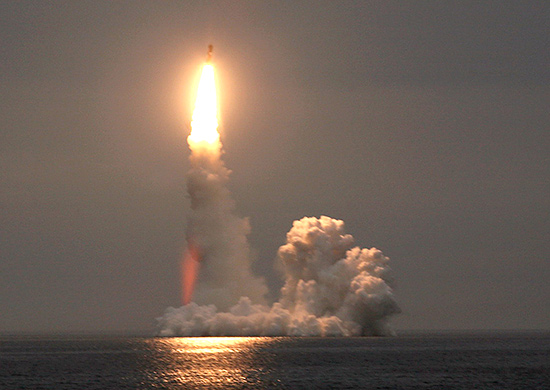
The cause, not the event: a launch of the submarine-launched Bulava (RSM-56) intercontinental ballistic missile. The 9 December 2009 spiral was a failed test of this same system —the third stage spun and vented its fuel, drawing the spiral—; this official photo shows a nominal launch of the weapon whose malfunction produced the phenomenon.
Ministry of Defence of the Russian Federation (mil.ru) · Wikimedia Commons · CC BY 4.0 · open original
The night in question
On the morning of 9 December 2009, still dark in the far north, thousands of people in Norway witnessed a light phenomenon. From the sky emerged a blue beam of light rising in a curve and, at its end, a large greyish-white spiral of almost perfect geometry began to turn, expanding to cover an enormous portion of the firmament. The spectacle was visible across the entire Trøndelag region, in the three northern counties of Norway and even from northern Sweden, and lasted about ten minutes before fading, leaving for a moment a dark ring where the spiral had been.
The sharpness and rarity of the shape (a perfect mathematical spiral in the night sky) immediately set off an avalanche of speculation. Before any official confirmation, hypotheses of every kind circulated: anomalous auroras, wormholes, extraterrestrial intervention, and even a supposed connection to the high-energy experiments the Large Hadron Collider (LHC) was then running in Switzerland. Geographic proximity to facilities like the HAARP project fed other theories.
The explanation, however, came quickly and was unequivocal. On 10 December 2009, barely a day later, Russia's Defence Ministry acknowledged that it had conducted a test of the submarine-launched intercontinental ballistic missile RSM-56 Bulava, and that it had failed. According to the statement, the first two stages worked normally, but the third suffered a technical malfunction: the engine deflected and expelled its fuel sideways, sending the missile into an uncontrolled spin. At high altitude (above 100 kilometres, already at the edge of space) the vented fuel particles were lit by the Sun, which was still below the horizon for ground observers; the missile's spin distributed that reflective fuel into the perfect spiral seen from the ground. The blue beam corresponded to the failed rocket's visible propulsive phase. The apparent absence of atmospheric drag confirmed the phenomenon occurred in the upper atmosphere, consistent with the missile's trajectory. Jonathan McDowell's GCAT launch catalog lists a Bulava launched on 9 December 2009 at 06:45 UTC from the White Sea, annotated 'St 3 fail' (third-stage failure), which fits the morning timing of the sightings in Norway.
Why it matters
The Norwegian spiral matters precisely because it is resolved, and so functions as a calibration anchor: it is an extraordinary aerial phenomenon (visually impossible, massive, photographed by thousands) that nonetheless had a mundane, verifiable human explanation, confirmed by the source itself within 24 hours. Its place is not that of a puzzle but of a reference pattern against which to measure other cases: when something seems to defy all known physics, the spiral recalls that a prosaic cause (a failed missile, spinning fuel lit by the Sun) can produce exactly that impression of impossibility.
The Russian acknowledgment closes the cause. The case is doubly useful: as a complement to the 1981 'China spiral' (another misinterpreted reentry/launch), it establishes that celestial spirals are a morphological class with a known technological explanation, and pre-empts the exotic reading of future similar events. When the possibility of the anomalous is taken seriously, the Norwegian spiral fulfills the indispensable role of marking where there is NO mystery: the discipline of acknowledging a resolved case with the same firmness with which one flags an open one.
What's left on paper
Documented evidence
- Hundreds of photographs and videos of the spiral over northern Norway, 9 December 2009, visible for ~10 minutes
- Almost perfect spiral geometry with a rising blue beam, visible from Trøndelag, northern Norway and northern Sweden
- Official acknowledgment by the Russian Defence Ministry (10 Dec 2009) of a failed Bulava missile test
- Mechanism: third-stage failure → uncontrolled spin → vented fuel lit by the Sun above 100 km altitude
- Apparent absence of atmospheric drag, consistent with an upper-atmosphere phenomenon
Sources
- Wikipedia — 2009 Norwegian spiral anomaly
- NBC News — 'Russia admits missile caused UFO lights'
- Christian Science Monitor — 'Norway spiral: A rocket scientist explains the mystery'
- McDowell, J. — GCAT, registro de lanzamientos (launch.tsv), entrada 2009-S65 — Bulava launched 9 Dec 2009 at 06:45 UTC from the White Sea; third-stage failure.
Related cases
same object · same period
Lisbon · Air Force radar target
2004 · Tier A
same object · same period
La Serena · the two-tailed object seen by five aircrews at the end of 2014
2014 · Tier A
same object
Copiapó · the lights to the south seen by three crews on the night of Cygnus NG-18
2022 · Tier A
same object
Antofagasta · the glowing cloud two airline crews saw over northern Chile
2023 · Tier A