2022·Airspace over Chamonate aerodrome, 11 km northwest of Copiapó (Atacama)
Chile.Copiapó · the lights to the south seen by three crews on the night of Cygnus NG-18
On the night of 7–8 November 2022, the crews of three airline flights heading south to Santiago from Iquique, Calama and Antofagasta asked Iquique control whether there was traffic to the south and said they had in sight two lights moving slowly, some 40 miles away, which another crew described as 'very large'. Radar recorded nothing. SEFAA considered that the conditions existed for them to be the rocket and spacecraft of launch 2022-149, the Cygnus NG-18 cargo mission, but without images from the witnesses it closed the case as a 'Report'.
Tier A · AcceptableWhat do they mean? →
Institutional evidence: several identified independent witnesses, or contemporary official documentation, without an instrumental record to corroborate them.
What it was
65%natural or human cause
Most likely explanation: rocket or missile
See the split across the six explanations
Natural or human cause
No known cause
Read the full reasoning
Against it, by our calculation: with the Sun about 44° below the horizon towards the south-southwest, no object at the height of the Cygnus or the stage (below some 330 km) visible from the area could reflect its light; and the report documents no engine burn at that hour nor the craft's pass over southern Chile.Primary documents
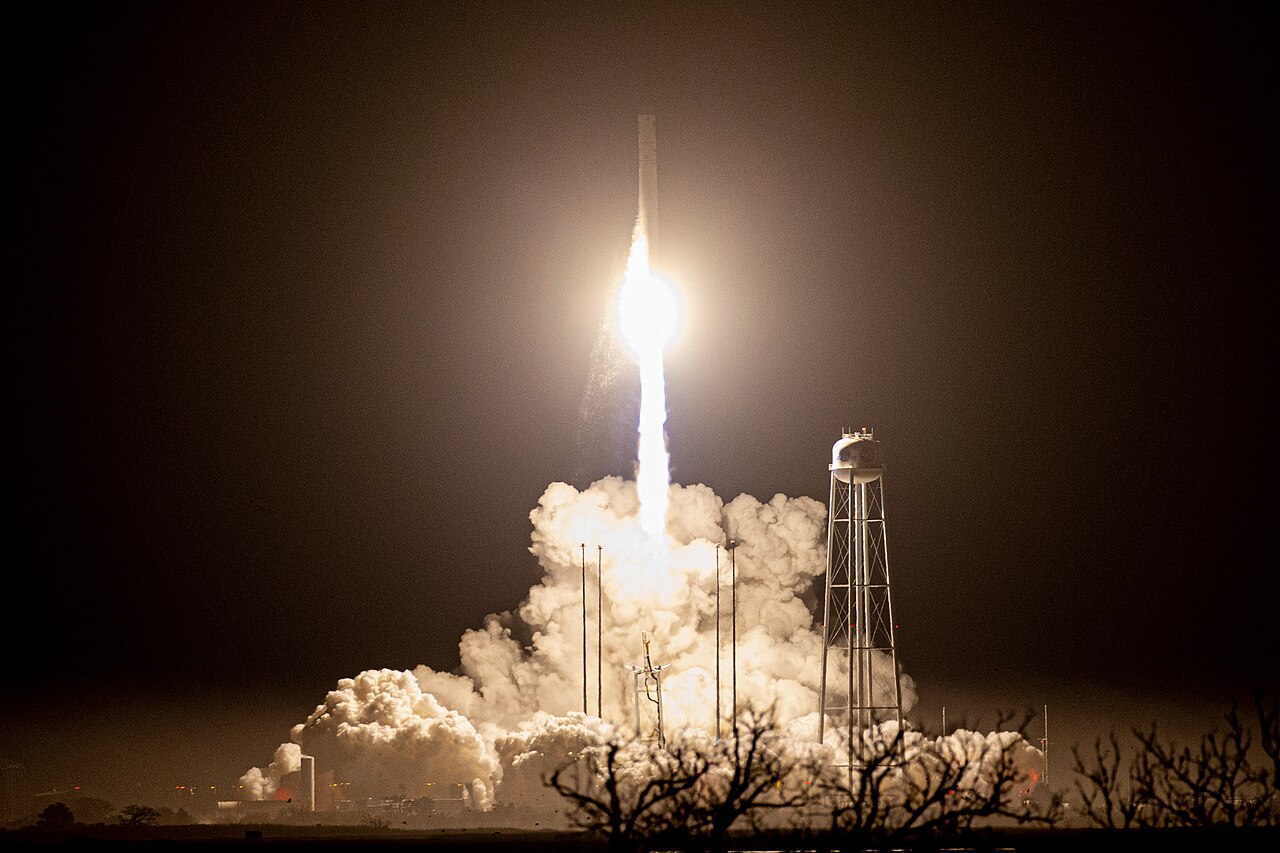
Context · the launch of Antares with the Cygnus NG-18 craft, Wallops Island, 7 November 2022
NASA photograph of the lift-off of Northrop Grumman's Antares rocket at 05:32 US Eastern time, about 17 hours before the crews saw the lights over Atacama. It is the launch that SEFAA considered a possible origin of what was reported. It is not an image of the phenomenon.
Antares CRS-18 Launch.jpg (NASA/Terry Zaperach, NASA Goddard Space Flight Center) · Wikimedia Commons · CC BY 2.0 · open original
SEFAA (Chilean DGAC) report, case no. 1838, Copiapó, 8 November 2022
Three-page report by the official anomalous aerial phenomena section. It summarises what the crews of three airline flights said by radio, identifies the aircraft and their positions with the synchronised radar video, rules out the only traffic to the south and proposes launch 2022-149 of the Cygnus NG-18 mission, but closes the case as 'Report' (Relato) for lack of images. A DGAC work with no open licence, so it is linked rather than hosted.
SEFAA, Dirección General de Aeronáutica Civil de Chile · view source
The night in question
At 03:27 UTC on Tuesday 8 November 2022, the crew of a JetSMART Airbus flying from Iquique to Santiago asked the Iquique Area Control Centre whether there was traffic to the south of its position. When told there was none, it reported having in sight to the south, some 40 miles away by its estimate, two lights that were moving slowly and that it had been watching for a while. At 03:57 UTC, the crew of a Sky Airline Airbus coming from Calama, at 39,000 feet, reported the same lights, but this time said they were very large and that, in its judgement, they were level with Santiago, more than 700 kilometres away. At almost the same moment, the crew of a second JetSMART Airbus, coming from Antofagasta and about 60 miles northeast of Chamonate aerodrome, also at 39,000 feet, said it had them in sight. The report by SEFAA, the anomalous aerial phenomena section of Chile's Directorate General of Civil Aviation, describes what was seen as two white lights, with no size given, visible to the south from overhead Chamonate, the Copiapó aerodrome, by aircraft flying between 35,000 and 39,000 feet; its summary speaks of one to three lights.
The office had the synchronised radar video from 03:30 to 04:09 UTC and no images from the witnesses. It identified the aircraft: a JetSMART Airbus 321 from Iquique to Santiago, a JetSMART Airbus 320 from Antofagasta to Santiago and a Sky Airline Airbus 320 from Calama to Santiago, flight SKY253. It placed SKY253, when it spoke to Iquique, at 39,000 feet at 26° 38′ S, 70° 21′ W, and the JetSMART flight from Antofagasta, one minute later, on heading 184°, at 26° 45′ S, 70° 22′ W. It checked the traffic to the south: the only aircraft was another JetSMART Airbus 321, from Lima to Santiago, which at 03:56 UTC was at 30° 53′ S, at 33,000 feet, too far away and too low for its navigation lights to match what was described. Its summary was that the pilots may have seen one or several luminous objects, very far away and above their flight levels, and that the radars did not record them.
It then looked for space launches in the register of the United Nations Office for Outer Space Affairs. On 7 November there was only one: a Northrop Grumman Antares rocket launched from Wallops Island, in the United States, the cargo craft S.S. Sally Ride, of the Cygnus NG-18 mission, international designator 2022-149A, bound for the International Space Station, which it reached on the 9th. The report notes that the craft can restart its engines and quotes Northrop Grumman on the rocket's difficulties during orbital insertion: 'During a stage separation event of the rocket, debris from an Antares acoustic blanket lodged in one of the Cygnus solar array mechanisms, which prevented it from opening'. Its conclusion, with a resolution date of 20 August 2024, says that 'the conditions existed' for what was seen to be 'the launcher and spacecraft of launch 2022-149', which, being beyond the reach of the radars, could not be recorded from the ground, but that, lacking images from the witnesses, the investigation had to be closed as a 'Report' (Relato).
Why it matters
The value of the case lies in its witnesses: three crews in three different aircraft, on flights identified by the report itself, spoke by radio with Iquique control about the same lights to the south over half an hour, and radar recorded where each aircraft was. They were not wholly independent, because they shared a frequency and the second and third calls came after the first; and they do not agree on the essentials: one crew saw two slow lights some 40 miles away and another thought them very large and level with Santiago. What is missing is what would allow them to be identified: no image, no radar echo and no precise direction or elevation in the sky.
The explanation SEFAA proposes has a difficulty the report does not address, and which follows from its own timeline. According to Jonathan McDowell's satellite catalogue, the Cygnus craft separated at 10:41 UTC on 7 November, about 17 hours before the first call, into an orbit of 227 to 332 kilometres, and the Antares second stage was left in one of 162 to 272 kilometres, from which it re-entered on 9 November. By our calculation, at 03:27 UTC the Sun was about 44° below the horizon in the Copiapó area, towards the south-southwest, and at that depth no object at the height of the Cygnus or the stage, below some 330 kilometres, that was visible above the horizon could be lit by the Sun: Earth's shadow covered it. Only something considerably higher, above some 500 kilometres, could be. For the craft or the stage to be seen, they would have had to be firing their engines at that moment and in that part of the sky; the report recalls that Cygnus can restart them, but it documents no burn at that hour and does not check that the craft passed over southern Chile. The full Moon was high in the north, on the opposite side from the lights.
The report also has internal inconsistencies. It calls the first flight JAT011 and JAT111, the one from Antofagasta JAT029 and JAT209, and the one from Calama SKU, SKY253 or by its level, FL390. It dates the event at 01:27 local time, but in November 2022 Chile was on summer time, three hours behind UTC, so 03:27 UTC was 00:27 local; that is our deduction. And it places SKY253 between Copiapó and Vallenar at coordinates, 26° 38′ S, that lie north of Copiapó, between that city and Chañaral. Of the JetSMART flight from Antofagasta it says it was 'approximately 60 miles northeast' of Chamonate, but the coordinates it gives put it about 33 miles to the north.
The event took place in the night corridor of northern Chile along which flights from Iquique, Calama and Antofagasta head south to Santiago, which appears in other SEFAA reports. Nine months earlier, the pilot of an air ambulance had reported 'very bright and fast' traffic near the REBEP waypoint, in Atacama, for which SEFAA found no explanation (↗). A year later, in November 2023, three crews reported lights to the southwest over airway UQ803, east of Paposo, and the office proposed orbital traffic, also without images (↗).
What's left on paper
Documented evidence
- Communications with Iquique control: at 03:27 UTC the first JetSMART flight reports two lights to the south, some 40 miles away, moving slowly; at 03:57 UTC SKY253 describes them as very large and level with Santiago, and the JetSMART flight from Antofagasta says it has them in sight
- Synchronised radar video from 03:30 to 04:09 UTC: it places two of the aircraft at 39,000 feet, at coordinates north of Copiapó, and does not record the lights
- The only traffic to the south: a JetSMART flight from Lima to Santiago at 30° 53′ S and 33,000 feet, too far and too low to explain what was seen
- United Nations launch register: a single launch on 7 November, the Antares of the Cygnus NG-18 mission (2022-149A), from Wallops Island
- SEFAA conclusion (20 August 2024): 'the conditions existed' for them to be the rocket and spacecraft of launch 2022-149; without images, closed as a 'Report'
Show 2 more items
- McDowell catalogue: Cygnus separated at 10:41 UTC on 7 November into an orbit of 227 to 332 km; the Antares second stage, into one of 162 to 272 km
- Our own calculation: the Sun about 44° below the horizon, towards the south-southwest, at Copiapó at 03:27 UTC, which leaves in shadow any object visible from there at the height of the Cygnus or the stage (below some 330 km), unless it was firing its engines
Sources
- SEFAA (Chilean Directorate General of Civil Aviation) — 'Case No. 1838', near Chamonate aerodrome, Copiapó, 8 Nov 2022 (resolved 20 Aug 2024) — Primary source: account of the three crews, radar positions, air traffic, launch 2022-149 and official conclusion.
- Jonathan McDowell — General Catalog of Artificial Space Objects (GCAT), entries 2022-149A and 2022-149B — Separation time of Cygnus NG-18 and initial orbits of the craft and of the Antares second stage.
- SEFAA — Anomalous Aerial Phenomena Study Section (DGAC), official site — Catalogue of cases published by the Chilean office.
Referenced by 1 case
Related cases
same object · same country · same period
Antofagasta · the glowing cloud two airline crews saw over northern Chile
2023 · Tier A
same object · same country · same period
La Serena · the two-tailed object seen by five aircrews at the end of 2014
2014 · Tier A
same explanation · same country · same period
Paposo · the lights seen by three airline crews over the desert
2023 · Tier A
same explanation · same country · same period
Calama · the light 'following' an Argentine Learjet
2023 · Tier B