2023·Airway UL550, southeast of Calama, near the PANED waypoint (Antofagasta region)
Chile.Calama · the light 'following' an Argentine Learjet
In the early hours of 8 November 2023, the pilot of an Argentine Learjet 60 flying from Guayaquil to Tucumán at 41,000 feet radioed, after passing Calama, about 'a bright light at 3 o'clock, about 5 miles away'.
Read the rest of the summary
When the Iquique controller suggested the reflection of a solar power plant, he replied that he knew the plant, that it was not that and that the light 'was following them'; according to the report, he saw it for 6 to 10 seconds crossing from east to west. SEFAA found several orbiting objects in that sector that could reflect sunlight, but without images it could not identify any and closed the case as a 'Report'.
Tier B · IndicativeWhat do they mean? →
Limited evidence: a single witness, testimony gathered years later, or an account without contemporary primary documentation.
What it was
70%natural or human cause
Most likely explanation: satellite
See the split across the six explanations
Natural or human cause
No known cause
Primary documents
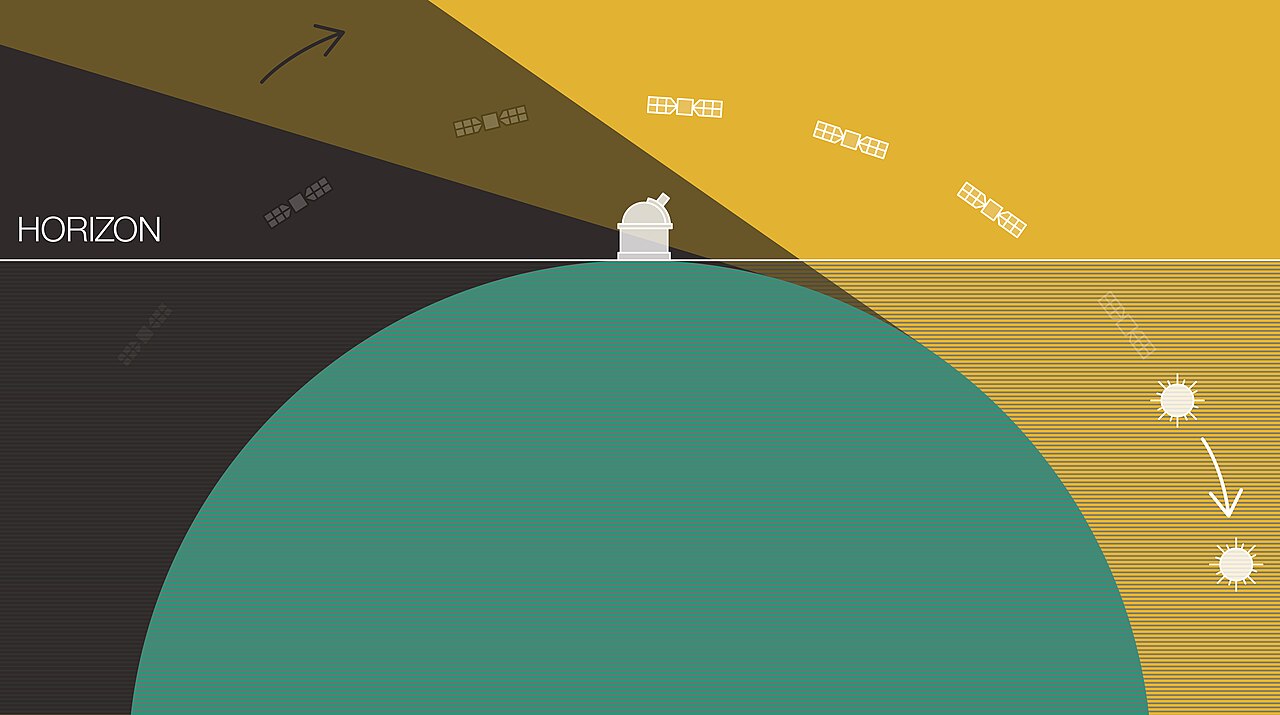
Context · why a satellite can shine in the middle of the night
Diagram by the European Southern Observatory: an observer only sees the satellites that are above their horizon and outside the Earth's shadow, lit by a Sun that has already set for them. It is the mechanism SEFAA proposed for this report; it is not an image of the phenomenon.
Schematic showing the satellites that would be visible at a given time and place (eso2004b).jpg (ESO/L. Calçada) · Wikimedia Commons · CC BY 4.0 · open original
SEFAA (Chilean DGAC) report, case no. 1937, Calama, 8 November 2023
Four-page report by the official anomalous aerial phenomena section. It quotes the Iquique controller's report with the exchange about the solar plant, searches for the flight in traffic records, rules out that day's Starlink launch, models the sky and space traffic towards 233° and concludes that several orbiting objects could have produced what was reported. It closes it as 'Report' (Relato), although its header says 'Resolved'. A DGAC work with no open licence, so it is linked rather than hosted.
SEFAA, Dirección General de Aeronáutica Civil de Chile · view source
The night in question
In the early hours of 8 November 2023, an Argentine-registered Learjet 60, a medium-size business jet belonging to the company Baires Fly, was flying from Guayaquil, in Ecuador, to San Miguel de Tucumán, in Argentina, along airway UL550, which crosses northern Chile. At 04:16 UTC, 01:16 in Chile, it had already passed Calama and was at 41,000 feet. Its pilot then called Iquique control. The controller on duty summed it up in her report like this: the aircraft, coming from Guayaquil and bound for Tucumán, 'reports having a bright light at 3 o'clock, about 5 nautical miles away'. There was no other traffic in the sector at that level. The controller suggested it could be the reflection of a solar power plant, and the pilot replied that he knew the plant, that the light was not that 'and that this light was following them'.
The report reached SEFAA on 25 November, seventeen days later. In it, what was seen is described as a white light, with no size given, seen for 6 to 10 seconds flying from the east to the west of the aircraft, with no sound, no navigation failures and no warning from the collision-avoidance system. No image was attached. The transcript itself mixes two registrations: the report identifies the aircraft as LV-FVC and the controller's quotation calls it 'LVFVZ'.
SEFAA tried to reconstruct the flight with the air-traffic records it consulted, but the aircraft did not appear with its transponder on, either at the time of the report or later, near its destination, up to 06:30 UTC. It ruled out the 23 Starlink satellites of mission G6-27, launched that day, because the launch was from 05:05 UTC onwards, almost an hour later. It took as its study point the airway near the PANED waypoint, southeast of Calama, where the aircraft should have been heading about 143°; a light 'at 3 o'clock' would thus lie towards 233°, to the southwest. The Sun was 50° below the horizon, to which the office added that its light could still reflect off the structures of orbiting objects. The model of space traffic at 04:16 UTC showed several such objects in the sector the pilot could take in. With no greater precision about the part of the sky where the light was seen, SEFAA could only establish that 'there were multiple space objects capable of having given rise to the case'. In its conclusion, of February 2024, it closed the file as a 'Report' (Relato) for lack of audiovisual material and added that there were orbiting objects that could have produced what was reported by reflecting sunlight. The header of the same report, by contrast, classifies the case as 'Resolved'.
Why it matters
The report's two descriptions do not sit well together: the form speaks of a light that crossed from east to west in 6 to 10 seconds, and the radio quotation of a light that 'was following them'. The five-mile distance, for its part, is an estimate made at night, with no reference point other than the light itself. The report is also second-hand and late: what exists is the controller's summary, written seventeen days afterwards, with the aircraft's registration transcribed two ways. There is no record that the pilot was asked for images or an account of his own, or that he provided them, and the report does not turn to control radar to place the flight.
SEFAA did not identify a specific object. What it did was show that in that direction and at that time there were several orbiting objects that could shine with sunlight, which makes the explanation plausible without proving it. That reading gains weight from the context: in the same weeks and along the same stretch of northern Chile, the office proposed sunlit satellites for four other crew reports, although only in one, with video, did it identify them —two days earlier, that of three airline flights south of Antofagasta (↗); and in the following days, that of LXP377 and LXP345, that of LXP905 and a Copa aircraft, and that of FACh922, whose crew filmed what they saw and made it possible to identify three Starlink satellites and the debris of Fengyun 1C—. That a pilot knowingly rules out the solar plant suggested to him from the ground is a real fact of the case; but with no image, no position in the sky and no account from the witness himself, there is nothing left to set against the pass of a satellite.
What's left on paper
Documented evidence
- Report by the Iquique controller (25 Nov 2023): the pilot 'reports having a bright light at 3 o'clock, about 5 nautical miles away', rules out the solar plant and says the light 'was following them'
- Description in the report: a white light seen for 6 to 10 seconds crossing from east to west, with no sound or collision-avoidance warning
- Baires Fly Learjet 60 LV-FVC, Guayaquil–Tucumán, at 41,000 feet on airway UL550; no transponder visible in the traffic records consulted
- The 23 Starlink satellites of mission G6-27 ruled out: launched from 05:05 UTC, after the report
- Model of space traffic at 04:16 UTC: several orbiting objects in the visible sector, with the Sun 50° below the horizon
- SEFAA conclusion: orbiting objects that could have produced what was reported by reflecting sunlight; closed as a 'Report' (the header says 'Resolved')
Sources
- SEFAA (Chilean Directorate General of Civil Aviation) — 'Case No. 1937', Calama, 8 Nov 2023 (resolved 20 Feb 2024) — Primary source: the controller's report, search for the flight, astronomical and space-traffic analysis, and official conclusion.
- SEFAA — 'Case No. 1933', north of the ENTOP waypoint, 10 Nov 2023 — Neighbouring report: lights consistent with sunlight reflecting off OneWeb satellites.
- SEFAA — 'Case No. 1935', airway UQ803, 20 Nov 2023 — Neighbouring report: 'Probably explained' by OneWeb, Starlink and Iridium satellites.
- SEFAA — 'Case No. 1936', FL350 over Antofagasta, 23 Nov 2023 — Neighbouring report with video: three Starlink satellites and Fengyun 1C debris.
- SEFAA — Anomalous Aerial Phenomena Study Section (DGAC), official site — Catalogue of cases published by the Chilean office.
Referenced by 2 cases
Related cases
same object · same country · same period
Paposo · the lights seen by three airline crews over the desert
2023 · Tier A
same object · same country · same period
Antofagasta · the three lights filmed by the FACh922 crew
2023 · Tier A
same object · same country · same period
Caleta Lobos · the lights below Orion's Belt seen by three airline crews
2024 · Tier A
same object · same country · same period
Southern Patagonian Ice Field · the light that crossed ahead of an A321 bound for Punta Arenas
2019 · Tier A