2024·XONOG reporting point, over the coast south of Caleta Lobos, Tarapacá Region
Chile.Caleta Lobos · the lights below Orion's Belt seen by three airline crews
On the night of 22 April 2024, the captain of Aerolíneas Argentinas flight ARG1364, at 38,000 feet over the coast south of Iquique, reported flashing lights with no defined path, three to four of them, very high and below Orion's Belt, known in Chile as the Three Marys; when asked, the crew of SKU333 said they saw two lights to the southwest, and a third flight also reported two lights on its left.
Read the rest of the summary
Without images, SEFAA reconstructed the sky from each aircraft, found the Sun below the horizon roughly in that direction and 24 sunlit satellites below the three stars, and considered it probably explained as sunlight reflected by space objects more than 400 km up.
Tier A · AcceptableWhat do they mean? →
Institutional evidence: several identified independent witnesses, or contemporary official documentation, without an instrumental record to corroborate them.
What it was
80%natural or human cause
Most likely explanation: satellite
See the split across the six explanations
Natural or human cause
No known cause
Primary documents
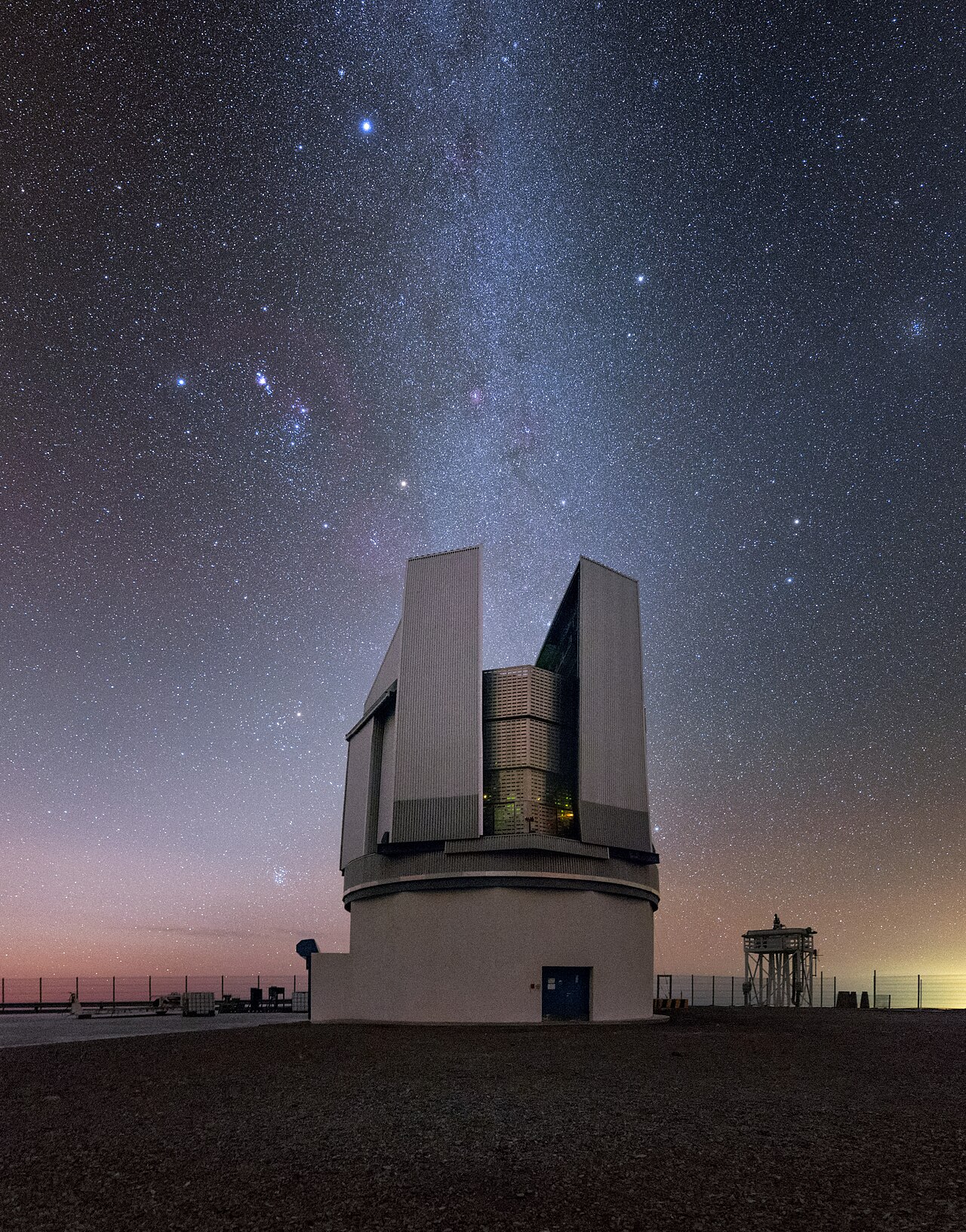
Context · Orion's Belt, the Three Marys, over the Atacama Desert
The VST telescope at Paranal Observatory, near the Antofagasta coast, under the Milky Way: on the left, Betelgeuse, Bellatrix and the three aligned stars of Orion's Belt, known in Chile as the Three Marys. It is the sector of the sky the ARG1364 captain used as a reference; it is not an image of this case.
Orion Watches over Paranal - potw2009a.jpg (ESO/Y. Beletsky) · Wikimedia Commons · CC BY-SA 4.0 · open original
SEFAA (Chilean DGAC) report, case no. 1984, south of Caleta Lobos, 22 April 2024
Five-page report by the official anomalous aerial phenomena section. It summarises the communications of flights ARG1364, SKU333 and a third flight with Iquique, places the aircraft with radar, reconstructs each one's horizon and lists 28 satellites below the Three Marys, and considers the case probably explained as reflections off space objects. A DGAC work with no open licence, so it is linked rather than hosted.
SEFAA, Dirección General de Aeronáutica Civil de Chile · view source
The night in question
The report reached SEFAA from Diego Aracena airport in Iquique. On the night of 22 April 2024, the captain of Aerolíneas Argentinas flight ARG1364 reported that he had in sight flashing lights with no defined path. He was flying at 38,000 feet along airway UL550, heading west-northwest according to the summary, near the compulsory reporting point XONOG (20° 59′ 14″ S, 70° 13′ 05″ W), over the coast south of Caleta Lobos, in the Tarapacá Region. Asked from the ground, the crew of Sky Airline's SKU333, which had just taken off from Iquique heading south and was at 18,000 feet, said they saw two moving lights to the southwest of their position. In addition, a third flight, heading north along airway UQ802, also reported having the two lights on its left. Finally, ARG1364 specified that there were three to four lights, visible intermittently, flying on different paths, with fast movements, at an altitude it could not determine but very high, and that they seemed to be 'below the constellation of the Three Marys (Orion's Belt)'.
The report is inconsistent about that third flight: the summary calls it LXP302, LATAM's call sign, but the investigation and conclusion call it SKU302, of Sky Airline, and the radar figure labels its track 'SKU302 457 / 360'; the LXP302 in the summary looks like a typo. The same figure shows SKU333 at flight level 150, climbing to 370. Nor does the report label the time of its analysis, 21:05:31. From the position of the Sun it gives, it must be local time: Chile had returned to winter time, UTC−4, on 6 April, and at 21:05 UTC it was still daylight (a deduction of this record, as is the inference that the report date, 23 April, would already be the event's date in UTC).
From the radio exchanges, the office established that the crews spoke of two to four lights of different intensity, which gave the impression of flying in different directions, far above their flight levels and to the west of their positions, in the sector of the Three Marys. It placed the three aircraft with the radar record at the moments they mentioned the lights and reconstructed the astronomical horizon ahead of each. For all three the sector was very low, near the horizon. For SKU333, heading south, it lay behind and far to the right, that is, towards the northwest, although its crew had spoken of lights to the southwest; according to the report, this explains why they struggled to locate it; for the northbound flight it lay to the left and was easy to see; and for the Argentine aircraft, which in the figure is on heading 320°, it was practically straight ahead. The Sun, although below the horizon, was at roughly the same azimuth: for ARG1364, at 269.4° and 38.6° below the horizon.
Without an audiovisual record that would identify which objects produced the lights, the office focused on those immediately below the three stars as seen from the ARG1364 cockpit. At 21:05:31 it counted 28 satellites in that sector, at altitudes from 446 to more than 36,000 kilometres. Although the observers were in darkness, 24 were lit by the Sun and could reflect its light, among them several Starlinks, two OneWebs, a Globalstar, an Orbcomm and the Chinese Yaogan-36 01C, as well as several between 8,000 and 36,000 kilometres up, which in this record's view were too far away to be seen with the naked eye; the other four, all Starlinks, were in penumbra. It found similar situations for the other two aircraft. Its conclusion, dated 14 May 2024, states that 'it was concluded that the situation reported' by the three crews 'was reflections caused by space objects, which were above 400 km in altitude, and therefore did not pose a dangerous situation', and classifies the case as 'Probably explained', the same category given in the header.
Why it matters
Like the Paposo case five months earlier (↗), this one brings together three crews in three aircraft who spoke by radio of the same lights in the air corridor of northern Chile, and as then there were no images. The difference lies in how it was closed: here SEFAA considered it probably explained, relying on a geometric coincidence the report documents for each aircraft, that of lights seen roughly where the Sun was below the horizon. That is the condition in which satellites at high altitude remain lit while the observer is in darkness, and it is the same mechanism the office found in November 2023 for the crew of the Air Force's FACh922, who did film what they saw, and in that case it was able to name three Starlink satellites and the remains of Fengyun 1C (↗).
What the report does not resolve is just as clear. Without video, it identifies no satellite: it shows 28 candidates in the sector, 24 of them lit, without saying which could have produced the lights. Nor does it discuss the most striking feature of the account, lights with 'fast movements' travelling on different paths and 'with no defined path'. Several satellites crossing at once in different orbits can give that impression, but each follows a straight, uniform line across the sky, and the list includes several between 8,000 and 36,000 kilometres up, which in this record's view were too far away to be seen with the naked eye; the report does not show that any of the objects did anything like what was described. The crews were not wholly independent: SKU333 answered a query from the ground after ARG1364's report, and the third flight spoke afterwards; both spoke of two lights, not three or four, and only ARG1364 placed them below the Three Marys, according to the summary. SKU333 saw them to the southwest, whereas the report's reconstruction puts the sector behind and to its right, northwest of an aircraft heading south. The conclusion uses both 'it was concluded' and 'Probably explained', and the summary and the investigation do not agree on the airline of the third flight, nor entirely on the heading of the Argentine aircraft, west-northwest in one place and 320° in the figure.
What's left on paper
Documented evidence
- Report by the ARG1364 captain at 38,000 feet near the XONOG point: three to four flashing lights, intermittent, fast and with no defined path, very high and 'below' the Three Marys
- Asked from the ground, SKU333, just after taking off from Iquique (the radar figure shows it at flight level 150, climbing), sees two lights to the southwest; a third, northbound flight on UQ802 reports the two lights on its left
- Positions of the three aircraft from the radar record at the moments they mentioned the lights
- Astronomical reconstruction: the sector of the Three Marys very low, near the horizon; the Sun at the same azimuth, at 269.4° and 38.6° below the horizon for ARG1364
- Satellite traffic at 21:05:31 (local time): 28 satellites below the three stars, 24 lit by the Sun and 4 Starlinks in penumbra
Show 2 more items
- SEFAA conclusion (14 May 2024): reflections from space objects above 400 km, no danger; 'Probably explained', without identifying any satellite
- Inconsistencies in the report: the third flight appears as LXP302 in the summary and as SKU302 in the investigation, conclusion and radar figure; the ARG1364 heading as west-northwest and as 320°; SKU333 saw the lights to the southwest and the reconstruction puts the sector to the northwest
Sources
- SEFAA (Chilean Directorate General of Civil Aviation) — 'Case No. 1984', south of Caleta Lobos, 22 Apr 2024 (resolved 14 May 2024) — Primary source: summary of the communications, radar positions, astronomical horizons for each aircraft, satellite table and official conclusion.
- SEFAA — 'Case No. 1936', FL350 over Antofagasta, 23 Nov 2023 — Comparable report with video from the FACh922 crew: three Starlink satellites and Fengyun 1C debris.
- SEFAA — Anomalous Aerial Phenomena Study Section (DGAC), official site — Catalogue of cases published by the Chilean office.
Related cases
same object · same country · same period
Paposo · the lights seen by three airline crews over the desert
2023 · Tier A
same object · same country · same period
Calama · the light 'following' an Argentine Learjet
2023 · Tier B
same object · same country · same period
Antofagasta · the three lights filmed by the FACh922 crew
2023 · Tier A
same object · same country · same period
Southern Patagonian Ice Field · the light that crossed ahead of an A321 bound for Punta Arenas
2019 · Tier A