2023·Airway UQ803, east of Paposo, some 100 nautical miles south of Antofagasta
Chile.Paposo · the lights seen by three airline crews over the desert
On the night of 5–6 November 2023, three airline crews heading south to Santiago along airway UQ803, south of Antofagasta, radioed Iquique control about lights to the southwest; one spoke of 'four lights turning at random', another of lights 'very, very high' that 'appear and disappear', and a third of 'the UFOs that were seen a few months ago'.
Read the rest of the summary
SEFAA established that satellites were crossing that sector, and a pass of China's Tiangong station, but without images it could not identify the objects and closed it as a 'Report'. In the same month and area it proposed sunlight reflecting off satellites for three other similar reports, and in one, with video, identified them.
Tier A · AcceptableWhat do they mean? →
Institutional evidence: several identified independent witnesses, or contemporary official documentation, without an instrumental record to corroborate them.
What it was
77%natural or human cause
Most likely explanation: satellite
See the split across the six explanations
Natural or human cause
No known cause
Primary documents
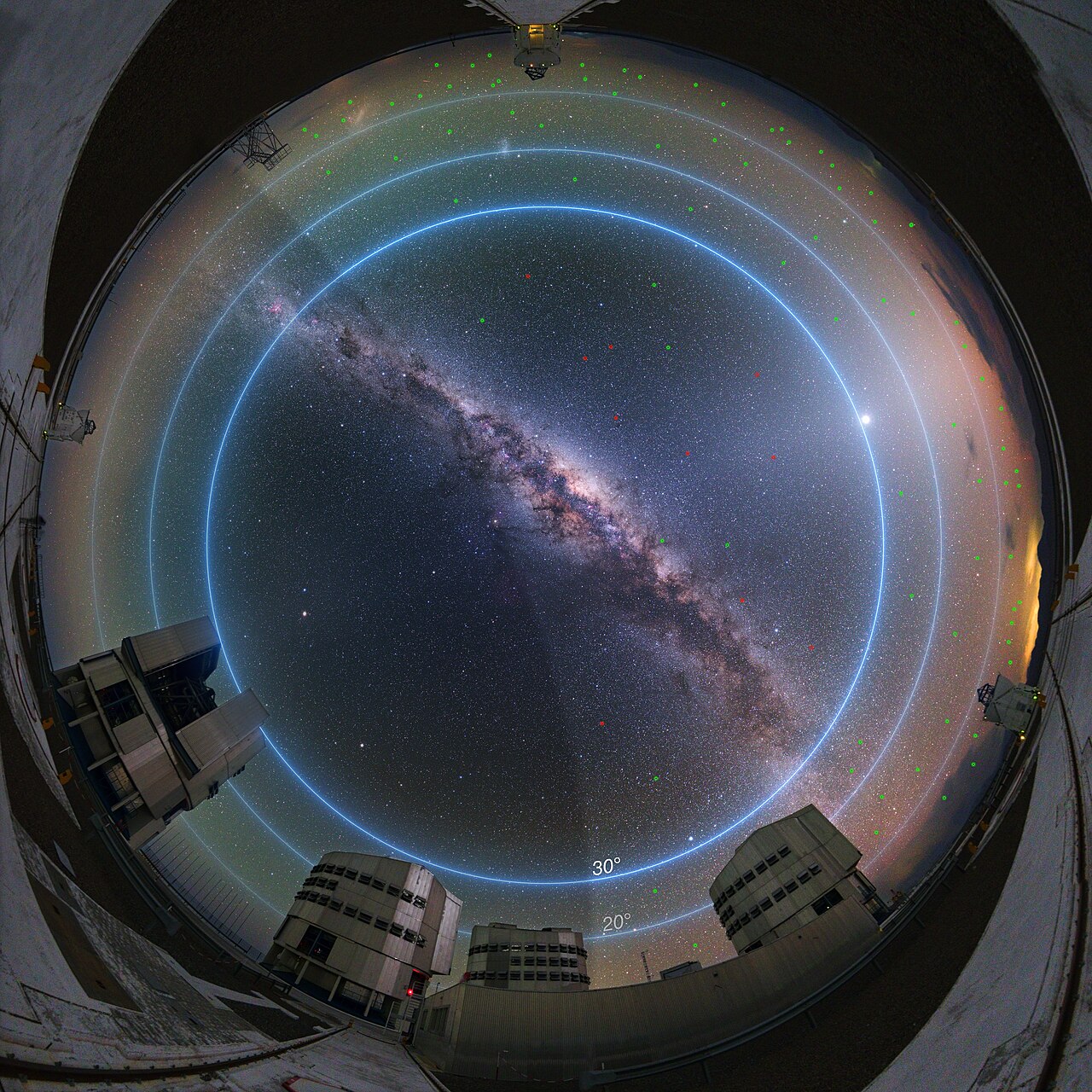
Context · satellites visible to the naked eye from Paranal, some 40 km from the route
Annotated illustration by the European Southern Observatory of the sky over its Paranal observatory, near the Paposo coast, during twilight: the circles mark the satellites of the large constellations that would be bright enough to see with the naked eye. It is not an image of the phenomenon; it shows the mechanism SEFAA proposed for this and other reports in the area.
Night sky at ESO's Paranal Observatory around twilight, Eso2004a.jpg (ESO/Y. Beletsky/L. Calçada) · Wikimedia Commons · CC BY-SA 4.0 · open original
SEFAA (Chilean DGAC) report, case no. 1931, airway UQ803, 6 November 2023
Five-page report by the official anomalous aerial phenomena section. It transcribes the audio between Iquique control and flights SKU307, LXP901 and JAT007, places the three aircraft with the synchronised radar video, reconstructs the visible sky with the pass of the Tiangong station and closes the case as 'Report' (Relato) because the objects could not be identified. A DGAC work with no open licence, so it is linked rather than hosted.
SEFAA, Dirección General de Aeronáutica Civil de Chile · view source
The night in question
On 5 November 2023, at 22:47 local time, a Sky Airlines Airbus A320 took off for Santiago as flight SKU307; according to SEFAA's investigation it left from Arica (Chacalluta), although the summary of the same report says Iquique, and the departure time is not labelled, but judging by the arrival time it is local. At about 23:37, already 6 November in UTC (02:37), it was flying at 39,000 feet along airway UQ803, over the desert, south of Antofagasta, and its crew called the Iquique Area Control Centre; five minutes later it passed east of the cove of Paposo. The transcript of the audio, which SEFAA included in its report, reads: 'Just to report that… er… the UFOs that were seen a few months ago, because it was those, we have them in sight… on about course 210'. The controller acknowledged and at once asked another flight further south on the same route, LATAM's LXP901, at 35,000 feet: 'Do you have some objects to the SW in sight?'. 'Correct. Also between 220 and 200… lights appear and disappear'. Were they above its altitude? 'Yes. Very, very high'. A third aircraft, JetSMART's JAT007, at 37,250 feet and further south, which was on the same frequency, broke in unprompted: 'Also sees them. They are… four… lights turning… at random'.
According to the report SEFAA received, the SKU307 crew saw them suspended in the air for more than a minute, always to the southwest of their position, changing colour and with no size given, with no noise, no instrument anomalies and no warning from the collision-avoidance system. The same report notes that other crews had earlier reported four lights above their altitude, which seemed suspended in the sky and flashed colours at random. The office placed the three aircraft using the synchronised radar video, between 02:37 and 02:40 UTC, all heading south (for SKU307 the report gives inconsistent headings, 210° and 292°, the first perhaps taken from the 'course 210' of the call; its own radar table shows 178°, that of a flight towards Santiago). It asked the crews for testimony and images. The captain of LXP345, following on the same airway, replied by email on 17 November that he had also seen the lights, that he associated them with satellite traffic and that he had no images. The report says the captain of JAT007 was the only one who responded to the request, which clashes with that email, and that his images and testimony, which would have made it possible to fix the time, path and appearance of what was seen, never arrived.
SEFAA reconstructed the sky visible from each aircraft at the start of its conversation with Iquique and verified that satellites crossed between 200° and 220° of azimuth, above the horizon, although not necessarily on paths like those described, and it also pointed to the pass of the Chinese space station Tiangong, which crossed SKU307's horizon from west to east. The United Nations Office for Outer Space Affairs launch register showed none immediately before, although the office warned that those notifications arrive late. Its conclusion, in June 2024, put forward the hypothesis of conventional orbital traffic, but that 'this could not be proven for lack of means of analysis that would allow these objects to be identified', and it closed the case as a 'Report' (Relato).
Why it matters
What sets the case apart is its witnesses: three crews in three different aircraft, tens of miles apart, spoke live by radio of lights to the southwest, and the Iquique control recording preserves it. They were not wholly independent: SKU307 spoke of suspended lights, the controller asked LXP901 whether it had 'some objects to the SW' and suggested they were above its altitude, and JAT007 heard everything on the same frequency. A fourth captain saw them too. What is missing is what would allow them to be identified: no image, no instrumental record of the object and no precise time or position in the sky, so SEFAA could only say that there were satellites in the sector, not which was which.
The report does not stand alone. In the same month and along the same stretch of routes, SEFAA studied three other crew reports of similar lights and proposed satellites for all three. On 10 November, the crew of LXP377, from Calama to Santiago, saw north of the ENTOP waypoint two to four lights moving fast, changing position and intensity, for about half an hour, and the crew of LXP345 saw the same; the office established that the Sun was some 44° below the horizon, right in the direction they were looking, and that satellites of the OneWeb constellation were crossing that sector, and concluded that what was reported was consistent with sunlight reflecting off spacecraft orbiting above 500 kilometres, although without images it closed it as a 'Report'. On 20 November, LXP905 and a Copa Boeing 737 saw white lights to the southeast and ahead; SEFAA identified in that sector a group of seven OneWeb satellites, five Starlink and two Iridium lit by the Sun, and classified it as 'Probably explained'. On 23 November, the crew of FACh922, an Air Force flight, filmed with a phone three lights that flashed on and off like stars and then began to move; with the video, analysed frame by frame, the office identified three Starlink satellites and the debris of the Chinese weather satellite Fengyun 1C. And two days after this report, on 8 November, the pilot of an Argentine Learjet passing Calama reported a bright light that the office also linked to orbiting objects (↗).
There is also a precedent in the same corridor: a year earlier, on 8 November 2022, three crews flying to Santiago from Iquique, Calama and Antofagasta reported one to three lights to the south, and SEFAA found that conditions existed for them to be the Antares rocket and the Cygnus NG-18 spacecraft, although without images it closed the case as a 'Report'. The report does not say what SKU307 meant by 'the UFOs that were seen a few months ago'. None of those findings concerns this night, and the witness who spoke of satellites did so days later; but the night corridor of northern Chile, with the Sun well below the horizon and satellites still lit at high altitude, produces this kind of report regularly, and when there was video, the explanation was orbital.
What's left on paper
Documented evidence
- Transcript of the audio with Iquique control: SKU307 reports 'the UFOs that were seen a few months ago', LXP901 lights 'very, very high' that 'appear and disappear' and JAT007 'four lights turning at random'
- Synchronised radar video: the three aircraft between 35,000 and 39,250 feet, heading south, between 02:37 and 02:40 UTC
- Captain of LXP345, by email: he also saw the lights and associated them with satellite traffic; no images
- The captain of JAT007 offered images that he never sent
- Astronomical analysis: satellites crossing between 200° and 220° of azimuth and a pass of the Tiangong station across the horizon; no launch notified immediately before
Show 2 more items
- SEFAA conclusion: hypothesis of conventional orbital traffic, not proven for lack of means of analysis; closed as a 'Report'
- Neighbouring SEFAA reports in November 2023 (cases 1933, 1935 and 1936) for which it proposed sunlight reflecting off OneWeb, Starlink and Iridium satellites; the 1936 report came with video
Sources
- SEFAA (Chilean Directorate General of Civil Aviation) — 'Case No. 1931', airway UQ803, 6 Nov 2023 (resolved 28 Jun 2024) — Primary source: audio transcript, radar table, astronomical analysis and official conclusion.
- SEFAA — 'Case No. 1933', north of the ENTOP waypoint, 10 Nov 2023 — Neighbouring report: lights seen by LXP377 and LXP345, consistent with sunlight reflecting off OneWeb satellites; 'Report'.
- SEFAA — 'Case No. 1935', airway UQ803, 20 Nov 2023 — Neighbouring report: lights seen by LXP905 and CMP454, attributed to OneWeb, Starlink and Iridium satellites; 'Probably explained'.
- SEFAA — 'Case No. 1936', FL350 over Antofagasta, 23 Nov 2023 — Neighbouring report with video from the FACh922 crew: three Starlink satellites and Fengyun 1C debris.
- SEFAA — 'Case No. 1838', crews over northern Chile, 8 Nov 2022 — Precedent a year earlier: three crews; SEFAA considered launch 2022-149 possible (Antares and the Cygnus NG-18 spacecraft) and closed it as a 'Report'.
- SEFAA — Anomalous Aerial Phenomena Study Section (DGAC), official site — Catalogue of cases published by the Chilean office.
Referenced by 5 cases
Caleta Lobos · the lights below Orion's Belt seen by three airline crews
2024 · Tier A
Calama · the light 'following' an Argentine Learjet
2023 · Tier B
Antofagasta · the glowing cloud two airline crews saw over northern Chile
2023 · Tier A
Antofagasta · the three lights filmed by the FACh922 crew
2023 · Tier A
Copiapó · the lights to the south seen by three crews on the night of Cygnus NG-18
2022 · Tier A
Related cases
same object · same country · same period
Calama · the light 'following' an Argentine Learjet
2023 · Tier B
same object · same country · same period
Antofagasta · the three lights filmed by the FACh922 crew
2023 · Tier A
same object · same country · same period
Caleta Lobos · the lights below Orion's Belt seen by three airline crews
2024 · Tier A
same object · same country · same period
Southern Patagonian Ice Field · the light that crossed ahead of an A321 bound for Punta Arenas
2019 · Tier A