2023·Next to the ISEKA control point, south of Antofagasta, at 35,000 feet
Chile.Antofagasta · the three lights filmed by the FACh922 crew
Shortly after midnight on 23 November 2023, the crew of FACh922, a flight from Iquique to Santiago with a Chilean Air Force call sign, saw over the Antofagasta Region three lights that flashed on and off like stars and at one point began to move, and filmed them with an iPhone.
Read the rest of the summary
SEFAA analysed the video's 1,110 frames, fixed the time and the aircraft's position from the metadata and the radar, and concluded that 'what was reported was' the overflight of three Starlink satellites and the remains of the Chinese satellite Fengyun 1C, without assigning each light to one of them. It classified the case as 'Probably Explained'.
Tier A · AcceptableWhat do they mean? →
Institutional evidence: several identified independent witnesses, or contemporary official documentation, without an instrumental record to corroborate them.
What it was
91%natural or human cause
Most likely explanation: satellite
See the split across the six explanations
Natural or human cause
No known cause
Primary documents
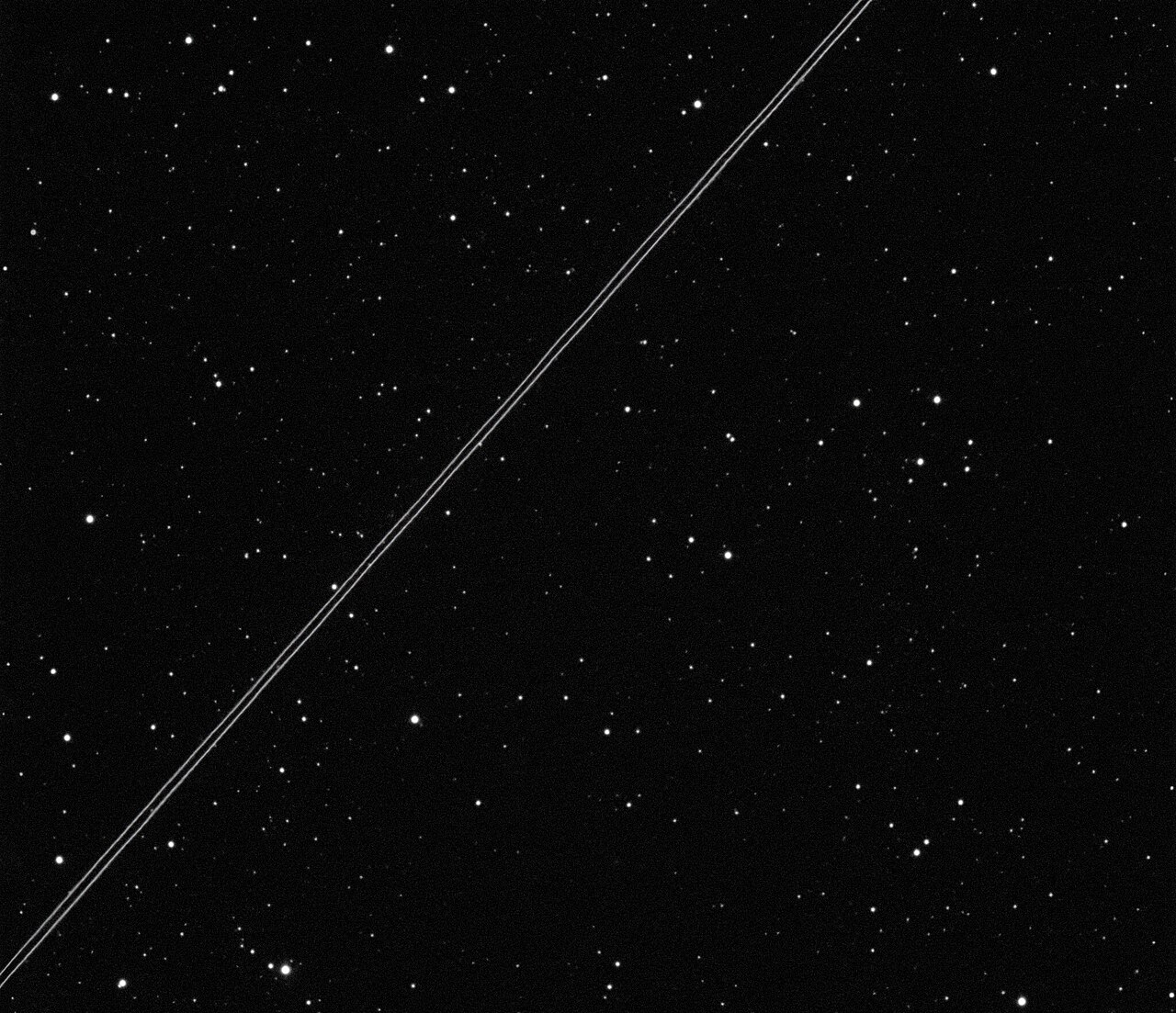
Context · two orbiting objects crossing the sky over Antofagasta
Five-second exposure taken on 10 November 2022 with the Chakana telescope at the Ckoirama Observatory, run by the University of Antofagasta: the two parallel trails are the BlueWalker 3 satellite and, according to its authors, the adapter of the rocket that launched it, lit by the Sun against a night sky. It is not an image of this case; it shows, from the same region, how two orbiting objects can be seen together.
Earlier image of a BlueWalker 3 pass over Ckoirama Observatory (ann22033e).jpg (CLEOsat/Ckoirama Observatory/IAU CPS, E. Unda-Sanzana) · Wikimedia Commons · CC BY 4.0 · open original
SEFAA (Chilean DGAC) report, case no. 1936, FL350 over Antofagasta, 23 November 2023
Five-page report by the official anomalous aerial phenomena section. It records the testimony of the FACh922 crew, reproduces a frame of the video, places the aircraft with radar, reconstructs the sky and the space traffic, and concludes that what was filmed was three Starlink satellites and the remains of Fengyun 1C. A DGAC work with no open licence, so it is linked rather than hosted.
SEFAA, Dirección General de Aeronáutica Civil de Chile · view source
The night in question
The report reached SEFAA, the section of Chile's Directorate General of Civil Aviation that studies anomalous aerial phenomena, on 24 November 2023. It said that on a flight the day before, over the Antofagasta Region, three white lights had been seen, with no size given, for more than a minute and always to the south. According to the report, there were more than three witnesses, all crew members of FACh922, a flight whose call sign, FACH, is that of the Chilean Air Force, flying from Iquique (SCDA) to Santiago (SCEL) at 35,000 feet; when the sighting began, according to the report, they were 'Vertical SCFA, heading 190', that is, over Antofagasta airport and heading south, slightly west. The testimony read: 'During the flight, three lights are seen that switch on and off intermittently (like a star). However, at one point they begin to move'.
The report arrived without images, but the crew later handed over the footage, and the office analysed each of its 1,110 frames. Frame 428, reproduced in the report, shows two of the luminous objects. According to the metadata, the file had kept its digital integrity and was recorded at about 00:21 local time on 23 November (03:21 UTC) with the main camera of an iPhone 11. The aircraft did not appear in the public records of transponder traffic, so SEFAA asked for help from the adviser of the Standards and Development Office of the Department of Aerodromes and Aeronautical Services (DASA). According to the adviser, the radar record placed the flight over Andrés Sabella airport, Antofagasta, at 03:07:54 UTC, thirteen minutes earlier than the report indicated. The radar figure the report uses to illustrate this shows two tracks over the airport labelled 'SOBERBI 371 370' and 'AVISPA 79 A025', neither with the call sign FACH922, and the report does not say which of them is the flight. It adds that when filming began, at 03:21 UTC, the aircraft was roughly next to the ISEKA control point, south of the city, some 40 kilometres from the airport; it does not explain how an aircraft at cruise covered so little distance in thirteen minutes (the distance and the objection are this record's). With that the office fixed its position at 23° 47′ 51″ S and 70° 22′ 34″ W, 11,278 metres above sea level, heading 190°.
The reconstruction of the sky put the Sun at azimuth 201° 15′, ahead of the crew, some 43° below the horizon, 'which allowed there to be light that could be fleetingly reflected by space objects orbiting near the horizon'. Seconds before filming began, according to the text of the report, the space traffic in that sector included 'the weather satellite Fengyun 1C' and Starlinks 30109, 3096 and 2102. The figure that identifies them a few seconds later labels the first 'FENGYUN 1C DEB (37047)', a catalogued fragment, and the others as Starlink-30109, Starlink-2102 and Starlink-3696 (51965): the 3096 in the text is a typo, since the figure labels 3696. According to the report, all four were on the horizon described, in orbits on different planes, and made movements similar to what the crew saw and to what was captured on video. The conclusion, dated 15 December 2023, states that 'it was concluded that what was reported was the overflight of three satellites of the Starlink project and the remains of the Fengyun 1C satellite', and classifies the case as 'Probably Explained'. The header says 'Resolved', a label SEFAA also puts on cases it closes as a 'Report' (Relato), such as the Calama case of that same month (↗).
Why it matters
What sets this case apart from the other crew reports that month in northern Chile is the video. In the same northern Chilean corridor and in the same weeks, SEFAA studied several sightings of lights by pilots, and where there was only testimony it could say that satellites were in the sector, but not which was which: that is how the lights seen by three crews east of Paposo on 6 November (↗) and the light an Argentine Learjet pilot saw passing Calama on 8 November (↗) ended up, both closed as a 'Report' (Relato). Here, by contrast, there was a recording with a verified time and camera and a radar record placing the aircraft, so the office could compare what was filmed with specific satellites and propose which they were, though without saying which light corresponded to each; that is why it left the case as 'Probably Explained'.
The report leaves loose ends. The testimony speaks of three lights and the conclusion of four objects, three satellites and the remains of another, without saying which one corresponds to each light or whether one was not seen; the frame it reproduces shows two. It does not analyse separately the moment when the lights 'begin to move', beyond stating that the satellites' movements were similar to what was filmed. The text calls Fengyun 1C a 'weather satellite', while its own figure labels it as a fragment, number 37047, and the conclusion speaks of its 'remains'; Jonathan McDowell's GCAT satellite catalogue completes the picture: it lists the satellite as destroyed on 11 January 2007, the date of the Chinese anti-satellite test. The text numbers as 3096 a Starlink the figure labels 3696. The space-traffic figure carries the stamp '23-12-2023 03:20:55Z', a month after the event, although the figure's caption and the Sun position the report gives correspond to 23 November. And the radar figure does not identify which of its tracks is FACh922 nor clarify the aircraft's path between the airport and the ISEKA point.
The mechanism SEFAA invokes is sunlight. With the Sun some 43° below the horizon and ahead of the crew, according to the report this 'allowed there to be light that could be fleetingly reflected by space objects orbiting near the horizon', and on that horizon it placed the four objects it proposes. That the report came from a flight with a military call sign, and that the office had to ask another department for the radar because the flight was not in the public records, did not change the method: with the video and its verified time, the office could move from the generic orbital traffic it proposed for the neighbouring reports to naming specific satellites, though without matching them one by one to the filmed lights.
What's left on paper
Documented evidence
- Testimony of the FACh922 crew: three lights 'like a star' that switched on and off and at one point began to move, for more than a minute and always to the south
- iPhone 11 video, 1,110 frames with intact metadata, recorded at about 00:21 local time (03:21 UTC) on 23 November 2023; frame 428 shows two luminous objects
- Radar record obtained through DASA: the flight over Antofagasta airport at 03:07:54 UTC and, when filming began, next to the ISEKA point, at 11,278 metres heading 190°
- Astronomical reconstruction: Sun at azimuth 201° 15′, some 43° below the horizon and almost straight ahead of the crew
- Space traffic: three Starlink satellites and Fengyun 1C in the sector, with movements similar to those filmed according to the report; the figure labels them Starlink-30109, Starlink-2102, Starlink-3696 (51965, given in the text as 3096 by a typo) and 'FENGYUN 1C DEB (37047)'
Show 3 more items
- Radar figure: over Antofagasta airport, two tracks labelled 'SOBERBI' and 'AVISPA', neither with the call sign FACH922; the space-traffic figure carries the stamp '23-12-2023'
- SEFAA conclusion (15 Dec 2023): 'what was reported was the overflight' of three Starlinks and the remains of Fengyun 1C; 'Probably Explained'
- The object the figure labels is a catalogued fragment, number 37047; the GCAT catalogue lists Fengyun 1C as destroyed on 11 January 2007
Sources
- SEFAA (Chilean Directorate General of Civil Aviation) — 'Case No. 1936', FL350 over Antofagasta, 23 Nov 2023 (resolved 15 Dec 2023) — Primary source: testimony, forensic analysis of the video, radar position, astronomical and space-traffic reconstruction, and official conclusion.
- SEFAA — 'Case No. 1931', airway UQ803, 6 Nov 2023 — Neighbouring report without images: three crews, satellites in the sector not identified; 'Report'.
- SEFAA — 'Case No. 1937', Calama, 8 Nov 2023 — Neighbouring report without images: possible orbiting objects, none identified; 'Report'.
- Jonathan McDowell — General Catalog of Artificial Space Objects (GCAT), satcat — Entry 1999-025A (Feng Yun 1C): destroyed on 11 January 2007; 37047 is one of its fragments (1999-025EEF) and 51965 is Starlink 3696.
- SEFAA — Anomalous Aerial Phenomena Study Section (DGAC), official site — Catalogue of cases published by the Chilean office.
Referenced by 1 case
Related cases
same object · same country · same period
Paposo · the lights seen by three airline crews over the desert
2023 · Tier A
same object · same country · same period
Calama · the light 'following' an Argentine Learjet
2023 · Tier B
same object · same country · same period
Caleta Lobos · the lights below Orion's Belt seen by three airline crews
2024 · Tier A
same object · same country · same period
Southern Patagonian Ice Field · the light that crossed ahead of an A321 bound for Punta Arenas
2019 · Tier A