2023·Airspace some 85 km north of Antofagasta airport (position of SKU329); JAT026 was flying 321 miles further south, near the PUNAP waypoint
Chile.Antofagasta · the glowing cloud two airline crews saw over northern Chile
On the night of 6 September 2023, the crew of Sky Airline flight SKU329, north of Antofagasta, told Iquique control of a light to the southwest that it first took for the Moon behind a cloud, which rose vertically and flashed 'like a beacon'; the crew of a JetSMART flight 321 miles further south said it saw the same thing pass over its aircraft.
Read the rest of the summary
SEFAA first attributed it to night military flights; five months later, with the captain's account and four phone photos taken in those same minutes, it concluded that it was the Chinese Long March 4C rocket that had put the Yaogan 33-03 satellite into orbit, although by our calculation that rocket was not in view of Chile at that hour.
Tier A · AcceptableWhat do they mean? →
Institutional evidence: several identified independent witnesses, or contemporary official documentation, without an instrumental record to corroborate them.
What it was
87%natural or human cause
Most likely explanation: rocket or missile
See the split across the six explanations
Natural or human cause
No known cause
Read the full reasoning
It is supported by the examined photos, which show 'a luminous object of gaseous consistency, with the glow of a star visible through it'. Against it: the first version of the report attributed it to 'institutional air operations', and the estimated trajectory passes over the Pacific, far to the southwest, with the caveat that it 'may have followed a parallel course further north'. And, by our calculation with the orbital elements the report publishes, at 00:30 UTC the orbital plane of Yaogan 33-03 and its stage lay some 50° of arc from northern Chile, below the horizon of both aircraft: the rocket named could not have been in view. The class stands because what was described and photographed is a rocket plume, and McDowell's catalogue records the separation of the SLIM probe from an H-IIA at 00:29:50 UTC, in those same minutes (our deduction, not an identification).Primary documents
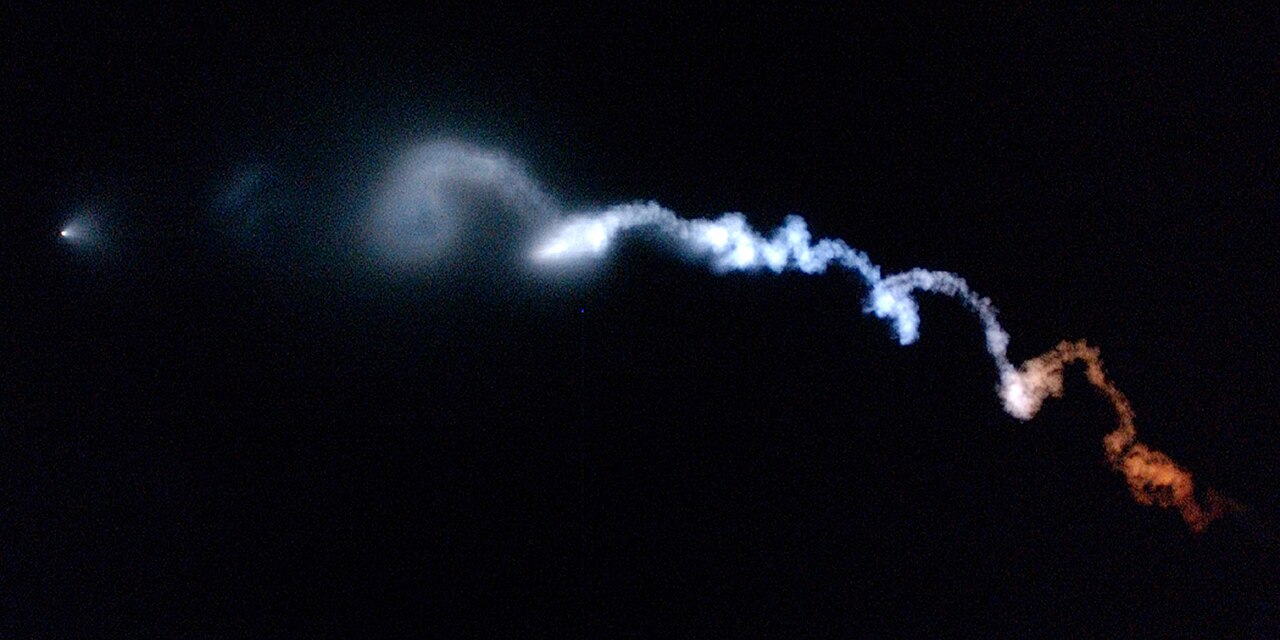
Context · the sunlit plume of a rocket in the night sky (Minotaur I, Vandenberg, 2005)
US Air Force photograph of the plume left by a Minotaur I rocket after lift-off from Vandenberg base, California: propellant expelled at high altitude reflects the light of the Sun, already below the horizon for an observer on the ground, and forms a bright cloud against a dark sky. It is not an image of the Antofagasta phenomenon, whose photos SEFAA did not publish in full; it illustrates the mechanism the office proposed.
Twilight phenomenon in the wake of a Minotaur I launch from Vandenberg AFB (U.S. Air Force/Staff Sgt. LeeAnn Sunn-Wagner) · Wikimedia Commons · Public domain (US Government work) · open original
SEFAA (Chilean DGAC) report, case no. 1918, final version, 7 September 2023
Eight-page report by the official anomalous aerial phenomena section, reissued in February 2024. It transcribes the audio between Iquique control and flights SKU329 and JAT026, places the aircraft with radar, reproduces enlarged the four examined photos from report 1967 and concludes that what was seen was the Long March 4C rocket of the Yaogan 33-03 satellite. Its first version, of October 2023, attributed the same sighting to military flights. A DGAC work with no open licence, so it is linked rather than hosted.
SEFAA, Dirección General de Aeronáutica Civil de Chile · view source
The night in question
At 00:30:48 UTC on 7 September 2023, 21:30 on the 6th in Chilean summer time, the captain of Sky Airline flight SKU329, which had taken off from Iquique for Santiago, called the Iquique Area Control Centre. He was flying at 35,000 feet, some 85 kilometres north of Antofagasta airport. The recording, which SEFAA transcribed, reads: 'We have… a light up there, we thought it was the Moon, it looks like a flash… we can't really tell the altitude… We thought it was the Moon, covered by clouds, but it's moving vertically'. Asked whether it was above his position, he said no, to the southwest. The controller told him she had no traffic, that the nearest was on the same airway 113 miles away. Almost two minutes later he confirmed he still saw it: 'it's fading, but in the centre I'd say you can see every so often a light that shines like a beacon or a strobe light, but at very high speed, very fast. Very high too'. At 00:32:58 JetSMART flight JAT026 broke in: 'we see the same… Right now it's above us', and confirmed it was overhead. At 00:33:16 SKU329 said it had now disappeared, that it had been 'three or four flashes'. The controller reported that the two aircraft were 321 miles apart, and JAT026, four miles from the PUNAP waypoint, repeated that the light had passed over them 'and had a kind of beacon'.
The Iquique air traffic operations officer sent SEFAA, the anomalous aerial phenomena section of the Directorate General of Civil Aviation, the controller's handwritten report and the synchronised radar and audio video. The office placed both aircraft with the tracking system; its map puts JAT026 off the coast, north of La Serena. In the radar image it highlighted the possible presence of at least three military aircraft in the line of sight of the SKU329 crew; Iquique's flight plans did not record them, but the Air Force liaison officer confirmed night operations by institutional aircraft in the area. With that, on 10 October 2023 it closed the case as 'Resolved': what was reported arose from 'the sporadic sighting of institutional air operations'. It had not obtained the crews' identities, requested by email three times in September.
On 11 February 2024 the SKU329 captain himself filed a report with his account and five images. He wrote that, already at cruise, he saw to the southwest, out over the Pacific, something that looked like a cloud glowing as when the Moon is behind a cloud, although, he wrote, that night 'we never could see the moon'; that his first officer first thought it was the Moon and then that it was not; that the cloud grew vertically, expanded in all directions and formed a halo that came to stretch 'from Argentina to the Pacific', with a flash at its centre, sometimes white and sometimes red, and at the end three white lights almost in a triangle, all within about 30 minutes. SEFAA examined four of the images with error level and copy-move analysis: they had not been altered, came from a Samsung S22 Ultra and were taken between 21:28 and 21:30 local time on 6 September. They showed a luminous object of gaseous appearance through which a star could be seen. The office searched the United Nations launch register, found that of the Chinese military satellite Yaogan 33-03 (2023-136A) on that 6 September, on a Long March 4C from Jiuquan into a sun-synchronous orbit, and on 14 February 2024 it reissued the report and concluded that what was reported was the launch of that rocket.
Why it matters
The case brings together witnesses and documentation: two crews from two airlines, 321 miles apart, spoke live with Iquique control about the same thing, and the recording preserves it timed to the second; and four phone photos, examined and found unaltered, capture it in those same minutes. Report 1967 says the photos are from 6 September, 'one day before what was reported', but by our reckoning there is no such gap: 21:28 in Chile on summer time was 00:28 UTC on the 7th, two minutes before SKU329's call. The gap lies in the captain's account, which dated the sighting the 7th in local time. That an object should be seen to the southwest from one aircraft and directly above another almost 600 kilometres away only fits something very high or very large, which is what the photos show and what the second conclusion holds; that is our deduction. The Moon, which SKU329 mentioned (and, according to the captain, the other traffic too), was below the horizon, some 63° below it by our calculation.
The case also shows how an official explanation can change. The first, in October 2023, rested on echoes of possible military aircraft on radar and on confirmation of night Air Force flights; the second keeps that paragraph but concludes something else, without explaining why it drops the first. What changed it were the photos and the description of a cloud that grew and let stars show through, the look a rocket's propellant plume usually has when lit by the Sun at great altitude. By our calculation, at that hour the Sun was about 28° below the horizon to the west, so something hundreds of kilometres up in that direction could be lit, as the captain described.
The identification has a problem the report does not see. It speaks of the 'launch', but according to Jonathan McDowell's satellite catalogue the satellite separated at around 18:26 UTC on 6 September, by the catalogue's estimate, some six hours before the photos; what was seen over Chile would not be the rocket's ascent but its third stage already in orbit, which the catalogue places in an orbit of 496 to 683 kilometres. By our calculation, that stage could not have been in view. Using the February 2024 orbital elements published in the report itself, taken back in time with the precession of a sun-synchronous orbit, the plane of the satellite and the stage passes over Jiuquan at about 18:15 UTC on the 6th, which confirms the calculation; at 00:30 UTC on the 7th, that plane lay some 48° of arc from JAT026 and some 53° from SKU329, whereas something 500 or 680 kilometres up is only visible within about 25 to 29°. The figure with which SEFAA estimates the trajectory draws it over the Pacific, far to the southwest and running west-southwest to east-southeast, hardly compatible with an orbit inclined at 98°, and the text concedes it may have followed 'a parallel course further north' without checking.
McDowell's catalogue offers another launch that matches the time; this is our deduction, not SEFAA's, and not an identification. At 23:42 UTC on 6 September, a Japanese H-IIA lifted off from Tanegashima with the XRISM observatory and the SLIM lunar probe, into an orbit inclined at 31°. According to the Japanese space agency, SLIM separated about 47 minutes and 33 seconds after lift-off, and the catalogue dates that separation at 00:29:50 UTC on the 7th: between the photos, from 00:28:55 to 00:30:02, and SKU329's first call, at 00:30:48. By an approximate calculation, the second stage's track was crossing the southeast Pacific towards Chile in those minutes and was above the horizon of both aircraft. Without the stage's precise position or the exact direction of the photos, this is a coincidence of time and of approximate geometry; but, unlike the Chinese rocket, this one could have been in view.
Nor does the report say who took the photos, although the captain supplied them; he attached a fifth image, which he attributed to a JetSMART aircraft flying along airway UQ814 towards Calama, and which the office did not analyse; he also mentioned photos taken from the ground at Tongoy that the report does not examine.
There are also inconsistencies of detail. The flight appears as SKU329, SKU239 and SKU234; the waypoint as PUNAP and PUNAB. The handwritten report says fewer than 10 seconds passed between the two aircraft's reports, but in the transcript about 20 seconds separate SKU329's second description from JAT026's, and two minutes from its first call. The captain recalled the controller telling him the only traffic was 300 miles to the south and belonged to LATAM; the recording says 113 miles, and the aircraft that answered was JetSMART's. His account also says the other traffic saw the cloud 'to the west of its position', whereas JAT026 said it was passing 'over us'; and the summary of his report says the sighting 'lasted more than a minute', whereas the account speaks of about 30 minutes. It is the same night corridor of northern Chile as ↗ and ↗.
What's left on paper
Documented evidence
- Transcript of the audio with Iquique control (00:30:48–00:33:52 UTC): SKU329 sees a light to the southwest that 'is moving vertically' and flashes 'like a beacon'; JAT026, 321 miles away, says it 'passed over us'
- The controller's handwritten report and the synchronised radar and audio video sent by the Iquique operations officer
- Radar: possible presence of at least three military aircraft in SKU329's line of sight; the Air Force liaison confirmed institutional night operations
- First SEFAA conclusion (10 October 2023): 'sporadic sighting of institutional air operations'
- Report by the SKU329 captain (11 February 2024): a glowing cloud that grew vertically and formed a halo, with white and red flashes, for about 30 minutes
Show 5 more items
- Four photos from a Samsung S22 Ultra, unaltered according to error level and copy-move analysis, taken between 21:28 and 21:30 local time on 6 September (00:28–00:30 UTC on the 7th)
- Second SEFAA conclusion (14 February 2024): the Long March 4C rocket that carried the Yaogan 33-03 satellite (2023-136A) into orbit
- McDowell catalogue: Yaogan 33-03 separation at around 18:26 UTC on 6 September (catalogue estimate); third stage in an orbit of 496 to 683 km
- Our own calculation with the report's orbital elements: at 00:30 UTC on 7 September the plane of Yaogan 33-03 and its stage lay some 48–53° of arc from the two aircraft, below their horizon
- McDowell catalogue and JAXA: the SLIM probe separated from the second stage of H-IIA F47 (launched at 23:42 UTC from Tanegashima) at 00:29:50 UTC on 7 September, between the photos and the first call; a coincidence of time, not an identification
Sources
- SEFAA (Chilean Directorate General of Civil Aviation) — 'Case No. 1918 08092023-1', between PUKTA and PUNAP, 7 Sep 2023 (resolved 14 Feb 2024) — Primary source, final version: audio transcript, radar positions, photo examination, launch 2023-136 and official conclusion.
- SEFAA — 'Case No. 1918 08092023', first version (resolved 10 Oct 2023) — First version of the same report: same transcript and radar, concluding that it was institutional air operations.
- SEFAA — 'Case No. 1967 11022024', report by the SKU329 captain (resolved 14 Feb 2024) — The captain's written account and the four examined photos; the office merged it with case 1918.
- Jonathan McDowell — General Catalog of Artificial Space Objects (GCAT), entries 2023-136A/B and 2023-137D/E — Estimated separation time of Yaogan 33-03 and orbits of the satellite and of the Long March 4C third stage; separation time of SLIM (00:29:50 UTC) and orbit of the H-IIA F47 second stage.
- JAXA — 'Launch Result of the X-ray Imaging and Spectroscopy Mission (XRISM) and the Smart Lander for Investigating Moon (SLIM)', 7 Sep 2023 — Lift-off of H-IIA F47 at 8:42:11 Japan time (23:42:11 UTC on 6 September); SLIM separation about 47 minutes and 33 seconds later.
Related cases
same object · same country · same period
Copiapó · the lights to the south seen by three crews on the night of Cygnus NG-18
2022 · Tier A
same object · same country · same period
La Serena · the two-tailed object seen by five aircrews at the end of 2014
2014 · Tier A
same explanation · same country · same period
Paposo · the lights seen by three airline crews over the desert
2023 · Tier A
same explanation · same country · same period
Calama · the light 'following' an Argentine Learjet
2023 · Tier B