2014·Calama–Santiago route, some 50 nautical miles north of La Serena (Coquimbo region)
Chile.La Serena · the two-tailed object seen by five aircrews at the end of 2014
On the last nights of 2014, the crews of an air ambulance and four airline flights radioed Santiago control about a white object, 'apparently with two tails', 'located towards the ocean' and 'moving upwards', north of La Serena; radar showed no traffic in that sector.
Read the rest of the summary
The official DGAC committee, then called CEFAA, concluded that the most probable origin was the orbital insertion of the Chinese Fengyun 2G satellite, launched on 31 December at 01:02 UTC. The report gives no time and its data fit two different nights: the clock on the radar screenshot matches the night of the launch; the weather reports and sky chart, the following one.
Tier A · AcceptableWhat do they mean? →
Institutional evidence: several identified independent witnesses, or contemporary official documentation, without an instrumental record to corroborate them.
What it was
76%natural or human cause
Most likely explanation: rocket or missile
See the split across the six explanations
Natural or human cause
No known cause
Read the full reasoning
Against it stand the date and time, contradictory within the report itself: the radar clock fits the launch night, while the weather reports and sky chart fit the following one; the Moon, more than 70% illuminated and high at either time, when the pilot said there was none; and the co-pilot, who described the objects as stationary and circling each other.Primary documents
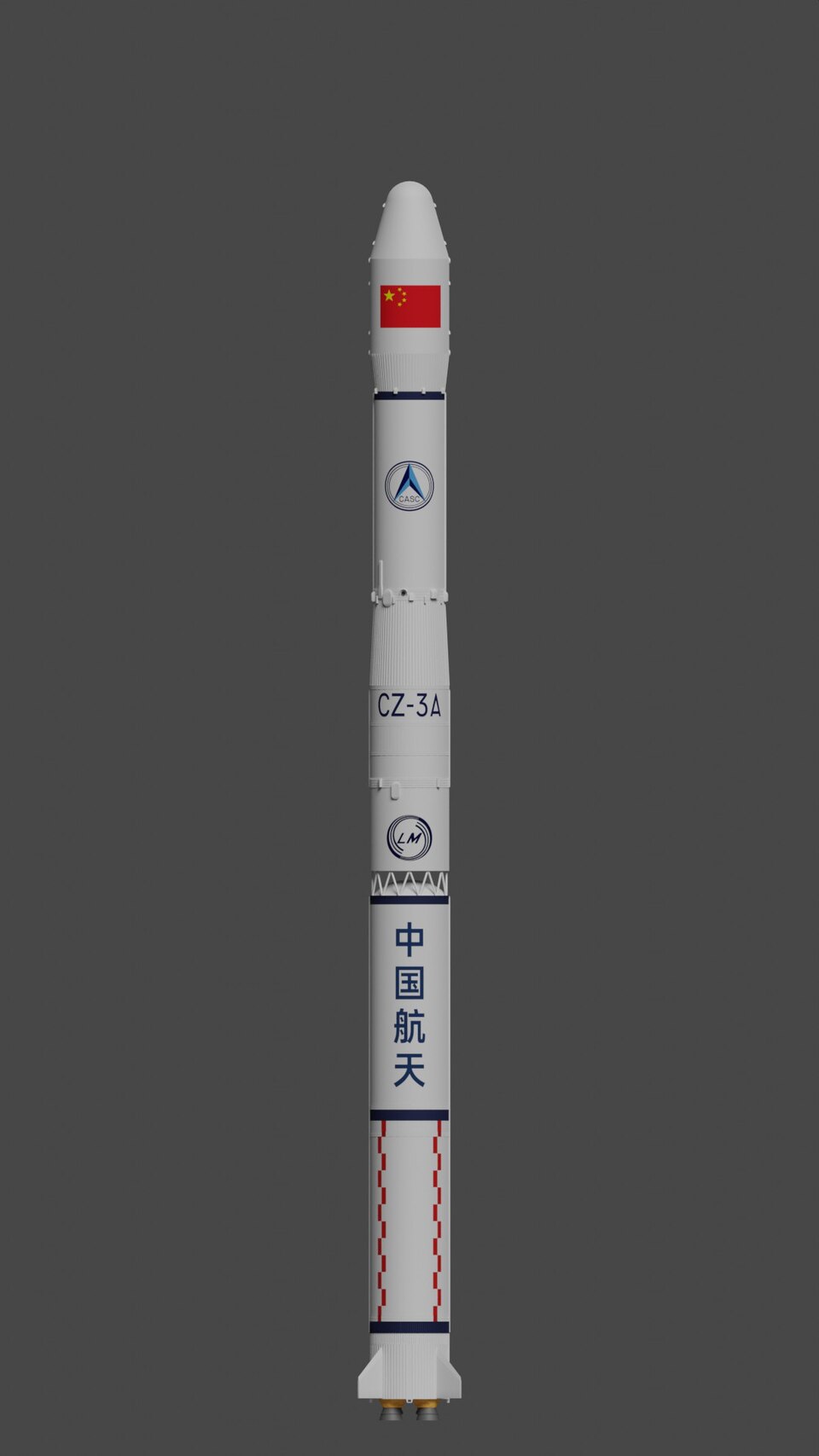
Context · the Long March 3A rocket, the type that launched the FY-2G satellite
Digital rendering of a Chinese Long March 3A (CZ-3A) rocket, the model that put the Fengyun 2G satellite into orbit from Xichang on 31 December 2014 and that the committee proposed as the origin of what was seen. It is not an image of the phenomenon or of that day's launch.
CZ-3A rendering.jpg (Shujianyang) · Wikimedia Commons · CC BY-SA 4.0 · open original
CEFAA (Chilean DGAC) report, case no. 510, north of La Serena, end of 2014
Eight-page report by the official anomalous aerial phenomena committee, now SEFAA. It records the Santiago control note on the five crews, a radar screenshot with controller annotations, the accounts of the CC-CDY air ambulance pilot and co-pilot and of the LXP325 pilot, the La Serena weather, a sky chart and the launch data for the Chinese FY-2G satellite, which it proposes as the most probable origin. Its header carries no classification. A DGAC work with no open licence, so it is linked rather than hosted.
SEFAA, Dirección General de Aeronáutica Civil de Chile · view source
The night in question
Between 31 December 2014 and 1 January 2015, according to the report on case no. 510, the occurrence log of the Santiago Area Control Centre received a note: the crews of the air ambulance registered CC-CDY and of flights SKU181, LXP325, LAN502 and SKU804 had radioed an anomalous aerial phenomenon 'located towards the ocean from their positions'. They described it as a white object, 'apparently with two tails', 'moving upwards', about 100 nautical miles north of La Serena. Santiago control had no other traffic information for that sector and saw no unreported traffic on radar. The report gives no time ('Approximate time: N/A'), but it reproduces a screenshot of the radar replay with the clock at 01:46:22 and two controller annotations next to the CC-CDY and SKU181 labels: 'SKU REPORTE OESTE 50 NM FL340/350' (SKU reports west, 50 nautical miles, flight level 340/350) and '… REPORTE A LAS TRES MUY ALTO' (reports at three o'clock, very high). Of the five crews, only three crew members, from CC-CDY and LXP325, gave their accounts to the committee, which was then called CEFAA (Committee for the Study of Anomalous Aerial Phenomena).
The most detailed account is the air ambulance pilot's. He was flying from Calama to Santiago at flight level 270, straight and level at just under 300 knots, with his co-pilot, a doctor, a nurse and a non-critical patient. Some 50 nautical miles north of La Serena, the co-pilot pointed out something off the right wing: two white spheres or ovals giving off white or 'creamy white' light, solid-looking and of considerable size, close together and lined up on the horizon, leaving a faint trail or 'white veil', which the report attributes to the speed at which they were moving. They seemed to grow, so he took them to be approaching, until they 'went vertical' and climbed with constant acceleration, at the speed of a jet, until they blended in with the stars. He put them between 35,000 and 45,000 feet. According to the pilot, it all lasted 8 to 10 minutes, the night was clear and there was no Moon. The report places that flight 'at dawn on the first of January 2015'.
The co-pilot told it differently. He said the sighting happened 139 nautical miles south-east of the TOY VOR, the La Serena radio beacon, with the aircraft level at 27,000 feet, and described two oval objects, with strong light and intermittent flashes, making circular movements around each other, far above the aircraft, above 45,000 feet; they stayed stationary and he lost sight of them as he continued towards Santiago. The pilot of LXP325, from Antofagasta to Santiago, saw through the right-hand window, to the west, a very strong light on the horizon on a rising path, round and with two halos at its sides, 'as if it were going very fast'. Neither crew had a contact on the onboard radar or a collision-avoidance alert, or noticed any instrument fault. La Florida aerodrome at La Serena logged nothing; its weather reports from 04:00 to 06:00 UTC on 1 January gave few clouds at 1,000 feet and clear sky above. There are no photographs.
The office looked into the possibility of a launch. Using the launch register of the United Nations Committee on the Peaceful Uses of Outer Space, it concluded that the orbital insertion of the Chinese weather satellite FY-2G, or Fengyun 2G, was compatible with what was reported. The report gives the figures itself: launched on 31 December 2014 at 01:02:04 UTC on a Long March 3A rocket from the Xichang centre in Sichuan, bound for a geostationary orbit over 86.5° East; its third stage is about 12 metres long and 3 in diameter, with two cryogenic engines. It adds an image of possible re-entry tracks according to which the object 'could have been visible to the west' of Coquimbo. In its conclusion the committee says the most probable origin of what the crews saw was 'the image of the orbital insertion and positioning' of Fengyun 2G, launched 'at the end of 31 December 2014', and that the 8 to 10 minutes given by one witness match the time a rocket takes to reach orbit.
Why it matters
The case brings together five crews in five different aircraft who alerted the same control centre, and the radar screenshot preserves two of those reports: a SKY flight that placed the object to the west, 50 miles away, at 34,000 or 35,000 feet, and another that saw it 'at three o'clock' and 'very high'. The LXP325 pilot also saw it to the west, and the air ambulance pilot off his right wing, that is, towards the sea on a route that runs north to south; his co-pilot, by contrast, placed it far above the aircraft. The shape described, a white object with two tails or two halos climbing and leaving a veil, is what rocket stages under power usually look like from far away, so the committee's hypothesis is plausible. What leaves it in dispute is the date.
The report gives no time and its data point to two different nights. In favour of the launch night are the case number, 31122014; the conclusion, which speaks of a satellite launched 'at the end of 31 December 2014'; and the clock on the radar replay, 01:46:22. If that time is UTC, as control centres usually work, the sighting took place at 22:46 on 30 December in Chile, which was on UTC−3, 44 minutes after the FY-2G lift-off and some 21 minutes after its separation, which Jonathan McDowell's satellite catalogue (GCAT) puts at 01:25 UTC (a deduction). In favour of the following night are the weather reports it cites, from 1 January between 04:00 and 06:00 UTC, that is, between 01:00 and 03:00 local time; the sky chart, dated '1:45 (UTC −03:00)' on 1 January, which seems to read the radar time as local time; and the sentence in which the report places the air ambulance flight 'at dawn' on 1 January, although that day the Sun rose at La Serena around 06:47, hours after the period those reports cover (our own calculation). If it was the night of the 31st to the 1st, the lift-off would have been some 28 hours earlier, and according to GCAT no other orbital mission lifted off anywhere in the world between 30 December and 2 January.
The committee does not speak of the ascent, which takes place over China, almost at Chile's antipode, but of 'the image of the orbital insertion and positioning' of the satellite. A rough calculation of ours, for a transfer orbit of some 200 by 37,000 kilometres inclined about 25° and separation around 01:24 UTC, puts the third stage and the satellite rising above La Serena's western horizon around 01:40–01:45 UTC on the 31st, climbing and lit by the Sun while the observer had the Sun 21° below the horizon: towards the ocean and rising, as the crews described. The Long March 3A third stage carries the two cryogenic engines the report mentions. It is a compatibility, not an identification: there are no images or sky positions to confirm it.
Other pieces of the same report weigh against it. The pilot said there was no Moon, and the Moon was high at either time: 74% illuminated and some 43° above the horizon at 01:46 UTC on the 31st, and 83% illuminated, at the same height, the following night (our own ephemeris calculation). The sky chart the committee used to confirm there was no Moon is computed for 30.1989° North and 71.2469° East, in the northern hemisphere: it shows the Pole Star and the Sun above the horizon. The co-pilot described two stationary objects circling each other, not a climb. The positions do not fit: the summary speaks of 100 miles north of La Serena, the pilot of 50 and the co-pilot of 139 miles south-east of the TOY VOR, a point that falls east of the Andes, in Argentina (a deduction). The image of possible re-entry tracks shows an object that, by its own caption, re-entered on 18 July 2017, whereas according to GCAT neither FY-2G nor its rocket's third stage has re-entered; on that day the third stage of a different Long March 3A, launched in 2007, came down. And the report states that 'there are no records of responses from the crews of the commercial aircraft' after quoting the account of the LXP325 pilot. On the same air corridor, years later, another air ambulance reported a 'very bright and fast' object north of Caldera: ↗.
What's left on paper
Documented evidence
- Note in the Santiago control occurrence log: five crews (CC-CDY, SKU181, LXP325, LAN502 and SKU804) radioed a white object 'apparently with two tails', 'moving upwards', 'located towards the ocean', some 100 nautical miles north of La Serena
- Screenshot of the radar replay (clock 01:46:22): no unreported traffic in the sector and two controller annotations, 'SKU REPORTE OESTE 50 NM FL340/350' and '… REPORTE A LAS TRES MUY ALTO'
- Pilot of the CC-CDY air ambulance: two white ovals with a faint trail that climbed vertically until they blended in with the stars; 8 to 10 minutes; no Moon, in his account
- Co-pilot of CC-CDY: two flashing oval objects, stationary and circling each other, above 45,000 feet, 139 nautical miles south-east of the TOY VOR
- Pilot of LXP325: a very strong light to the west, rising, round and with two halos at its sides
Show 3 more items
- CEFAA conclusion: most probable origin, the orbital insertion of the Chinese FY-2G satellite (2014-090A), launched from Xichang on 31 December 2014 at 01:02 UTC
- Disputed date: the radar clock and the case number fit the launch night (22:46 on 30 December in Chile, if the time is UTC); the weather reports and sky chart fit the following night, some 28 hours later
- Against the identification: the Moon, 74–83% illuminated, was high at either time; the report's sky chart is computed for the northern hemisphere
Sources
- SEFAA (Chilean Directorate General of Civil Aviation) — 'Case No. 510 31122014', north of La Serena, end of 2014 (report by the then CEFAA) — Primary source: the Santiago control note, radar screenshot with controller annotations, accounts of the CC-CDY pilot and co-pilot and of the LXP325 pilot, weather, sky chart, FY-2G launch data and official conclusion.
- McDowell, J. — General Catalog of Artificial Space Objects (GCAT), satellite catalogue — FY-2G (2014-090A) separated at 01:25 UTC on 31 Dec 2014; the satellite and its rocket's third stage (2014-090B) remain in orbit; re-entry on 18 Jul 2017 of the third stage of a different Long March 3A (2007-011B); no other launches between 30 Dec 2014 and 2 Jan 2015.
- SEFAA — Anomalous Aerial Phenomena Study Section (DGAC), official site — Catalogue of cases published by the Chilean office.
Related cases
same object · same country · same period
Copiapó · the lights to the south seen by three crews on the night of Cygnus NG-18
2022 · Tier A
same object · same country · same period
Antofagasta · the glowing cloud two airline crews saw over northern Chile
2023 · Tier A
same explanation · same country · same period
Petorca · the flashes LXP337 saw crossing towards Argentina
2018 · Tier A
same object · same period
Norwegian Spiral
2009 · Tier A