2018·DABIT reporting point, over Petorca province (Valparaíso region), on the approach to Santiago
Chile.Petorca · the flashes LXP337 saw crossing towards Argentina
Just after midnight on 12 February 2018, the captain of LATAM flight LXP337, descending towards Santiago near the DABIT reporting point over Petorca, asked Santiago control by radio whether there was high-altitude traffic entering Argentine airspace from the Pacific: he could see some flashes 'like stoplights' crossing from west to east, following a path 'like the Magellanic Cloud'. There was nothing on radar.
Read the rest of the summary
SEFAA could not get the pilot to answer five messages and, with an adviser's opinion, narrowed the origin to high-altitude aerospace traffic or atmospheric luminescence, without identifying a specific object.
Tier A · AcceptableWhat do they mean? →
Institutional evidence: several identified independent witnesses, or contemporary official documentation, without an instrumental record to corroborate them.
What it was
72%natural or human cause
Most likely explanation: space object
See the split across the six explanations
Natural or human cause
No known cause
Read the full reasoning
One of its advisers 'leans towards associating what is described in the audio with an atmospheric phenomenon above the troposphere', and only as 'a possibility' pointed to 'the atmospheric reentry of rotating space junk, capable of glinting'. The report identifies no object and the pilot did not answer the queries. Separately, a check made for this record: the GCAT catalogue records no reentries that day, which does not exclude uncatalogued debris.Primary documents
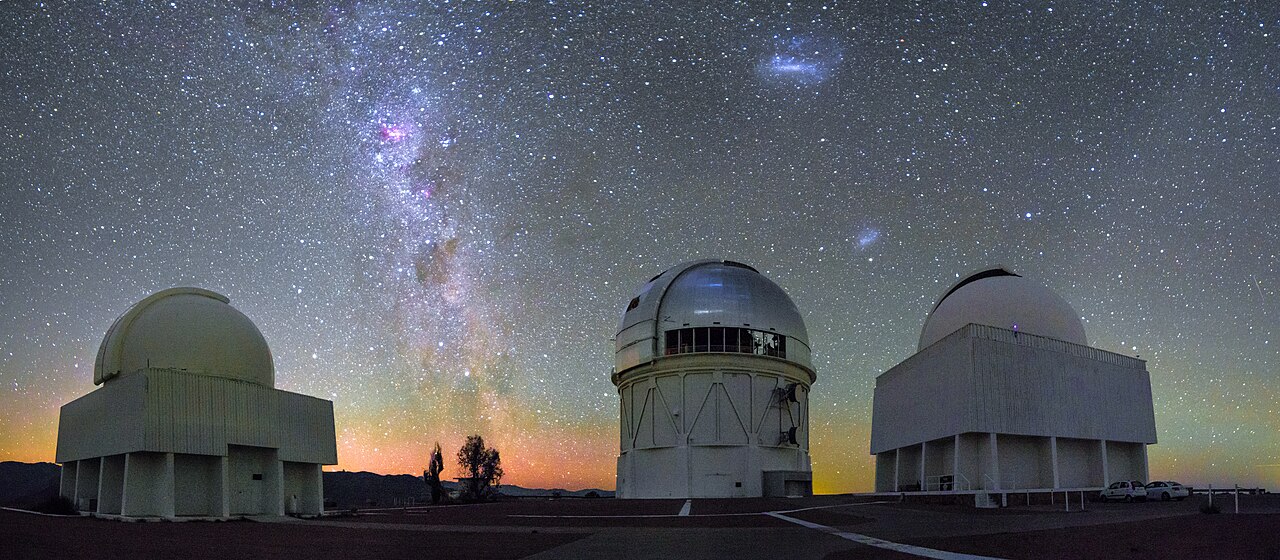
Context · the Magellanic Clouds over Cerro Tololo, Chile
The Large and Small Magellanic Clouds over the telescopes of the Cerro Tololo Inter-American Observatory, in the Coquimbo region. It is not an image of the event: it shows the reference the captain of LXP337 used to describe the path of the flashes, two satellite galaxies of the Milky Way that appear as diffuse patches in the dark skies of central and northern Chile.
Large and Small Magellanic Clouds over Cerro Tololo (noirlab2030c).jpg (CTIO/NOIRLab/NSF/AURA/H. Stockebrand) · Wikimedia Commons · CC BY 4.0 · open original
SEFAA (Chilean DGAC) report, case no. 792, Petorca, 12 February 2018 (resolved 30 January 2019)
Five-page report by the official anomalous aerial phenomena section. It transcribes the exchange between LXP337 and Santiago control, reconstructs the aircraft's descent, gathers the weather and a sky chart from DABIT, records the opinions of the Air Force and another adviser and narrows the origin to aerospace traffic or atmospheric luminescence. A DGAC work with no open licence, so it is linked rather than hosted.
SEFAA, Dirección General de Aeronáutica Civil de Chile · view source
The night in question
On 23 February 2018, on the instructions of the head of the Santiago Area Control Centre, an air traffic controller reported as an 'occurrence' something that had affected LATAM flight LXP337 eleven days earlier, on 12 February. The report by SEFAA, the section of Chile's Directorate General of Civil Aviation that studies anomalous aerial phenomena, says it happened 'at dawn', but gives the time: 0:53 local time, 3:53 UTC, that is, in the middle of the night. The aircraft, an Airbus A320 registered CC-BAZ flying the Antofagasta–Santiago route, was near the DABIT reporting point over Petorca province, and its captain reported a flashing light moving from west to east, at a high altitude relative to his aircraft. He asked whether there was traffic nearby and was told there were no returns on radar.
SEFAA merged the audio files into one and transcribed the exchange. The pilot asks whether there is 'high-altitude traffic entering Argentine airspace coming from the Pacific', from west to east. 'No sir. No traffic from sea to cordillera.' 'I can see some flashes up there. Never mind.' Shortly afterwards, control calls him back to confirm that the query was his and whether he still has the flashes in sight. The pilot says yes, that what he saw 'was following the route more or less… so to speak… like the Magellanic Cloud. That was the route you could see.' He no longer sees it, 'but you could see a flash like… stoplights'. The report places the exchange with the Santiago area control centre, though its summary says the report was made to the tower.
The investigation identified the captain and wrote to him asking for details, with the CEFAA form for civilian pilots; by the date of the report five messages had been sent without reply. So that he could draw on it the path of what he saw, the office prepared a sky chart of the moment centred on DABIT, which it places at 32° 15′ 05″ S, 70° 50′ 06″ W (the chart's own label says 32.0902° S and gives the time as 0:50, UTC −3). It checked with the La Serena and Santiago weather reports that visibility conditions were good along the route and reconstructed the descent: the aircraft passed SIMOK at 30,525 feet and DABIT at 20,300, on a track of 178° at about 362 knots, bound for Santiago. The Air Force delegate on the committee said on 15 May 2018 that it was not a FACh flight. Another adviser, on 30 January 2019, leaned towards an atmospheric phenomenon above the troposphere, gases ionised by the electric fields there that show up as lights, and pointed to the possible reentry of rotating space junk capable of glinting; he added that, given its altitude and because radar did not detect it, it posed no immediate risk and it seemed reasonable to file the case. The conclusion, of the same day, says the phenomenon did not threaten flight safety and that the available information allows its origin to be narrowed to 'high-altitude aerospace traffic and, possibly, the manifestation of atmospheric luminescence'. The header classifies it as 'Resolved'.
Why it matters
The case is valuable for the live testimony, not for the solution. The recording preserves the captain's words at the time, with a direction (west to east, from the Pacific towards Argentina), a relative position (above the aircraft) and a celestial reference, the Magellanic Cloud, that would make it possible to fix its path across the sky. But the pilot answered none of the five messages and did not draw the route on the chart prepared for him, and there was no image or radar return. With that, SEFAA did not identify an object: it narrowed the origin to two families of explanations, one space-related and one atmospheric, and filed the case because it did not affect flight safety. The 'Resolved' classification in the header says more than the conclusion does.
Some checks of our own narrow those two options; they are deductions made for this record, not statements of the report. At 3:53 UTC, from DABIT, the Sun was about 41° below the horizon, so low-orbit satellites, the great majority, were in the Earth's shadow and could not reflect its light: overhead, only what lay more than about 2,100 kilometres up was still lit, and towards the Large Magellanic Cloud, which stood at the same azimuth as the Sun, the threshold fell to about 1,200 kilometres. Rocket stages or satellites in high orbits that flash as they tumble remain possible. Jonathan McDowell's satellite catalogue records no reentry on 12 February 2018; the nearest with a recorded time, that of the Iridium SV043 satellite, is listed on 11 February at around 14:20 UTC (with the time flagged as uncertain), some thirteen hours earlier, and the same catalogue gives another on 13 February, that of Iridium SV049, and Kosmos 2251 debris on the 11th and the 13th with no time. Absence from the catalogue does not exclude a reentry, because uncatalogued debris is not listed. The Moon was below the horizon. The Large Magellanic Cloud stood to the south-southwest, about 44° high, that is, ahead of and slightly to the right of an aircraft on a 178° track: the pilot's reference points to that part of the sky. None of this rules out a space object or a luminous phenomenon of the upper atmosphere, but it does not confirm them either.
What the file does exclude is known traffic: Santiago control had none 'from sea to cordillera', radar showed nothing and the Air Force said it was not one of its flights. The witness was an airline pilot on descent, in good visibility, who merely asked and described without offering an interpretation, and the report was filed eleven days later at the initiative of air traffic control. It is an example of the short crew reports SEFAA receives from the corridor between northern Chile and Santiago, where the lack of images leaves the case with a generic explanation.
What's left on paper
Documented evidence
- Transcript of the audio with Santiago control: high-altitude flashes from west to east, towards Argentine airspace, following a path 'like the Magellanic Cloud'
- No radar returns and no traffic 'from sea to cordillera'; the Air Force confirmed it was not one of its flights (15 May 2018)
- Airbus A320 CC-BAZ on descent: DABIT at 20,300 feet, track 178°; good visibility conditions according to the La Serena and Santiago reports
- The captain answered neither five messages nor the CEFAA form; a sky chart was prepared for him to draw the path
- An adviser's opinion (30 Jan 2019): a luminous phenomenon above the troposphere or the reentry of rotating space junk
Show 2 more items
- SEFAA conclusion: origin narrowed to high-altitude aerospace traffic and, possibly, atmospheric luminescence; header 'Resolved'
- Own check: Sun about 41° below the horizon (low-orbit satellites in shadow) and no reentry recorded in the GCAT catalogue on 12 February 2018, which does not exclude uncatalogued debris
Sources
- SEFAA (Chilean Directorate General of Civil Aviation) — 'Case No. 792', Petorca, 12 Feb 2018 (resolved 30 Jan 2019) — Primary source: audio transcript, flight data, weather, sky chart, the advisers' opinions and official conclusion.
- Jonathan McDowell — General Catalog of Artificial Space Objects (GCAT), satellite catalogue — Reentry dates checked for 11 and 12 February 2018: none recorded on the 12th; Iridium SV043 on the 11th at around 14:20 UTC (uncertain time) and Iridium SV049 on the 13th.
- SEFAA — Anomalous Aerial Phenomena Study Section (DGAC), official site — Catalogue of cases published by the Chilean office.
Related cases
same explanation · same country · same period
Southern Patagonian Ice Field · the light that crossed ahead of an A321 bound for Punta Arenas
2019 · Tier A
same explanation · same country · same period
La Serena · the two-tailed object seen by five aircrews at the end of 2014
2014 · Tier A
same explanation · same country · same period
Copiapó · the lights to the south seen by three crews on the night of Cygnus NG-18
2022 · Tier A
same explanation · same country · same period
Paposo · the lights seen by three airline crews over the desert
2023 · Tier A