Case No. 166·United States
1965·Exeter / Kensington, New Hampshire
United States.Exeter · low-altitude object seen by two police officers (USA, 1965)
In the early hours of September 3, 1965, near Exeter (New Hampshire), 18-year-old Norman Muscarello reported a large object with pulsating red lights that rose above the trees at close range. His credibility was reinforced when two Exeter police officers —patrolman Eugene Bertrand and officer David Hunt— responded and saw the same object at low altitude over a field: 'as big as a barn,' with flashing red lights, floating and maneuvering 'in a way no plane could.' Project Blue Book tried to attribute it to Operation Big Blast (a B-47 exercise) and to stars/planets, but the timings did not fit and the case was classified 'unidentified.' John Fuller popularized it in 'Incident at Exeter' (1966). It is one of the best-attested multi-witness cases with police involvement of the Blue Book era.
Year
1965
Tier
A
Probability
58%
Category
Incident
Institutional evidence: multiple verifiable witnesses or official documentation. Three independent axes: the «tier» measures the strength of the evidence; the «probability» estimates how genuinely unexplained the case is —a natural phenomenon can remain unexplained, so it does not equal «non-prosaic»—; and the partition of explanations (below) says what it most plausibly was. So a well-documented case can have a possible hoax as its most plausible cause, and a Tier B is not, for that reason, a hoax.
Primary documents · viewer
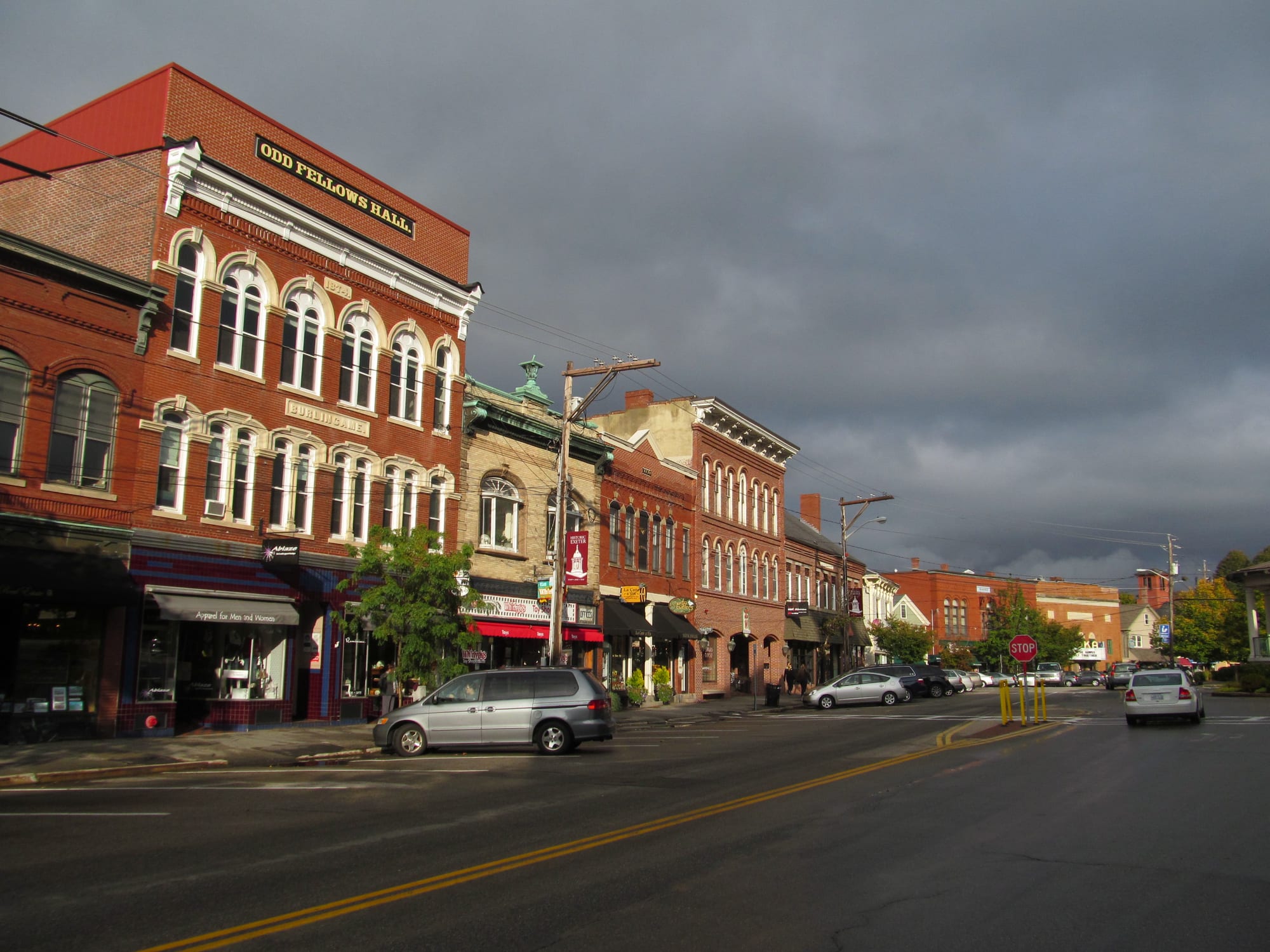
Context · Exeter (New Hampshire), scene of the low-altitude sighting
Water Street, Exeter NH.jpg · Wikimedia Commons · CC BY-SA 3.0 · open original
Part 01
The night in question
After midnight on September 3, 1965, Norman Muscarello —an 18-year-old newly enlisted in the Navy, on his way home— was hitchhiking along Route 150 near Kensington, outside Exeter, New Hampshire, when he said he saw a large object with a row of pulsating red lights emerge from behind some trees, in a field near a farm, and approach until he threw himself into the ditch for cover. The lights, as he would describe them, flashed in rapid sequence —right to left and then back—, with no tail, no wings and no engine sound. Terrified, he got a ride to the Exeter police station and convinced the staff on duty of the sincerity of his account.
Patrolman Eugene Bertrand —who a little earlier that same night had assisted a woman frightened because a light had followed her car along the highway— drove Muscarello back to the field. There, both saw a dark, enormous object with flashing red lights rise from behind the trees; Bertrand would describe it with the phrase that made the case famous: 'as big as a barn.' The object moved toward them and the witnesses reacted with alarm. Officer David Hunt arrived a few minutes later and observed the same object, which floated, wobbled and maneuvered in a way that, in his judgment, no plane could, before moving off toward Hampton. Animals in the area reacted: horses in a nearby corral were spooked and kicked, and dogs barked. The station dispatcher and a supervising officer heard the accounts in real time, adding a layer of contemporary indirect witnesses.
The case entered the USAF Project Blue Book. The explanations floated —Operation Big Blast, a nighttime SAC/NORAD training exercise with bombers that ran on September 2-3, and confusion with bright stars or planets— collided with the timing: the exercise reportedly ended about an hour before Muscarello and Bertrand's encounter, so it could not account for what the officers saw. After reviewing the additional information submitted from Exeter, the Air Force acknowledged in writing in 1966 that it had been unable to identify the object, and Blue Book listed the case as 'unidentified.' What distinguishes it is not instrumentation —there was none— but the quality of the witnesses: a low-altitude, close-range sighting corroborated by two on-duty police officers in addition to the initial witness, with trained, sober and concordant observers.
Part 02
Why this case moved the needle
It is one of the best-attested multi-witness sightings of the Project Blue Book era and an official 'unidentified' case that survives with its label intact to this day — no small detail, because Blue Book was, in its general orientation, a program with a strong tendency to close cases with conventional explanations, so an 'unidentified' that survived its own scrutiny carries particular weight.
Its strength lies in the witnesses. Besides the initial observer, two on-duty police officers described at close range, and concordantly, a large, silent object with red lights in sequence and maneuvers incompatible with conventional aircraft. They are exactly the kind of witnesses —trained, sober, used to reporting precisely and with a professional reputation to lose— that make it hard to dismiss the sighting as casual confusion or a prank; and the reaction of the animals and the chain of indirect witnesses at the station reinforce that something happened. Its limit, however, is that of its time and must be weighed honestly: there was no radar, photograph or film to fix the object. The testimony, however convergent, describes what the witnesses perceived, not the physical nature of what was perceived, and the prosaic explanations —though the Operation Big Blast one failed on timing— cannot be entirely excluded in the absence of an instrumental record. That is why the case is Tier A and not S: it rests on convergent professional testimony, strong but not diagnostic. Alongside Levelland and Socorro, it anchors the line of Blue Book-era cases the USAF itself, despite its bias toward closure, could not produce a holding explanation for.
Part 03
What's left on paper
Documented evidence
- Initial report by Norman Muscarello (18) of an object with pulsating red lights at close range, September 3, 1965, near Exeter, NH
- Corroboration by two on-duty Exeter police officers: patrolman Eugene Bertrand and officer David Hunt
- Concordant description: large object ('as big as a barn'), flashing red lights, floating and maneuvering with no aircraft sound
- Earlier report the same night of a driver followed by a light (assisted by Bertrand)
- Project Blue Book classified the case 'unidentified' after the Operation Big Blast and stars/planets explanations failed on timing
- Popularization and documentation in John G. Fuller's 'Incident at Exeter' (1966)
Sources
- Wikipedia — Exeter incident — Chronology, witnesses and Blue Book classification.
- UFO Evidence — The Incident at Exeter (Muscarello Case) — Synthesis of the case and testimony.
Location
Exeter / Kensington, New Hampshire · 42.98°, -70.95°
Distribution of explanations
This case is classified among the model's hypotheses: the bar splits 100% by how much each explanation weighs (the uncertainty is spread across the hypotheses the case supports). Summed across the corpus they produce the comparable partition. It is a different question from the Probability above: that one estimates how likely the case is a genuinely unexplained phenomenon; this one splits which the explanation would be.
Modal hypothesis: Misidentification 58% · sums to 100%
Confused with: No single object identified
Structured analytical judgment, not a calibrated frequency. Forced classification: the mass the evidence cannot assign is spread across the hypotheses the case does support.
Related cases