2026·Southern Tennessee and western North Carolina, U.S.
United States.Tennessee · witnesses and NASA cameras see a fireball meteor
On the night of Thursday, November 5, 2026, at about 7:45 p.m. Eastern time, a fireball crossed the sky over southern Tennessee and filled social media with posts from witnesses. Four NASA cameras that watch the night sky recorded it. According to the agency's analysis, it was a piece of an asteroid about 2 inches across and weighing 6 ounces that appeared over Robbinsville, North Carolina, at about 47,000 mph and broke up 25 miles above East Ridge, next to Chattanooga. NASA added that it was not part of the Taurid meteor shower.
Tier S · SolidWhat do they mean? →
Strong evidence: a contemporary instrumental record (radar, sensor, film or photo of known provenance) that corroborates several independent witnesses.
What it was
97%meteor or fireball
The most likely explanation.
- 97% meteor or fireball
- 1% other earthly causes
- 2% no known cause
See the split across the six explanations
Earthly origin (human or natural)98%
No known cause2%
Ordinary cause the sources propose: meteor or fireball
Record of the event
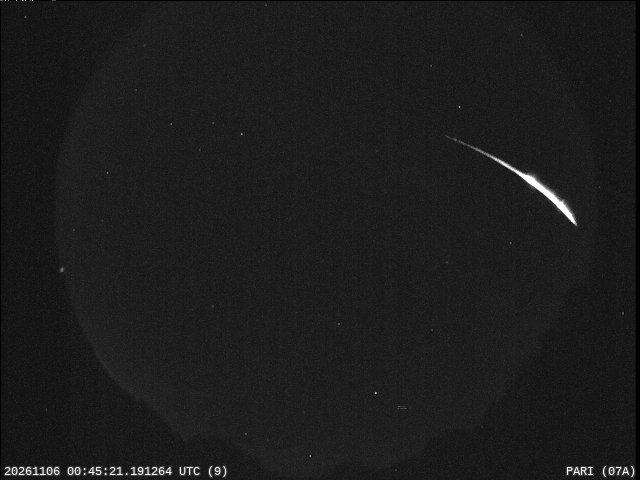
The fireball in NASA's PARI camera at 00:45:21 UTC on November 6, 2026
Frame from the all-sky camera labeled PARI (07A), part of NASA's fireball network, published on event page 20261106-004521: the white streak across the right side of the circle is the meteor. The image is a fisheye view of the whole sky, with the horizon at the edge. It is one of the four cameras NASA used to work out the path.
NASA Meteoroid Environment Office, All Sky Fireball Network (fireballs.ndc.nasa.gov) · Public domain (NASA) · open original
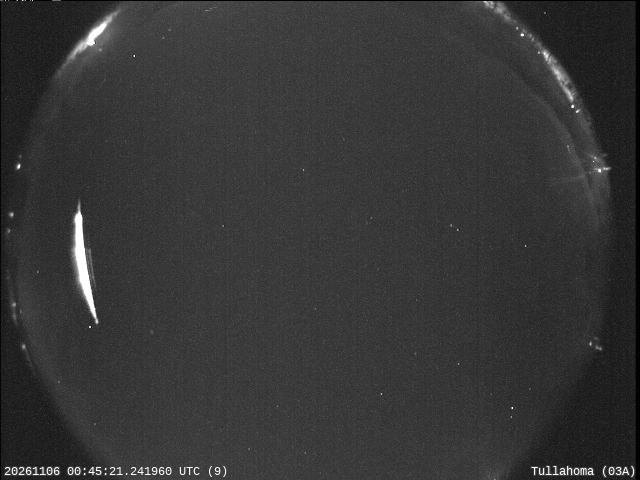
The fireball in NASA's camera at Tullahoma, Tennessee
Frame from the Tullahoma all-sky camera (03A), part of NASA's fireball network, published on event page 20261106-004521: the meteor is the nearly vertical white streak on the left, at 00:45:21 UTC. It is the camera whose video Chattanooga station WTVC aired.
NASA Meteoroid Environment Office, All Sky Fireball Network (fireballs.ndc.nasa.gov) · Public domain (NASA) · open original
What happened
On Thursday, November 5, 2026, at about 7:45 p.m. Eastern time (00:45 on the 6th in universal time), a very bright light crossed the sky over southern Tennessee. Many people posted on social media about what they had seen. According to the science news site Daily Galaxy, which gathered accounts posted on Reddit, witnesses described shades of blue, white and orangish yellow. One called it the "biggest ball of fire" they had ever seen, and another, in Chattanooga, said they had heard a brief noise like the "poof" of a lighter and that the light left a glowing tail behind it.
The light was caught on camera. NASA's Meteoroid Environment Office runs a network of cameras that watch the whole night sky to record fireballs, the name for meteors brighter than the planet Venus. Four of those cameras picked it up: the ones in Huntsville, Alabama, and Tullahoma, Tennessee, and two more labeled Tellus and PARI. The frames the agency published all carry the same time, 00:45:21 universal time, and the meteor shows up in all of them: in three as a white streak that widens toward the end, and in the Huntsville frame as a bright dot near the edge.
From that video, NASA worked out the path. According to the page it published about the event, the object was "a small piece of an asteroid" about 2 inches across and weighing about 6 ounces. It appeared 86 kilometers (53 miles) up over Robbinsville, a town in western North Carolina, and moved west, angled slightly to the south, at 21.2 kilometers per second, about 47,000 mph. It disintegrated 40 kilometers (25 miles) up over East Ridge, Tennessee, southeast of Chattanooga. At its brightest it reached magnitude -6.1, brighter than the planet Venus. By a calculation made for this case from NASA's coordinates, it covered about 150 kilometers (95 miles), which at that speed took about seven seconds.
NASA gave the explanation the next day. On the afternoon of Friday, November 6, its space alerts account on X, @NASASpaceAlerts, wrote that several witnesses had seen a fireball over southern Tennessee the evening before and that four of the agency's cameras had detected it, giving the size and weight of the piece of asteroid. The event page added that the meteor was not part of the Taurid shower, which was active in those weeks. The Taurids are a meteor shower that Earth passes through every fall and, according to Daily Galaxy, they have a reputation for producing bright fireballs, which made them the first suspect. On Tuesday, November 10, Chattanooga TV station WTVC reported the event with NASA's data and the video from the Tullahoma camera.
Where it happened

Why it matters
The explanation came from the same instruments that recorded the event. Four cameras in the same network, at different sites in the region, saw the streak in the same second. Each camera gives a direction in the sky, and where several of them cross fixes the object's height, heading and speed. With that data, NASA gave the size of the rock, the point where it broke up and its relation to the Taurid shower.
The other cause often raised when a fireball appears, falling space junk, does not fit the records. The catalog of space objects kept by astrophysicist Jonathan McDowell lists several falls of satellites and of rocket and spacecraft parts on November 5 and 6 in universal time. The closest in time is a Starlink satellite, listed at about 01:45 on the 6th in universal time, an hour after the fireball, with the time flagged as uncertain. The other falls are many hours earlier or later. The Chinese satellite Henan-1 has no time, but it is listed on the 5th in universal time, a day that ended at 7 p.m. Eastern time, before the fireball. There are also parts of a Chinese rocket, but that rocket lifted off almost a day after the fireball. Neither the 01:45 Starlink entry nor the Henan-1 entry says where the object came down.
Duration also sets a natural fireball apart from a reentry: the Tennessee fireball lasted about seven seconds, while in Australia in 2023, cameras followed the debris of a reentering Soyuz rocket for 68 seconds (↗ Melbourne).
An instrument that watches the sky from space did not record it. The lightning sensor on the GOES-19 weather satellite, run by the U.S. agency NOAA, also picks up fireballs and located the fireball that crossed south-central Chile on November 13 (↗ Chile). It logged no flash over the southeastern United States between 00:40 and 00:50 universal time, according to the data NOAA publishes. The Tennessee rock, about 2 inches across according to NASA, was much smaller than the one over Chile, which an astronomer put at tens of centimeters. The record of this case is the ground cameras.
About 21 hours passed between the fireball and NASA's notice on X, and the notice already gave the size and weight of the rock. There is no known meteorite find.
Documents and sources
Documented evidence
- Event page 20261106-004521 on NASA's fireball site: time 00:45:21 UTC on November 6 (7:45 p.m. Eastern on the 5th), magnitude -6.1, size 2 inches, start at 35.435° N, 83.745° W and end at 34.989° N, 85.245° W, altitude 86.3 to 40.5 kilometers, and speed 21.2 kilometers per second. The table gives 47,500 mph and the text rounds it to 47,000.
- The same page publishes the frames from four cameras in NASA's network, labeled Huntsville (01A), Tullahoma (03A), Tellus (04A) and PARI (07A), with times between 00:45:21.19 and 00:45:21.36 UTC (in the Huntsville frame the meteor is a bright dot near the edge, not a streak), and says the meteor was not part of the Taurid shower, then active. It credits supporting data to the American Meteor Society, with no event number.
- Post by @NASASpaceAlerts on X on November 6 at 21:48 UTC (4:48 p.m. Eastern): several witnesses saw a fireball over southern Tennessee on the 5th at 7:45 p.m., and four NASA All Sky cameras detected it; the object was a small piece of an asteroid 2 inches across.
- Data from the GLM lightning sensor on the GOES-19 satellite (NOAA): the 30 files from 00:40 to 00:50 UTC on November 6 record no flash between 25° and 45° N and 75° and 95° W.
- Jonathan McDowell's GCAT catalog (updated November 23, 2026): decays of the satellites Starlink 2298 (Nov 5, about 03:00 UTC, time uncertain), Henan-1 (Nov 5, no time), Starlink 36253 (Nov 6, about 01:45 UTC, time uncertain) and Starlink 1420 (Nov 6, 06:23 UTC, at 38° S, 79° E, in the southern Indian Ocean); and of Varda's W-8 reentry capsule (Nov 5, 13:58, landed at Koonibba, Australia), the IROSA 3B solar array (Nov 5, 16:28) and the first and fourth stages of a Gushenxing-2 rocket launched on the 6th at 23:37 UTC.
- According to Daily Galaxy (November 11), which gathered accounts posted on Reddit, witnesses saw shades of blue, white and orangish yellow; one called it the "biggest ball of fire" they had ever seen and another, in Chattanooga, heard a noise like the "poof" of a lighter.
Sources
- NASA, event page 20261106-004521 on its fireball site (November 2026) — Primary source: NASA's analysis with the path, speed, size, relation to the Taurids, and the frames and video from its four cameras.
- NASA Space Alerts (@NASASpaceAlerts), post on X (Nov 6, 2026, 21:48 UTC) — Primary source: NASA's public notice about the fireball and the four cameras that detected it.
- NASA Meteoroid Environment Office, "All Sky Fireball Network" — Description of the camera network and of what counts as a fireball: a meteor brighter than Venus.
- NOAA, GOES-19, Geostationary Lightning Mapper (GLM), Level 2 product, file for Nov 6, 2026, 00:45:20 to 00:45:40 UTC — The sensor's public data: the file for the minute of the fireball; those from 00:40 to 00:50 UTC are in the same folder.
- Jonathan McDowell, General Catalog of Artificial Space Objects (GCAT), satellite, auxiliary object, lower stage and launch catalogs (updated Nov 23, 2026) — Catalog: decays on November 5 and 6, 2026, in universal time. It also lists the first stage and both fairing halves of a Chinese Long March 2C rocket launched from Xichang on the 5th at 15:58 UTC, about nine hours before the fireball, and the other pieces of the Gushenxing-2.
- Daily Galaxy, "A Mysterious Fireball Streaked Across the Tennessee Sky at 47,000 MPH, NASA Reveals What It Was" (Nov 11, 2026) — Press: witness accounts posted on Reddit (colors, the noise heard in Chattanooga) and the Taurids' reputation. It says the meteor covered about 120 miles in under ten seconds, without saying where the figure comes from; NASA's coordinates give about 95 miles.
- WTVC NewsChannel 9, "NASA tracks fireball that disintegrated over East Ridge, Tennessee" (Nov 10, 2026) — Chattanooga local press: summarizes the data NASA published and airs the video from the Tullahoma camera.
Related cases
Cases this case cites and cases with the same likely cause.
Cited in this case · Within 10 years
Melbourne · residents see a fireball and hear a sonic boom
2023 · Tier S
Cited in this case · Within 10 years
Chile · a fireball streaks by and booms over Ñuble and Biobío
2026 · Tier A
Meteor or fireball · Same country · Within 10 years
Las Vegas · a family reports two aliens in its backyard
2023 · Tier A
Meteor or fireball · Same country
Coyne incident · an Army helicopter nearly hits a red light
1973 · Tier A