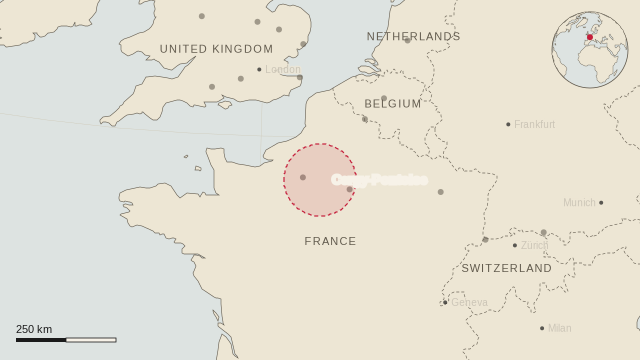
1979·Cergy-Pontoise, northwest of Paris, France
France.Cergy-Pontoise · a young man vanishes after seeing a light
On November 26, 1979, before dawn, two friends said in Cergy-Pontoise, near Paris, that a young man, Franck Fontaine, had vanished from a car enveloped in mist and balls of light. He reappeared seven days later, believing it was still the same morning, and said he remembered only a dream. The police, the gendarmerie, a prosecutor and GEPAN, the official French service for studying aerospace phenomena, investigated; GEPAN found no physical evidence and pointed to serious contradictions. In 1983 one of the two friends said it had all been a hoax.
Tier A · AcceptableWhat do they mean? →
Institutional evidence: several identified independent witnesses, or contemporary official documentation, without an instrumental record to corroborate them.
What it was
80%possible hoax
The most likely explanation.
- 80% possible hoax
- 4% other earthly causes
- 16% no known cause
See the split across the six explanations
Earthly origin (human or natural)84%
No known cause16%
Ordinary cause the sources propose: possible hoax
What happened
In 1979, Jean-Pierre Prévost and Salomon N'Diaye, both 25, lived in neighboring apartments in a district of the new town of Cergy-Pontoise, northwest of Paris. Franck Fontaine, 18, lived with his mother about ten kilometers away and sometimes slept at Prévost's place. Prévost and Fontaine made a living as market traders; N'Diaye, out of work, sometimes helped them. On the night of November 25, Fontaine and a fourth man, Léon, a painter who had just been laid off, slept in Prévost's living room. They were going to sell jeans at the market in Gisors, about 60 kilometers away, and for that they had a borrowed station wagon with no starter that had to be pushed to start. Prévost had no driver's license; Léon was the only one in the group who did.
According to what the three said that morning, on Monday, November 26, they went down around 4:00 a.m. to load the car. Around 4:15, Fontaine, at the wheel, pointed out a beam of light slowly descending over the parking lot toward the fields and the power station. Fontaine drove off after the light. Prévost went up for a sunshade for the stall and N'Diaye for a camera, which he brought down without film. When they came back, they saw the car enveloped in a sphere of white mist with small luminous balls. N'Diaye ran toward it; the sphere shrank and rose into the sky, and Fontaine was no longer in the car.
On the 26th, according to the police and gendarmerie service logs cited by GEPAN, at 5:00 a.m. a call to the police station said: "My friend has been abducted by a UFO." At 5:20 the first car arrived with three police officers, and at 5:25 a patrol of four. They found no clue in the car, on the road or in the fields; the car was full of jeans and the windows were fogged. The officers noted that N'Diaye was very nervous, shouting and crying, that Prévost soon regained his calm and that Léon seemed uninterested. In the first reconstruction, at the gendarmerie, the witnesses placed the car at one spot; the police, who had seen it, placed it 30 meters to the west.
Over the following week, journalists, private investigators and psychics arrived. The gendarmerie searched the Oise river with a river brigade and combed the area with a dog. Commander Roger Courcous told the newspaper Sud Ouest: "The most extraordinary thing is that physically we find nothing," and the newspaper added that the investigation gave no reason to doubt the witnesses' sincerity. The weather station recorded 3 °C at 4:00 a.m. and 90 percent humidity, with no fog.
The gendarmerie measured radioactivity with a Geiger counter and a compass and found no anomaly, and the dog did not react. According to Sud Ouest of November 28, police and gendarmes found no contradiction between Prévost's and N'Diaye's accounts, questioned together and separately, although they were skeptical. According to Vallée, they came to suspect that Prévost and N'Diaye had killed Fontaine, and his mother and his partner denied it.
GEPAN, the service of the National Center for Space Studies (CNES) that investigated such cases, was alerted by the gendarmerie on November 26 itself. It interviewed other residents. "Rémi," a man who worked at a construction site and lodged in the same building as Prévost and N'Diaye, arrived around 4:25 (a GEPAN calculation, give or take ten minutes) and saw two people get into a family car, which drove off. He saw no luminous phenomenon, only the street lighting.
GEPAN considered his account "fundamentally incompatible" with that of the three friends. "Lisette," 14, saw neither the car nor anyone: from her window, between 4:00 and 4:30, she saw colored circles over the electric pylons. GEPAN suggested a discharge on the cables, although it noted that this is not a typical incident on such lines and that the power company recorded none. The radars of two airports showed no aircraft with the orientation of the beam and nothing anomalous in the area.
On Monday, December 3, at 4:20 a.m. according to N'Diaye, Fontaine rang N'Diaye's doorbell, almost seven days after he vanished, believing it was still the morning of the 26th. According to GEPAN, he said he had woken up in a cabbage field and remembered the week as a dream lasting half an hour, with presences and voices whose content he did not remember. That day the gendarmerie and the deputy prosecutor of Pontoise questioned them, with two GEPAN collaborators present. According to the gendarme, and Fontaine agreed, Fontaine's soles were clean. The deputy prosecutor suspended legal action, although opening a case for "contempt of a magistrate" had been considered in case of false testimony. There were no charges.
On December 3, around 6:40 a.m., the radio station RTL received an anonymous call from a man who said he had seen a ball of light and a silhouette like Fontaine's in the cabbage field. GEPAN established that nobody was at the switchboard before 6:30 and that the call was not recorded. N'Diaye admitted to GEPAN and at the December 5 press conference that he had called RTL, but said he had called around 5:30, giving his name, with a message.
According to GEPAN, the witnesses agreed to go to the full medical examination at Bonneval and then dodged the appointments; Fontaine gave blood, with normal cortisol, but did not bring the promised urine or go back to his doctor. Prévost accepted hypnosis by a private group, under which he said he remembered the car surrounded by a sphere and voices. Fontaine refused hypnosis. In 1980 the three published a book with the writer Jimmy Guieu, and Paris Match published a paid interview with Fontaine.
Under hypnosis, Prévost said he was in contact with a being called "Haurrio" and announced a "great contact" for August 15, 1980 at the site. Hundreds of people came, by some accounts up to two thousand; nobody appeared. In 1983, according to Vice and the journalist Michel Granger, who cite Le Parisien Libéré of July 7, Prévost declared that the case was "a fake from beginning to end" and that Fontaine had spent the eight days of his disappearance in a friend's apartment in Pontoise. Vallée and the Encyclopedia of Occultism and Parapsychology also report the confession, without reproducing the original. Fontaine and N'Diaye stuck to their version.
Where it happened
Why it matters
In Cergy-Pontoise the police, the gendarmerie, the courts and a scientific service of the State all investigated. The gendarmerie measured radioactivity and the compass; GEPAN checked the power station, the radar records and Fontaine's cortisol. Nobody found a physical sign. GEPAN's 1981 technical note records good general coherence in the accounts and many inconsistencies of detail, some serious.
It concluded that the contradictions and some proven lies, such as the call to the radio station or the account of GEPAN's visit, made it impossible to consider any element apart from "a manifest desire to manipulate information"; according to the note, some lies can only be explained by a conscious desire to distort, falsify or invent information. It did not use the word "hoax," and added that the case might interest psychology and sociology. In its third part, another author compares the witnesses' account with confabulation and acknowledges that the analogy is only an indication.
What has not been shown is where Fontaine was that week. Prévost said in 1983 that it was in a friend's apartment in Pontoise; Jacques Vallée records a later conversation in which Prévost said it was not in Pontoise but in his own apartment, and that Fontaine assured him in 1989 that he did not know where he had been. Prévost's confession is known only from secondary sources: Vice and Granger cite Le Parisien Libéré of July 7, 1983; Vallée places it in an interview with Émile Bouchon; the Encyclopedia of Occultism and Parapsychology mentions it without further details. None reproduces the original. Fontaine and N'Diaye stuck to their version; in 1989 Fontaine reaffirmed the abduction to Vallée, although he called the Haurrio episode "pure fabrication."
Vallée, who visited Pontoise in 1980, does not believe Fontaine was abducted by extraterrestrials, but neither that he lied nor that it was a simple hoax; he proposes the involvement of an organization with means. He bases it on what he says an investigator without a name told him, who met an anonymous Defense Ministry official, and on a police officer, also anonymous, who reportedly saw the car in very thick fog, a detail that does not appear in the reports; it is his opinion and he himself qualifies it. The independent witnesses GEPAN found neither prove a hoax nor rule it out: "Rémi" saw two people get into the car, when according to the witnesses Fontaine was alone, and no luminous phenomenon; "Lisette" saw colored lights over the cables between 4:00 and 4:30.
Documents and sources
Documents
GEPAN/CNES, Technical note no. 6, "A propos d'une disparition" (1981)
Official 102-page report by the Groupe d'Études des Phénomènes Aérospatiaux Non Identifiés, the French CNES service that investigated the case.
Read more
It gives the chronology of the morning of November 26, 1979 from the police and gendarmerie logs, the physical tests, the interviews with neighbors and the conclusion that the case has no interest for the scientific study of physical phenomena. It anonymizes everyone involved.
Sud Ouest, November 27, 1979, on Franck Fontaine's disappearance
Article from the regional newspaper Sud Ouest, the day after the event, in Patrick Gross's transcription. It reports what Prévost and N'Diaye told the gendarmerie and that investigators noted there was no fog that night.
Documented evidence
- Service logs of the police station and the gendarmerie, cited by GEPAN's technical note: a call at 5:00 a.m. on November 26, 1979 ("My friend has been abducted by a UFO"), three police officers arriving at 5:20 and four more at 5:25, with no clue in the car, on the road or in the fields.
- GEPAN/CNES technical note no. 6, "A propos d'une disparition" (data up to January 1981): concludes that no physical sign suggests a phenomenon and that the contradictions make it impossible to consider any element apart from "a manifest desire to manipulate information"; it calls the case of "total lack of interest" for the scientific study of the physical aspects of unidentified aerospace phenomena.
- Negative physical tests: the gendarmerie's Geiger counter and compass with no anomaly and the dog with no reaction; weather station with 3 °C at 4:00 a.m., 90 percent humidity and no fog; power company with no incidents; radars of two airports with nothing anomalous in the area; Fontaine's cortisol normal.
- Statements by two people to GEPAN: "Rémi" saw two people get into the car, with no luminous phenomenon, around 4:25 (a GEPAN calculation); "Lisette," 14, saw colored circles over the electric pylons between 4:00 and 4:30.
- Sud Ouest, November 27, 28, 29 and December 5 and 6, 1979: the witnesses' account, Commander Courcous ("physically we find nothing"), the reappearance on December 3, the absence of charges and N'Diaye's admission that he made the call to the radio station.
Show 3 more facts
- Fontaine's reappearance on December 3, 1979 at 4:20 a.m. according to N'Diaye, almost seven days later, with clean soles according to the gendarme, and the Pontoise deputy prosecutor suspending legal action.
- Prévost's 1983 confession ("a fake from beginning to end," according to Vice), reported by Vice and Granger from Le Parisien Libéré of July 7, 1983; Vallée and Encyclopedia.com also mention it, without reproducing the original.
- Vallée ("Revelations," 1991): does not believe Fontaine was abducted, but neither that he lied nor that it was a simple hoax; he interviewed Fontaine in 1989.
Sources
- GEPAN/CNES, Technical note no. 6, "A propos d'une disparition" (inquiry 79/07), 1981 — Official report by the CNES service that investigated the case; it anonymizes the witnesses and cites the police and gendarmerie logs.
- Sud Ouest, November 27, 1979, "Un O.V.N.I. apparaît… un jeune homme disparaît" — Press of the time, in Patrick Gross's transcription.
- Sud Ouest, November 28, 1979 — Police and gendarmes found no contradictions among the witnesses but were skeptical.
- Sud Ouest, November 29, 1979 — Statements by Commander Courcous and the search of the Oise.
- Sud Ouest, December 5, 1979, "L'aventure extra-terrestre de Franck Fontaine" — The reappearance on December 3 and the absence of charges.
- Sud Ouest, December 6, 1979 (press conference of the 5th) — N'Diaye's admission that he made the call to the radio station.
- "The Cergy Investigation," BUFORA Journal, vol. 9, no. 2 (May 1980), translation of Gérard Lebat's (GEOS) report — Private investigator who visited the witnesses on December 1, 1979.
- Jacques Vallée, "Revelations: Alien Contact and Human Deception" (1991), ch. 5 — Chapter 5, "Purple Justice," pp. 122-152.
- Vice France, "L'affaire de l'ovni de Cergy-Pontoise" — Reports Prévost's 1983 confession, citing Le Parisien Libéré.
- "Cergy-Pontoise Hoax," Encyclopedia of Occultism and Parapsychology (Gale) — Secondary summary, with errors in details.
Related cases
Cases with the same likely cause.