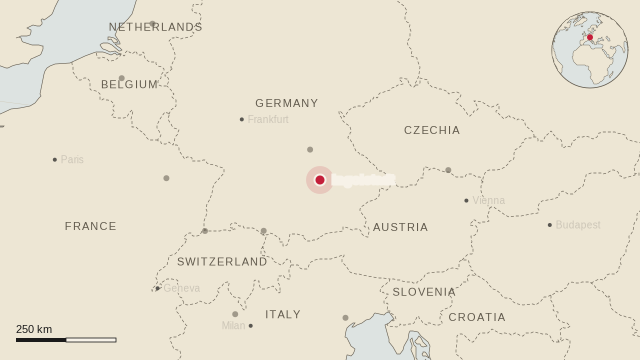
1979·Ingolstadt, Bavaria, Germany
Germany.Ingolstadt · police officers see star-shaped lights
On September 16 and 18, 1979, police officers in several Bavarian towns saw silvery five-pointed lights with yellow and red flashes over Ingolstadt and as far as about 70 km to the north. The press of the day spoke of ten officers who watched them independently for an hour and a half. A Federal Border Police helicopter saw nothing, and the Bavarian Interior Ministry spoke of mirages of anti-aircraft fire from the Hohenfels range. The investigator Illobrand von Ludwiger adds the account of a light-aircraft pilot, which appears only in his book.
Tier A · AcceptableWhat do they mean? →
Institutional evidence: several identified independent witnesses, or contemporary official documentation, without an instrumental record to corroborate them.
What it was
62%optical phenomenon
The most likely explanation.
- 62% optical phenomenon
- 6% other earthly causes
- 32% no known cause
See the split across the six explanations
Earthly origin (human or natural)68%
No known cause32%
Ordinary cause the sources propose: optical
What happened
Ingolstadt is a Bavarian city on the Danube, with a large Audi factory on its outskirts. On Sunday, September 16, 1979, at about 9:30 p.m., a television technician whom the investigator Illobrand von Ludwiger calls only "Mr. Y." arrived at his home on the edge of town. A neighbor pointed out three bright lights in the sky. According to his account, later collected by the research group MUFON-CES, the three objects were about 15 meters across, nearly motionless at about 200 meters of altitude and a kilometer away, looked metallic, "like silver foil," and were surrounded by a white, yellow or greenish glow.
One of the objects approached a large cube-shaped billboard with the name AUDI on all four sides, about 450 meters from the house, and stopped about 70 meters above it. The witnesses made out five points, two pointing up, two down and one in the direction of travel, with red lights flashing around them. After a minute the object returned to the other two and they formed a chain of lights that, in only five seconds, flew toward the cube and then continued in the direction of Eichstätt, about 25 km away. The observation lasted about five minutes. The technician called the Ingolstadt-West police station, which had already received six or seven other calls that evening. According to the press of the day, at 9:38 p.m. a Turkish worker had called to report "three UFOs hovering over the Audi factory grounds"; before the officers arrived, the objects moved off to the northwest.
Reports continued to the north. At 9:45 p.m. police in Eichstätt saw the objects; one of them, a 22-year-old officer, told the press that two flew on and one stayed for fifteen minutes above his position, with a strong yellow light. At 9:53 p.m. police in Gunzenhausen, about 60 km from Ingolstadt, reported in, and minutes later those in Weißenburg, about 40 km away, saw two lights at high altitude; the newspaper places them over the village of Pleinfeld at 9:49 p.m., ten minutes earlier than the book. At 10:01 p.m. the state police headquarters in Munich, about 70 km to the south, was notified.
The two officers who had attended the technician were patrolling north of Ingolstadt. At 11:02 p.m. they saw a five-pointed object about 20 degrees above the horizon and about 2 km away, the size of the Moon, yellowish and flashing continuously. The points shone orange-red at irregular intervals and the interior glowed like a floodlight. One of the officers, F., noticed that a light source on the edges moved around about three times a second, which caused the flicker. They watched it for 10 to 15 seconds; when the car reached a spot with a clear view, it was gone. F. said afterward: "I was amazed. I didn't believe in the whole mumbo jumbo. But suddenly that thing was there!" At 11:22 p.m. two other officers saw two luminous objects in Schwabach, about 70 km to the north.
The Hamburger Morgenpost of September 19 ran a headline saying ten police officers swore they had seen flying objects. According to the paper, they had observed, independently and for an hour and a half, silvery five-pointed objects with yellow and red flashes. To some they looked the size of a ball, to others the size of a house. The paper added that the objects did not appear on radar screens, and quoted a police spokesman: "The officers' observations cannot be doubted. Whether it was a visit from extraterrestrials, we cannot say."
Two nights later, on Tuesday, September 18, the lights returned. According to the Abendpost, that night the Ingolstadt police felt they were being "made fools of" and, unlike the first night, there was no chase with radio and patrol cars. At about 8:30 p.m., witnesses in Nuremberg saw an eight-pointed object at about 1,300 meters flying south; an hour later an oval one, with flashing red lights, moving up and down, was seen near Ingolstadt. Ingolstadt police again informed Munich, which asked air traffic control at Munich-Riem to look for "UFO-related shapes over the area Ingolstadt."
According to the Abendpost, the Bavarian Interior Ministry, under its minister Gerold Tandler, was informed and sent a Federal Border Police (Bundesgrenzschutz) helicopter up shortly before 11 p.m. Ludwiger gives its call sign, "Pirol 203," and says it arrived at 11:03 p.m. and circled over the city until 11:21 p.m. without seeing any unusual light. According to the Ministry, the pilot "literally hit empty space."
That same night, according to Ludwiger's book, controller H. had on his screen a Cessna 414 flying at 3,600 meters, about 30 km north of Ingolstadt, from Munich to Brussels, with its owner and a pilot on board. He asked her to look for unusual lights. About 30 seconds later the pilot reported several lights rising from the ground in her direction and, soon after, very excited, four or five very bright yellow-green lights with six points flying toward her, matching her speed and altitude, switching sides at great speed and circling the plane. They disappeared after 30 seconds. The two occupants landed in Frankfurt, and the owner called Munich control to confirm the account; he said he did not believe in UFOs but that what he had seen was inexplicable to him.
The radio conversation was overheard by military flight control at Fürstenfeldbruck, and a police officer who listened to it told colleagues in Ingolstadt afterward that it sounded like the soundtrack of a science-fiction movie. The MUFON-CES catalog says the radio traffic was recorded in Munich-Riem and in Fürstenfeldbruck. This part appears only in the book: neither the pilot nor the controller is named, and no recording or statement from them is known to have been published.
The book's dates do not add up. Ludwiger dates the first night September 16 and the second "two days later, on September 9," and also dates the Ministry statement September 9; other versions of his text online begin on the 6th. The press passages reproduced in a compilation by the group CENAP (Centrales Erforschungs-Netz außergewöhnlicher Himmelsphänomene, a German network of UFO investigators) settle it: the Abendpost of September 20 speaks of the night from Tuesday to Wednesday and of another just like it two nights earlier, and the MUFON-CES catalog dates the case September 18, 1979. The two nights were therefore Sunday the 16th and Tuesday the 18th, two days apart, and the Ministry statement dates from September 19 or 20.
According to the Abendpost, the Ministry's immediate inquiries produced this solution: Lufthansa and Bundeswehr (the German armed forces) pilots had often observed mirages over Ingolstadt, and the intermittent pentagons the police saw were probably reflections of anti-aircraft fire from the Hohenfels range, about 120 km away according to the paper. The meteorologist Ernst Ittner told the paper that such air layers form in the area every two or three years: six degrees at the ground, ten at two meters up and up to thirteen at 200 meters, so light bends at the contact between layers. Ludwiger quotes the Ministry's press statement as document 315/79, which also mentions, "in some cases," civilian aircraft, and calls it "pure nonsense."
Where it happened
Why it matters
The case brings together police officers in five towns who saw the lights and, in several cases, reported them, and a statement from the Interior Ministry that acknowledges the sightings and attributes them to mirages. Both nights are backed by press of the day; the account of the Cessna pilot, by contrast, appears only in Ludwiger's book. There is no instrumental record of the objects: according to the paper, radar did not pick them up, and the helicopter that was sent saw nothing.
The official explanation has one point in its favor. A helicopter that sees nothing while lights are visible from the ground points to an optical effect near the surface, and the figures the paper gives describe a strong temperature inversion, the kind that bends light and can create false radar targets. It also has three problems. A muzzle flash lasts an instant and a mirage repeats it for the same instant, yet an officer said an object stayed fifteen minutes above his position. The paper put Hohenfels 120 km away, and the straight-line distance, by a calculation made for this case, is about 55 to 60 km. And no document that could be consulted shows that there was anti-aircraft fire there on those nights.
The group CENAP, which takes a skeptical stance, judged that the Ministry's explanation did not fit and proposed another, without evidence: small hot-air balloons, from a manufacturer in Staffelstein, released by a group of people to produce "UFO terror" for an hour and a half. No witness or document supports it, and it does not account for what the Cessna pilot described, whose account rests on a single book.
Ludwiger says MUFON-CES interviewed several air traffic controllers, a dozen police officers and many other witnesses, and analyzed photographs and radar recordings on film. None of those photographs or recordings has been published, and the book's own account mentions only a radar screen showing the Cessna, not a trace of the lights. The reliability index of 99.99% that MUFON-CES gives the case measures the group's confidence in its witnesses and its investigation; it does not estimate whether the event was extraordinary. Ludwiger also admits that the authorities may have given that explanation to spare themselves the work of handling sightings they could not resolve, and not out of a cover-up.
What remains to be seen is what MUFON-CES Report No. 8 (1981), statement 315/79, the Ingolstadt police records and the Munich-Riem recording that the MUFON-CES catalog says was kept would show. None of them is published.
Documents and sources
Documented evidence
- The Hamburger Morgenpost of September 19, 1979 reported that ten Bavarian police officers had independently seen, for an hour and a half, silvery five-pointed objects with yellow and red flashes, and that they were not picked up on radar; a police spokesman said the officers' observations could not be doubted.
- The same paper records a call to Ingolstadt police at 9:38 p.m. about "three UFOs hovering over the Audi factory grounds," confirmation by Weißenburg police at 9:49 p.m. of two objects over Pleinfeld, and an object about 400 meters up over Ingolstadt at 11:03 p.m.
- According to Ludwiger, on September 16 there were police sightings in Eichstätt (9:45 p.m.), Gunzenhausen (9:53 p.m.) and Weißenburg (about 9:59 p.m.), Munich headquarters was informed at 10:01 p.m., a two-officer patrol saw a five-pointed object at 11:02 p.m. for 10 to 15 seconds, and two other officers saw two lights in Schwabach at 11:22 p.m.
- The Abendpost of September 20 and Ludwiger's book agree on a Federal Border Police helicopter sent shortly before 11 p.m. that saw no light; the book specifies it was "Pirol 203," from 11:03 to 11:21 p.m.
- The Abendpost of September 20 reports the Bavarian Interior Ministry's explanation (mirages from anti-aircraft fire at the Hohenfels range) and the temperature figures of the meteorologist Ernst Ittner: 6 degrees at the ground, 10 at two meters and up to 13 at 200 meters; Ludwiger cites it as document 315/79.
Show 3 more facts
- The Westfälische Zeitung of September 20 reported that police alerted the NATO air base at Zell, near Neuburg, and air traffic control, which found nothing at the first alarm; the group CENAP suggests an inversion-caused false radar target may have prompted the helicopter.
- According to Ludwiger, the pilot of a Cessna 414 at 3,600 meters described from the air, by radio with Munich-Riem control, four or five six-pointed lights that circled the aircraft for 30 seconds; the MUFON-CES catalog says the radio traffic was recorded, and no recording has been published.
- The book dates the first night September 16 and the second the 9th; the Abendpost of September 20 speaks of the night from Tuesday to Wednesday and of another two nights earlier, and the MUFON-CES catalog gives September 18, 1979.
Sources
- Illobrand von Ludwiger, Best UFO Cases – Europe (NIDS), cap. 2.4: «Star-Shaped Objects Over the City of Ingolstadt» — Report by the MUFON-CES investigator himself, citing his 1981 Report No. 8; not an official file. It is the only source for the Cessna pilot and the "Pirol 203" call sign (the helicopter also appears in the Abendpost), and its dates contradict each other.
- CENAP, «Historische Noten der UFOlogie aus dem CENAP-Archiv: September-UFO-Meldungen» (alien.de, 1 sep 2009) — Reproduces passages from the Hamburger Morgenpost (Sep 19, 1979), the Abendpost (Sep 20, 1979) and the Westfälische Zeitung (Sep 20, 1979), with CENAP's own skeptical commentary; the original newspapers have not been consulted.
- MUFON-CES, Typen-Katalog der untersuchten UFO-Fälle (Stand Dezember 1999), entrada 9.5 — Dates the case September 18, 1979, cites a MUFON-CES investigation and says the pilot's radio traffic was recorded at Munich-Riem and Fürstenfeldbruck. It speaks of three objects around the Cessna; the book, of four or five.
- UFO Evidence, caso 653: «Star-shaped objects observed for several nights over Ingolstadt, Germany» — Reproduces Ludwiger's text (MUFON-CES, 1998) with the first night dated September 6, another variant of the date.
- Wikipedia (alemán): Truppenübungsplatz Hohenfels — Secondary source: the training area has been used by the U.S. Army since 1951.
Related cases
Cases with the same likely cause.
Optical · Within 10 years
Bardenas Reales · soldiers on guard see lights over the range
1975 · Tier B
Optical · Within 10 years
Becerreá · a driver sees a lit-up object on a hillside
1969 · Tier B
Optical · Within 10 years
Noia · a military radar tracks a near-motionless signal all night
1989 · Tier A
Optical
Orogrande · a driver says a passing object burned him
1957 · Tier B