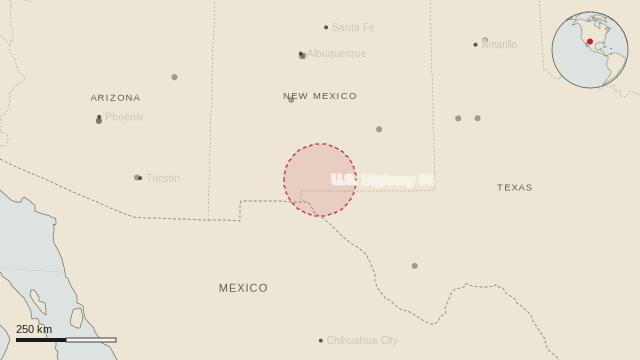
1957·U.S. Highway 54, south of Orogrande, New Mexico
United States.Orogrande · a driver says a passing object burned him
On November 4, 1957, James Stokes, an employee of the missile development center at Holloman Air Force Base, told an Alamogordo, New Mexico, radio station that on U.S. Highway 54 his car radio and engine died while an egg-shaped object passed over the road, and that its heat gave him a sunburn. He was the only witness who could be traced. According to a November 10 message from ATIC, the Air Force office that analyzed these reports, the hospital found no burns on him, his witnesses could not be found, and investigators rated him unreliable.
Tier B · IndicativeWhat do they mean? →
Limited evidence: it falls short of what Tier A requires. Any one of these is enough: a single testimony (or several witnesses who saw it together), testimony gathered years later, or an account without contemporary primary documentation.
What it was
72%optical phenomenon
The most likely explanation.
- 72% optical phenomenon
- 5% other earthly causes
- 23% no known cause
See the split across the six explanations
Earthly origin (human or natural)77%
No known cause23%
Ordinary cause the sources propose: optical
Record of the event
DOW-UAP-D194 — Air intelligence report on James Stokes's sighting
Report AISS-UFOB-438-57 of the 1006th Air Intelligence Service Squadron, with the November 6, 1957, interview of James Stokes: his account as Air Force investigators took it down.
Read more
It is a six-page AF Form 112 dated November 12, prepared and signed by Lieutenant Colonel William P. Brunson, with Captain Patrick O. Shere as investigator and an evaluation of "E-3." Part one gives the witness's details and reliability and his description of the sighting (pp. 2 and 3) and a memory sketch with the highway, the six cars and the object's two passes (p. 4); part two, the checks with Holloman and the El Paso Weather Bureau (p. 5); and part three, the officer's conclusion, a possible optical phenomenon (p. 6). It is preceded by both sides of the intelligence archive's distribution control record, stamped as received on November 18, 1957, and followed by two archive code sheets; in the 10-page PDF, the sketch ended up on page 8. Grayscale copy at 130 ppi.
U.S. Air Force, 1006th Air Intelligence Service Squadron (PURSUE Release 08) · Public domain · US Government work · open original
What happened
At about 1:10 p.m. on Monday, November 4, 1957, according to the military report on the case, James Stokes was driving on U.S. Highway 54, which crosses the desert of southern New Mexico from Alamogordo to El Paso, Texas, by way of the small town of Orogrande. He worked at the Air Force Missile Development Center at Holloman Air Force Base, next to Alamogordo. The press called him an electronics engineer on an upper-air research project. That report describes him as an electronics technician in the rocketsonde branch, with two years of college and a private pilot's license, and as a retired Navy chief petty officer with 24 years of service. His age changes with the source: 42 in the United Press dispatch, 45 in another clipping and 46 in that report.
Stokes gave his account in a taped interview for Terry Clark, news director of radio station KALG in Alamogordo, and United Press summarized it the next day. The dispatch placed the event on U.S. 54 near Alamogordo, between the White Sands Proving Ground and the missile center.
The first odd thing, he said, was that his car radio gradually faded. Then the engine died, and he saw that other cars had stopped too and that their occupants were getting out and pointing at the sky. "Looking up, I saw a light-colored, egg-shaped object making a shallow dive across the sky to the northeast," he said. According to the dispatch, the object approached from the northeast over the Sacramento Mountains; it wheeled, crossed the highway no more than two miles ahead and moved away to the southwest, toward the Organ Mountains. He added that it looked about 500 feet long, with a surface that shone like mother-of-pearl.
"As it passed at its closest point I could feel a kind of heat wave, but there was no sound," he said. He saw no portholes, trail, smoke or flame. Stokes had gotten out of his car, and when he got back to it the battery was steaming, but the engine started with no trouble and he looked for a phone to notify the missile center. He said he remembered the details because he had written them in a notebook, and that after he got home he noticed a severe sunburn. The United Press dispatch spoke of ten stopped cars, and a wire-service teletype of the same day of ten motorists besides Stokes.
That teletype, from November 5, says that Lieutenant Colonel John McCurdy, public information officer of the missile center, questioned Stokes at length, said he was "personally satisfied" with his story and announced a thorough medical examination and a radiation test. In this version, Stokes placed the object about two miles away and 3,000 to 5,000 feet up, and said: "I believe the object or phenomena was controlled by an intelligence." McCurdy added that the Air Force was looking for the other motorists and that Major General Leighton I. Davis, the center's commander, had appointed a coordinator to investigate that week's reports.
On November 8, the Air Technical Intelligence Center (ATIC) sent Air Force intelligence headquarters in Washington an eight-part message on the cases filling the press, among them Levelland ↗ Levelland, Kearney ↗ Kearney and the sightings around the White Sands Proving Ground ↗ White Sands. Part four said that Stokes, who had told an Alamogordo radio station about a sunburn caused by the heat of an object that passed near him, had been taken to the hospital for observation.
On the 10th, a second ATIC message added that the hospital found no burns on him, that Stokes, under examination, admitted that he had had radio fade-outs in that area before, and that the witnesses whose names he said he had written down could not be found "after diligent search." It ended: "Stokes evaluated as unreliable by AF investigators."
The message does not say who those investigators were. In the field, the case was investigated by the 1006th Air Intelligence Service Squadron (AISS), based at Ent Air Force Base, Colorado. Captain Patrick O. Shere interviewed Stokes on November 6, and Lieutenant Colonel William P. Brunson, the squadron's operations officer, signed report AISS-UFOB-438-57 on the 12th. According to that report, the event took place eight to ten miles south of Orogrande. Stokes was driving alone toward El Paso at about 70 miles per hour, with the radio tuned to a station in that city. He said the station came in well, although the area had several dead spots.
In the report's version, the radio began to fade and at the same time the car slowed, "almost as though it were developing battery trouble." About six cars had pulled off the road, not ten as first reported, and their occupants were pointing at the sky. Stokes got out and saw the object to the northeast, toward the Sacramento Mountains, about 35 degrees above the horizon. It was lustrous, the color of mother-of-pearl with a faint purplish tinge, brighter than the gray sky but not as bright as a car headlight, and the size of a pea held at arm's length.
According to the report, the object came down from about 5,000 feet to between 1,500 and 2,500, passed three to five miles ahead of the first stopped car, turned west toward the San Andres Mountains and disappeared; about two minutes later it made the same pass slightly farther south. A sketch Stokes drew from memory shows the two passes, the highway and the six cars. The day was gray, with scattered clouds and a high layer of cloud covering most of the sky, but Stokes said he watched the object for three or four minutes in all, and he later put its speed at 1,500 to 2,000 miles per hour.
On the sunburn, the report says that the medical examination found no trace of one and that Stokes "later admitted that he had been in error on this point." Stokes discussed the object with two motorists, one of whom took notes while the other, according to him, took photographs; he wrote down their names but not their license numbers, and they could not be traced or further identified. No one else reported the sighting. Holloman's flight service center had no unidentified aircraft in the area, and the Weather Bureau in El Paso said conditions did not favor ball lightning.
The investigator did not trust the witness. According to the report, despite his schooling and his GS-11 federal civil service grade, Stokes "does not give the impression of being a reliable or careful observer," and he later contradicted himself in part. By the time the captain could see him, he had talked to several reporters and taped the radio interview, and he did not seem to mind the publicity. He had called himself an engineer to the press, though he was a technician. He said he had hesitated over whether to report the sighting and had asked his chief, who saw nothing wrong with it; even so, he showed no doubt about what he had seen. The squadron gave the report an evaluation of "E-3": unreliable source, information possibly true.
The officer who prepared the report concluded that Stokes "possibly witnessed an optical phenomenon." The object did not resemble an aircraft, a balloon, a meteor, a star or a planet, and its speed ruled out ball lightning. Its shape, the lack of trail and sound and its speed fit an optical illusion. He added that at the estimated speed Stokes could not have watched it as long as he said, and that mirages are not unusual over that flat, white, sandy terrain.
Where it happened
Why it matters
Between the press version and the military report, the number of cars changes, and so do the object's distance, altitude and heading, and even the place: the press put it near Alamogordo, the report south of Orogrande, much closer to El Paso. The Air Force changed its mind too: in five days it went from a press officer satisfied with the story to investigators who rated him unreliable.
ATIC handled the case in the same messages as Levelland, where several drivers said their engines stopped, and Kearney, Nebraska ↗ Kearney, where a grain buyer said he had seen a craft on the ground and a farmer's truck stalled nearby; the mechanic who repaired the truck blamed a broken piece of an ignition part that had stayed wedged inside. In Stokes's case, his admission of earlier radio fade-outs in the area gives a local cause for the radio, but there is no known documented explanation for the dead engine or the steaming battery, two details that rest only on his word.
The cause the squadron proposed, an optical phenomenon or mirage, is weak. The officer did not say what might have been reflected or from where, and one of his arguments, that at that speed Stokes could not have followed the object for several minutes, counts against the reliability of the account more than for a mirage. There is no known alternative cause proposed at the time, and the other witnesses, the only way to check Stokes's story, were never found.
The U.S. Department of War (the name the Department of Defense has used since 2025) released the report in 2026 through PURSUE, its program for publishing records on anomalous phenomena, together with other 1006th AISS reports on the wave of November 1957. The ATIC messages and the press clippings on Stokes are filed in Blue Book, the Air Force program that collected these reports, inside the files of other cases from those days.
Documents and sources
Primary documents
ATIC message of November 10, 1957, on the Stokes case
The message in which the Air Technical Intelligence Center (ATIC) told Air Force intelligence headquarters in Washington what had been found out about James Stokes: the hospital found no burns on him, he admitted he had had radio fade-outs in that area before, the witnesses he said he had written down could not be found, and investigators rated him unreliable.
Read more
It is the first of the message's two pages (DD Form 173, dated November 10, 1957), which adds to an eight-part message of November 8; on the same page, ATIC explains a truck engine that stopped in the Kearney case. It carries later handwritten notes. It is page 18 of the 31-page Blue Book file on White Sands, where it was filed because it also covers that case.
Project Blue Book, file 1957-11-7228923 (archive.org) · Public domain · US Government work · open original
Documented evidence
- ATIC message of November 8, 1957, in eight parts, to Air Force intelligence headquarters (Blue Book file 1957-11-7228923, pp. 20, 22 and 24): part IV says that Major General Leighton Davis set up a committee to look into the sightings in the White Sands area and that James Stokes, an engineer with the missile development center, who told an Alamogordo radio station about a sunburn from the heat of an object, was taken to the hospital for observation.
- ATIC message of November 10, 1957 (same file, p. 18): "Hospital examination reveals no burns on Stokes"; during the examination he admitted earlier radio fade-outs in that area; the witnesses he said he had written down could not be found, and "Stokes evaluated as unreliable by AF investigators."
- United Press dispatch datelined Alamogordo, November 5, 1957, in The Washington Daily News of that day and in another clipping with a handwritten date (file 1957-11-7229338, pp. 31 and 25): taped interview for Terry Clark of KALG; fading radio, dead engine, light-colored egg-shaped object about 500 feet long, heat wave with no sound, steaming battery and a severe sunburn noticed at home; age 42; several cars stopped in the Daily News and ten in the other clipping.
- Unsigned wire-service teletype of November 5, 1957 (same file, p. 33): McCurdy "personally satisfied" with the story, medical examination and radiation test announced; object about two miles away and 3,000 to 5,000 feet up; Stokes and ten other motorists stopped; the Air Force looking for the other motorists; Stokes says he and other scientists at the center have their own theory about the object, which he will not discuss, and that it has nothing to do with missile work. The name is blacked out at the start of the text and appears unredacted further down.
- Other clippings from the time: the one in file 1957-11-7232817 (p. 14) quotes the heat wave "like radiation from a giant sun lamp"; the one in file 1957-11-7230046 (p. 64) gives Stokes's age as 42 and reports the announced medical examination.
Show 2 more facts
- Report AISS-UFOB-438-57 of the 1006th AISS, dated November 12, 1957 (DOW-UAP-D194, report pp. 1–4): information of November 4 collected on the 6th by Captain Patrick O. Shere; event at 042010Z (20:10 GMT), eight to ten miles south of Orogrande, on U.S. 54; about six cars pulled off, "originally reported as ten"; two passes, from about 5,000 down to 1,500–2,500 feet, toward the San Andres Mountains; a sharply outlined, solid object that, Stokes said, did not flicker or change shape; three or four minutes; 1,500 to 2,000 miles per hour; Stokes's memory sketch (p. 4).
- Same report, pp. 1, 2, 3, 5 and 6: Stokes "does not give the impression of being a reliable or careful observer" and admitted he was wrong about the sunburn; evaluation "E-3"; two motorists not traced and no other report; no unidentified aircraft according to Holloman; weather not conducive to ball lightning according to El Paso; at 1:00 p.m. at Holloman, 62.2 degrees, scattered clouds at 1,400 feet and a broken high overcast at 2,500; conclusion of Lieutenant Colonel William P. Brunson, a possible optical phenomenon or mirage.
Sources
- war.gov/UFO — DOW-UAP-D194, "Air Intelligence Information Report, New Mexico, 1957" (PURSUE Release 08) — The 2026 release of a scan of report AISS-UFOB-438-57 by the 1006th AISS, six pages, the fourth a sketch by Stokes. There is no known copy in Blue Book. Pages cited are the report's own; in the 10-page PDF, the sketch is on page 8.
- Project Blue Book — file 1957-11-7228923, White Sands, New Mexico (archive.org) — Holds the ATIC messages of November 8 (pp. 20, 22 and 24, part IV) and November 10 (p. 18), which deal with the Stokes case alongside White Sands.
- Project Blue Book — file 1957-11-7229338, SE Off Florida Coast (archive.org) — Clippings of the United Press dispatch of November 5, 1957 (The Washington Daily News, p. 31, and another paper, p. 25) and a wire-service teletype of the same day with McCurdy's statements (p. 33).
- Project Blue Book — file 1957-11-7232817, Del Rosa, California (archive.org) — Clipping without masthead (p. 14) with Stokes's account and the quote "like radiation from a giant sun lamp."
- Project Blue Book — file 1957-11-7230046, Kearney, Nebraska (archive.org) — Clipping "Visitor to Saucer Is Former Convict" (p. 64), with McCurdy's statements on Stokes.
Related cases
Cases this case cites and cases with the same likely cause.
Cited in this case · Same country · Within 10 years
Levelland · drivers see a light as their engines stall
1957 · Tier A
Cited in this case · Same country · Within 10 years
Kearney · a grain buyer says he went aboard a landed ship
1957 · Tier A
Cited in this case · Same country · Within 10 years
White Sands · two military police patrols see bright lights
1957 · Tier A
Optical · Same country · Within 10 years
Washington · radar and pilots spot objects over the capital
1952 · Tier S