1958·Trindade Island
Brazil.Trindade Island
Dozens of people aboard the ship Almirante Saldanha said they saw a Saturn-shaped object off Trindade Island; Almiro Baraúna's photos were developed on board and they were published in the Rio press in February 1958. Project Blue Book, relying on US naval intelligence analysis, classified them as a hoax.
Tier A · AcceptableWhat do they mean? →
Institutional evidence: several identified independent witnesses, or contemporary official documentation, without an instrumental record to corroborate them.
What it was
53%natural or human cause
Most likely explanation: possible hoax
See the split across the six explanations
Natural or human cause
No known cause
Read the full reasoning
But the same sheet admits that "a detailed investigation was not undertaken" by the US Navy, and the naval attaché's report records that the executive officer "had formed the opinion that those on deck had seen it", and that the photographer developed the negatives alone, with an officer waiting outside.Primary documents
Project Blue Book · "hoax" record card and US Naval Intelligence report 39-58 (extract)
Seven pages of the Blue Book file "Trinidade Island" (NARA). The record card notes that the Brazilian Navy refused to make an official statement and that the Office of Naval Intelligence judged the photos a hoax; a later summary says the case is still carried as a "TRICK". Report 39-58 by the naval attaché in Rio, dated 11 March 1958, records the Navy Ministry statement of 24 February, that the commanding and executive officers had not seen the object, that the captain said his secretary had, and that the photographer developed the negatives alone while an officer waited outside. The attaché leans towards a publicity hoax.
Project Blue Book, expediente «16 Jan 58, Trinidade Island» (NARA), espejo en archive.org · pp. 1, 2, 10–14 · Public domain · US Government work · open original
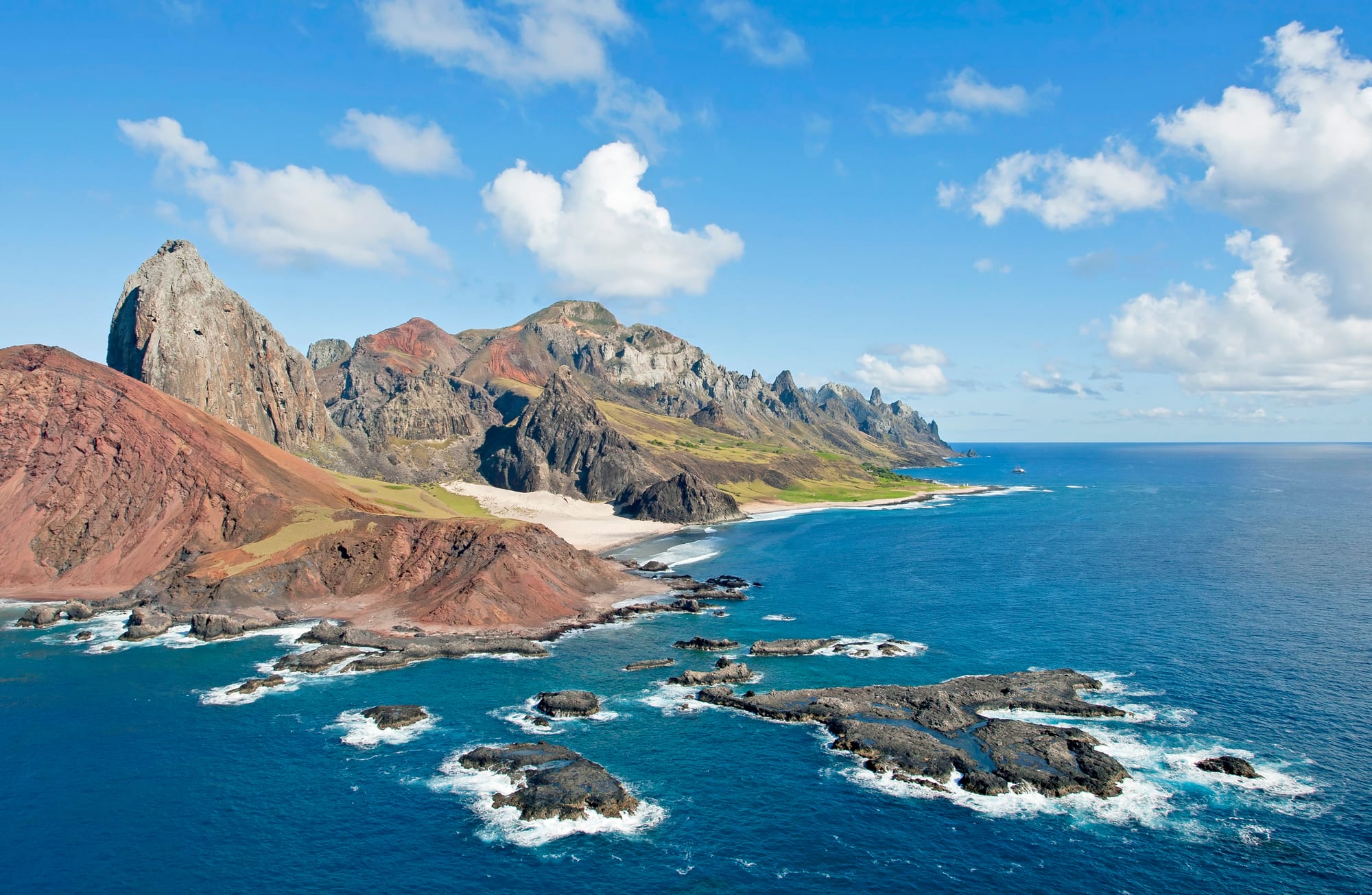
Context · Trindade Island (Brazil), where the training ship photographed the object
Simone Marinho - Trindade - 2010 05 08 edited.jpg · Wikimedia Commons · CC BY-SA 3.0 · open original
The night in question
On January 16, 1958, the Brazilian Navy training ship Almirante Saldanha was anchored off Trindade Island, an uninhabited volcanic islet about 1,200 km off the coast of Espírito Santo, where an oceanographic station had been set up for the International Geophysical Year (1957-1958). Aboard were officers, sailors and a group of civilians attached to the scientific work. Around midday, several dozen people on deck (the figures cited across sources range from roughly 40 to about a hundred) watched a Saturn-shaped object (a central body ringed by a perimeter band) approach the island, pass behind the Desejado peak, reappear and withdraw over the horizon on a trajectory described as fast and undulating. The sighting lasted under a minute.
The civilian photographer Almiro Baraúna, hired to document the operations, managed to fire six exposures with his Rolleiflex 2.8E camera while others pointed the object out to him. Four of the frames showed a disc-shaped silhouette sharp enough to be reproduced in the press. The negatives were developed on board shortly after the incident, but not in anyone's sight: a March 1958 report by the US Naval Attaché in Rio records that the photographer 'was accompanied to the dark room by an officer who waited outside the door' while he developed the negatives alone. Development on the ship, with no access to an external lab, narrows the room for later manipulation, but no one witnessed the process. The Navy's Aerial Reconnaissance Laboratory examined the plates and judged them consistent with a real event. The Navy sent proofs of the negatives to the other armed forces and to President Juscelino Kubitschek, who according to the press became convinced the event was real; the images appeared in the Rio press in February 1958, and the Ministry of the Navy issued a note acknowledging the episode.
The photographs have been re-analyzed for decades. Project Blue Book did not leave it unexplained: its record card closes it as a hoax. The Brazilian Navy refused to make an official statement to the Air Force, the US Office of Naval Intelligence concluded the photos were a hoax, and a later summary in the file explains why: the disc has little contrast and casts no shadow against a very sharp landscape; it appears inverted in one photo relative to the others; it shows none of the lateral blur the described speed would produce; the photographer was an expert in trick photography; and, according to that summary, no sailor reported seeing it, only two friends of Baraúna. 'This sighting is still carried as a TRICK in Air Force files.' That claim about the witnesses does not square with the file itself: the naval attaché's report notes that the commanding officer, Captain José Santos Saldanha da Gama, had not seen the object and was noncommittal, but said his secretary, an officer, had (though he avoided the subject when questioned), and that the executive officer, who had not seen it either because he arrived on deck shortly afterward, 'had formed the opinion that those on deck had seen it'; and the Navy Ministry's statement of February 24 says the photos were taken 'in the presence of a large number of the crew', while adding that they 'do not constitute sufficient proof' to pronounce on the object. The version of dozens of witnesses, to be sure, was never documented in a signed record. The attaché's hoax verdict, for its part, came with the admission that 'a detailed investigation was not undertaken', and with openly prejudiced reasoning: he found the staging hypothesis most likely 'considering Brazilians' love for sensationalism and gossip'. On the other side, a 1978 digital analysis by an independent laboratory found no manipulation. The controversy, however, never closed: Baraúna had a reputation as an expert in photo-montage (he had previously published faked images as a journalistic demonstration) the witnesses signed no unified record, and the documentary chain of custody is weaker than the official narrative suggests. In 2010 a Brazilian television program aired claims that the photographer had admitted a staging, a version his defenders dispute as decontextualized. The balance is that no analysis has demonstrated manipulation, but the official US assessment was a hoax and the forensic traceability that would settle the debate does not exist.
Why it matters
Trindade pairs the image with formal institutional backing: a Brazilian Navy investigation, proofs of the negatives sent to the President, and a Ministry of the Navy note. The US Air Force and naval intelligence called it a hoax.
The case also illustrates the epistemic asymmetry of pre-forensic photography: structured morphology (body plus ring), multiple witnesses on deck and development on board pull toward a non-conventional reading; but a single photographer with trick-photography skills, who developed alone in the darkroom, no originally auditable negatives today, and scattered testimony keep the staging hypothesis open. Strong institutional backing is not the same as forensic verification, and the two must not be conflated.
What's left on paper
Documented evidence
- Six original Baraúna exposures (Rolleiflex 2.8E) developed on board by the photographer himself, alone in the darkroom while an officer waited outside (US Naval Attaché report, March 1958)
- Dozens of witnesses on deck according to the Brazilian version (figures vary between about 40 and a hundred); the Air Force held that only two friends of the photographer reported seeing it, but the naval attaché's report records that the captain said his secretary saw it and that the executive officer believed those on deck had seen it
- Official Ministry of the Navy communiqué (February 24, 1958): photos taken 'in the presence of a large number of the crew', but which 'do not constitute sufficient proof'
- Proofs of the negatives sent to President Kubitschek, who according to the press became convinced the event was real
- Project Blue Book record card: 'Other: Hoax,' with the US Office of Naval Intelligence analysis
Sources
- Project Blue Book, expediente «Trinidade Island», 16 de enero de 1958 (archive.org) — Record card ('Other: Hoax'), the Office of Naval Intelligence analysis and Brazilian press clippings
- Marinha do Brasil — Comunicado oficial Trindade (1958) — Published in O Globo
Referenced by 1 case
Related cases
same explanation · same country · same period
Antônio Vilas-Boas
1957 · Tier B
same explanation · same country · same period
Fort Itaipu · burned sentries
1957 · Tier B
same explanation · same country · same period
Conde, Bahia · the manned sphere no one on the ground ever saw
1963 · Tier B
same explanation · same country · same period
Barra da Tijuca · the hoax the Air Force endorsed
1952 · Tier A