1957·Weather observatory south of Cajamarca, Peru
Peru.Sunchubamba · a weather observer tracks a bright daytime dot
Between October 26 and November 8, 1957, around midday, a weather observer at an observatory in the Andes south of Cajamarca, Peru, saw a white, steel-gleaming object several times, first alongside people from the Sunchubamba hacienda. On November 7 and 8 he followed it with a Zeiss recording theodolite for 124 and 94 minutes and logged its direction and height in tables, often minute by minute on the first day. The U.S. air attaché's office in Lima sent his tables to Washington, and in 1958 the Air Force concluded that they matched the position of the planet Venus.
Tier A · AcceptableWhat do they mean? →
Institutional evidence: several identified independent witnesses, or contemporary official documentation, without an instrumental record to corroborate them.
What it was
94%planet or star
The most likely explanation.
- 94% planet or star
- 2% other earthly causes
- 4% no known cause
See the split across the six explanations
Earthly origin (human or natural)96%
No known cause4%
Ordinary cause the sources propose: planet or star
Record of the event
Report IR-364-57 from the air attaché's office in Lima, with the theodolite tables (November 29, 1957)
The intelligence report that Lieutenant Colonel Vergil N. Nestor, the U.S. air attaché in Lima, signed on November 29, 1957, with an extract from the report that weather observer John F. Withrow dated November 8: his sightings of October 26, 28 and 29 and the theodolite tables for November 7 and 8, with Lima time and GMT, azimuth, elevation, visibility and cloud cover for each reading.
Read more
It is the copy that Air Force intelligence headquarters in Washington received on December 4, 1957, and that the Department of War released in 2026 in the eighth PURSUE batch as DOW-UAP-D202. It runs to six pages: headquarters' distribution control record, with the date of receipt and the list of copies (among them to the CIA, the Navy, the Army and the NSA), and a reproduction form; the report's cover sheet (form AF 112, p. 3), with the source ("U.S. Naval Attache") and the C-3 evaluation; and the three sheets of the extract (pp. 4 to 6). The names are not blacked out: Withrow's, that of the Sunchubamba hacienda's administrator, Rudolf Hildebrand, that of his wife, who phoned on November 7, and those of Mr. and Mrs. Raven. It does not carry the handwritten notes of the Blue Book copy.
U.S. Department of War, DOW-UAP-D202 (PURSUE Release 08) · Public domain · US Government work · open original
What happened
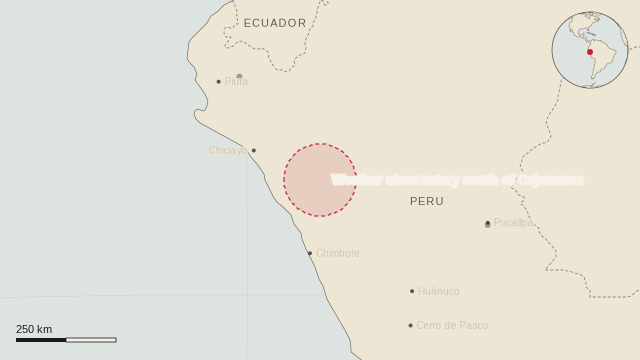
In late October 1957, the Compañía Peruana de Servicios Meteorológicos, a Peruvian weather service company, ran an observatory on the continental divide of the Andes, about 35 miles (56 km) south of the city of Cajamarca in northern Peru, at an altitude of 3,750 meters. One of its observers, John F. Withrow, later wrote a report, dated November 8, which is the source of almost everything known about the case. He wrote that on October 26, around noon, while he was staying by Sunchubamba lake, the administrator of the Sunchubamba hacienda, Rudolf Hildebrand, pointed out to him an object in the sky that was "white-steel-gleaming." Mrs. Hildebrand and Mr. and Mrs. Raven were also watching it. It stayed in view for more than 15 minutes and could easily be seen without binoculars.
On October 28 he saw it again at 12:39 p.m. Lima time, from the observatory's pilot balloon stand, where small balloons are released to measure the wind aloft. He measured it with the observatory's Zeiss recording theodolite, a telescope mounted on two graduated circles that gives an object's direction (the azimuth, in degrees from north) and its height above the horizon. He placed it to the east-southeast, 44° above the horizon. He added, however, that he could not identify its direction exactly, without saying whether he meant the point in the sky where it was or the course it was taking.
At the same moment he measured the Moon, and that measurement confirms the time he wrote down: by a calculation made for this case from the observatory's coordinates, at 12:39 p.m. Lima time the Moon stood almost where he placed it, only about 3° lower. The report converts that time to GMT with an extra hour (1839 instead of 1739, since Lima is five hours behind).
On October 29 he saw it twice, at 12:51 and 1:39 p.m., higher up, between 65° and 71° above the horizon, and the second time he noted that it was moving slowly toward about 300° to 310°, to the northwest. The first time he wrote that its direction could not be identified exactly, and he added that visibility had been poor on all those days.
On November 7 Mrs. Hildebrand phoned him from the hacienda to tell him that the same gleaming object was in view and to give him its approximate position. This time he followed it continuously with the same theodolite, which marks each reading on a disk and stood fixed and leveled on a concrete base. He logged its direction and height 48 times, often minute by minute, from 12:43 to 2:47 p.m. Lima time: the object climbed from about 49° to 69° above the horizon while its direction swung from the southeast toward the south-southeast. Clouds covered between four and seven eighths of the sky, and at times he saw it shining through them. He stopped because of fog, after 124 minutes.
On November 8, the day he dated the report, he measured it again, with 10 readings, from 12:52 to 2:26 p.m., for 94 minutes, until clouds and fog ended the observation. On both days the object followed almost the same path at the same time: at 1:10 p.m., for example, the table gives the same direction and the same height on each day. The totals the observer wrote at the foot of each table do not quite match his own readings: the swing in direction he records is about 2° smaller than the first and last readings give on the 7th, and about 5° smaller on the 8th.
Meanwhile the U.S. air attaché's office in Lima was collecting other reports. On November 14, Captain Harry W. Deffebach, the assistant air attaché, signed an intelligence report covering two of them. One was a telegram from the Inspector of Indian Affairs in Andahuaylas, in the south of the country, about a luminous aqua-colored sphere that fell giving off sparks on the evening of October 28; Project Blue Book, the Air Force office that studied such reports, filed it separately as a probable meteor.
The other report came from Homer Hungerford, an American working for the mining company Incanadium S.A.: on November 11 and 12, as a guest at Rudolph Hildebrandt's hacienda in Sunchubamba (Withrow spells the name Rudolf Hildebrand), he saw an object that hazily looked like a balloon, too high to identify, which he said was visible 24 hours a day, shone very brightly at night and could not be a star because it was much too low.
Deffebach's report adds that a German named Alberto Schnell, who ran a weather station in the mountains between Cajamarca and Sunchubamba, had tracked the object for two weeks "between 75° and 77° latitude," a figure the report does not explain and that does not fit the theodolite tables, whose elevations never exceed 69.3°. According to Deffebach, the object had also been seen by Guillermo Dobbertin, from a hacienda in Cajamarca, and by Echevarría, manager of the Porcón hacienda. Deffebach added that since the launches of the Soviet satellites Sputnik I and II there had been a rash of sightings in Peru.
On November 29, Lieutenant Colonel Vergil N. Nestor, the air attaché in Lima, sent Washington a second report with an extract from the observer's report, which the U.S. naval attaché had passed to him. Its summary speaks of a qualified weather observer who followed the object with the Zeiss recording theodolite and dates the observations to October 26, 28 and 29 and November 8; it does not mention the 7th, the day of the longest table. The extract names its author, Withrow, who tells of the observations in the first person; Deffebach had credited the tracking to Alberto Schnell. In the Blue Book copy that name is blacked out. Air Force intelligence headquarters in Washington received the report on December 4.
On April 1, 1958, a handwritten memo for the case file, signed by Air Science Division personnel who had reviewed the case and plotted the positions, concluded that they were "the almost exact position of the Planet Venus for the times given." It added that seeing Venus by day is rare, but that the observer's instruments made it possible, and that the planet was so brilliant during those months that newspapers and astronomy journals were commenting on it. The memo and the case card date the event to October 26, 28 and 29, and the memo's example gets the day wrong: the movement of 35.8° in two hours and five minutes that it assigns to the 29th comes, by its figures, from the November 7 table. Hungerford's report has its own card, which also attributes it to Venus while noting that it gave no azimuth.
Where it happened
Why it matters
The theodolite tables make it possible to check the Air Force's explanation against other sources. A calculation made for this case used ephemerides from the Horizons system of NASA's Jet Propulsion Laboratory (JPL) and from the PyEphem library, for the observatory's coordinates. Across the 58 readings in the two November tables, the measured object and Venus stay within 1.1° of each other, about twice the apparent size of the Moon, and move together for more than two hours. The planet was then brighter than any star and near its greatest apparent distance from the Sun, almost 47°, so by day it stood high in the sky, away from the Sun's glare.
The October readings fit less well: all three fall between 8° and 13° from the position of Venus. The observer wrote that visibility had been poor on those days, and twice that he could not identify the object's direction exactly. Nor does Hungerford's account of an object visible 24 hours a day, as Deffebach's report tells it, fit Venus, since the planet set a little over three hours after the Sun. Whoever reviewed his report at Blue Book wrote by hand, at the foot of the report and in partly illegible writing, that the 24 hours did not hold up unless the observer had stayed awake for that purpose, and that there was very little data.
The case shows how a planet can pass for an unknown object in front of trained people. Venus by day is hard to find, but once located it is visible to the naked eye as a fixed white dot, and someone who does not know it can be seen at noon has no reason to think of it. The observer measured carefully, logged the exact time of each reading and measured the Moon as well. Those same times are what made it possible to identify the object.
In 2026, the U.S. Department of War (the name the Department of Defense has used since 2025) released both reports from the attaché's office in the eighth batch of PURSUE, its program for publishing files on anomalous phenomena, as DOW-UAP-D200 and DOW-UAP-D202, under the title "Air Intelligence Information Report, Peru, 1957." The Venus conclusion, the memo and the cards are in the case's Blue Book files, which are preserved on archive.org.
Documents and sources
Primary documents
Project Blue Book copy of report IR-364-57, with the reviewers' notes (1957)
The copy of report IR-364-57 kept in Project Blue Book file 1957-10-7227942, with handwritten notes by those who reviewed it that the Washington copy lacks, among them one about the cloud cover and the sum "2:04 minutes in sight" next to the November 7 table. It runs to four pages: the report's cover sheet (form AF 112), with a December 23, 1957 receipt stamp, and the three sheets of the extract. In this copy the names of the people are blacked out.
Project Blue Book, file 1957-10-7227942 (archive.org) · Public domain · US Government work · open original
DOW-UAP-D200 — Report IR-350-57 from the air attaché's office in Lima: Andahuaylas and Sunchubamba (November 14, 1957)
The intelligence report that Captain Harry W. Deffebach, the U.S. assistant air attaché in Lima, signed on November 14, 1957, with the approval of Lieutenant Colonel Vergil N. Nestor, on two reports of objects in Peru.
Read more
The first is a telegram from the Inspector of Indian Affairs in Andahuaylas about a luminous sphere that fell on the evening of October 28. The second is the account of Homer Hungerford, an American working for the mining company Incanadium S.A., of the object he saw on November 11 and 12 at Rudolph Hildebrandt's hacienda in Sunchubamba; the report adds that Alberto Schnell tracked it for two weeks from a weather station and that Guillermo Dobbertin and Echevarría, manager of the Porcón hacienda, also saw it. It runs to three pages: the document's distribution record, its back, and the report, with the source ("Personal contacts") and the F-6 evaluation.
U.S. Department of War — PURSUE, Release 08 (DOW-UAP-D200) · Public domain · US Government work · open original
Documented evidence
- Report IR-364-57 from the U.S. air attaché's office in Lima (form AF 112), signed by Lieutenant Colonel Vergil N. Nestor on November 29, 1957: source "U.S. Naval Attache," date of information "November 1957," evaluation C-3, reference to IR-350-57; the distribution control record of Air Force intelligence headquarters gives December 4, 1957 as the date of receipt, and the Blue Book copy bears a receipt stamp of December 23. Its summary dates the observations to October 26, 28 and 29 and November 8.
- Extract from the observer's report, dated November 8, 1957: observatory of the Compañía Peruana de Servicios Meteorológicos S.A. on the continental divide, about 35 miles south of Cajamarca, at 3,750 m, at 07°25'30" S and 78°20'30" W, coordinates that put it about 34 km (21 miles) south-southeast of Cajamarca rather than 35 miles. On October 26, around noon, a "white-steel-gleaming" object for more than 15 minutes; on the 28th, at 12:39 p.m. Lima time (written "1839 GMT"), azimuth 116° and elevation 44°, with the Moon at 106.3° and 30.2°; on the 29th, at 12:51 p.m. at 119° and 65.6°, and at 1:39 p.m. at 118.5° and 71°.
- Table for November 7, 1957 (Zeiss recording theodolite): 48 readings from 12:43 to 2:47 p.m. Lima time (1743 to 1947 GMT), with azimuth from 123.2° to 159° and elevation from 48.6° to a maximum of 69.3°; cloud cover of 4 to 7 eighths; "increasing fog, observation finished." Stated total: 124 minutes, "21,2° elevation and 33,8° Azimuth angle."
- Table for November 8, 1957: 10 readings from 12:52 to 2:26 p.m. Lima time, with azimuth from 124.3° to 148.4° and elevation from 50° to 67.2°; it ends with "increasing clouds and fog, observation finished." Stated total: 94 minutes, "19,2° Az. and 17,2° Elevation."
- Report IR-350-57 by Captain Harry W. Deffebach, November 14, 1957, approved by Nestor (source "Personal contacts," evaluation F-6): an October 29 telegram from Andahuaylas about an aqua-colored sphere at 6:05 p.m. on the 28th; Homer Hungerford's account of November 11 and 12 at Sunchubamba (placed on the aeronautical chart at 7°46' S and 78°39' W); a two-week tracking attributed to Alberto Schnell; witnesses Guillermo Dobbertin and Echevarría.
Show 3 more facts
- Handwritten memo for the Blue Book case file, April 1, 1958: positions reviewed and plotted by Air Science Division personnel; conclusion "The plotted positions indicated that they were the almost exact position of the Planet Venus for the times given." The case card (October 26, 28 and 29, 12:00, 15 minutes) checks "Probably Astronomical" with "Venus."
- Blue Book card for Hungerford's report (Sudehobamba, November 11 and 12, 1957): "Was Astronomical: Venus," with the comment "No azimuth given; however, the object appears to be Venus." The card for the Andahuaylas telegram: probable meteor.
- Calculation made for this case with JPL Horizons and PyEphem for 07°25'30" S, 78°20'30" W and 3,750 m: across the 58 readings of November 7 and 8, the separation between the object in the table and Venus never exceeds 1.1° (mean 0.55°); Venus, at magnitude −4.4, was about 47° from the Sun. The three October readings fall 7.7°, 13.3° and 11.1° from the planet. The Moon measured on October 28 (106.3° and 30.2°) lies 3.2° from its position at 1739 GMT (106.2° and 27.0°) and 10.8° from its position at 1839 GMT.
Sources
- war.gov/UFO — DOW-UAP-D202, "Air Intelligence Information Report, Peru, 1957" (PURSUE Release 08) — Report IR-364-57 from the air attaché's office in Lima, with the theodolite tables; this case's viewer embeds this copy and the copy of the same report kept in Blue Book file 1957-10-7227942.
- war.gov/UFO — DOW-UAP-D200, "Air Intelligence Information Report, Peru, 1957" (PURSUE Release 08) — Primary document, embedded in this case's viewer: report IR-350-57 with the Andahuaylas report and Hungerford's account from Sunchubamba.
- Project Blue Book — file 1957-10-7227942, S of Caja Marca, Peru (archive.org) — Seven pages: the case card, report IR-364-57 with the theodolite tables and the names blacked out, the handwritten memo of April 1, 1958 with the Venus conclusion, and an article by James Stokley, "Venus Most Prominent," on the brightness of Venus in November 1957.
- Project Blue Book — file 1957-11-6782691, Sudehobamba, Peru (archive.org) — Card for Hungerford's report, with the conclusion "Was Astronomical: Venus," and the second sheet of report IR-350-57 with the names blacked out and handwritten notes ("Possibly ASTRO").
- Project Blue Book — file 1957-10-7228351, Andahuaylas, Peru (archive.org) — Card for the Andahuaylas sighting of October 28, 1957, with the conclusion of a probable meteor, and the first sheet of report IR-350-57, with the handwritten note "INSUF DATA TO EVALUATE."
- JPL Horizons (NASA) — Venus ephemerides (body 299) for 78.3417° W, 7.425° S and 3.75 km, November 7, 1957 — Airless azimuth and elevation of Venus at 1743, 1845 and 1947 GMT: 122.8° and 49.1°; 134.7° and 61.2°; 161.7° and 69.6°, at magnitude −4.4. The calculation for all 58 readings and for the Moon on October 28 was repeated with PyEphem 4.2 for the same coordinates.
Related cases
Cases with the same likely cause.
Planet or star · Within 10 years
Father Gill · dozens of witnesses see figures on a disc
1959 · Tier B
Planet or star · Within 10 years
Redmond · two men watch a light and seven fighters take off
1959 · Tier A
Planet or star · Within 10 years
Kimpo · five airmen watch a bright light hang in the dawn sky
1954 · Tier A
Planet or star · Within 10 years
Ellsworth · two fighters go after a light tracked on radar
1953 · Tier S