1957·White Sands Proving Ground (Stallion Site area), New Mexico
United States.White Sands · two military police patrols see bright lights
On Sunday, November 3, 1957, a few hours after the Levelland sightings in Texas, two military police patrols saw lights on the White Sands missile range in New Mexico. At about 2:30 a.m., Cpl. Glenn H. Toy and Pfc. James E. Wilbanks saw a very bright object come down to the ground and go out; at about 8:00 p.m., Henry R. Barlow and Forest R. Oakes saw a light rise from the ground and watched it for about 25 minutes. The Air Force concluded they were the setting Moon and Venus, but by a calculation made for this case, Venus had already set by 8:00 p.m.
Tier A · AcceptableWhat do they mean? →
Institutional evidence: several identified independent witnesses, or contemporary official documentation, without an instrumental record to corroborate them.
What it was
68%moon
The most likely explanation.
- 68% moon
- 7% other earthly causes
- 25% no known cause
See the split across the six explanations
Earthly origin (human or natural)75%
No known cause25%
Ordinary cause the sources propose: moon
What happened
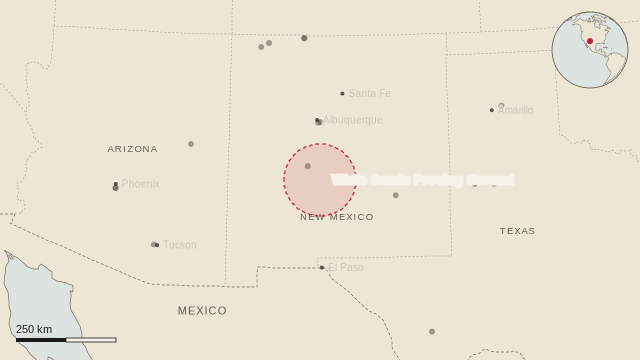
White Sands Proving Ground was the U.S. Army's missile test range in southern New Mexico. Both sightings took place in its northern part, around the Stallion Site camp, about 90 miles (145 km) north of the range headquarters and near the Trinity site, where the first atomic bomb was tested in 1945. The four witnesses were military policemen from the Army garrison detachment (Det 5) who patrolled the range by jeep. It was Sunday, November 3, 1957, a few hours after several drivers in Levelland, Texas, reported a light that stalled their engines (↗ Levelland).
The first patrol was made up of Cpl. Glenn H. Toy, 21, and Pfc. James E. Wilbanks. According to the account later taken down by the Air Force investigator, at about 2:30 a.m. Toy saw a "very bright" object high in the sky. It came down slowly to about 50 yards (some 45 m) above the ground, stayed still for about three minutes and then kept descending to the ground, where the light went out. Toy had it in sight for about ten minutes. Toy put it two or three miles away, egg-shaped and 75 to 100 yards across, and said it looked as big as a grapefruit held at arm's length. It was cold, drizzling and windy, and no stars were visible. The two drove on north to the Stallion Site camp and told the sergeant of the guard, who went out to the area and found nothing.
Both soldiers signed a sworn statement for their commanding officer. Toy's places the event "at about 0230-0300 Sunday morning," as they headed north toward a range entrance called the South Gate. The object stopped about 50 yards above the ground and went out; a few minutes later it turned "real bright (like the sun)," fell at an angle and went out again, and according to Toy it landed by the bunker area, about three miles away. Wilbanks was on a three-day pass and the investigator did not interview him. In his statement he wrote that at about 2:30 he saw a "fire like" object between the bunker area and the South Gate, 60 or 80 feet off the ground; it came down slowly, went out for a while, reappeared and came down at an angle of about 40 degrees. He put it about three miles away and about 120 feet across.
The second patrol saw its light that same Sunday, at about 8:00 p.m. They were Henry R. Barlow, 21, and Forest R. Oakes, 19, specialists third class (SP-3), driving west near the Trinity site. According to the investigator's account, the night was fairly bright, with some stars showing through scattered clouds, and the Moon was visible. At that moment both saw a bright light that climbed slowly to about 45 degrees above the horizon. It seemed to pulse and had the color of red-hot metal: red, then white. It never went behind the clouds, left no smoke and made no sound, and it kept climbing until it looked like a star and vanished. They watched it for about 25 minutes.
Barlow's and Oakes's sworn statements differ. Barlow wrote that, at their check of the Trinity site, they looked toward the West Impact area and saw a bright light leave the ground and rise slowly. They drove on to another post, Nip Site, and on the way the light grew brighter, dimmed, went out and brightened again; there they watched it for a few minutes until it disappeared, and they went to report to the sergeant of the guard. Oakes wrote that the light hung about 50 feet over a bunker, took off at a 45-degree angle and began blinking on and off, that it was "two or three hundred feet" long and about as wide, and that it was as bright "as the sun." He ended: "We were approximately four or five miles west of the light." The light, then, lay to their east.
The investigation was done by the Air Force's 1006th Air Intelligence Service Squadron, based at Ent Air Force Base, Colorado. Capt. Patrick O. Shere did the interviews, the cover gives November 6 as the date of collection, and Lt. Col. William P. Brunson signed report AISS-UFOB-389-57 on the 13th. Shere wrote that by the time he talked to Toy, Toy had already told his story several times to the press and to military personnel and had discussed it with the other patrol. He judged him sincere, but "quite ingenuous, naive and impressionable." He found Barlow and Oakes neither observant nor competent witnesses. A preliminary teletype from the squadron, dated November 9, added that all four had discussed what they saw among themselves and with reporters from a local newspaper before the formal investigation.
To identify the lights, the report records a check with Lincoln LaPaz, head of the meteoritics department at the University of New Mexico, which found that no unusual weather or astronomical events occurred in that period. Citing weather records, the report also noted that the Moon had set at 2:29 a.m. in the west and that at 8:00 p.m. Venus was shining 15 degrees up in the southwest. On that basis, Brunson concluded that the first patrol mistook the setting Moon for a flying object and that the second saw the planet Venus. Blue Book, the Air Force program that filed these reports, closed the case as astronomical, with "1. Moon" and "2. Venus," and its card commented that the report had been influenced by the famous Levelland case, which the press, radio and television had spread nationwide.
Where it happened
Why it matters
The explanation for the first patrol holds up. A calculation was made for this case with NASA Jet Propulsion Laboratory (JPL) DE421 ephemerides and the position of Stallion Site. By that calculation, at 2:30 a.m. the Moon stood about 4 degrees above the horizon, almost due west, 84% lit, and it set at about 2:50; the report gave 2:29 from "uninterpolated data," according to the teletype. The Blue Book card places the first light to the west, though no witness gives a direction in the report. A nearly full Moon sinking toward the horizon through broken clouds, disappearing and reappearing, fits what Toy and Wilbanks described. Against it, Toy first saw the light high in the sky, and Shere's account says the light was not blurred, while the card calls it fuzzy.
The explanation for the second patrol does not hold up. By the same calculation, Venus set at about 7:50 p.m., and at 8:00 it was about 2 degrees below the horizon. The 15 degrees of altitude given in the report match Venus at about 6:15 p.m., almost two hours earlier. At sunset, at 5:12 p.m., Venus stood about 22 degrees up and only sank from there, while the light Barlow and Oakes saw climbed to about 45. The direction does not fully fit either: the card puts the light toward the south-southwest, and Oakes wrote that they were west of the light.
The Air Technical Intelligence Center (ATIC), which coordinated these reports, summed up the case in a message to Washington on November 10: Venus in the direction of the first patrol's sighting and the Moon in that of the second. The message adds no check of its own: it repeats the squadron's preliminary teletype conclusion from the day before, with the two patrols swapped, and copies from the teletype even the brightness it gave Venus and the scattered clouds that went with the Moon. Nor does the Moon explain the second light. At 8:00 p.m. it stood about 55 degrees up in the southeast, and Shere's account lists it as visible at the moment the light appeared, a light both soldiers saw lift off the ground.
The rest of the case turns on the quality of the testimony, which the file itself calls into question. The two patrols talked to each other and to the press before the formal investigation, and in the interview the two soldiers of the second gave an account that Shere found identical, although their sworn statements differ. The preliminary teletype also shows that the astronomical check was hurried: it rules out Sirius as a cause, calling it a "planet" and dismissing it as faint, of third magnitude, when it is the brightest star in the night sky.
In the same messages, ATIC was briefing Washington on other cases in the wave: Levelland, and that of James Stokes, an engineer at the missile development center who told an Alamogordo radio station that an object had burned him as it passed; at the hospital no burns were found. The next day, two controllers saw another object over Kirtland Air Force Base in Albuquerque (↗ Kirtland).
In 2026, the U.S. Department of War (the name the Department of Defense has used since 2025) released the report in the eighth batch of PURSUE, its program for publishing files on anomalous phenomena, under the code DOW-UAP-D193 and the title "Air Intelligence Information Report, New Mexico, 1957." It is the same report that appears in the case's Blue Book file, with the same ATIC control number (1141959).
Documents and sources
Primary documents
Report AISS-UFOB-389-57 from the 1006th Air Intelligence Service Squadron on the two White Sands patrols, 1957
The air intelligence report (AF Form 112) that the 1006th Air Intelligence Service Squadron, at Ent Air Force Base, Colorado, wrote on the two White Sands sightings of November 3, 1957. It runs eight pages.
Read more
The first two are the distribution control record of Air Force intelligence headquarters in Washington, with the date of receipt and the list of copies, and a reproduction form. The report's cover (p. 3) gives November 3 as the date of information, November 6 as the date of collection and November 13 as the date of the report; it is signed by Lt. Col. William P. Brunson, operations officer, also on behalf of Col. John W. Meador, the squadron commander; it names Capt. Patrick O. Shere as investigator, rates the source "F-6," and sends the original to the Air Force intelligence chief with copies to ATIC and Air Defense Command. Part one holds the interview with Toy and the sworn statements of Toy and Wilbanks; part two, the interview and statements of Barlow and Oakes; part three, the check with Lincoln LaPaz and the data on Venus and moonset; part four, Brunson's conclusion (p. 8): the Moon for the first patrol and Venus for the second. It is the original sent to that headquarters, which logged it as received on November 18, 1957; the Department of War released it in 2026 in the eighth PURSUE batch as DOW-UAP-D193. The Blue Book file keeps a badly faded copy of the same report, a hand-annotated one, the case card, the preliminary teletype of November 9 and the ATIC messages of November 8 and 10.
U.S. Department of War, DOW-UAP-D193 (PURSUE Release 08) · Public domain · US Government work · open original
Documented evidence
- Report AISS-UFOB-389-57 from the 1006th Air Intelligence Service Squadron, dated November 13, 1957, and signed by Lt. Col. William P. Brunson: two military police patrols from the garrison's Detachment 5 saw an object on two occasions near the Stallion Site camp, about 90 miles north of White Sands headquarters; investigator, Capt. Patrick O. Shere; date of collection, November 6.
- Part one of the report: Cpl. Glenn H. Toy, 21, saw at about 2:30 a.m. (0930 GMT) a "very bright" object that came down to about 50 yards above the ground, hung still for about three minutes and descended until it went out on the ground; about ten minutes in view, two or three miles away, 75 to 100 yards across, egg-shaped; cold weather, with drizzle and wind and no stars visible. Pfc. James E. Wilbanks, on pass, left only a sworn statement: a "fire like" object at about 2:30, about three miles away and about 120 feet across.
- Part two: SP-3s Henry R. Barlow, 21, and Forest R. Oakes, 19, saw at about 8:00 p.m. (0300 GMT on the 4th), near the Trinity site, a light that climbed to about 45 degrees, red then white, blurred and without a distinct silhouette, for about 25 minutes; according to the investigator's account, the Moon was visible. Barlow stated that the light lifted off the ground in the West Impact area; Oakes, that it hung over a bunker and that they were "four or five miles west of the light."
- Part three: Lincoln LaPaz, of the University of New Mexico, found no unusual weather or astronomical events; according to "weather records," Venus at first magnitude at 2000 MST, 15 degrees up at azimuth 225 degrees; moonset on November 3 at 0229 MST, azimuth 270 degrees. Part four: the first patrol mistook the setting Moon for an object and the second saw Venus.
- Blue Book card (ATIC Form 329): conclusion "Was Astronomical," "1. Moon," "2. Venus," and the comment that the report was influenced by the Levelland case, which took place a few hours earlier and was spread by press, radio and television.
Show 3 more facts
- Preliminary teletype from the 1006th Squadron (November 9, 1957): all four discussed what they saw among themselves and with reporters from a local newspaper before the formal investigation; ages 17 to 21; during both sightings, "a few stars" visible through scattered clouds, although Toy said no stars were visible; Venus "probably" for the 2000 patrol and the Moon "probably" for the 0300 one, with reflections from scattered clouds; it rules out Sirius as a third-magnitude "planet."
- Message from the ATIC commander to Washington, November 10, 1957 (written by Capt. George T. Gregory): "astro plots" place Venus in the direction of the first patrol's sighting and the Moon in the general direction of the second, "with scattered clouds": the previous day's teletype conclusion, with the patrols numbered the other way around; the same message reports that the hospital found no burns on James Stokes and that investigators judged him unreliable.
- By a calculation made for this case with JPL DE421 ephemerides for 33.82° N, 106.65° W: at 2:30 a.m. MST on November 3, the Moon 4 degrees up at azimuth 268 degrees, 84% lit, setting at about 2:50; Venus set at about 7:50 p.m. MST and at 8:00 was 2 degrees below the horizon; 15 degrees up at azimuth 225 degrees matches Venus at about 6:15 p.m.; at 8:00 p.m., the Moon 55 degrees up at azimuth 144 degrees.
Sources
- Project Blue Book — file 1957-11-7228923, White Sands, New Mexico (archive.org) — A 31-page file: the case card, a printed page with an assessment of the two sightings (the file's index lists it as "Dr. Mensel's evaluation") that puts the first light down to the Moon, "then roughly half full" (84% lit, by a calculation made for this case), and the second "unquestionably" to Venus, a hand-annotated copy of report AISS-UFOB-389-57, a clean but badly faded one, a typed transcript without names, the preliminary teletype of November 9 and the ATIC messages of November 8 and 10.
- war.gov/UFO — DOW-UAP-D193, "Air Intelligence Information Report, New Mexico, 1957" (PURSUE Release 08) — Copy of the same report AISS-UFOB-389-57 released in 2026, with the same ATIC control number (1141959); it is the copy embedded in this case's viewer.
- JPL (NASA), DE421 planetary ephemerides, computed with Skyfield for 33.82° N, 106.65° W, November 3–4, 1957 — Altitude, azimuth, setting time and illumination of the Moon and Venus at the report's times (0930 GMT on November 3 and 0300 GMT on the 4th); a reproducible calculation with those coordinates, checked against PyEphem.
- AARO — Fiscal Year 2024 Consolidated Annual Report on Unidentified Anomalous Phenomena (November 2024), ODNI copy — Base rate used by the class basis: most cases AARO does not resolve stay open for lack of data (p. 13).
Referenced by 1 case
Related cases
Cases this case cites and cases with the same likely cause.
Cited in this case · Same country · Within 10 years
Levelland · drivers see a light as their engines stall
1957 · Tier A
Cited in this case · Same country · Within 10 years
Kirtland · two controllers watch an object cross the base
1957 · Tier A
Astronomical object · Same country · Within 10 years
Southern California · six people report a bluish streak of light
1957 · Tier A
Astronomical object · Same country · Within 10 years
Redmond · two men watch a light and seven fighters take off
1959 · Tier A