1957·Southern California, from San Clemente Island to Blythe
United States.Southern California · six people report a bluish streak of light
On the night of November 30, 1957, six people at distant points in Southern California reported a very bright white-blue light crossing the sky in seconds. Five saw it between 7:08 and 7:10 p.m.: the pilot of a Navy fighter, an Air Force major near Blythe and three civilians in Oxnard, Ventura and San Bernardino. The sixth, a sailor on San Clemente Island, saw a bluish streak at a time that differs between his teletype and the Blue Book card. Four fighters took off and found nothing. The officers who passed on the reports and Project Blue Book judged it a meteor.
Tier A · AcceptableWhat do they mean? →
Institutional evidence: several identified independent witnesses, or contemporary official documentation, without an instrumental record to corroborate them.
What it was
90%meteor or fireball
The most likely explanation.
- 90% meteor or fireball
- 2% other earthly causes
- 8% no known cause
See the split across the six explanations
Earthly origin (human or natural)92%
No known cause8%
Ordinary cause the sources propose: meteor or fireball
What happened
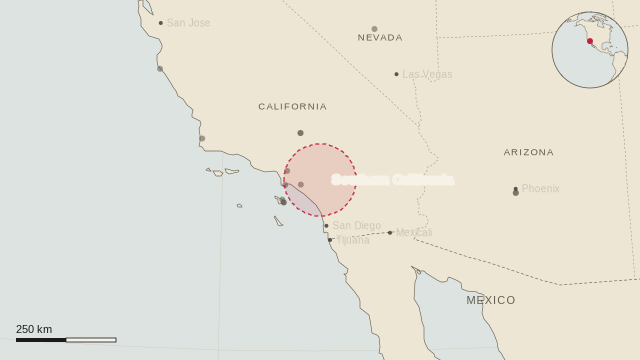
On the night of Saturday, November 30, 1957, shortly after seven, a very bright light crossed the sky of Southern California in a few seconds. Six people, spread from San Clemente Island, off the coast, to the desert near Blythe, by the Arizona line, reported a light like it. Their accounts reached air defense, which on December 2 passed them on by teletype to the Air Force's Air Technical Intelligence Center (ATIC), among other recipients. The 27th Air Division, the region's air defense unit, sent all six reports; the pilot's also came through the 751st Aircraft Control and Warning Squadron, the radar station on Mount Laguna. Project Blue Book, the Air Force program that logged these sightings, gathered them in a single file.
At 7:08 p.m. Pacific time, Ensign Woolf, of the Navy Reserve, was flying at 24,000 ft (about 7,300 m) in an F3D fighter from Naval Air Station North Island, in San Diego, over Highway 78, southeast of Borrego Springs. He saw a ball the apparent size of a baseball wrapped in a white and blue flame. Blown back, the flame formed a cone that ended in a tail "the size of a pin." He judged that it was coming down toward the ground from far above his plane, from the southeast toward Los Angeles, and that it burned out after 15 to 30 seconds, by then about 30 degrees below his eye level. The teletype notes that it "looked like huge meteor," without saying whose words those are, and rates the pilot an excellent witness.
A minute later, Major Donald L. Heryford, of the 27th Air Division's 4th Weather Detachment, was driving about 30 miles (48 km) west of Blythe when a bright light appeared to the west. He saw two objects, one behind the other. The first, round and the apparent size of a grapefruit, was reddish at first, glowed bluish about halfway through and then seemed to burn out; a much smaller one, also bluish, followed it and went out at about the same time. According to the full copy of his teletype, the light appeared 35 degrees up to the southwest, traced an arc toward the northeast and went out 15 degrees up in that direction, in about 10 seconds. Heryford himself said that what he saw suggested meteors.
At 7:10 p.m. three civilians saw it. Smalley, a retired Army man driving east about 5 miles from Oxnard, saw a blue and white ball the size of a baseball that traced an arc from south to north and faded in five seconds; he told the officer of the day at Oxnard Air Force Base. In Ventura, a resident named Down saw a round, white, very bright object the size of a grapefruit cross the sky from south to north in five seconds; the teletype adds that it was reported to have burst into flame north of Santa Paula, near a canyon it calls "Sextan." In San Bernardino, Robert S. Morgan saw a bluish-white light the size of a half dollar, with a trail of the same color, go from southwest to north-northeast and vanish in three seconds just above the mountains, toward Lake Arrowhead.
The sixth report came from San Clemente Island, where seaman Nolan Anderson served at the Naval Ordnance Test Station. Anderson saw a bluish streak of light, about 20 feet long according to the teletype, pass directly overhead; it came from the area of Santa Catalina Island, went on northeast toward the mainland and dropped below the horizon in about five seconds. The officer who prepared the report, Lieutenant Farr, wrote that it looked like a shooting star. His time does not match the others. The teletype twice gives 03:46 universal time, 7:46 p.m. in California, as an analyst worked out by hand in the margin; the Blue Book summary card has 03:06, or 7:06 p.m. If the teletype is right, Anderson saw a different light 36 minutes later; if the card is right, he saw the same one, two minutes before the pilot.
The 27th Air Division's air defense control center scrambled four fighters to search the area, first two from North Island and then two from Oxnard Air Force Base, with no result. In the teletype for the Ventura report, the same center passed on that Mount Wilson Observatory believed the object was a meteor. The officers who passed on the other reports agreed: the Mount Laguna director, in both teletypes of the pilot's report, spoke of "large meteor," the control center of "meteor" and Captain Fontes, of the same center, of "possibly large meteor."
Where it happened
Why it matters
The case shows how air defense handled a bolide, a very bright meteor, in the months of Sputnik. Six named reports went out two days later, four fighters were launched, and at ATIC the papers were read together. In the margins, the analysts wrote by hand that this was one of many reports of "a large meteorite" that streaked over California between 03:08 and 03:10 universal time, and that the Mount Laguna director's comments were worth noting. Of the pilot's report they wrote that it was highly suggestive of a "bolide," similar to earlier reports. Of others, that the description, flight path and duration were typical of a meteorite. ATIC's conclusion was probable meteor, and the summary card checked "astronomical: meteor."
The analysts also ruled out a satellite. On Morgan's report, someone asked for a check of the orbits of the Sputniks, the two Soviet satellites launched in October and November. Another hand answered in red: "Not Sputnik! Other side of the world." No document in the file proposes the Sputnik 1 rocket stage as the cause; according to Jonathan McDowell's catalog of space objects (GCAT), it fell back into the atmosphere on December 1, around 10:00 universal time (a time the catalog flags as uncertain), some seven hours after the California light.
The accounts do not agree on everything, and none of the documents tries to reconcile them. The ground witnesses saw the light head north or northeast, while the pilot saw it come down from the southeast toward Los Angeles, which lay northwest of where he was flying. The durations run from three seconds to between 15 and 30, Heryford saw two objects and the others one, and the end point lies in places far apart: north of Santa Paula for Down, over the mountains by Lake Arrowhead for Morgan. No teletype mentions radar or photographs, and the card records that there were no photos.
Even so, every source that put forward a cause put forward the same one, a meteor, and none suggested another. That cause came from one of the witnesses himself, Heryford, and from ATIC, and air defense passed on that Mount Wilson Observatory gave it too. In 2026, the U.S. Department of War (the name the Department of Defense has used since 2025) released the file in the eighth batch of PURSUE, its program for publishing files on anomalous phenomena, under the title of an "unresolved" report (Unresolved UAP Report); the document it released carries Blue Book's meteor conclusion.
Documents and sources
Primary documents
DOW-UAP-D210 — Blue Book card and seven air defense teletypes on the light of November 30, 1957
Seventeen pages with the Project Blue Book summary card and the teletypes that passed on the six reports of the light seen over Southern California on the night of November 30, 1957 (December 1 in universal time).
Read more
The "Project 10073 Record Card" (ATIC Form 329) gives the location as "Southern California," ground-visual and air-visual observation, military source, five seconds, one object, course northeast, and lists the six reports from 01/0306Z to 01/0310Z; it checks "Was Astronomical" with "Meteor" and comments "Meteor." Seven teletypes dated December 2 follow: six from the 27th Air Division (Defense) (messages 2701 TAC L0010 to L0019) and one from the 751st Aircraft Control and Warning Squadron, on Mount Laguna, with the pilot's report, which the division retransmitted with some differences (the estimated starting altitude, 50,000 to 75,000 ft in one and 60,000 to 75,000 in the other). The witnesses are seaman Nolan Anderson (San Clemente Island), Ensign Woolf (F3D fighter over Borrego Springs), Major Donald L. Heryford (west of Blythe) and the civilians Smalley (Oxnard), Down (Ventura) and Robert S. Morgan (San Bernardino). ATIC's receipt stamps are of December 3. The handwritten notes include "ASTRO," "Prob Meteorite," "bolide," "1 Witness" on the reports, the check of the Sputnik orbits ("Not Sputnik! Other side of the world.") and ATIC's conclusion, probable meteor. In this copy, the sheet of Heryford's teletype lacks items 2.B to 5 (elevations, arc, duration, time and place), which do appear in the copy of the Blue Book file on archive.org; that other copy, 24 pages long, blacks out the names of the three civilians and the sailor and includes material unrelated to the case.
U.S. Air Force, Project Blue Book, 27th Air Division and 751st Aircraft Control and Warning Squadron (PURSUE Release 08) · Public domain · US Government work · open original
Documented evidence
- "Project 10073 Record Card" (ATIC Form 329): November 30, 1957, "Southern California"; six reports, from 01/0306Z (San Clemente Island) to 01/0310Z (Oxnard, Ventura, San Bernardino), with 01/0308Z southeast of Borrego Springs and 01/0309Z west of Blythe; one object, five seconds, course northeast, no photos; "Was Astronomical" with "Meteor" and the comment "Meteor."
- Teletype from the 751st Aircraft Control and Warning Squadron, Mount Laguna (group 021920Z, December 2), retransmitted by the 27th Air Division (L0017): Ensign Woolf, Navy Reserve, in an F3D (124638) at 24,000 ft, heading 020, 245 knots, at 01/0308Z; ball with a white and blue cone of flame, tail "the size of a pin"; from an estimated 50,000 to 75,000 ft (60,000 to 75,000 in the retransmission) toward the ground, from the southeast toward Los Angeles; 15 to 30 seconds; "LOOKED LIKE HUGE METEOR"; a DC-7 at 20,000 ft in the area; the station director, "large meteor."
- 27th Air Division teletype L0012: Major Donald L. Heryford, 4th Weather Detachment, 30 miles west of Blythe, 01/0309Z; two objects in trail, the larger reddish then bluish; from 35 degrees to the southwest to 15 to the northeast, about 10 seconds; "OBJECT SIGHTED SUGGEST METEORS." Items 2.B to 5 appear only in the copy of the Blue Book file on archive.org.
- 27th Air Division teletypes L0010, L0018 and L0011, 01/0310Z: Smalley, retired Army, five miles east of Oxnard, blue and white ball, south to north, five seconds, "ADCC BELIEVES OBJECT WAS METEOR"; Down, Ventura, white object that "BURST IN FLAME NORTH OF SANTA PAULAM," five seconds; Robert S. Morgan ("ROBERTAS. MORGAN" in the teletype), San Bernardino, southwest to north-northeast, three seconds, "CAPTAIN FONTES, ADCC - POSSIBLY LARGE METEOR."
- The Ventura teletype (L0018), item 9: the 27th Division's control center "SCRAMBLED FOUR FIGHTERS, TWO FROM OXNARD AF, TWO EARLIER FROM NORTH ISLAND TO SEARCH AREA. NEGATIVE RESULTS."; item 11: "ADCC - MT. WILSON OBSERVATORY BELIEVES OBJECT WAS METEOR."
Show 3 more facts
- 27th Air Division teletype L0019: seaman Nolan Anderson, Naval Ordnance Test Station, San Clemente Island; bluish streak about 20 feet long, directly overhead, from the Santa Catalina area toward the northeast, about five seconds; time "01/0346Z" twice, with the handwritten note "0346-8 = 1946"; Lieutenant Farr: "APPEARED TO BE SHOOTING STAR."
- ATIC handwritten notes: "This is one of a large number of reports of a large meteorite that went streaking over California between 0308Z + 0310Z. Reported by many."; "Highly suggestive of a 'bolide'"; "Sputnik charts checked. Not Sputnik! Other side of the world."; "4 acft. investigated and found nothing."; "ATIC Conclusion: Concur with above. All info indicates obj. Prob. METEOR." Receipt stamps of December 3, 1957.
- Jonathan McDowell's GCAT catalog: the Sputnik 1 rocket stage (1957 Alpha 1) fell back into the atmosphere on "1957 Dec 1 1000?", with the time flagged as uncertain.
Sources
- war.gov/UFO — DOW-UAP-D210, "Unresolved UAP Report, California, 1957" (PURSUE Release 08) — Primary document, embedded in this case's viewer: the Blue Book card, the six air defense teletypes and ATIC's notes.
- Project Blue Book — file 1957-11-6965021, Southern California (archive.org) — Independent scan of the same file, with the names of the civilians and the sailor blacked out; it has the full sheet of Heryford's teletype (elevations, arc, about 10 seconds) and material unrelated to the case, including an index of December 1–4 sightings and clippings about Brazil.
- Jonathan McDowell, General Catalog of Artificial Space Objects (GCAT), satcat.tsv — Reentry date of the Sputnik 1 rocket stage (S00001): December 1, 1957, around 10:00 UTC, time uncertain.
- Probed — DOW-UAP-D210 entry (third-party summary, with the release's official description) — Secondary source: it summarizes the official war.gov description (six reports, bright object heading northeast, evaluated by the Air Force as a meteor) and converts the times to 7:06–7:10 p.m. on November 30.
Related cases
Cases with the same likely cause.
Meteor or fireball · Same country · Within 10 years
Avalon · a resident sees an orange-red light drop straight down
1955 · Tier A
Meteor or fireball · Same country · Within 10 years
Kecksburg · residents say something fell into the woods
1965 · Tier A
Meteor or fireball · Same country · Within 10 years
New Mexico · green fireballs over the nuclear sites
1948 · Tier A
Meteor or fireball · Same country · Within 10 years
Chiles-Whitted · two airline pilots and a windowed object
1948 · Tier A