1957·Taichung, Taitung, Tawu and Hualien, Taiwan
Taiwan.Taichung · white lights over four towns on two nights
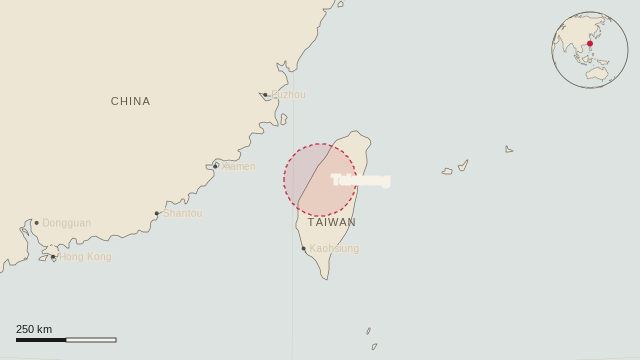
On the nights of December 20 and 21, 1957, unnamed observers in the towns of Taichung, Taitung, Tawu and Hualien, in Taiwan, saw white lights and objects in the sky, eight reports in all, some through a telescope. Chinese Nationalist sources passed the reports to the U.S. military in Taipei. Each report gives the time and place of the sighting, which makes it possible today to check it against the sky on those two nights.
Tier B · IndicativeWhat do they mean? →
Limited evidence: it falls short of what Tier A requires. Any one of these is enough: a single testimony (or several witnesses who saw it together), testimony gathered years later, or an account without contemporary primary documentation.
What it was
78%ordinary cause, unidentified
The most likely explanation.
- 78% ordinary cause, unidentified
- 8% other earthly causes
- 14% no known cause
See the split across the six explanations
Earthly origin (human or natural)86%
No known cause14%
Why no ordinary cause is identified
What happened
It was night in Taiwan on December 20, 1957, when the sightings began; a U.S. military message gathered the reports three days later. At 6:48 p.m., in Taitung, on the island's southeast coast, someone followed through a telescope a bright white object moving slowly southwest, ten times brighter than a meteor. On the message that reports it, the place name was cut off between two pages, but its coordinates are those of Taitung. At 7:09 p.m., in Tawu, a coastal town south of Taitung, another observer saw through a telescope a white object like a shooting star, flying slowly, just as bright.
At 7:35 p.m., over Taichung, in the west-central part of the island, a white object larger than a star appeared. It stayed in the same spot until it faded at 8:07 p.m. At 8:15 p.m., again in Tawu, "white material" was seen dropping to the northwest; by 8:54 p.m. it had moved about ten kilometers to the west. The report adds "no sound or light," without saying what that refers to.
The message lists one more Taichung report first: a bright white object shaped like a wheel, heading north at high speed, which faded to the northeast. Its time, 11:54, does not fit the others. The record card of Project Blue Book, the U.S. Air Force project that studied UFOs, read it as Greenwich time, which would be 7:54 p.m. in Taiwan; read as local time, it would fall before noon, outside the evening hours in which, according to the same message, the objects were seen.
The next night, December 21, brought three more reports. At 6:42 p.m., in Hualien, on the east coast, a "white shooting light" was seen heading southwest; the report places it about six miles away in that direction, without saying from where. At 7:00 p.m., in Taitung, a similar light moved southwest to about eight miles west of the city and faded at 7:50 p.m. At 7:05 p.m., in Tawu, a third white light was seen to the south.
The reports reached the Americans through Chinese Nationalist sources (the Nationalists ruled Taiwan), and went to the U.S. section of the joint operations center in Taipei. According to the message, they came from "a variety of sources," with no names and no word on who was looking through the telescopes. The Nationalist air force reported that it scrambled no fighters. On December 23, the U.S. air command in Taipei summed them all up in the unclassified message to five Air Force commands in Hawaii, Japan, the Philippines, Alaska and Colorado, and noted that this was all the information it had.
At Blue Book, someone wrote "INSUFF INFO" (insufficient information) by hand on the message and numbered the eight objects. The case's record card closed it for lack of data to evaluate it. The card summarizes all eight reports, but places them all in Taichung, when only two came from there, and lists the source as "civilian," which the message does not say.
Where it happened
Why it matters
Working out the positions of the planets from the message's coordinates and times, taken as Taiwan time, Venus shone low in the southwest, far brighter than any star, and set at about 8:20 p.m. The nearly new Moon was below the horizon.
Several reports point to the part of the sky where Venus was: the Taitung and Hualien lights seen to the southwest between 6:42 and 7:50 p.m., and perhaps the Taichung object that stayed put until it faded at 8:07 p.m., when Venus was grazing the horizon, where haze dims any light. One doubt the message leaves open: it gives those lights a heading of 225 degrees, southwest, without saying whether that is the way they moved or the way the observer was looking. Venus does not visibly move in a few minutes, so if the lights were moving, they were not Venus.
Other reports do not fit that calculation: the wheel-shaped object heading north at high speed, the light seen to the south from Tawu, and the white material dropping to the northwest over Tawu between 8:15 and 8:54 p.m., away from where Venus stood and until half an hour after the planet had set. Two satellites were in orbit that week, Sputnik 1 and Sputnik 2, according to astronomer Jonathan McDowell's catalog of space objects; whether either passed over Taiwan at those hours would take their orbits for those days to check.
Blue Book proposed no cause: it closed the case for lack of data. The four pages of the file hold no interviews, no witness names, no drawings, and no request for more details. The reports came secondhand, through Chinese Nationalist sources, two or three days later and boiled down to one line each, and that is how they reached five Air Force commands. With so little, all that can be checked today are the times and directions, and in some of the reports they point to Venus.
Documents and sources
Primary documents
Blue Book file on the Taiwan lights (December 1957): record card and the Taipei message, 4 pp.
The four pages of the Blue Book file on the eight Taiwan reports of December 20 and 21, 1957. Page 1 is the record card, with the conclusion "Insufficient Data for Evaluation."
Read more
Pages 2 to 4 are the unclassified message from the U.S. air command in Taipei, dated December 23, 1957, with the times, coordinates and headings of each report; written on it by hand are "INSUFF INFO" and the numbering of the eight objects. Some text is lost between pages 2 and 3, including the place name of the second report. Grayscale copy, recompressed.
Project Blue Book (NARA), via archive.org · Public domain · US Government work · open original
Documented evidence
- Unclassified message from the "ATF 1 PROV" command in Taipei, dated December 23, 1957, 0830Z, to the commanders of PACAF (Hickam, Hawaii), Fifth Air Force (Fuchu, Japan), Thirteenth Air Force (Clark, Philippines), Alaskan Air Command and Air Defense Command (Colorado): the reports came through Chinese Nationalist sources to the U.S. section of the Taipei joint operations center (Blue Book file, pp. 2 to 4)
- December 20 reports according to the message: 11:54, Taichung (24°10' N, 120°40' E), white wheel-like object, north, "2M," at high speed, faded to the northeast "AT 175"; 18:48, place cut off, 22°45' N, 121°10' E (Taitung), "225 degrees," "30M," slow, by telescope; 19:09, Tawu (the message writes 12°23' N, 120°54'), "30M," by telescope; 19:35 to 20:07, Taichung, stationary; 20:15 to 20:54, Tawu, white material to the northwest, then 10 km to the west
- December 21 reports: 18:42, Hualien (24°00' N, 121°36' E), white light, heading 225°, "7M," six miles to the southwest; 19:00 to 19:50, Taitung, heading 226°, to eight miles west, "8-10M"; 19:05, Tawu, white light to the south, "10M." The message adds "CAF REPTD NO SCRAMBLE ACTION" (the Chinese air force scrambled no fighters) and that it includes all the information available
- Blue Book record card (p. 1): date December 20 and 21, 1957; location "Taichung, Formosa (8 sight)"; time "GMT 20-21/1154Z," no local time; ground-visual observation and telescope; source "Civilian"; no photos; conclusion "Insufficient Data for Evaluation," with the comment "Insufficient information for evaluation." Handwritten on the message: "20+21 Dec 57 Taichung Formosa," "Multi (8) sightings," "INSUFF INFO," and each object numbered first to eighth
- Times: Taiwan used UTC+8 in December 1957 (IANA time zone database, Asia/Taipei; daylight saving time ran April to September). The card's 11:54Z equals 7:54 p.m. Taiwan time; the message's 18:42 to 20:54, read as Greenwich time, would fall between 2:42 and 4:54 a.m. the next day, outside "the evening hours" the message announces. A 7:54 p.m. time would also break the message's order, which lists each night's other reports by time and puts the 11:54 report first
Show 2 more facts
- Calculation with PyEphem 4.2.1 for Taichung, Taitung, Tawu and Hualien, in Taiwan time: sunset between 5:11 and 5:18 p.m.; Venus at magnitude −4.5, about 20° high at azimuth 238° at 6:42 p.m., 9° and 245° at 7:35 p.m., 3° and 248° at 8:07 p.m.; it set between 8:17 and 8:23 p.m. depending on the place. The Moon, at new phase, was below the horizon throughout the hours of the reports
- Jonathan McDowell's GCAT catalog: in orbit on December 20 and 21, 1957, were Sputnik 1 (1957 Alpha 2, reentered about January 4, 1958) and Sputnik 2 (1957 Beta 1, reentered April 14, 1958); Sputnik 1's rocket stage had reentered on December 1, 1957
Sources
- Project Blue Book, file "1957-12-6970981, Taichung, Formosa," 4 pp. (record card and the U.S. air command's message from Taipei of December 23, 1957), NARA, archive.org mirror — Primary source. The scan's text layer is poor: times, coordinates and quotations were read from each page image.
- Jonathan McDowell, General Catalog of Artificial Space Objects (GCAT), satellite catalog — Objects in orbit in December 1957: Sputnik 1 and Sputnik 2, with their reentry dates.
- All-domain Anomaly Resolution Office (AARO), Fiscal Year 2024 Consolidated Annual Report on Unidentified Anomalous Phenomena (Nov 14, 2024) — Base rate (p. 3): AARO resolved 118 cases in the reporting period and later closed another 174, all to prosaic objects; many others remain unresolved.