1957·Uzundzhovo military airfield, near Haskovo, Bulgaria
Bulgaria.Uzundzhovo · a Turkish major watches searchlights track a light
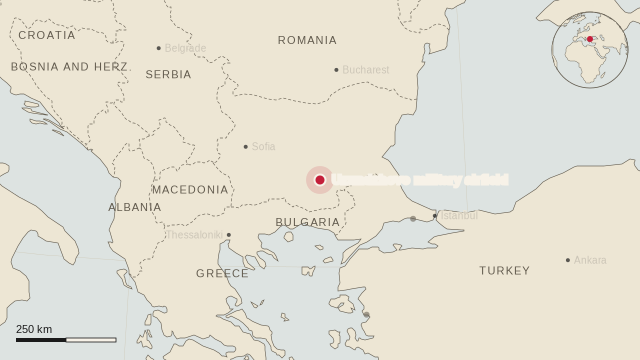
At about 8:00 p.m. on August 21, 1957, a Turkish Army major driving from Sofia to Edirne stopped near Haskovo, in southern Bulgaria, and saw a light over the military airfield of Uzundzhovo. As he told the U.S. air attaché's office in Turkey, the scene repeated eight times in half an hour: the light switched on and hung still, moved off in a straight line while antiaircraft searchlights followed it, and went out. On one of those runs, a jet took off, passed it and landed. Project Blue Book classified it as a probable military night exercise.
Tier B · IndicativeWhat do they mean? →
Limited evidence: it falls short of what Tier A requires. Any one of these is enough: a single testimony (or several witnesses who saw it together), testimony gathered years later, or an account without contemporary primary documentation.
What it was
70%human-made flying object
The most likely explanation.
- 70% human-made flying object
- 8% other earthly causes
- 22% no known cause
See the split across the six explanations
Earthly origin (human or natural)78%
No known cause22%
Ordinary cause the sources propose: human-made flying object
What happened
On August 21, 1957, a Turkish Army major was driving across Bulgaria from Sofia toward Edirne, the first Turkish city past the border. He was heading home from Warsaw, where he had been Turkey's military attaché from February to August that year; before that he had spent a year and a half as assistant Turkish Army attaché in London. He was an artillery officer with 20 years of service. At about 8:00 p.m. local time he was approaching the city of Haskovo, in southern Bulgaria. The night was clear but very dark. On his left he saw a moving light in the sky, followed by antiaircraft searchlights. Suddenly the light vanished or went out, and at that moment the searchlights went off too.
The major stopped the car and got out to see better. Soon another light appeared at the same spot, over and slightly to one side of the military airfield of Uzundzhovo, about five kilometers northeast of Haskovo. In his account, the same thing happened each time. The airfield went completely dark and no aircraft could be heard. The light came on all at once at about 1,000 to 1,500 feet (300 to 450 meters), without lighting up the ground the way a flare does, and the major said it looked like a single light bulb turned on with the flick of a switch. It hung still for five or ten seconds and then moved off in a straight line, always at the same height.
As soon as the light began to move, the searchlights posted around the airfield came on and picked it up in their beams one by one. The major counted three or four batteries, with three or four searchlights each. Inside the beams, the object reflected no light and showed no shape, and its own light could still be seen. He estimated its speed at 100 to 150 knots (about 115 to 175 mph). After two minutes, timed by his watch, the light went out and so did the searchlights. He heard no engine noise and saw no exhaust flame, and he could not tell what became of the object once the light was off. He said he had checked the time carefully and saw the sequence eight times between 8:00 and 8:30 p.m.
During one of those eight runs, a jet took off from Uzundzhovo, climbed toward the light and passed it while still climbing; then it turned straight into the airfield's landing pattern and touched down using the runway lights. It was the only aircraft the major saw or heard in the whole half hour. He said he had a great deal of experience with antiaircraft searchlight batteries and could not explain what he had seen.
Lt. Col. Joseph A. Burt, the U.S. assistant air attaché in Turkey, wrote the account up in report IR-734-57, dated September 5, 1957, fifteen days after the event; the air attaché, Col. Joe H. Daniel, approved it. Burt wrote that the major had impressed him with his intelligence and that his powers of observation and memory were far above average.
The report includes a sketch, drawn as an overlay to a U.S. Air Force aeronautical chart, marking the spot where the major watched from, at the edge of Haskovo on the Sofia road. The light's track is a dashed line running northwest from the airfield, with no arrow to show its direction. Burt promised to ask about the case when debriefing escapees and travelers leaving Bulgaria, and he sent the report to the Air Force's Air Technical Intelligence Center (ATIC), which ran Project Blue Book.
In the report's margins, someone wrote two objections by hand. Next to the major's statement that there was no exhaust flame that could have come from an engine, the note reads "Pretty broad statement"; next to the jet's pass, another note says the pilot apparently knew what the object was. The case's record card checked "Prob Mil Night Opr," a probable military night operation, as its conclusion. According to the card, although it was hard to check from the United States, this looked like a simulated night antiaircraft tracking exercise of some sort; the target could have been a balloon carrying a light, an illuminated drone aircraft like those used in the United States, a lighted sleeve or something similar. The fact that a jet went up, passed the light and came back showed, again according to the card, that the pilot knew what it was.
The card summarizes the case with two differences from the report. Under number of objects it writes "one," whereas the major described a light that went out and another that then appeared at the same spot, eight times. And it converts 8:00 p.m. local time into 1900 Greenwich time, when it was actually 1800: according to the IANA time zone database, Bulgaria then kept Eastern European Time, two hours ahead of Greenwich with no daylight saving time. It is a slip on the card; the report gives local time.
Where it happened
Why it matters
The account comes from an artillery officer who knew searchlight batteries, stopped his car to watch and timed what he saw, and a U.S. assistant air attaché put it in writing. But it rests on a single witness, recorded fifteen days later, with no instrumental record, and there is no known Bulgarian source on what happened that night at Uzundzhovo.
Much of what the major saw fits Blue Book's explanation. A CIA report distributed in September 1958, which does not say when its information was gathered, describes Uzundzhovo as the base of a jet fighter regiment, with 30 to 35 MiG-15s and MiG-17s and lights along both sides of the runway for night flying. A light that comes on over the blacked-out base, is picked up by the searchlights one by one and goes out at the same moment they do, eight times in half an hour, looks like the batteries practicing on a target.
The card does not say which of the targets it suggests it was, and its list ends in "etc." The height and speed figures are the major's estimates for a light at night, at no known distance. Taken at face value, the speed and duration in the report give each run a length of 6 to 9 km, a long way for a balloon at 300 to 450 meters. A sleeve target needs an aircraft to tow it, and a drone has an engine of its own; the major heard no engine while the light was moving.
Astronomical causes do not fit. A calculation with the PyEphem ephemeris for Haskovo at 1800 Greenwich time puts the waning Moon below the horizon until after midnight. Venus and Jupiter shone low, about 5 degrees above the western horizon, and set around 8:30 p.m. local time; the airfield lay on the opposite side, to the major's north and northeast. There were no artificial satellites either: Jonathan McDowell's catalog of space objects lists none before Sputnik 1, launched on October 4, 1957, six weeks later.
The case shows how reports from behind the Iron Curtain reached Blue Book: through military attachés, secondhand, with no way to check them on the ground. The card offers the exercise only as the probable answer, and admits it was hard to check from the United States.
Documents and sources
Primary documents
Blue Book file on Uzundzhovo (Bulgaria, 1957), 5 pp.: record card and report IR-734-57 from the air attaché's office in Turkey
The U.S. Air Force papers on the light a Turkish Army major saw over the Bulgarian airfield of Uzundzhovo on the night of August 21, 1957.
Read more
Page 1 is the undated Blue Book record card, which concludes "Prob Mil Night Opr." Pages 2 to 5 are report IR-734-57 of September 5, 1957, signed by Lt. Col. Joseph A. Burt, assistant air attaché in Turkey: the witness's background, the sequence repeated eight times, the jet's pass and, on the last page, the sketch on an aeronautical chart with the observation point and the light's track. The report's first page bears a stamp dated October 22, 1957 and a handwritten note naming a "Capt Gregory"; the second has hand underlining and circled figures; the third carries handwritten objections and a draft of the conclusion. This is a grayscale copy with the report's pages in their proper order, which in the scanned original runs 1, 3, 2 and 4; the witness's surname is already blacked out in the original.
Project Blue Book (NARA), via archive.org · Public domain · US Government work · open original
Documented evidence
- Blue Book record card (ATIC Form 329, undated; PDF p. 1): date "21 August 1957," location "Uzundzhovo, Bulgaria," time "2000 - 2030 local" and "21/1900Z," ground-visual sighting, no photos, source "Foreign Military Officer," 30 minutes, one object, course "gen orbit"; conclusion checked "Other: Prob Mil Night Opr."
- Report IR-734-57 from the U.S. air attaché's office in Turkey, dated September 5, 1957, signed by Lt. Col. Joseph A. Burt and approved by Col. Joe H. Daniel (PDF pp. 2 to 5): it places the airfield at 41°58′ N, 25°35′ E, near Haskovo, and names as its source Maj. Nejat of the Turkish Army, whose surname is blacked out; it rates source and information B-2 (usually reliable source, information probably true). It is distributed to U.S. Air Forces in Europe and to ATIC.
- Report IR-734-57 (pp. 2 and 3) describes the sequence: airfield blacked out, light hanging still for five or ten seconds at 1,000 to 1,500 feet, a horizontal run of about two minutes with three or four batteries of three or four searchlights each, no reflection from the object in the beams, no engine noise, an estimated speed of 100 to 150 knots and eight repetitions between 8:00 and 8:30 p.m.
- Report IR-734-57 (p. 3) records that during one of the eight runs a jet took off, passed the object while climbing and landed using the runway lights, and that it was the only aircraft seen or heard; the major said he had a great deal of experience with antiaircraft searchlight batteries and could not explain it.
- The margins of p. 3 of report IR-734-57 carry handwritten notes: "Pretty broad statement" next to the sentence about the exhaust flame, the remark that the pilot apparently knew what the object was, and a text the card repeats almost word for word, though blunter on one point: "Cannot check from ZI, but believed to be night AA operations," ending in "(Other)."
Show 2 more facts
- A CIA report titled "Uzundzhovo Airfield," distributed on September 3, 1958, describes the airfield about 5 km northeast of Haskovo, occupied by a jet fighter regiment with 30 to 35 MiG-15s and MiG-17s and with electric lights along both sides of the runway for night flying.
- According to the IANA time zone database, Bulgaria kept Eastern European Time (Greenwich plus two hours) in 1957, with no daylight saving time. A PyEphem calculation for Haskovo at 1800 Greenwich time puts the Moon below the horizon, Venus and Jupiter about 5 degrees above the west and Saturn about 25 degrees up in the south-southwest. Jonathan McDowell's GCAT catalog lists no object in orbit before October 4, 1957.
Sources
- Project Blue Book (NARA), file "1957-08-6968552-Uzundzhovo-Bulgaria," 5 pp., copy at archive.org — Primary source. PDF p. 1: record card; pp. 2, 4, 3 and 5, in that order: pages 1 to 4 of report IR-734-57. The scan's text layer is poor: figures, times and quotations were read from the page images. The witness's surname is blacked out in the original.
- CIA, Information Report "Uzundzhovo Airfield," distributed September 3, 1958, 3 pp. (CIA-RDP80T00246A044200290001-9), copy at archive.org — Pp. 1 and 2: the airfield's location, the jet fighter regiment, a runway lit for night flying and 30 to 35 MiG-15s and MiG-17s. The date of the information is redacted.
- Jonathan McDowell, General Catalog of Artificial Space Objects (GCAT), satcat.tsv — Its first entries are 1957 Alpha 1 and 2 (Sputnik 1 and its rocket), dated October 4, 1957.
- Brandon Rhodes, PyEphem 4.2 (astronomical ephemerides based on the XEphem library) — Tool used to calculate the positions of the Sun, the Moon and the planets as seen from Haskovo (41.93° N, 25.55° E) at 1800 Greenwich time on August 21, 1957.
- IANA time zone database (tz), zone Europe/Sofia — Records that Bulgaria kept Eastern European Time, two hours ahead of Greenwich, with no daylight saving time between 1945 and 1979.
- UFOScans, "Project 10073 Record Card — Uzundzhovo, Bulgaria, 21 August 1957," copy and machine-generated summary of the file — Secondary version, generated by a language model: it attributes to Lt. Col. Burt the card's comment that the case was hard to check, presents the witness as a serving assistant attaché, reads "illuminated aircraft" where the card says illuminated drone aircraft and says the jet "intercepted" the object.