1957·Port of Spain harbor, Trinidad
Trinidad and Tobago.Port of Spain · an object with three lights seen from a launch
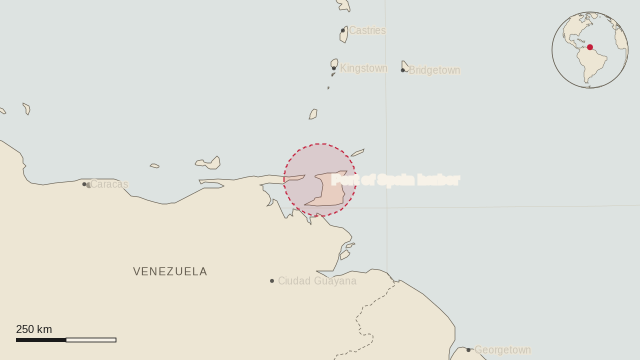
On the night of Friday, March 22, 1957, at about 8:18 p.m., a civilian crossing Port of Spain harbor in Trinidad, then a British colony, by motor launch watched a dark object for about five minutes. It had a red light on top, a yellow one on the left and a green one on the right; it seemed to stand still, sped up and vanished behind low hills to the southeast. He described it in a U.S. Air Force questionnaire, and the Air Force filed the case in Project Blue Book as a light aircraft.
Tier B · IndicativeWhat do they mean? →
Limited evidence: it falls short of what Tier A requires. Any one of these is enough: a single testimony (or several witnesses who saw it together), testimony gathered years later, or an account without contemporary primary documentation.
What it was
78%airplane
The most likely explanation.
- 78% airplane
- 3% other earthly causes
- 19% no known cause
See the split across the six explanations
Earthly origin (human or natural)81%
No known cause19%
Ordinary cause the sources propose: airplane
What happened
On Friday, March 22, 1957, after dark, a man was riding a motor launch from the ship Bonaire, of the Dutch shipping line KNSM, to the dock at Port of Spain, the capital of Trinidad, then a British colony. He gave as his address a company in Georgetown, in neighboring British Guiana, and his name is blacked out in the copy of the file. By his account, the launch was heading east at 8 to 10 mph, still out from shore, at a distance that is illegible in the handwriting, and it did not stop while he watched. The sky was clear, moonless and full of stars; there was no wind, and the night was dry and warm.
At about 8:18 p.m., Trinidad standard time, while he was looking ahead, someone on the launch kept telling him that there was a "flying saucer" behind him, to the south. On the third try, he wrote, he turned around and saw it. The object was to the southwest, about 230° from north and about 30° above the horizon: since the launch was heading east, it was behind him and to his right. It looked solid to him, its body "faintly outlined black against a black sky": the body was no brighter than the sky, but its lights were, as bright as a car headlight a block away. He drew a red light on top, a yellow one at the left end and a green one at the right end, with an arrow pointing left. He heard nothing: any sound, he said, was drowned out by the launch's engine.
On the questionnaire he marked that the object appeared to stand still at one point and suddenly sped up at another, and that it did not break up, give off smoke or change brightness, shape or intensity. He put its speed at 15 mph when he first saw it and 120 mph at the end, and its distance at 1,320 to 2,640 feet, a quarter to half a mile. As it left, he wrote, it turned south, sped up considerably and disappeared behind a low range of hills south of Port of Spain, about 150° from north and right at the horizon. He estimated that the sighting had lasted about five minutes and said he was fairly certain of that figure.
In one answer he gave a diameter of 55 feet, worked out with similar triangles, and noted that the figure assumed an object a quarter mile away; in another, he gave 50 to 100 feet across and 10 to 15 feet thick at the center. At arm's length, he said, the object covered as much as a quarter coin. He thought it was made of a metal alloy and compared it to a narrow-rimmed lid set on top of a wide, shallow saucer or a dessert dish.
According to the questionnaire, other people were with him and also saw the object, but he did not give their names because, he wrote, "they do not wish to be involved with (the ridiculous term of) 'Flying Saucers.'" He marked that it was the first time he had seen an object like this one, though he added that he had seen other kinds of UFOs on other occasions. Asked what it had been, he answered that, after inquiring with the R.A.F., Britain's air force, and civil aviation staff, he had concluded that the object differed from any known aircraft, and that in his opinion it was a "Scout ship," of interstellar origin; the word before "interstellar" and the end of the sentence are hard to read. He dated the questionnaire March 25 and noted that this was his first report.
The Air Force filed the case in Project Blue Book with an undated record card, Form 329 of its Air Technical Intelligence Center (ATIC). The card sums it up as a solid object with a red light on top, a yellow light on the left and a green light on the right that flew over a valley, seemed to hover and changed speed, up to 120 mph. It marks the conclusion "Was Aircraft" and comments that an aircraft approaching or moving away from the observer while maneuvering will appear to stand still, that there was "nothing in letter" to indicate it was anything other than a light aircraft flying over the city, and that the speeds, maneuvers, lights, duration and description fit that explanation.
Where it happened
Why it matters
The card's explanation, a light aircraft, rests on what the witness himself reported: colored lights, speeds of 15 to 120 mph, five minutes of observation and a sound the launch's engine could have drowned out. According to a calculation done for this case, the Moon had not yet risen at that hour (it rose after midnight, local time), as the witness said, and there was no planet in the direction where the object appeared: Jupiter, the brightest that night, was in the east, and Mars was in the west-northwest. A star or planet also does not sweep 80° along the horizon, from 230° to 150°, in five minutes or drop from 30° to the horizon in that time, so an astronomical explanation does not fit.
The card leaves two mismatches unaddressed. The first is the time: it converts it to Greenwich time with a difference of 3 hours 45 minutes written by hand on the questionnaire, while Trinidad had used a four-hour difference since 1912; the error is a quarter of an hour and does not change what was seen. The second is the valley: the card says the object flew over a valley, and no answer on the questionnaire mentions one. The flight over the city does find support in the witness's sketch, which takes the path up to Port of Spain before turning south.
The card also cites a "letter" that is not among the eleven scanned pages of the file: they are the card, the eight-sheet questionnaire and two repeated sheets of the questionnaire. How the questionnaire reached the Air Force is also unknown. The main thing weighing against an aircraft is the witness's own word: he said he had inquired with the R.A.F. and the civil aviation staff, but none of the eleven pages records those inquiries or their answers, or any Air Force search for a specific flight that night. His companions, who by his account saw the same thing, did not give their names.
The UFOScans site reproduces the file with a summary that departs from it on three points. It attributes to an evaluation letter the statement that the object differed from any known aircraft, when the witness himself wrote it on his questionnaire. It describes the night as hot, when the witness checked "warm." And it presents the witness as an employee of the company whose address he gave, which the questionnaire does not say: the question about his job was left blank.
Documents and sources
Primary documents
Blue Book file on Port of Spain (Trinidad, 1957), 9-page extract: record card and witness questionnaire
The U.S. Air Force papers on the object with three lights that a civilian saw from a launch in Port of Spain harbor on March 22, 1957.
Read more
Page 1: the record card, an undated ATIC Form 329 that checks "Was Aircraft" and comments that a maneuvering aircraft appears to stop. Pages 2 to 9: the eight sheets of the questionnaire "U.S. Air Force Technical Information Sheet," dated by the witness March 25, with the time, the place, the bearings, the drawing of the lights, the sketch of the path over Port of Spain and his opinion that it was a "Scout ship." This is a grayscale extract of pages 1, 7, 5, 6, 4, 8, 2, 3 and 9 of the file, with the card cropped and the witness's address and schooling covered; his name is already blacked out in the original. Pages 10 and 11 of the original repeat pages 3 and 2.
Project Blue Book (NARA), via archive.org · Public domain · US Government work · open original
Documented evidence
- "Project 10073 Record Card" (ATIC Form 329, undated; p. 1 of the file PDF): date "22 March 1957," location "Trinidad," local time 2018 and "23/0003Z" GMT, ground-visual sighting, no photos, civilian source, five minutes, one object, course "maneuvered"; conclusion checked "Was Aircraft," with the comment that a maneuvering aircraft appears to stop as it approaches or moves away, and that nothing in the letter points to anything but a light aircraft.
- Questionnaire "U.S. Air Force Technical Information Sheet," first sheet (PDF p. 7): sighting at 8:18 p.m. on March 22, 1957, standard time, time zone "TRINIDAD"; location "Port of Spain, Trinidad"; the witness was traveling to the dock from the ship Bonaire (KNSM) by motor launch; duration, five minutes ("fairly certain"); handwritten note "+3 45" beside the time.
- Same questionnaire (PDF pp. 5, 6 and 4): moonless night with many stars; body no brighter than the sky but lights brighter, like a car headlight a block away; it seemed to stand still and suddenly sped up; no smoke or changes of shape or brightness; drawing with a red light on top, yellow on the left and green on the right; sound drowned out by the launch's engine; disappeared behind the low hills south of Port of Spain; the size of a quarter at arm's length.
- Same questionnaire (PDF pp. 2, 8 and 9): the launch was heading east at 8 to 10 mph and did not stop; the object appeared at 230° and 30° elevation and disappeared at 150° at the horizon; speed of 15 to 120 mph; distance of 1,320 to 2,640 feet; diameter of 50 to 100 feet in one answer and, on p. 4, 55 feet for an object a quarter mile away; clear sky, no wind, dry and warm.
- Same questionnaire (PDF pp. 3 and 9; pp. 10 and 11 repeat pp. 3 and 2): companions who saw the object and would not give their names; the witness's opinion, after inquiring, as he wrote, with the R.A.F. and civil aviation, that the object differed from every known aircraft and was a "Scout ship"; questionnaire dated March 25, 1957, and declared his first report.
- By a calculation made for this case with PyEphem for Port of Spain at 00:18 GMT on March 23, 1957: the Moon below the horizon (it rose at about 04:29 GMT); Jupiter at 94° azimuth and 36° elevation; Mars at 289° and 30°; no planet near 230° azimuth.
Sources
- Project Blue Book (NARA), file "1957-03-6787695-Trinidad," 11 pp., copy at archive.org — Primary source. PDF p. 1: record card; pp. 7, 5, 6, 4, 8, 2, 3 and 9, in that order: the eight sheets of the questionnaire; pp. 10 and 11 repeat pp. 3 and 2. The scan's text layer is poor (it reads "24 March" where the card says 22): figures and quotations were read from the page images. On the first sheet of the questionnaire, the day seems written over another digit and reads 22, as on the card. The witness's name is blacked out.
- Brandon Rhodes, PyEphem 4.2 (astronomical ephemerides based on the XEphem library) — Tool used to calculate the positions of the Moon, the planets and the bright stars as seen from Port of Spain at 00:03 and 00:18 GMT on March 23, 1957.
- IANA time zone database (tz), zone America/Port_of_Spain — Records that Trinidad switched in 1912 from local mean time to Atlantic Standard Time, four hours behind Greenwich.
- UFOScans, "1957-03-6787695-Trinidad," copy and summary of the file — Secondary version: it attributes to an evaluation letter the witness's statement that the object differed from every known aircraft, describes the night as hot and presents the witness as an employee of the company whose address he gave.
Related cases
Cases with the same likely cause.
Airplane · Within 10 years
Southern U.S. · a spy plane picks up a signal and sees a light
1957 · Tier S
Airplane · Within 10 years
Kirtland · two controllers watch an object cross the base
1957 · Tier A
Airplane · Within 10 years
Abingdon · three witnesses see an orange object at dusk
1957 · Tier A
Airplane · Within 10 years
Fontana · red lights with tails and two lights in formation
1956 · Tier A