2020·In flight at about 28,000 feet, abeam Teniente Vidal aerodrome, Coyhaique (Aysén region)
Chile.Aysén · the blue-green light seen by the Carabineros pilot over Coyhaique
At around 20:00 on 20 April 2020, the pilot of a Carabineros Air Prefecture aircraft flying from Punta Arenas to Puerto Montt, at about 28,000 feet, saw abeam Coyhaique a large, oval, blue-green light that stayed above and in front of his aircraft; he took it for an airliner until it moved and came closer, and it then disappeared towards the northwest. SEFAA identified the flight from the flight plans, but the pilot stopped cooperating and handed over no images, and the case was closed as a 'Report' (Relato) with no cause proposed.
Tier B · IndicativeWhat do they mean? →
Limited evidence: a single witness, testimony gathered years later, or an account without contemporary primary documentation.
What it was
61%natural or human cause
Most likely an ordinary cause that no one has identified
See the split across the six explanations
Natural or human cause
No known cause
Primary documents
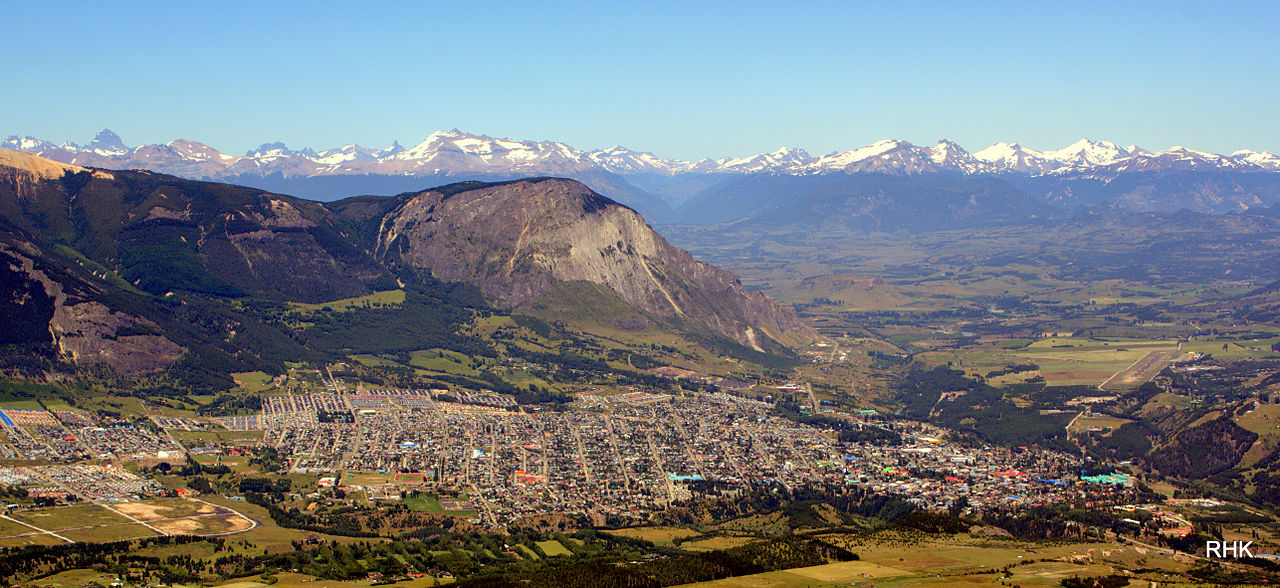
Context · Coyhaique seen from the Coyhaique National Reserve
Panoramic view of the city beside which lies Teniente Vidal aerodrome, the reference point the pilot gave. It is an image of the place, taken by day in 2013, not of the phenomenon: no image of the sighting was handed over.
Coyhaique desde la RNC.jpg (Rakela) · Wikimedia Commons · CC BY-SA 3.0 · open original
SEFAA (Chilean DGAC) report, case no. 1101, Coyhaique, 20 April 2020
Two-page report by the official anomalous aerial phenomena section. It quotes the pilot's account, explains how his flight was identified from the flight plans and the passenger manifest of the other aircraft on the route, reproduces his email declining to cooperate further and closes the case as a 'Report' (Relato) for lack of study material. A DGAC work with no open licence, so it is linked rather than hosted.
SEFAA, Dirección General de Aeronáutica Civil de Chile · view source
The night in question
On Monday 20 April 2020, a 36-year-old pilot, identified in the report only by his initials, took off from Carlos Ibáñez del Campo airport in Punta Arenas bound for El Tepual airport in Puerto Montt. According to his report to what was then CEFAA, at around 20:00 local time, while flying at about 28,000 feet 'abeam' Teniente Vidal aerodrome in Coyhaique, in the Aysén region, 'a large light stayed above, in front of my aircraft; I thought it was an airliner, but as it moved and came closer it clearly was not'. He described it as oval, blue-green in colour, and placed it 1,000 metres from his aircraft. He could not say where it came from, but said it disappeared towards the northwest. The report records no weather ('N/A') and no other witnesses.
The pilot added a detail that the report records without comment: 'Later that same light, on an outing with my son to Puerto Varas, appeared in some photos taken of Lake Llanquihue'. Those photos never reached the office.
SEFAA, the section of Chile's Directorate General of Civil Aviation that studies these reports, began by establishing which aircraft it was. According to the flight-plan register, only two aircraft flew from Punta Arenas to Puerto Montt that day. The passenger manifest of one of them, a Piper Cheyenne belonging to the air-ambulance company Aerotac, showed a pilot and co-pilot whose names did not match the informant's; by elimination, the report came from flight C62 of the Air Prefecture of Carabineros de Chile, the national police. The report does not say what type of aircraft C62 was or whether it carried other crew or passengers.
The office asked the pilot for more details of the flight and any images he had of what he described. In an email of 5 May 2020 he replied that he found 'the procedure for sending the information cumbersome' and that, although he had 'had several episodes' with anomalous phenomena, he did not want to 'get involved' in the subject, ending with 'I'll leave it here'. From 8 May the file was handled by the director of CEFAA. The user, the report notes, provided no material for study. After more than a year and ten months with no further communication, SEFAA closed the investigation under paragraph 2d of its technical procedure, which concerns supporting audiovisual material, because there was nothing that allowed it to go beyond the account, and classified the case as a 'Report' (Relato). The report proposes no cause and does not mention any review of that night's sky, of radar or of visible satellites.
Why it matters
The case shows the limit of a cockpit report when the witness withdraws. SEFAA did what it could without him: it identified the flight by cross-checking flight plans and passenger manifests, and so inferred, by elimination, that the report came from Carabineros flight C62, which flew that route that night. But everything else rests on a single short account by a single crew member, with no images, no radar data in the report and no other recorded witnesses, and its author declined to expand on it. That he said he had had 'several episodes' with anomalous phenomena, and that he later saw 'that same light' in photos of Lake Llanquihue, some 480 kilometres to the north and on another day, are details of his own account that the report could not check: the photos were never handed over.
SEFAA proposed no cause, and that absence is not evidence against an ordinary one. On our own account, not SEFAA's, we used the PyEphem ephemeris software to calculate the position of Venus for an observer at 8,500 metres above Coyhaique. If 20:00 was Aysén time (UTC−4, the same as Santiago in April 2020), the planet was to the northwest, at an azimuth of about 305 to 307 degrees, and in the middle of setting: at 19:50 its geometric altitude was about −2.6 degrees and at 20:00 about −4.0. From 8,500 metres the apparent horizon lies about 3 degrees below the horizontal, and refraction along a grazing ray lifts objects a little further, so Venus was sinking behind that horizon at around 20:00, ahead and to the left of an aircraft heading almost due north. If the pilot gave Punta Arenas time (UTC−3), it was 19:00 in Aysén and Venus stood about 4 degrees above the horizontal, some 7 above the horizon visible from that height, also to the northwest. It was shining at magnitude −4.4, close to its peak brightness of late April 2020; the Sun was between 11 and 21 degrees below the horizon and the Moon, almost new, had not risen.
That coincidence identifies nothing, and the account itself has details that do not fit it. The pilot said the light was 'above' and 'in front of' the aircraft, not low on the horizon and off to one side; that it 'moved and came closer'; that it was 1,000 metres away, a distance a witness cannot measure at night for a light with no reference points; and that it was oval and blue-green. A very bright, low planet can look elongated and change colour through atmospheric turbulence, but that is a general possibility, not something the report checks. The time is also approximate, and the report gives neither the aircraft's heading nor its exact position. What remains is what SEFAA left: an account that could not be studied beyond its own words.
What's left on paper
Documented evidence
- Pilot's account: at around 20:00 local time and about 28,000 feet, abeam Teniente Vidal aerodrome in Coyhaique, a large, oval, blue-green light that 'stayed above, in front of my aircraft', 1,000 metres away, and disappeared towards the northwest
- The pilot first took it for an airliner, until it 'moved and came closer'
- Flight-plan register: only two aircraft flew from Punta Arenas to Puerto Montt that day; from the manifest of the other, an Aerotac Piper Cheyenne, the report was attributed to flight C62 of the Carabineros Air Prefecture
- The pilot said he later saw 'that same light' in photos of Lake Llanquihue, which he did not hand over
- Email of 5 May 2020: he found the procedure 'cumbersome', said he had had 'several episodes' and that he would 'leave it here'
Show 2 more items
- No images, no radar data in the report and no other recorded witnesses; closed as a 'Report' (Relato) under paragraph 2d of the technical procedure, with no cause proposed
- Our own deduction, not SEFAA's: according to PyEphem, Venus (magnitude −4.4) was setting to the northwest, azimuth about 305 to 307 degrees, at around 20:00 Aysén time as seen from 8,500 metres
Sources
- SEFAA (Chilean Directorate General of Civil Aviation) — 'Case No. 1101', Coyhaique, 20 Apr 2020 — Primary source: the pilot's account, identification of the flight from flight plans and manifests, the witness's email and the official conclusion.
- AARO — Fiscal Year 2024 Consolidated Annual Report on UAP (14 Nov 2024) — Base rate: the 174 cases resolved that year were all resolved to prosaic objects; many others remain unresolved.
- SEFAA — Anomalous Aerial Phenomena Study Section (DGAC), official site — Catalogue of cases published by the Chilean office.
Related cases
same country · same period
Southern Patagonian Ice Field · the light that crossed ahead of an A321 bound for Punta Arenas
2019 · Tier A
same country · same period
Iquique · the dawn 'aircraft' photographed by LXP380
2019 · Tier A
same country · same period
Arica · the light chased by the Carabineros aircraft
2018 · Tier A
same country · same period
Atacama · the light seen by the air ambulance near REBEP
2022 · Tier B