1985·Greek airspace — Naxos, Lemnos and Corfu
Greece.Greece · three air traffic controllers (Naxos, Lemnos, Corfu)
On 14 December 1985, according to the most traceable record, three air traffic controllers at Naxos, Lemnos and Corfu separately reported seeing a cigar-shaped object pass overhead at over 3,000 mph (about 4,800 km/h); the incident was documented at Hellenic Air Force Headquarters. A 2026 press account places it in 1990 and turns it into a radar target, with no date, places or source. An example of how a sighting changes as it is retold.
Tier B · IndicativeWhat do they mean? →
Limited evidence: a single witness, testimony gathered years later, or an account without contemporary primary documentation.
What it was
61%natural or human cause
Most likely an ordinary cause that no one has identified
See the split across the six explanations
Natural or human cause
No known cause
Context image (not a document from the case)
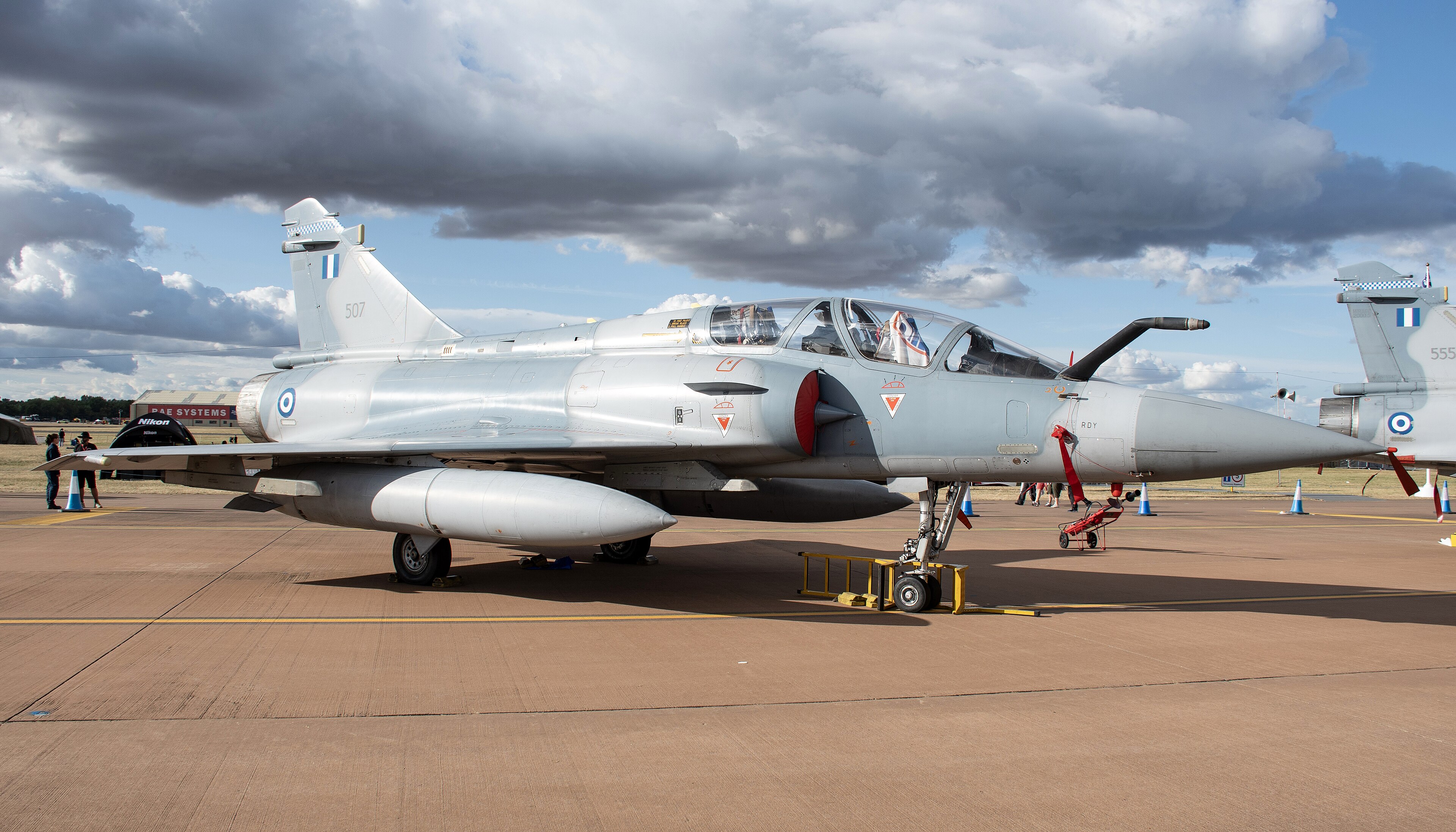
Context · the Hellenic Air Force, at whose headquarters the incident was documented
Hellenic Air Force Mirage 2000.jpg · Wikimedia Commons · CC BY-SA 4.0 · open original
The night in question
According to Wikipedia's list of Greek sightings, which relies on Greek researcher Thanasis Vempos, on 14 December 1985 three air traffic controllers stationed at Naxos, Lemnos and Corfu (three points far apart in Greek airspace, in the central Aegean, the northern Aegean and the Ionian Sea) reported seeing a cigar-shaped object pass overhead at a speed of over 3,000 mph, about 4,800 km/h, close to Mach 4. The sightings occurred close together in time, and the incident was documented at Hellenic Air Force Headquarters. According to the same source, officials concluded it was 'a spaceship of some kind' or American laser tests by the Strategic Defense Initiative, the missile-defence programme the Reagan administration had launched two years earlier.
There is a second version, more widely circulated in 2026. A GreekReporter article on Greek UFOs places the episode in 1990 and describes it as a hard target that three controllers followed on their radar screens, crossing Greek airspace at over 3,000 mph, and that led the Hellenic Air Force to open a file. It gives no day, places or source, and we have found no record supporting it: everything suggests it is a retelling of the same episode in which a visual sighting became a radar datum. This entry gives priority to the version with a date, places and an identifiable source, and keeps the other as an unverified account.
The context matters. In the mid-1980s the Aegean was one of the most closely watched and contested airspaces in Europe, with frequent interceptions between Greek and Turkish fighters, and the controllers were professionals used to telling real traffic apart. But what is known is thin: there is no published instrumental record or recovered material, the controllers' names and the content of the file are unknown, and the speed figure is an estimate that cannot be audited. A speed attributed to an object seen from the ground depends entirely on the distance assumed for it, and no source says how it was calculated. The conclusion the source attributes to the officials is not prosaic either: a spaceship or a secret laser-weapons test are extraordinary or classified-technology readings, not an identification.
Why it matters
What defines it is its institutional profile: not an anonymous sighting but three air traffic controllers at different points of the country and an incident documented at Hellenic Air Force Headquarters. It was preferred to the 'Greek Roswell' of Megas Platanos (2 September 1990, in central Greece), whose witnesses were villagers who described lights and an object falling in flames, and whose official explanation (the re-entry of a Soviet satellite, with the Air Force collecting debris) is plausible and mundane.
The case also shows how an episode is distorted as it passes from source to source. In the most traceable version, three controllers saw an object; in the 2026 one, they tracked it on radar as a hard target, five years later. The shift from a visual sighting to a radar datum is exactly the kind of embellishment that turns testimony into something that looks instrumental, and the one that gains most weight in the retelling: a radar return sounds like a measurement, a sighting sounds like a perception. That is why the entry gives priority to the version with a date, places and an identifiable source.
The documentary limit is clear. The content of the Hellenic Air Force file is not public, the controllers' names and any closing report are unavailable, and the figure of over 3,000 mph and the cigar shape are second-hand descriptions we cannot audit. That is the difference between the available Greek cases and a file of the French kind (GEIPAN), where the data are published. The episode has institutional provenance, but only the air force archive holds the detail.
What's left on paper
Documented evidence
- Three air traffic controllers at Naxos, Lemnos and Corfu separately reported seeing a cigar-shaped object pass overhead (14 Dec 1985, per Wikipedia citing Thanasis Vempos).
- Estimated speed over 3,000 mph; incident documented at Hellenic Air Force Headquarters.
- Conclusion attributed to officials: 'a spaceship of some kind' or American Strategic Defense Initiative laser tests.
- GreekReporter version (2026): the episode in 1990 and as a hard radar target, with no day, places or source; no record supports it.
- No published instrumental record or recovered material; the Hellenic Air Force file is not public.