1963·Mountain in northern Lebanon
Lebanon.Jebal · five professors watch a light that changes course
On the night of April 15, 1963, five university professors camping on an isolated mountain in northern Lebanon watched a very bright, star-like object for about 10 minutes. It crossed the sky from northeast to southwest with abrupt changes of course, turned back near the horizon and vanished overhead, without a sound. The U.S. naval attaché in Beirut reported it. The Air Force asked for more data, received three questionnaires and classified it as an aircraft, against the opinion of the principal witness.
Tier B · IndicativeWhat do they mean? →
Limited evidence: it falls short of what Tier A requires. Any one of these is enough: a single testimony (or several witnesses who saw it together), testimony gathered years later, or an account without contemporary primary documentation.
What it was
64%airplane
The most likely explanation.
- 64% airplane
- 6% other earthly causes
- 30% no known cause
See the split across the six explanations
Earthly origin (human or natural)70%
No known cause30%
Ordinary cause the sources propose: airplane
What happened
On Monday, April 15, 1963, Carl George, a professor of marine biology at the American University of Beirut, was camping with four other professors on a mountain in northern Lebanon. They were two geologists, one of them an amateur astronomer, a natural historian and a physics instructor. According to the report the U.S. naval attaché in Beirut wrote a week later, the mountain stood about 4,500 ft high (about 1,370 m) in a very isolated area that could be reached only on foot. The report calls it "Jebal," which is simply Arabic for "mountain," gives its coordinates and adds a place name that is barely legible in the copy ("…rrouha").
At 7:15 p.m. Lebanon time, the five saw a very bright object flying high and traveling from northeast to southwest. It seemed to give off its own light, "much like a star." The moon had not risen and the sky was clear and dark. As it crossed the sky it made several very abrupt changes of course, "much too quickly to have been an aircraft," according to the report. As it neared the horizon in the southwest it reversed course, and it finally disappeared when it was once more overhead. They heard no sound at any time. The sighting lasted about 10 minutes in all.
The naval attaché's office, known in Navy shorthand as ALUSNA Beirut, took down the account on April 19 and sent it on April 22 in a two-page intelligence report. It was prepared by Lt. Cmdr. J. G. Douglass Jr. and approved by Lt. Cmdr. Thomas G. Donahue, both of the U.S. Navy. The report described George as "a very observant man not given to exageration" and said all five agreed with the account and none could explain it. It rated the source A, the top grade for reliability, and the information 6, the grade meaning its truth cannot be judged. It cited an earlier report from the same office, numbered 199-61, on another UFO seen in Lebanon, and asked for an evaluation.
On June 3, the Air Force's Foreign Technology Division (FTD) replied from Wright-Patterson Air Force Base in Ohio. The FTD ran Project Blue Book, the program that studied UFO reports. The message, written by Lt. Col. Robert J. Friend and released in the name of Col. Eric T. de Jonckheere, went to the U.S. air attaché in Lebanon. It said the report "does not contain sufficient information to allow a valid conclusion" about the cause, and that the FTD knew of no event in Lebanon that could explain it.
The message asked for the witnesses to be contacted again with 14 questions. It wanted their names and addresses, the brightness compared with the brightest star, the apparent size, whether it left a trail or twinkled, and a diagram of the course changes. It also asked how it reversed, whether there were clouds, its elevation above the horizon and its bearing when first seen, when it turned back and when it vanished, and what "the four observers" thought afterward, probably meaning George's four companions.
The air attaché answered on June 5 that the report came from the naval attaché, and that he had asked the naval attaché for the information. The naval attaché replied, in a message received at Wright-Patterson on June 7, that the source was temporarily unavailable and that he would send the information in about three weeks. On July 10, 1963, Douglass sent a second report with three completed questionnaires. He explained that the other two sources had left the country; questionnaires had been mailed to them and would be forwarded when they came back. None of the 14 pages of the file is a labeled questionnaire from those two witnesses.
The questionnaires are typed and handwritten, and the copy is so faint that much of it cannot be read. George's answers say the object had no measurable size, left no trail and did not twinkle, that its turns were "remarkable," and that it grew dimmer as it neared the horizon, whereas the attaché's report has it vanish overhead. The sheet that follows his questionnaire adds that it showed no visible structure and no blinking lights, that no sound was heard, but a strong wind was blowing, and that a cloudy day had given way to a clear night with excellent visibility; they saw several shooting stars. They had a campfire going, but its sparks were not the cause. The sheet ends: "not an airliner," "quite unidentified."
Another questionnaire, answered by hand and initialed on July 1, 1963, says what struck its author most was "its erratic behaviour," which set it apart from any ordinary flying object, and its great speed. He wrote that its fairly constant brightness had led him to assume it was very far away, and that he had forgotten much of what he could have told at the time. He added that in the field he usually carried a geologist's compass (a "pocket transit") and would be willing to take measurements if he ever saw something similar again, provided he was told the results.
The third questionnaire, from a witness whose name cannot be read, rates the brightness as "about same" as the brightest star and, in its diagram, labels two paths "Object ①" and "Object ②," with a note about several abrupt changes of course; it does not say whether these were two objects or two legs of one flight. The attaché's report and the Blue Book record card, the form on which the project summed up and classified each case, both speak of a single object. A handwritten sheet with no attachment label puts the sighting at "about 7" p.m.; the figure after the 7 is smudged.
There are two versions of the time. The attaché's report gives "1915B": 7:15 p.m. in time zone B, Lebanon's zone, two hours ahead of Greenwich. The Blue Book card wrote "15/1915Z," 19:15 GMT, which would have been 9:15 p.m. in Lebanon; the moon had not risen by then either. The handwritten sheet, with its "about 7" p.m., is closer to the attaché's time.
The UFOScans site reproduces the file online. Its version takes the GMT time from the card, reads the mountain's name as "Marrouna," and calls the final assessment inconclusive. It quotes the card's comment about a misread aircraft but does not say that Blue Book closed the case as an aircraft.
Where it happened
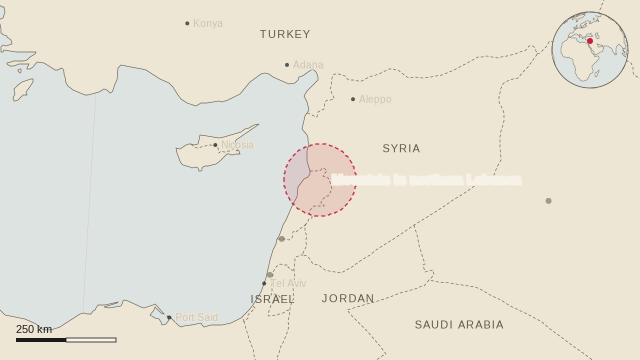
Why it matters
The Blue Book record card, which is undated, checks the box "Was Aircraft." Its comment says more data had been requested, that the report described the maneuvers confusingly, that the data contained inconsistencies, and that nothing "of a factual nature" pointed to anything other than a misread aircraft. It names a single objection: "the opinion of the principal witness that changes in direction were too abrupt for a/c." It ends: "Case evaluated as a/c."
The conclusion does not rest on any new fact. In June, the FTD itself had written that the report was not enough to conclude anything, and the July questionnaires give no height, heading or time for any aircraft; there is no known inquiry to civil or military aviation in the area. The questionnaires repeat the abrupt turns and the silence, and the sheet attached to George's rules out an airliner. A light crossing the sky silently for 10 minutes fits a high-flying aircraft, and the silence counts for less given the strong wind George noted. What does not fit are the turns and the reversal, and those rest on what the witnesses estimated at night, with no reference points in the sky.
Other causes can be checked. According to a calculation done for this case, at 7:15 p.m. Lebanon time the sun was about 14° below the horizon and the moon rose close to midnight, so the sky was dark, as the report says. Venus and Jupiter were below the horizon; Mars shone very high in the south, but a planet does not cross the sky in 10 minutes. The GCAT catalog kept by astronomer Jonathan McDowell, which lists rocket and satellite launches and reentries, has no reentry between April 14 and 16, 1963, and the only launch on the 15th is a Nike sounding rocket from Cape Canaveral, Florida, at 19:30 GMT, across the Atlantic and at the wrong hour. A satellite, moreover, does not reverse course.
The five witnesses were scientists, one of them an amateur astronomer, but they saw the object together, so they count as a single testimony, and their questionnaires came in almost three months later. What keeps the doubt alive is their account of the turns; what supports Blue Book's conclusion is that nothing else contradicts it.
Documents and sources
Primary documents
Blue Book file on Jebal (Lebanon, 1963), 6-page extract: record card, naval attaché reports and Air Force message
The Air Force record card and the official reports and messages on the object five professors saw from a mountain in northern Lebanon on April 15, 1963. The card, an undated ATIC Form 329, checks "Was Aircraft."
Read more
It is followed by the intelligence report of the U.S. naval attaché in Beirut dated April 22, 1963 (two pages, approved by Lt. Cmdr. Thomas G. Donahue), the FTD message of June 3 asking for more data (two pages), and the attaché's second report, dated July 10. This is a grayscale extract of pages 1, 7, 8, 9, 10 and 13 of the file; the full original, with the witnesses' questionnaires, is at archive.org.
Project Blue Book (NARA), via archive.org · Public domain · US Government work · open original
Documented evidence
- Intelligence report 5 857 0099 63 from the U.S. naval attaché's office in Beirut (ALUSNA), April 22, 1963, two pages (PDF pp. 7 and 8 of the file): event date April 15, account taken in Beirut on the 19th; five professors camping at about 4,500 ft; very bright object from northeast to southwest at "1915B," abrupt course changes, reversal and disappearance overhead, no sound, 10 minutes; source "Dr Carl George," evaluation A-6; prepared by J. G. Douglass Jr. and approved by Thomas G. Donahue
- FTD (Wright-Patterson) message to the air attaché in Lebanon, June 3, 1963 (pp. 9 and 10), written by Lt. Col. Robert J. Friend and released in the name of Col. Eric T. de Jonckheere, though someone else signed for him: the report "does not contain sufficient information to allow a valid conclusion"; the FTD knows of no event in Lebanon that would explain it; asks the witnesses 14 questions
- Messages received at Wright-Patterson on June 7, 1963 (pp. 11 and 12): the air attaché refers the request to the naval attaché, who wrote the report, and the naval attaché says the source is unavailable and that he will send the information in about three weeks
- Second naval attaché report, 5 857 0154 63, July 10, 1963 (p. 13), with three questionnaires (pp. 2 to 6 and 14): the other two sources had left the country. George compares the brightness with that of the brightest star and, in the faint copy, seems to note some clouds, but only at the horizon. The sheet following George's questionnaire says "not an airliner" and "quite unidentified"; another, signed July 1, stresses "its erratic behaviour"; the third labels "Object ①" and "Object ②" in its diagram
- Blue Book record card, ATIC Form 329, undated (p. 1): April 15, 1963, "Jebal, Lebanon," time "15/1915Z," visual observation from the ground, civilian source, one object, 10 minutes; "Was Aircraft" box checked; the comment names the principal witness's opinion as the only objection and ends "Case evaluated as a/c"
- Jonathan McDowell's GCAT catalog: no reentries from April 14 to 16, 1963; the only launch on the 15th is a Nike smoke rocket from Cape Canaveral at 19:30 GMT. By a calculation made for this case, at 17:15 GMT the sun was about 14° below the horizon at the site, the moon rose around 21:53 GMT, and Venus and Jupiter were below the horizon
Sources
- Project Blue Book (NARA), file "1963-04-9317107, Jebal, Lebanon," 14 pp., copy at archive.org — Primary source. PDF p. 1: record card; pp. 2 to 6 and 14: three witnesses' questionnaires; pp. 7 and 8: naval attaché report of April 22, 1963; pp. 9 and 10: FTD message of June 3; pp. 11 and 12: the attachés' replies; p. 13: report of July 10, 1963.
- Jonathan McDowell, General Catalog of Artificial Space Objects (GCAT), satcat.tsv, auxcat.tsv and launch.tsv — Reentry dates (satcat.tsv and auxcat.tsv): none from April 14 to 16, 1963. Launches (launch.tsv): on April 15, only the Nike rocket "Smoke 354" from Cape Canaveral, at 19:30 GMT.
- UFOScans, "1963-04-9317107 Jebal, Lebanon," copy and summary of the file — Secondary version: it gives the time as 19:15 GMT, reads the mountain's name as "Marrouna," and calls the final assessment inconclusive; it quotes the card's comment about a misread aircraft but not its "Was Aircraft" box. The page states that its summary was generated by a language model.
Related cases
Cases with the same likely cause.
Airplane · Within 10 years
USS Gyatt · a destroyer and Navy fighters track a fast object
1964 · Tier S
Airplane · Within 10 years
Nadi-Honolulu · a Qantas flight sees a plane's lights go dark
1962 · Tier B
Airplane · Within 10 years
Exeter · low red lights seen by two police officers
1965 · Tier A
Airplane · Within 10 years
USS Hassayampa · a Navy oiler's crew sees fast-moving lights
1965 · Tier S