1963·St. Gallen, canton of St. Gallen, Switzerland
Switzerland.St. Gallen · a light returns a second night and bursts apart
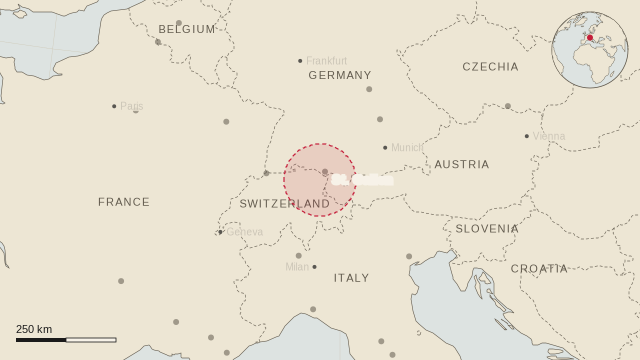
In St. Gallen, Switzerland, local residents saw a light like a small fireball cross the sky on August 13, 1963, and the next evening, at the same time, rise again over the mountains. On the second night it stopped glowing, looked dark through binoculars and, at about 8:04 p.m., became a larger fireball that burst like fireworks. They described it in an August 16 letter to NASA, which passed it on; the U.S. Air Force could not evaluate it and listed it as unidentified.
Tier B · IndicativeWhat do they mean? →
Limited evidence: it falls short of what Tier A requires. Any one of these is enough: a single testimony (or several witnesses who saw it together), testimony gathered years later, or an account without contemporary primary documentation.
What it was
72%ordinary cause, unidentified
The most likely explanation.
- 72% ordinary cause, unidentified
- 6% other earthly causes
- 22% no known cause
See the split across the six explanations
Earthly origin (human or natural)78%
No known cause22%
Why no ordinary cause is identified
What happened
What is known about the event comes from a letter written in English in St. Gallen, a city in northeastern Switzerland, on August 16, 1963. It is on the letterhead of a local company whose name is blacked out in the archive copy. The signature is blacked out too and is preceded by "ppa.," the abbreviation used when an authorized agent signs on behalf of a firm. The authors write as "we" and do not say how many of them there were. The letter is addressed to "NASA, Pentagong, Washington USA": to the U.S. space agency, but at the headquarters of the Defense Department, the Pentagon, spelled with an extra "g."
According to the letter, on Tuesday, August 13, they saw "somekind of a missile or satelite" flying at about 15,000 to 18,000 feet (4,600 to 5,500 meters). In the letter the second figure is hard to read; a later U.S. Air Force summary gives it as 18,000. It was glowing, looked like "a small fireball," and its speed and height did not change. For that first night the letter gives no time, direction or duration; it only says, when describing the second night, that the light came back at the same time.
On Wednesday, August 14, they waited, and at the same time as the evening before, the glowing ball rose again "exactly at the same point over the mountains." It flew at the same speed and in the same direction, a little lower: they estimated 7,500 to 10,000 feet (2,300 to 3,000 meters). The sky was slightly cloudy, but the light did not disappear behind the clouds. After about four minutes it suddenly stopped glowing. At first they thought it had gone into a cloud bank, but through binoculars they saw "a dark looking flying object," and a minute later the glow came back.
About 30 seconds later, that small glow turned into a fairly big fireball, about five times larger than before. It glowed for a few seconds and then suddenly broke into pieces, "so that it looked as firework on festivals." According to the letter, the burst came "at approx. 20.04," around 8:04 p.m., and the authors estimated that the glowing pieces fell in the area of the Toggenburg, which the letter places as "western part, county St. Gall": a district in the west of the canton of St. Gallen, southwest of the city. On Thursday, August 15, the light did not appear.
The letter ends by asking whether anyone in Washington knew of "a low flying satelite," because the newspapers were already running "silly talk" about flying saucers; the letter types "flying sources" where it meant "saucers." The airmail envelope was postmarked in St. Gallen the same day, August 16. In Washington, the mail section that received it, apparently NASA's, stamped it August 19, and a handwritten note headed "NASA" and dated August 20, 1963, passed it on "for appropriate action," noting that the writer had not been told of the referral. The letter ended up in Project Blue Book, the U.S. Air Force program that studied sightings.
Blue Book's record card for the case is an undated Form 329 of the former Air Technical Intelligence Center (ATIC) that sums up the letter. It lists August 13-14, 1963, a naked-eye sighting from the ground, a civilian source, one object, six minutes of observation, no photos, and a "southerly" course, a detail the letter does not give. The six minutes add up the stages of the second night: four minutes of flight, one dark, and half a minute until the burst.
The time is given as 14/1904Z, meaning 7:04 p.m. GMT on the 14th. Switzerland kept Central European Time with no daylight saving, so in St. Gallen it was the letter's 8:04 p.m. The card's summary copies the words "missile or Satellite" from the letter. For its conclusion, it checks the "Other" box with "UNIDENTIFIED" typed in; the "Unknown" box also appears to be checked. Both say the same thing: it was not identified.
The case comes up again in an Air Force sheet titled "UFO Sightings & Information Sheet," addressed to the Air Force public information office in Washington and signed "For the Commander" by Col. Eric T. de Jonckheere, Deputy for Technology and Subsystems. It has no typed date, but it was written after October 7, 1963, since it includes a case from that day; a handwritten note in the margin seems to read "5 Feb 64" or "6 Feb 64."
According to the sheet, on August 16, 1963, a sender whose name is blacked out reported observations on the nights of August 13 and 14. It adds, "We are unable to evaluate the case," and that it was listed as unidentified. A brief description had been included in the brochure the Air Force sent to people asking about UFOs, and the sheet suggested sending a copy to "Mr Schelling," a name that this time is not blacked out.
Where it happened
Why it matters
None of the documents identifies a cause. The letter's authors thought they had seen a missile or a satellite and asked whether it was one, and the Air Force wrote that it could not evaluate the case. The file's five pages are the record card, the letter, its envelope and the two pages of the information sheet: there is no report from Switzerland and no follow-up question to the authors. The case is listed as unidentified because there was nothing to evaluate it with, not because any particular cause was ruled out.
Some causes can be checked against the letter. The Perseids, the August meteor shower, peak on August 12 and 13, but a meteor crosses the sky in a second or two, and the letter describes four to six minutes of flight. The GCAT catalog kept by the astronomer Jonathan McDowell, which records rocket and satellite launches and reentries, lists no launch anywhere near that hour on August 13 or 14. The launches on those days were a Soviet R-16U missile at Baikonur, a Polaris A3 missile at Cape Canaveral, an Arcas rocket in Antarctica and an X-15 rocket plane in California, all far from Europe and, where the hour is recorded, at other times.
The same catalog gives August 13 as the reentry date of the U.S. spy satellite Corona M-23 and its Agena stage, with no time, and lists no reentry on the 14th. A reentry, moreover, does not repeat at the same time the next night. According to a calculation done for this case, at 7:04 p.m. GMT on August 14 the Sun had set in St. Gallen about half an hour earlier and was about 5° below the horizon. It was twilight: straight above the city, only something flying higher than about 23 kilometers was still in direct sunlight. At the heights the authors estimated, 2 to 5 kilometers, an object was already in shadow, so its glow could not have been reflected sunlight. Judging the height of a light with nothing to compare it to is only a guess, though, and an object much higher up could have been sunlit.
Another version of the case comes from the list of Blue Book unidentified cases compiled by the aviation writer Don Berliner after he went through the files at Maxwell Air Force Base, Alabama, in January 1974; the French researcher Patrick Gross is among those who reproduce it on their websites. That list dates the case to August 13 at 8:04 p.m., names the witness as "A.F. Schelling," and describes the fireball that went dark, glowed again and exploded. It then adds that the same witness had another, "undescribed" sighting on the 14th.
The letter tells it differently: on the 13th they only saw the light cross the sky, and the loss of the glow, the dark object and the 8:04 p.m. burst came on the 14th. The record card, with its time on the 14th, agrees with the letter. The initials "A.F." cannot be read in the archive copy, where the signature and letterhead are blacked out. The information sheet says "Mr Schelling," and the envelope's postage meter stamp carries the name of a St. Gallen company, "…fred. Schelling & Co."
What is left is the witnesses' own account, written two days after the second sighting, with a precise time and a detailed description of the second night. It reached the Air Force because its authors wrote to NASA and NASA passed it on, and nothing in the file checks it against anything else. It remains to be seen whether the Swiss press of those days, which the letter mentions, recorded other witnesses to the light or to its burst over the Toggenburg.
Documents and sources
Primary documents
Blue Book file on St. Gallen (August 1963), 2-page extract: record card and the witnesses' letter
The Air Force record card and the witnesses' letter about the light seen over St. Gallen on the nights of August 13 and 14, 1963.
Read more
The card, an undated ATIC Form 329, sums up the case, gives the time as 14/1904Z and concludes "UNIDENTIFIED." The letter, in English and dated August 16, 1963, is on the letterhead of a St. Gallen company and addressed to NASA; the company name and the signature are blacked out. This is a grayscale extract of pages 1 and 2 of the file; the full original, with the envelope and the Air Force information sheet, is at archive.org.
Project Blue Book (NARA), via archive.org · Public domain · US Government work · open original
Documented evidence
- Letter in English on the letterhead of a St. Gallen company, August 16, 1963, addressed to "NASA, Pentagong, Washington USA" (p. 2 of the file PDF): company name and signature blacked out; on August 13, a light "like a small fireball" at about 15,000 to 18,000 feet; on the 14th, at the same time, again over the mountains, at 7,500 to 10,000 feet; loss of glow after about 4 minutes, a dark object seen through binoculars, renewed glow and a burst "at approx. 20.04"; on the 15th it did not appear
- The letter's envelope (p. 3): St. Gallen postmark of August 16, 1963, and a postage meter stamp of a company named "…fred. Schelling & Co." (the first letter is illegible); a "…SA Mail Sec." stamp (apparently NASA's mail section) of August 19, 1963, and a handwritten note "NASA," August 20, 1963, "for appropriate action," noting that the writer had not been told of the referral
- Blue Book record card, ATIC Form 329, undated (p. 1): August 13-14, 1963; time 14/1904Z; naked-eye sighting from the ground; civilian source; one object; 6 minutes; "southerly" course; no photos; the final fireball with "5X brightness" (the letter says five times as big); heights of 15,000 to 18,000 and 7,500 to 10,000 feet; "Explosion took place at 200…" (the last digit is at the edge and illegible); conclusion "Other: UNIDENTIFIED," with the "Unknown" box apparently also checked
- Air Force "UFO Sightings & Information Sheet" to its public information office (SAFOI-PB), signed by Col. Eric T. de Jonckheere, written after October 7, 1963, with a handwritten note that seems to read "5 Feb 64" or "6 Feb 64" (pp. 4 and 5): "Mr Schelling" reported on August 16, 1963, observations on the nights of the 13th and 14th; "We are unable to evaluate the case"; listed as unidentified and included in the brochure for the public
- Jonathan McDowell's GCAT catalog (launches and satellites): no launch near 7:04 p.m. GMT on August 13 or 14, 1963; reentries of Corona M-23 and its Agena stage on August 13, with no time; no reentry on the 14th
- Don Berliner's list of Blue Book unidentified cases (reviewed at Maxwell, January 1974), reproduced by Patrick Gross: "Aug. 13, 1963, St. Gallen, Switzerland. 8:04 p.m.," witness "A.F. Schelling," a fireball that went dark and exploded, and another "undescribed" sighting on the 14th; according to Gross, Berliner read the original files and noted witnesses' names where given
Sources
- Project Blue Book (NARA), file "1963-08-9733054, St. Gallen, Switzerland," 5 pp., copy at archive.org — Primary source. PDF p. 1: record card (ATIC Form 329); p. 2: letter of August 16, 1963; p. 3: envelope, stamps and NASA referral note; pp. 4 and 5: Air Force information sheet covering this case and three others.
- Jonathan McDowell, General Catalog of Artificial Space Objects (GCAT), satcat.tsv, auxcat.tsv and launch.tsv — Launches on August 13 and 14, 1963 (launch.tsv) and reentry dates (satcat.tsv and auxcat.tsv): Corona M-23 (1963-029A) and its Agena D 1412 stage on August 13, with no time.
- Patrick Gross, page of 1963 Project Blue Book unexplained cases, with Don Berliner's list of unidentified cases — Secondary version: it puts the burst on August 13 and lists the 14th as an "undescribed" sighting, the reverse of the letter.
- All-domain Anomaly Resolution Office (AARO), Fiscal Year 2024 Consolidated Annual Report on Unidentified Anomalous Phenomena (Nov 14, 2024) — Base rate (p. 3): the 174 closed cases were resolved to prosaic objects; many others remain unresolved.