Case No. 162·Israel
1993·Moshav Kadima, near Netanya
Israel.Kadima · encounter wave with traces and police response (Israel, 1993)
Between March and June 1993, in the moshav of Kadima (near Netanya, Israel), several people —mostly women, in independent accounts— claimed encounters with a tall, bald 'gray'-type entity. The episode left verifiable material elements: circular depressions in a field with sampled residues (gelatinous material, reddish liquid, silicon deposits) and deep footprints that police tracked for several kilometers. The institutional response was real —about 30 Border Police officers combed the area— but the case's diffusion was dominated by sensational ufology (Barry Chamish), which erodes its credibility. It is the best-documented Israeli case, and it illustrates a high-strangeness point with fragile evidence: it enters the corpus as a Middle East opener and contrast case, not as an evidential anchor.
Year
1993
Tier
B
Probability
16%
Category
Incident
Limited evidence: single-witness, local or without primary verification. Three independent axes: the «tier» measures the strength of the evidence; the «probability» estimates how genuinely unexplained the case is —a natural phenomenon can remain unexplained, so it does not equal «non-prosaic»—; and the partition of explanations (below) says what it most plausibly was. So a well-documented case can have a possible hoax as its most plausible cause, and a Tier B is not, for that reason, a hoax.
Primary documents · viewer
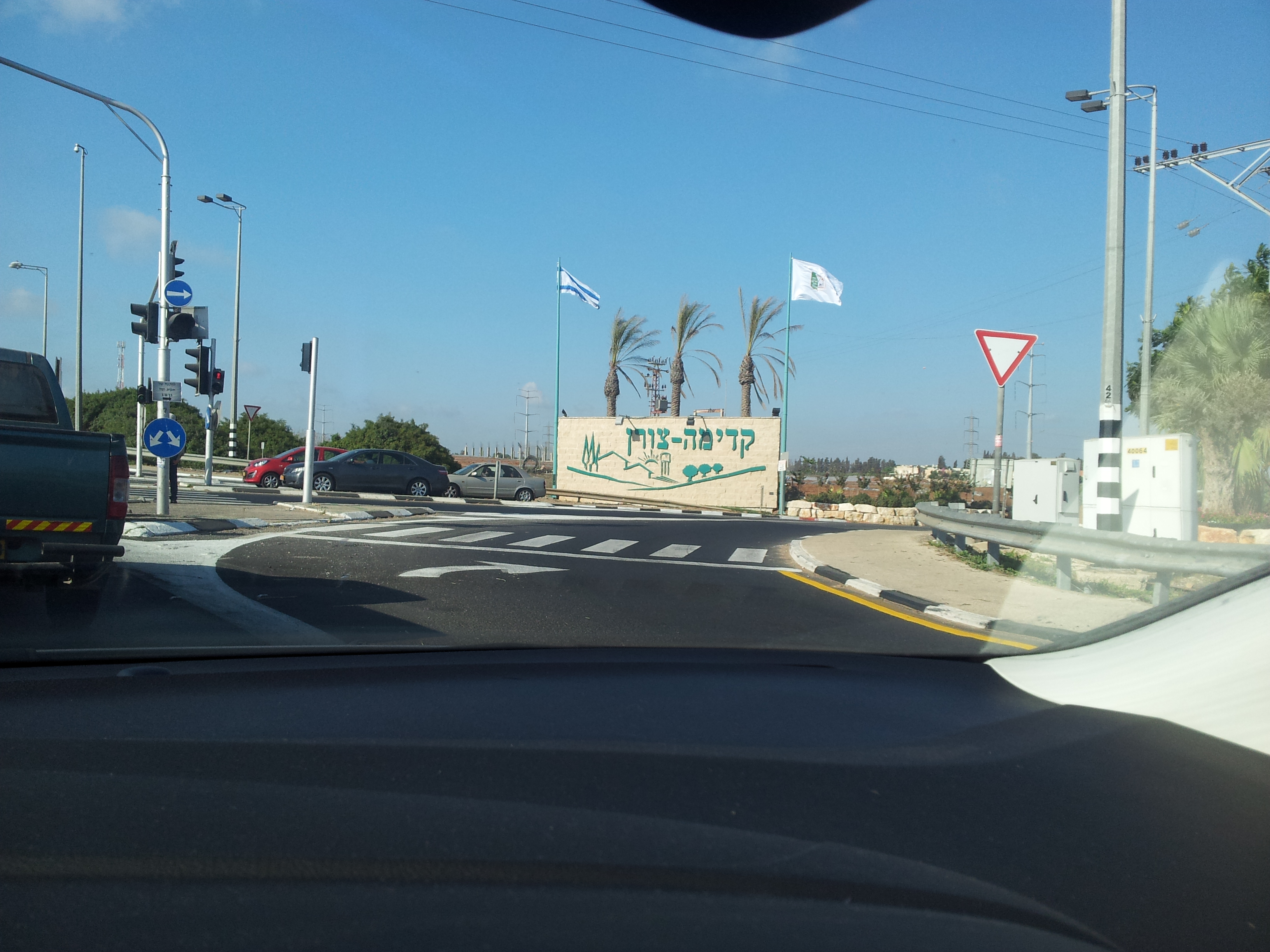
Context · Kadima (near Netanya, Israel)
Tzoran-KadimaEntrance.jpg · Wikimedia Commons · CC BY-SA 3.0 · open original
Part 01
The night in question
In the spring of 1993, the agricultural moshav of Kadima, near Netanya, was the setting for a series of reports of encounters with a non-human entity —the start of a wave that the area, today regarded as an Israeli ufological 'hotspot', would extend through 1998. Between March and June, several residents —accounts usually cite five women in separate episodes— independently and with notable agreement described a very tall being (about 2.5 meters), bald, of a 'gray' type, with an oval face, large glittering eyes and a minimal dot-like nose. That convergence between independent descriptions is the trait that drew local investigators' attention.
The case left material elements, which distinguishes it from a purely testimonial sighting. Depressions or 'landing circles' appeared in the fields —accounts mention a first one, then a second a few meters away and a third days later, and the full wave is said to have left more than a dozen— each with residues that were sampled: a black gelatinous material, a reddish, supposedly cadmium-based liquid, and, in at least one large circle about 18 meters across, remnants of a material that, as reported, the Geological Institute of Israel analyzed as very high-purity silicon. Deep footprints were also reported that, according to the accounts, police followed for several kilometers.
The institutional response was tangible: with the moshav's security alerted, the Border Police were called and about 30 officers combed the area overnight. They found no being, but the deployment and the footprint tracking were recorded. The case's problem is one of evidential provenance. Although the finding of high-purity silicon by a geological institute sounds impressive, pure silicon is not exotic —it is the base material of the semiconductor industry and appears in many industrial contexts— and no chain of custody was ever published that verifiably tied the analyzed sample to the field circle. Worse, the case's documentation and diffusion were handled by Israel's most enthusiastic ufology —in particular Barry Chamish, an author of highly questioned credibility who went so far as to frame the encounters within a biblical, prophetic narrative. The result is a high-strangeness file (occupant encounter + traces + police response) built on a fragile evidential base.
Part 02
Why this case moved the needle
It opens Israel —and with it the Middle East beyond Iran and Iraq— in a corpus where the region was the largest geographic gap. Its value is double and deliberately modest: regional coverage and a contrast case. Kadima gathers ingredients that in other files would be powerful —convergent independent descriptions, sampled physical traces, documented police response— but builds them on the worst provenance base: a maximally exotic morphology (giant grays), no independent lab analysis of the residues, and diffusion dominated by a sensational author. Hence Tier B and low probability: it is exactly the kind of case the corpus's discipline requires including without inflating —high strangeness, fragile evidence— as a reminder that the vividness of an account is not its evidential weight. The Border Police response is the only firm institutional element. And it is worth puncturing the 'pure silicon' mirage: though invoked as a hard technical datum, high-purity silicon is an ordinary industrial material —the substrate of all microelectronics— and, without a chain of custody tying it to the field circle, it certifies nothing exotic. Kadima thus works as a teaching case on evidential weight: on paper it gathers more ingredients than many celebrated files —convergent testimonies, traces, analysis, police— and yet it collapses once the provenance of each piece is examined. Its lesson is that the corpus's discipline consists of including what belongs geographically and historically without letting the vividness of the account substitute for the quality of the evidence.
Part 03
What's left on paper
Documented evidence
- Independent accounts (typically five women) of encounters with a tall (~2.5 m), bald, 'gray'-type entity between March and June 1993 in Kadima
- Circular depressions in a field, appearing in sequence, with sampled residues: black gelatinous material, reddish liquid and silicon deposits
- Deep footprints reported and tracked by police for several kilometers
- Response by Israel's Border Police — about 30 officers combed the area
- The residues were not analyzed by an independent lab with a published chain of custody
- Diffusion dominated by sensational ufology (Barry Chamish), of questioned credibility — the case's main limit
Sources
- Religion News Service — 'Is ET having a close encounter with the Holy Land?' (1996) — Press coverage of the Israeli wave and its context.
- David Halperin — 'UFOs in Israel' — Academic analysis of the UAP phenomenon in Israel (includes a critical framework).
Entity form (1)
Location
Moshav Kadima, near Netanya · 32.28°, 34.92°
Distribution of explanations
This case is classified among the model's hypotheses: the bar splits 100% by how much each explanation weighs (the uncertainty is spread across the hypotheses the case supports). Summed across the corpus they produce the comparable partition. It is a different question from the Probability above: that one estimates how likely the case is a genuinely unexplained phenomenon; this one splits which the explanation would be.
Modal hypothesis: Possible hoax 74% · sums to 100%
Structured analytical judgment, not a calibrated frequency. Forced classification: the mass the evidence cannot assign is spread across the hypotheses the case does support.