Case No. 161·Peru
1980·La Joya Air Base, Arequipa
Peru.La Joya · a Peruvian fighter fires at an object (Peru, 1980)
On April 11, 1980, at La Joya Air Base (Arequipa, Peru), Peruvian Air Force lieutenant Óscar Santa María Huertas scrambled in a Sukhoi Su-22 fighter to intercept an object the base initially took for a spy balloon. He fired 64 of his 140 rounds in a first burst that, by his testimony, the object seemed to absorb without damage; on the following attempts the object moved away just as he locked onto it. The object —described as about 10 meters across, with a shiny cream-colored dome over a silver circular base, like a cut light bulb— withstood 22 minutes of pursuit, was seen by hundreds of people at the base, and remained stationary for about two more hours. Santa María is the only documented pilot to have fired at an unidentified object.
Year
1980
Tier
A
Probability
60%
Category
Incident
Institutional evidence: multiple verifiable witnesses or official documentation. Three independent axes: the «tier» measures the strength of the evidence; the «probability» estimates how genuinely unexplained the case is —a natural phenomenon can remain unexplained, so it does not equal «non-prosaic»—; and the partition of explanations (below) says what it most plausibly was. So a well-documented case can have a possible hoax as its most plausible cause, and a Tier B is not, for that reason, a hoax.
Primary documents · viewer
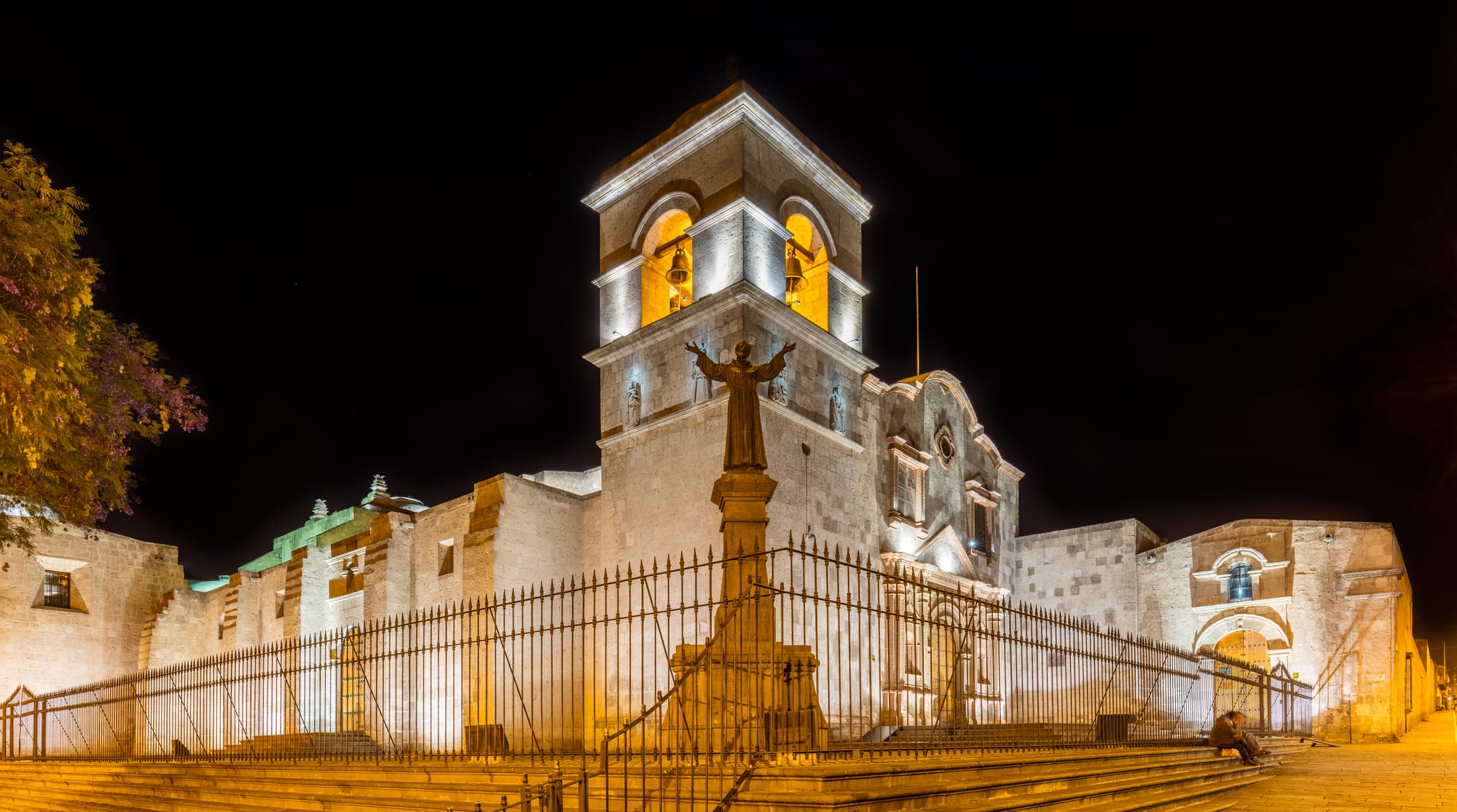
Context · Arequipa (Peru), near La Joya where a FAP fighter fired at the object
Complejo San Francisco, Arequipa, Perú, 2015-08-02, DD 79-81 HDR.JPG · Wikimedia Commons · CC BY-SA 4.0 · open original
Part 01
The night in question
On the morning of April 11, 1980, around 7:15, some 1,800 personnel assembled in formation in the yard of La Joya Air Base, in the Arequipa desert, observed a luminous spherical object hovering near the perimeter, a few kilometers away and at low altitude. Suspecting a foreign surveillance balloon over sensitive military facilities, the command ordered an interception. Lieutenant Óscar Santa María Huertas, about 23, took off in a Sukhoi Su-22 armed with 140 rounds of 30 mm cannon.
By his account, on his first pass he fired a burst of 64 rounds that formed 'a wall of fire' over the object; none seemed to damage it —the object absorbed the impact or dodged it with no visible effect. On the next three approaches, each time Santa María locked onto the target and was about to fire, the object climbed or moved away at high speed and stopped again out of range, in a pattern the pilot read as deliberate evasion. He came, by his testimony, within about 90 meters of the object, close enough to describe it in detail. The pursuit, at varying altitudes and toward high levels, lasted about 22 minutes. Out of useful ammunition and low on fuel, the pilot returned to base. The object —which he described as about 10 meters across, with a shiny cream-colored upper dome, like a light bulb cut in half, and a wide silver circular base— remained stationary in the sky for nearly two more hours, in view of hundreds of personnel.
The case stands as one of South America's best-attested military aeronautical files: a named, living protagonist, hundreds of witnesses at a military base, and behavior (active evasion of a fighter, resistance to cannon fire, prolonged stationarity) hard to fit a balloon or a natural phenomenon. Its limit is the absence of surviving instrumental record: no gun-camera film or published radar tracks are preserved, and the episode was not officially reported by the authorities of the time, which fed both its reputation as a 'perfect' case and the doubts of skeptics. Santa María testified publicly for decades —including before international forums and in the U.S.— and his account remained consistent until his death.
Part 02
Why this case moved the needle
It is Peru's most famous case and one of the few in the world with a military pilot firing live ammunition at an unidentified object — Óscar Santa María Huertas is, as far as documented, the only pilot to have done so. Its value is testimonial and institutional: a named officer, a military base as the setting, hundreds of witnesses, and object behavior that simultaneously strains the balloon hypothesis (it neither evades nor withstands cannon fire) and the natural-phenomenon one (it does not maneuver against a fighter). Tier A and not S because of the hard limitation: the episode rests on testimony —very consistent and sustained for forty years— but with no gun-camera film or published radar record to fix it objectively. It fits the fork the corpus treats as central: the initial suspicion was another state's surveillance technology; what the pilot reports pushes toward something no 1980 balloon could do.
It is worth weighing the two readings honestly, however. The case's strength is the convergence of a verifiable, exceptional act —a fighter firing live ammunition, recorded in the rounds expended— with the mass of witnesses in formation. Its weakness is that almost all the anomalous content (the absorbed fire, the intelligent evasion, the exact dimensions) comes from a single narrator, with no image or radar to back it, and an account repeated for forty years can consolidate and polish itself over time. The Peruvian Air Force's own official silence, which some read as cover-up, is also compatible with a routine episode —fire against an unidentified target that proved inconsequential— that never warranted a public report. The case therefore lives on the border between a genuinely extraordinary military event and a single, unverifiable testimony: it weighs, but it does not decide.
Part 03
What's left on paper
Documented evidence
- Decades-long sustained testimony of FAP lieutenant Óscar Santa María Huertas, the intercepting pilot
- Interception in a Sukhoi Su-22 armed with 140 rounds of 30 mm; 64 fired in the first burst
- The object appeared to absorb or dodge the fire without damage and evaded the fighter's subsequent locks
- Pursuit of about 22 minutes at varying altitudes; the object remained stationary for nearly two hours after the pilot returned
- Hundreds of witnesses among La Joya Air Base (Arequipa) personnel
- Object description: ~10 m, cream-colored upper dome like a cut light bulb over a silver circular base
- Initial institutional suspicion of a foreign surveillance balloon — ruled out by the observed behavior
- No known surviving instrumental record (no gun-camera film or published radar tracks)
- Initial debrief by the FAP Intelligence Service (1980)
Sources
- Enigma Labs — 'La Joya Air Force Base, Arequipa, Peru, April 11, 1980' — Case file with chronology and description of the object.
- Inexplicata (Journal of Hispanic Ufology) — 'Peru: La Joya AFB, The Perfect UFO Case (1980)' — Analysis of the case in Spanish-language ufology.
- Haines, R. F. & Vallée, J. — "Aerial Phenomena: Pilot Reports" (Journal of Scientific Exploration) — Scientific analysis of the La Joya / Santa María case (from the NARCAP archive).
Patterns it exhibits (1)
Location
La Joya Air Base, Arequipa · -16.61°, -71.87°
Distribution of explanations
This case is classified among the model's hypotheses: the bar splits 100% by how much each explanation weighs (the uncertainty is spread across the hypotheses the case supports). Summed across the corpus they produce the comparable partition. It is a different question from the Probability above: that one estimates how likely the case is a genuinely unexplained phenomenon; this one splits which the explanation would be.
Modal hypothesis: Non-human, no state management 33% · sums to 100%
Structured analytical judgment, not a calibrated frequency. Forced classification: the mass the evidence cannot assign is spread across the hypotheses the case does support.
Related cases
Associated actors (2)
