Case No. 163·United States
2004·Tinley Park, Illinois (Chicago metropolitan area)
United States.Tinley Park Lights · mass wave investigated by MUFON (USA, 2004)
On August 21, 2004, more than a hundred people in Tinley Park and neighboring towns of the Chicago area observed three reddish-orange lights in a triangular formation gliding silently across the sky. The episode repeated on Halloween night 2004, with dozens of additional witnesses across several towns. It is one of the best-documented mass sightings investigated by MUFON —Illinois MUFON director Sam Maranto compiled photos and video and publicly maintained it was not a hoax. But the prosaic explanation is robust: silent orange lights in a drifting formation are the classic signature of sky lanterns or flares. With no agreed resolution, it enters the corpus as a case of high testimonial participation and low evidential weight.
Year
2004
Tier
B
Probability
22%
Category
Incident
Limited evidence: single-witness, local or without primary verification. Three independent axes: the «tier» measures the strength of the evidence; the «probability» estimates how genuinely unexplained the case is —a natural phenomenon can remain unexplained, so it does not equal «non-prosaic»—; and the partition of explanations (below) says what it most plausibly was. So a well-documented case can have a possible hoax as its most plausible cause, and a Tier B is not, for that reason, a hoax.
Primary documents · viewer
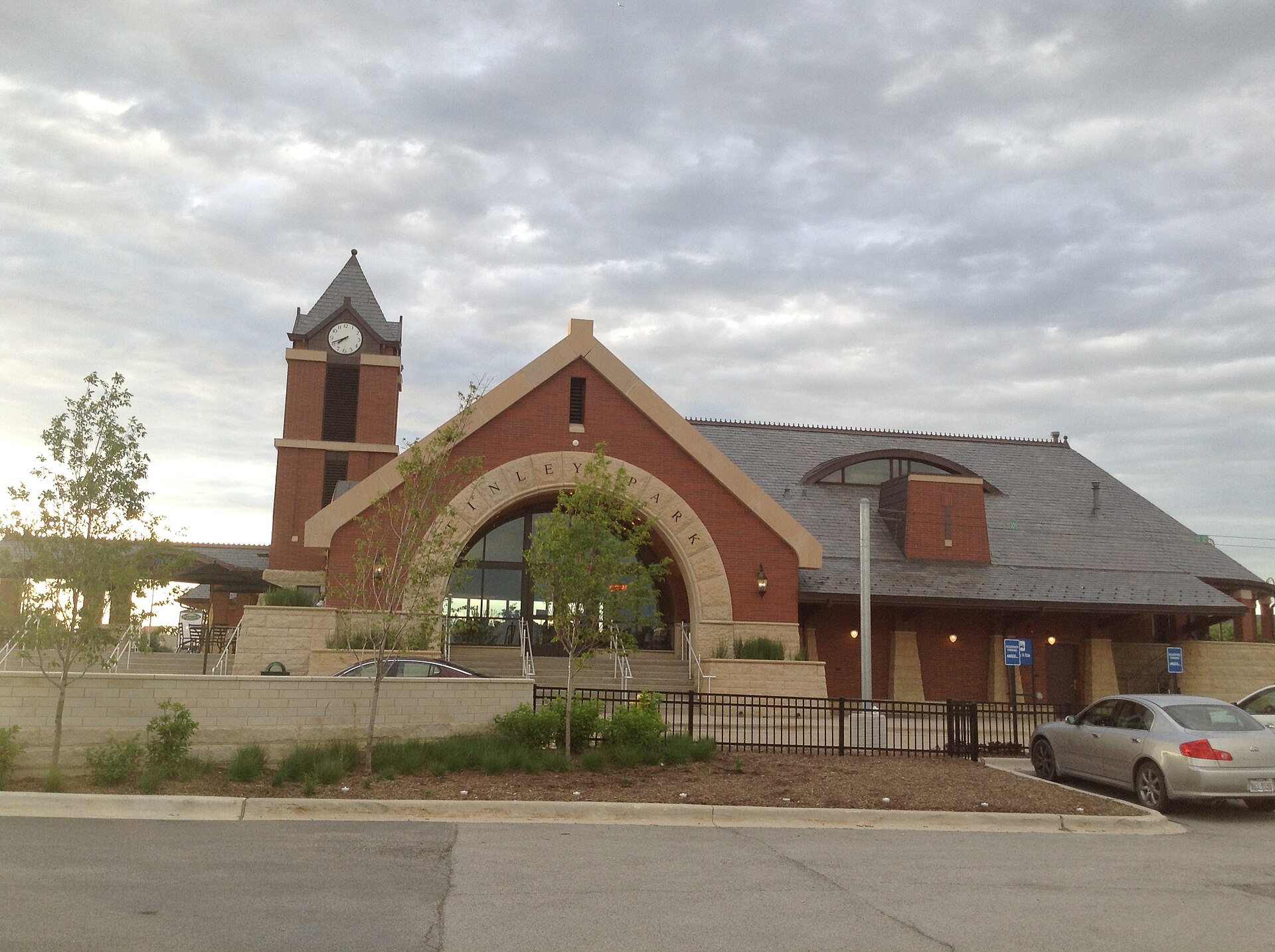
Context · Tinley Park (Illinois)
Tinley Park, Ill..JPG · Wikimedia Commons · CC BY-SA 4.0 · open original
Part 01
The night in question
On the night of August 21, 2004, over Tinley Park —a southern suburb of the Chicago metropolitan area— numerous residents reported three reddish-orange lights arranged in a triangular or linear formation, moving slowly and in complete silence. The distinctive feature was the scale: more than a hundred people, in Tinley Park and neighboring towns such as Oak Forest, Mokena, Orland Park, Frankfort and Evergreen Park, described the same phenomenon simultaneously. One factor that aided the mass scale was the context: an Ozzfest festival concert had just ended at the local amphitheater (the then Tweeter Center), so thousands of people were out on the street, heading home and looking at the sky. Several witnesses captured the lights in photographs and video.
The episode was not isolated: on Halloween night 2004 the lights reappeared, with dozens of additional witnesses (reports cite some 77 people) describing the same pattern. The recurrence in the same area, with the same appearance, reinforced interest and pushed the case into national coverage; years later it was covered on television, including an episode of the series 'UFO Hunters' (History Channel) titled 'Invasion Illinois'.
The case was investigated by MUFON, in particular by Sam Maranto, director of the Illinois chapter, who compiled the testimonies and the visual material and has publicly argued the event was not staged, stressing that the observing conditions —clear sky, a crowd of sober, dispersed witnesses— were optimal. Skeptics, in turn, offered conventional explanations: sky lanterns, ground-launched flares, or balloons with lights. Neither position was conclusively demonstrated; it is worth noting a nuance sometimes misused in this case: although Illinois banned sky lanterns in 2013, that rule is later and says nothing about their availability in 2004, when they circulated normally. The reported behavior —orange, silent lights, in formation, drifting with the wind— is compatible both with an unidentified sighting and, more economically, with lanterns: the reddish-orange is the color of a flame, the silence and drift are typical of unpowered objects carried by the wind, and the 'formation' can be the result of several lanterns released together that the wind aligns and then disperses.
Part 02
Why this case moved the needle
It matters as the best-documented MUFON-linked mass sighting missing from the corpus, and as an honest calibration anchor. It gathers what makes a case memorable —a hundred or more independent witnesses, recurrence, photos and video, field investigation by the largest civilian network— over a phenomenon that very probably has a prosaic cause. It is the U.S. counterpart to the 1981 China spiral: it shows that witness count measures notoriety, not anomaly. The corpus's discipline requires including these cases —highly participated, weakly evidential— so as not to confuse virality with evidential weight. Tier B and low probability precisely because the lantern/flare hypothesis economically explains all the reported features; the file's value is methodological, not evidential.
It is worth underscoring where the disagreement lies. The field investigator does not argue it was a craft; he argues it was not a hoax —that is, that a hundred people saw something real in the sky. That is very probably true and yet perfectly compatible with the prosaic explanation: sky lanterns are real physical objects that very many people can see at once. 'It was not staged' and 'they were lanterns' do not contradict each other. The error the case helps avoid is sliding from 'the sighting is genuine' to 'the object is unexplained', a leap the witness count invites but the evidence does not support. That is why Tinley Park anchors calibration: it measures how much mass participation weighs when the hard datum is missing.
Part 03
What's left on paper
Documented evidence
- Simultaneous observation by more than a hundred people in Tinley Park and neighboring towns (Oak Forest, Mokena, Orland Park, Frankfort, Evergreen Park) on August 21, 2004
- Second wave on Halloween night 2004 with dozens of additional witnesses (~77)
- Photographs and video taken by witnesses
- MUFON field investigation; Sam Maranto (Illinois MUFON director) compiled the material and publicly ruled out a hoax
- Consistent description: three reddish-orange lights, silent, in formation, drifting
- Sustained conventional skeptical explanation: sky lanterns, flares or balloons with lights — compatible with all reported features
Sources
- The Clio — 'First Sighting of the Tinley Park Lights' — Chronology and context of the case.
- Patch (Tinley Park) — 'UFO Expert On Tinley Park's 2004 Sightings: They Were Not A Hoax' — Position of Sam Maranto (MUFON Illinois).
- Chicago Sun-Times — '5 notable UFO sightings in Illinois history' — Press coverage of the case in context.
Location
Tinley Park, Illinois (Chicago metropolitan area) · 41.57°, -87.78°
Distribution of explanations
This case is classified among the model's hypotheses: the bar splits 100% by how much each explanation weighs (the uncertainty is spread across the hypotheses the case supports). Summed across the corpus they produce the comparable partition. It is a different question from the Probability above: that one estimates how likely the case is a genuinely unexplained phenomenon; this one splits which the explanation would be.
Modal hypothesis: Misidentification 89% · sums to 100%
Confused with: No single object identified
Structured analytical judgment, not a calibrated frequency. Forced classification: the mass the evidence cannot assign is spread across the hypotheses the case does support.
Related cases