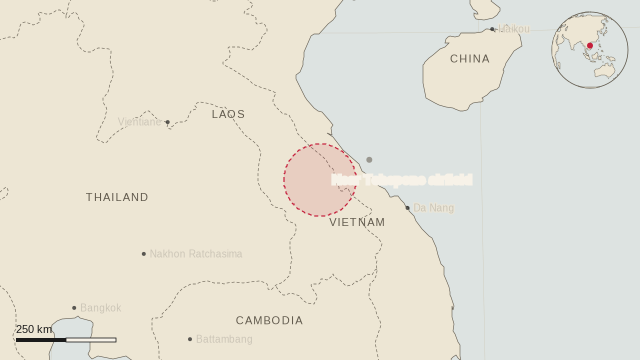
1966·Near Tchepone airfield (now Xepon), southern Laos
Laos.Tchepone · a fighter pilot sees a green-trailed light pass over
On the night of March 18, 1966, a U.S. Marine major flying an F-4 fighter on a strike mission near Tchepone, in southern Laos, saw a light that passed over his aircraft toward the northeast in two or three seconds and went out "as if burnt out." It left a white trail edged with very bright green. His air wing reported it that same day and sent fuller details on March 29. Project Blue Book filed it as a meteor, with a date and time on its card that do not match that message.
Tier A · AcceptableWhat do they mean? →
Institutional evidence: several identified independent witnesses, or contemporary official documentation, without an instrumental record to corroborate them.
What it was
78%meteor or fireball
The most likely explanation.
- 78% meteor or fireball
- 5% other earthly causes
- 17% no known cause
See the split across the six explanations
Earthly origin (human or natural)83%
No known cause17%
Ordinary cause the sources propose: meteor or fireball
What happened
In March 1966, U.S. Marine fighters based in South Vietnam were flying "Steel Tiger" missions, the name of the air campaign against the North Vietnamese supply routes that ran through southern Laos. On one of them, a major from a squadron the message spells "VMFA 7314" was flying an F-4 Phantom, a two-seat fighter. The designation looks like a typo for VMFA-314, a Marine Phantom squadron that flew from Chu Lai and Da Nang between 1965 and 1970, according to its official history.
According to the message his air wing sent eleven days later, at about 22:00 on the 18th the aircraft was at 6,000 ft near the airfield the text calls "ICHEP," next to Tchepone (now Xepon) according to the military map grid in the message, in a left turn with its heading passing 100 degrees. That time is in military zone H, eight hours ahead of Greenwich. Laos is one hour behind that zone, so it was 9:00 p.m. there, and working from that time and the airfield's position, the sun had set about three hours earlier: it was full night.
The pilot first saw the object to his right and slightly behind, between 90 and 120 degrees off the nose, 45 degrees above the horizon. Within two or three seconds, by his estimate, it passed over the aircraft toward the northeast and faded from sight "as if burnt out," about 10 degrees past the vertical. He judged it to be "possibly" 10,000 ft above him. All he saw of the object was a "tail" of gaseous residue spanning an arc of about 25 degrees, white in the center and edged on both sides by a strip of very bright green. The tail did not linger in the sky: it moved with whatever produced it, "much like an afterburner or rocket exhaust," and small particles seemed to rise as it went over the aircraft.
His first impression, the message says, was "a big comet," but it seemed too close and too big, "more like a rocket." Visibility was five miles in haze, with a scattered cloud layer around 18,000 ft, and the pilot noticed no unusual atmospheric or electronic effects. The message reports only what the pilot saw: it does not say whether the F-4's second crew member saw anything, and it mentions no radar.
The message adds the account of a captain from the same squadron, who said he had seen "the same or similar object" twice before: once in the same area and once about 5 nautical miles from Chu Lai, on a bearing of 150 degrees. The next sentence is garbled in the copy ("WAS REPORTED OR DEGRIFFED"), but it opens with "however," so it most likely says that no one reported those sightings or asked about them in a debriefing. The captain was not available for interview at the time.
The message with all those details was sent in the name of the general commanding the 1st Marine Aircraft Wing on March 29 at 07:17 GMT and addressed to the head of U.S. Pacific Command. It answered a request for more details: the first report, an operational report (OPREP-4) the same wing sent on the 18th at 17:15 GMT, about three hours after the event, had given information that was "imprecise and in part misleading," and Pacific Command asked for more details on the 25th. On April 14 the Pacific Fleet forwarded it to the Navy, and the Air Force Chief of Staff's office forwarded it to the Wright-Patterson division that ran Project Blue Book, the Air Force program that studied sightings.
The Blue Book record card dates the event "18 April 66" at "18/2200Z" and concludes "Astro (METEOR)," a meteor, the same note handwritten at the foot of the message. Both figures clash with the message. The month of April most likely comes from the April 14 forwarding, since the wing answered on March 29 about a report from the 18th. And the time reads the message's H as a Z, Greenwich time, which is impossible: by 22:00 GMT the wing had already reported the event, in its 17:15 GMT report. The card also records the direction, "90 to 120 degrees," without saying that the message measures it from the aircraft's nose, not from north. Measured from north with the 100-degree heading, working from the message's data, the light appeared to the south-southwest, which fits its crossing overhead toward the northeast.
Where it happened
Why it matters
The case has a trained witness, a report sent the same day and a detailed message eleven days later, sent because that report had been imprecise and Pacific Command asked for more details. The features the message records are those of a meteor, Blue Book's conclusion: a light that crosses the sky in two or three seconds with a colored trail and goes out. The pilot first thought of a comet and then of a rocket because he believed it was close, but the 10,000 ft above the aircraft is a naked-eye estimate, made at night, of a light of unknown size.
In that area there was a concrete reason to think of a rocket: the aircraft was flying a combat mission over the supply routes in Laos. No document in the file mentions a missile fired that night, and the message describes no maneuvers, fire or damage. The April 14 forwardings to the Navy's weapons bureau and its test and evaluation force carry no comment.
A reentering piece of space debris can also leave a trail like that. Jonathan McDowell's satellite catalog (GCAT) lists a single decay for March 18, 1966: a small sensor cover from a U.S. satellite launched in 1965, with no time or mass. For April 18, the card's date, it lists the Gemini 8 equipment module and a stage of a Soviet Voskhod rocket, also with no time; with the message's date, those two are ruled out.
The file also shows how a detail got distorted as it passed from hand to hand. The first report had errors that the command itself corrected eleven days later, and the card that sums up the case in Blue Book added two new ones, the month and the time zone. They are repeated by the ufoscans.com page that reproduces the file, which gives April 18, 22:00 GMT and an altitude of 12,000 ft. In the scanned copy, the second digit of that altitude is faint but has the shape of the typewriter's zero, not its 2, and it reads 10,000.
Documents and sources
Primary documents
Project Blue Book file on the sighting near Tchepone, March 1966 (excerpt, 5 pp.)
The Blue Book record card, with the meteor conclusion, and the 1st Marine Aircraft Wing message of March 29, 1966 describing what the F-4 pilot saw.
Read more
The card dates the event April 18 at 22:00 GMT; the message, sent March 29, places it on the 18th at 22:00 in military zone H (14:00 GMT). The message reached the Air Force forwarded on April 14, and carries its declassification stamps and the conclusion handwritten at the foot. Grayscale excerpt with pages 1, 3, 4, 5 and 6 of the file; page 3 carries the message header with its date, "290717Z MAR," and the April 14 forwardings. Page 2, another copy of that header, is left out.
Project Blue Book (USAF), U.S. National Archives, via archive.org · Public domain · US Government work · open original
Documented evidence
- Message from the 1st Marine Aircraft Wing to Pacific Command, March 29, 1966 at 07:17 GMT (pp. 2–6): between 22:00 and 22:03 or 22:13 (zone H) on the 18th, a major from squadron "VMFA 7314" was flying an F-4 ("F4R" in the copy) on a Steel Tiger mission near "ICHEP AIRFIELD (XD 25485)," at 6,000 ft, in a left turn with his heading passing 100 degrees
- Same message: the object appeared between 120 and 90 degrees off the nose and 45 degrees above the horizon, passed over the aircraft in two or three seconds toward the northeast and faded "as if burnt out" about 10 degrees past the vertical; altitude estimated at "possibly" 10,000 ft above the aircraft; only a tail of gaseous residue of about 25 degrees was seen, white and edged with very bright green, moving with its source
- Same message: the pilot's first impression, "a big comet"; then too close and too big, "more like a rocket"; visibility five miles in haze, scattered layer around 18,000 ft, no unusual atmospheric or electronic effects
- Same message: a captain from the same squadron said he had seen the same or a similar object twice before, in the same area and about 5 nautical miles from Chu Lai; the sentence on whether they were reported is garbled, and the captain was not available for interview
- Same message, paragraph 1: the first report was an OPREP-4 from the same wing, sent on the 18th at 17:15 GMT, whose information was "imprecise and in part misleading"; neither that reference nor the time of the event gives a month, and March follows from the sequence of messages; Pacific Command (25th, 04:29 GMT) and the Pacific Fleet (25th, 21:04 GMT) asked for and ordered more details
Show 3 more facts
- Forwarding headers (pp. 2 and 3): the Pacific Fleet passed it on April 14 to the Navy's Operational Test and Evaluation Force, the Chief of Naval Operations and the Bureau of Naval Weapons; the Air Force Chief of Staff's office, the same day, to the Air Force Cambridge Research Laboratories (AFCRL) and the Foreign Technology Division (FTD) at Wright-Patterson
- Project Blue Book record card (p. 1): "18 April 66 18/2200Z," Laos, military source, one object, 2 to 3 seconds, air-visual, northeasterly course; summary with an "azimuth" of 90 to 120 degrees; conclusion "Astro (METEOR)"
- Jonathan McDowell's GCAT catalog: the only decay listed for March 18, 1966 is a sensor cover from OPS 6717, identified with a question mark in the catalog (launched April 28, 1965), with no time; on April 18, 1966 the Gemini 8 equipment module and the Blok I stage of the Voskhod launched on April 6 decayed
Sources
- Project Blue Book, file "1966 04 7107384 Laos" (archive.org, 6 pp.) — Primary source: record card (p. 1), the header of the 1st Marine Aircraft Wing message of March 29, with the April 14, 1966 forwardings (pp. 2 and 3, two copies of the same header), and the message text (pp. 4–6), with the conclusion handwritten on p. 6.
- Jonathan McDowell, General Catalog of Artificial Space Objects (GCAT), satcat.tsv — Decay dates for March 18 and April 18, 1966 (DDate column), checked for the reentry hypothesis.
- 3rd Marine Aircraft Wing, "Marine Fighter Attack Squadron 314: History" — The squadron's official history: combat flights from Chu Lai and Da Nang between 1965 and 1970; context for reading "VMFA 7314."
- UFOScans, "1966-04-7107384-Laos" (secondary source) — Reproduces the file with an automatically generated summary: it takes April 18 and 22:00 GMT from the card and reads 12,000 ft where the copy says 10,000; used only to compare the version in circulation.
Related cases
Cases with the same likely cause.
Meteor or fireball · Within 10 years
Kecksburg · residents say something fell into the woods
1965 · Tier A
Meteor or fireball · Within 10 years
Rangoon · flashes and a white streak over the city
1965 · Tier B
Meteor or fireball · Within 10 years
Jakarta · eight young people see a bright object with a tail
1963 · Tier B
Meteor or fireball · Within 10 years
Suva · a fireball crosses Fiji and falls into the sea
1963 · Tier A