1965·Rangoon (now Yangon), Burma
Burma.Rangoon · flashes and a white streak over the city
On a clear night in March 1965, in Rangoon, the capital of Burma, a civilian employee of the U.S. aid agency and a Japanese diplomat watched a bright light burst almost directly overhead, then fade into a white streak. Their account reached the U.S. Air Force in the same days that debris from two Soviet spacecraft was falling back to Earth, and the case came down to a choice between a meteor and one of those falling pieces.
Tier B · IndicativeWhat do they mean? →
Limited evidence: it falls short of what Tier A requires. Any one of these is enough: a single testimony (or several witnesses who saw it together), testimony gathered years later, or an account without contemporary primary documentation.
What it was
85%meteor or fireball
The most likely explanation.
- 85% meteor or fireball
- 3% other earthly causes
- 12% no known cause
See the split across the six explanations
Earthly origin (human or natural)88%
No known cause12%
Ordinary cause the sources propose: meteor or fireball
What happened
It was a clear night in Rangoon, and a group of people was sitting outdoors. At about 8:20 p.m. local time, a bright flash made them look up toward the north-northwest, high in the sky. There they saw two or three more flashes and then a big one, which at arm's length would have covered about two inches. That last light lit up everything around them and left the people present with an afterimage in their eyes.
After the big flash, everything went dark for a moment. Then a bright white streak appeared, coming from the north-northwest and lasting five to ten seconds. According to the account, the whole episode lasted no more than ten to fifteen seconds. The witnesses thought it might be an exploding comet.
Two of the people present reported what they saw: a civilian employee of the U.S. Agency for International Development (USAID), the body that ran U.S. aid abroad, and a Japanese diplomat. The message preserved by Blue Book, the U.S. Air Force program that studied UFOs, does not give their names or say how many people were in the group.
That message was sent on March 30, five days later, by the air attaché's office at the U.S. embassy in Rangoon. It went to the Defense Intelligence Agency and Air Force headquarters in Washington, with copies to, among others, the North American Air Defense Command (NORAD) and the Air Force center that tracked satellites in orbit.
Someone corrected two words of the message by hand. The teletype gave the flashes' position in degrees of "azimuth," a compass direction; the hand crossed out the word and wrote "elevation," the height above the horizon. The correction makes sense: the figure, smudged in the message, is 80 degrees according to the case's summary card, and an elevation of 80 degrees puts the flashes almost straight overhead, as the witnesses described. The same hand, or perhaps another, crossed out "comet" at the end of the text and wrote "meteor" beside it.
That card, a form from the Air Force office that ran Blue Book, copied the account with both corrections: it noted that the witnesses thought of an exploding meteor, although in the message, as written in Rangoon, they spoke of a comet. It also added a course the message does not give, south-southeast: the way a streak coming from the north-northwest would be heading.
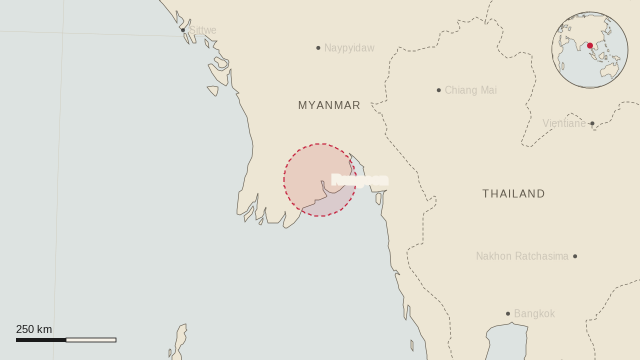
Where it happened
Why it matters
Blue Book closed the case as astronomical, a meteor, and below the conclusion someone wrote by hand a word that looks like "Bolide," the name given to the brightest meteors. The card's analyst also weighed the other explanation the date allowed. He noted "considerable" reentry activity, the fall into the atmosphere of objects in orbit, and cited two specific objects coming down that very day, as well as several pieces of the Soviet satellite Cosmos 57 that kept falling until March 26. He judged that the direction and description fit both causes and that the duration did too, though it was more typical of a meteor, and that the whiteness of the light pointed to a meteor.
The space object catalog kept by astrophysicist Jonathan McDowell confirms both reentries. The first, a Cosmos 57 fragment, fell on March 25, 1965. The second, going by the catalog number on the card, is the inflatable airlock of the Soviet spacecraft Voskhod 2. The spacecraft had launched on March 18 and carried out the first spacewalk; its airlock also came down on the 25th. Cosmos 57, an uncrewed test of that same spacecraft, had been destroyed in orbit on its launch day, February 22, and its debris had been falling ever since: the catalog lists two more of its pieces that fell on that March 25. The orbits of those objects passed over Rangoon's latitude, but the catalog gives only the day of each fall, not the time or the place, so it cannot show whether any of them crossed the Burmese sky at 8:20 p.m.
The automatic summary posted online alongside the case scans presents the Air Force's explanation as "meteor or satellite decay," as if the two carried equal weight. That is not what the card says: it concludes meteor and leaves reentry as the weaker alternative.
The case rests on an account the embassy relayed for the witnesses, without their names and five days later. The card marks no photographs and no physical evidence, and the message mentions no instrument. What the witnesses saw, several flashes that lit up their surroundings and a streak lasting a few seconds, is what the card judged typical of a meteor. The Moon could not have played a part: according to a calculation from the message's time and Rangoon's position, it was below the horizon.
Documents and sources
Primary documents
Project Blue Book, Rangoon, March 25, 1965: summary card and air attaché message (2 pp.)
The two pages Blue Book holds on the Rangoon sighting of March 25, 1965. The first is the Foreign Technology Division's summary card, with the conclusion "Astronomical (METEOR)" and the comment on the reentries of Cosmos 57 and of an object whose catalog number identifies it as the Voskhod 2 airlock.
Read more
The second is the U.S. air attaché's message from Rangoon, transmitted on March 30, with the hand corrections from "azimuth" to "elevation" and from "comet" to "meteor." Grayscale copy, cropped to the margins.
Source: Project Blue Book, U.S. National Archives (copy on archive.org) · Public domain (US Government) · open original
Documented evidence
- Unclassified message from the U.S. air attaché's office in Rangoon (CITE AIRA 36, March 1965), transmitted at 30/0850Z: a USAID civilian employee and a Japanese diplomat saw a bright flash at 25/1350Z from Rangoon, in clear weather, sitting outdoors; addressees: DIA, Air Force Chief of Staff (a line half cut off by the edge of the sheet), 1127th USAF Field Activities Group (Fort Belvoir), with copies to CINCPAC, CINCPACAF, 13th and 5th Air Forces, NORAD and Space Track (Hanscom Field)
- Local time: 13:50 UTC on March 25, 1965, is 8:20 p.m. in Rangoon, which kept Burma time (UTC+6:30, IANA time zone database, Asia/Yangon); the message went out on March 30 at 3:20 p.m. Rangoon time
- Hand corrections on the message: "AZIMUTH" crossed out and "elevation" written above it; "COMET" crossed out and "Meteor" written beside it; the number of degrees before "DEGREE" and the word before "BULB" ("similar ... bulb," a comparison for the light of the flash) are smudged; at the top, by hand, "25 March 65"
- The message's account: two or three flashes and then a big one about two inches in diameter at arm's length, which lit up everything around and left an afterimage in the group's eyes; then momentary darkness and a white streak of five to ten seconds from the north-northwest; the whole episode, no more than ten to fifteen seconds
- FTD 0-329 summary card (Sep 1963 form): date "25 March 65 25/1350Z"; location "Rangoon, Burma"; civilian source; one object; duration "Flash then 5-10 Seconds"; ground-visual observation; course SSE; no photos or physical evidence; conclusion "Astronomical (METEOR)," with a handwritten note below that looks like "Bolide"; summary: flash at 80 degrees elevation in the north-northwest
Show 3 more facts
- The card's comment: "Considerable Decay activity on this date," with "1965-12K (Part of Cosmos 57)," a second object "1965-22C (Part of 1286)" whose first digits are faded, and sections of Cosmos 57 entering between March 2?-26 (the first day is barely legible); direction and description fit a meteor or a reentry, and "more bits of data fall toward meteor analysis"
- McDowell's GCAT (satcat.tsv): 1965-012K, Kosmos-57 debris, reentry March 25, 1965; catalog number 01286 is 1965-022C, the Voskhod 2 "Volga airlock" (launched March 18), reentry March 25; 1965-012AU and 1965-012BS also came down that day; inclinations of 64.7 degrees; the catalog gives the reentry day, with no time
- According to a calculation from the message's time (13:50 UTC) and Rangoon's coordinates (16.8° N, 96.15° E), made with the PyEphem astronomy library: the Sun was about 30 degrees below the horizon and the Moon about 65 degrees below it
Sources
- Project Blue Book, Rangoon, Burma case, March 25, 1965 (file 1965-03-9068803), 2 pp., copy on archive.org — Primary source: FTD 0-329 summary card (p. 1) and the U.S. air attaché's message from Rangoon of March 30, 1965, with hand corrections (p. 2). Scan of the Blue Book microfilms at the U.S. National Archives.
- Jonathan McDowell, General Catalog of Artificial Space Objects (GCAT), satcat.tsv — Reentry dates of 1965-012K (Cosmos 57 debris) and 1965-022C (No. 01286, the Voskhod 2 airlock), both March 25, 1965, and of the other Cosmos 57 pieces; the catalog gives no reentry time.
Related cases
Cases with the same likely cause.
Meteor or fireball · Within 10 years
Kecksburg · residents say something fell into the woods
1965 · Tier A
Meteor or fireball · Within 10 years
Tchepone · a fighter pilot sees a green-trailed light pass over
1966 · Tier A
Meteor or fireball · Within 10 years
Jakarta · eight young people see a bright object with a tail
1963 · Tier B
Meteor or fireball · Within 10 years
Suva · a fireball crosses Fiji and falls into the sea
1963 · Tier A