1965·Palos Verdes Peninsula, California
United States.Palos Verdes · two boys see a colored light through a telescope
On the night of Sunday, August 8, 1965, two boys aged 14 and 15 were watching the sky through a telescope on the Palos Verdes Peninsula, south of Los Angeles. According to their report, they saw a round object with flashing red, white and blue lights that moved back and forth over Santa Catalina Island faster than an airplane. The report reached an Air Force division's command post that same night. Blue Book asked for more details and later changed the conclusion on its case card by hand: Mars setting on the horizon, although at the time of the sighting the planet still stood some 15° high.
Tier A · AcceptableWhat do they mean? →
Institutional evidence: several identified independent witnesses, or contemporary official documentation, without an instrumental record to corroborate them.
What it was
58%ordinary cause, unidentified
The most likely explanation.
- 58% ordinary cause, unidentified
- 4% other earthly causes
- 38% no known cause
See the split across the six explanations
Earthly origin (human or natural)62%
No known cause38%
Why no ordinary cause is identified
What happened
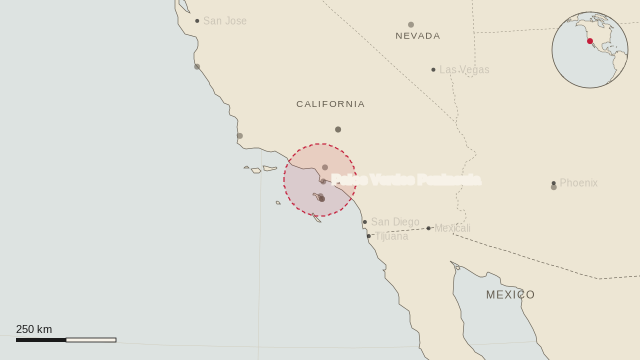
Around 9:30 p.m. on Sunday, August 8, 1965, two boys aged 15 and 14 were watching the sky through a telescope on the Palos Verdes Peninsula, a residential area of hills by the sea south of Los Angeles. Across a stretch of water from the peninsula lies Santa Catalina Island. According to the report they made that night, they saw between the peninsula and the island a round object with flashing red, white and blue lights. It moved back and forth over Catalina at a speed estimated as faster than an airplane's, and they watched it for 10 minutes. The Air Force documents give their names, addresses and phone numbers, blacked out in the released copy.
At 9:45 p.m., the report reached the command post of the Air Force Systems Command's Space Systems Division, based at Los Angeles Air Force Station. The staff duty officer, 2nd Lt. Marvin Chasen, logged it in his report for the night and added: "No inquiry made regarding photos or weather condition. No action taken." The next day, the division sent an extract of that entry to the 6592d Support Group, another unit at the same station.
On August 13, Col. Howard E. Short, deputy commander of the 6592d Group, forwarded the case to the Foreign Technology Division (FTD) at Wright-Patterson Air Force Base, Ohio. Project Blue Book, the Air Force program that studied UFO reports, came under the FTD. Short's letter gave the time as 9:30 p.m. and the sky as clear, and said the object moved between the peninsula and Catalina "at extremely high speed," a stronger phrase than the duty log's "faster than a possible aircraft."
According to the comments of the officer who prepared the letter, a man was contacted for further information; the letter blacks out his name and does not say how he was connected to the boys. That man could only add the boys' ages and the weather, and he asked whether it was normal for a helicopter to be in the area at that time of night.
On September 2, Major Hector Quintanilla, the head of Blue Book, wrote to Palos Verdes that the information was not enough to evaluate the case and enclosed the FTD questionnaire, Form 164. The 15-year-old returned it filled out, dated September 24. He put the sighting at 9:15 p.m., daylight saving time, and stretched it to 15 minutes "by my watch," though he did not see the object the whole time. He checked a clear night, many stars and bright moonlight. He described it "as a light," brighter than the brightest stars, like the "headlight of a car when standing in front of it."
According to the questionnaire, the light stood still at times, suddenly sped up, changed brightness and shape, flashed, and "blinked off and then came on a different color." The colors were red, blue, white and green, and there was no sound. The reports speak of one object, but the boy wrote that there were two. He drew them side by side with the note "Traviling back and forth." He also drew a ball of turning colors and a shape with "one wing" that "looked like 1/2 of airplane." He put them 18 to 20 miles (29 to 32 km) away, left blank the height and direction in which he saw them, and said another person was with him and saw them too.
The Blue Book card gives the time in Universal Time: 5:30 a.m. on the 9th, which was 10:30 p.m. in Palos Verdes, an hour later than the reports' 9:30 p.m. The gap comes from adding eight hours to local time, those of Pacific Standard Time, instead of the seven of daylight saving time, which was in effect in August.
The card lists one object, and its typed duration is struck out and corrected by hand to 15 minutes. The typed conclusion, "Insufficient data for evaluation," is struck out too, and above it is handwritten "ASTRO (MARS)": astronomical, Mars. A handwritten line was added to the summary: "Position to west. Mars at 260° az on horizon in process of setting." Below the struck-out conclusion, the typed note, written before the questionnaire came back, still stands: Form 164 had been sent and not returned, and the case would be reevaluated if it was. The handwritten corrections are undated.
Where it happened
Why it matters
The only explanation in the file is the one handwritten on the card, Mars, and the handwritten note in the summary describes the sky at the card's wrong time, not at the time in the reports. According to ephemerides from the Horizons system of NASA's Jet Propulsion Laboratory (JPL), computed for the peninsula, Mars was grazing the western horizon at 10:30 p.m. and shortly after, as the note says. An hour earlier, at the time in the reports and the questionnaire, it still stood some 15° to 17° above the west-southwest: plainly visible, but not on the horizon.
Other details fit the note poorly. By a calculation made for this case from the coordinates of the peninsula and the island, Catalina lies between south and southwest as seen from there, so Mars stood well west of the island over which the object was placed. Mars shone like an ordinary bright star, and the boy described something brighter than the brightest stars. The reports speak of one object, and the questionnaire of two. The only point in the note's favor is that nobody gave an azimuth: the boy left the questionnaire's compass blank. The only direction in the papers is Catalina, and none of them places the object to the west, as the note does.
More than three weeks passed between the report and Quintanilla's letter, and the case was closed with a handwritten line over a struck-out conclusion; none of the fourteen pages in the file holds a calculation to back it. It remains to be seen whether Blue Book checked the time before writing the note. In 2026, the U.S. Department of War (the name the Department of Defense has used since 2025) released the file in the eighth batch of PURSUE, its program for publishing files on anomalous phenomena, under the title of an "unresolved" report (Unresolved UAP Report), although the card it contains gives Mars as the cause.
Documents and sources
Primary documents
DOW-UAP-D208 — Blue Book file on the Palos Verdes sighting, August 8, 1965
Fourteen pages holding all the paperwork on the case: the two Air Force reports, Blue Book's letter, the questionnaire one of the boys returned, and the card with the conclusion "ASTRO (MARS)."
Read more
In order: the "Project 10073 Record" card (FTD form 0-329, September 1963), with "Insufficient data for evaluation" struck out and the handwritten correction; two copies, stamped "Official File Copy," of Major Hector Quintanilla's letter of September 2, 1965, one with the whole salutation line blacked out and one with "Dear" visible; the August 9 extract from the Space Systems Division staff duty officer's report, with the 21:45 entry of the 8th signed by 2nd Lt. Marvin E. Chasen, in an extract sent by the Office of Administrative Services over the name of 2nd Lt. James J. Ruane; the August 13 letter from Col. Howard E. Short, deputy commander of the 6592d Support Group, to the Foreign Technology Division (FTD); the envelope of that letter, sent by pouch; and the eight pages of the FTD 164 questionnaire, dated September 24, the last one blank. The witnesses' names, addresses and phone numbers are blacked out with the (b)(6) mark. Another copy is in archive.org's Blue Book collection (file 1965-08-7472520), with 13 pages: it lacks the eighth page of the questionnaire, the blank one.
U.S. Air Force, Project Blue Book, Space Systems Division and 6592d Support Group (PURSUE Release 08) · Public domain · US Government work · open original
Documented evidence
- August 9, 1965 extract from the staff duty officer's report of the Space Systems Division (Los Angeles Air Force Station): 9:45 p.m. entry, "Report of Unidentified Flying Object Observed"; two observers from Palos Verdes, with addresses and phone numbers blacked out; a round object with flashing red, white and blue lights between the peninsula and Santa Catalina Island, "moving back and forth across Catalina at an estimated speed faster than a possible aircraft"; seen through a telescope at about 9:30 p.m., for 10 minutes. Signed by 2nd Lt. Marvin Chasen.
- Letter from Col. Howard E. Short, deputy commander of the 6592d Support Group, to the Foreign Technology Division (FTD), August 13, 1965: report received at the Space Systems Division command post at 9:45 p.m.; sighting at 9:30 p.m. local time; movement between the peninsula and Catalina "at extremely high speed"; clear weather; witnesses aged 15 and 14. A man whose name is blacked out, contacted according to the comments of the officer who prepared the letter, could only add the ages and the weather, and asked whether a helicopter was normal in the area at that hour.
- Letter from Major Hector Quintanilla, head of Project Blue Book, September 2, 1965, to the blacked-out addressee in Palos Verdes: the information received is not enough to evaluate the case; FTD Form 164 enclosed.
- FTD 164 questionnaire returned by the 15-year-old, dated September 24, 1965: August 8, 9:15 p.m., daylight saving time; 15 minutes "by my watch," not continuous; clear night, many stars, bright moonlight; telescope; "as a light," brighter than the brightest stars; colors red, blue, white and green; no sound; two objects "Traviling back and forth"; 18 to 20 miles away; height and direction left blank; another person present who also saw it. He answered that he could not estimate the speed, and that a match head at arm's length would have covered "The whole object."
- Blue Book "Project 10073 Record" card: August 8, 1965, 09/0530Z; Palos Verdes; source: civilians; one object; typed duration struck out and corrected by hand to 15 minutes; course "Not Reported"; "Insufficient data for evaluation" struck out and "ASTRO (MARS)" handwritten; handwritten note "Position to west. Mars at 260° az on horizon in process of setting"; the typed note that Form 164 had not come back remains unstruck.
- Ephemerides for Mars from JPL's Horizons system for the peninsula (33.77° N, 118.38° W), without refraction: August 9, 1965 at 04:15 and 04:30 Universal Time (9:15 and 9:30 p.m. Pacific Daylight Time), altitude 17.4° and 14.6°, azimuth 245.6° and 248.1°, magnitude +1.05; at 05:30 (10:30 p.m., the card's time), altitude 2.7° and azimuth 257.0°; at 05:45, altitude −0.4° and azimuth 259.1°. By a calculation made for this case from the coordinates of the peninsula and the island, Catalina lies at azimuths of roughly 172° (east end) to 213° (west end) as seen from there.
Sources
- war.gov/UFO — DOW-UAP-D208, "Unresolved UAP Report, California, 1965" (PURSUE Release 08) — Primary document, embedded in this case's viewer: the Blue Book card, Quintanilla's letter, the reports from the Space Systems Division and the 6592d Support Group, and the returned questionnaire.
- Project Blue Book — file 1965-08-7472520, Palos Verdes, California (archive.org) — Independent scan of 13 of the 14 pages, with the witnesses' names blacked out; it confirms the 9:45 p.m. entry in the duty log and the handwritten notes on the card.
- JPL Horizons System (NASA), ephemerides of Mars for 33.77° N, 118.38° W, August 9, 1965, 04:15–05:45 UT — Altitude, azimuth and magnitude of Mars at the times in the reports and on the card; a reproducible query with body 499 (Mars) and those coordinates.
- AARO — Fiscal Year 2024 Consolidated Annual Report on Unidentified Anomalous Phenomena (November 2024), ODNI copy — Base rate used by the class basis: most cases AARO does not resolve stay open for lack of data (p. 13).