1979·Manises, Valencia
Spain.Manises 1979
On the night of 11 November 1979 the crew of TAE flight JK-297 saw two red lights that seemed to follow the aircraft and diverted to Valencia; a Mirage F-1 took off from Albacete after lights seen from the airport.
Read the rest of the summary
The Spanish Air Force file records that Pegaso recorded only the Caravelle's track, that EVA 5 made out up to five momentary echoes, later put down to fixed echoes, that the fighter had three lock-ons without a consistent lock, and identifies the light seen from the ground with a star. The investigating officer treated as unidentified a traffic seen by two controllers; the Air Transport Command found no proof of any UFO.
Tier A · AcceptableWhat do they mean? →
Institutional evidence: several identified independent witnesses, or contemporary official documentation, without an instrumental record to corroborate them.
What it was
65%natural or human cause
Most likely explanation: human light or activity
See the split across the six explanations
Natural or human cause
No known cause
Primary documents
Spanish Air Force file 791111/791117/791128 (extract, 16 of 150 pp.): the Air Operations Command sheet, the daily report and the start of the tape transcript
Fuente: Biblioteca Central del Ejército del Aire y del Espacio / Biblioteca Virtual de Defensa · CC BY 4.0 · open original
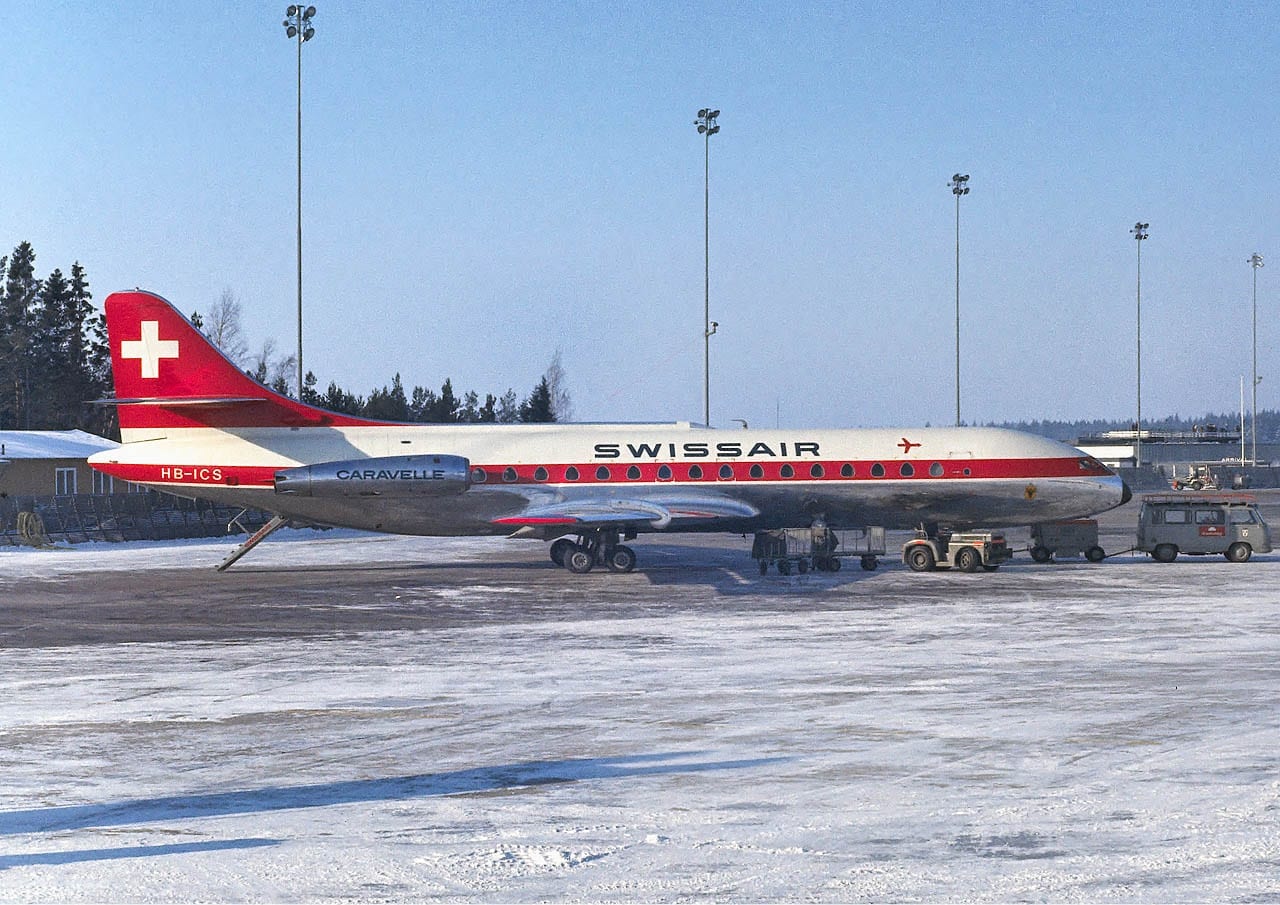
Context · a Sud Aviation Caravelle, the type of the TAE aircraft diverted to Manises
Swissair Sud-Aviation Caravelle Soderstrom-1.jpg · Wikimedia Commons · CC BY-SA 3.0 · open original
The night in question
On the night of 11 November 1979, TAE (Trans Europa) flight JK-297, a Supercaravelle registered EC-CUM according to the military telex, was flying from Palma de Mallorca to Tenerife with passengers aboard, under Captain Francisco Javier Lerdo de Tejada (his name is blacked out in the file, but he made it public himself). From 20:27 Z the Madrid SAR centre had been receiving reports of a signal on 121.5, the emergency frequency, placed about 40 miles north-east of Valencia. At 22:02 Z Barcelona control asked JK-297 to listen on that frequency; the crew heard the signal but could not identify it. At 22:05 Z, 15 miles south of Ibiza and climbing from flight level 230 to 330, it reported "two signals, red lights" about three miles away "at ten o'clock" and at its own altitude. Barcelona replied that there was no traffic. According to the transcript of tape 34, the crew insisted: they were "two steady red lights, without flashing"; the "traffic" was climbing "much faster than us"; it was "less than half a mile" away; it dropped about 3,000 feet and came back to their level. At 22:09 Z the captain turned towards Valencia ("I don't like continuing with that traffic, it is following me"); the controller noted that he had raised his voice considerably. He later stated that he never made out an object, only the two lights, whose spacing and precise movement made him think of a large aircraft. At 22:24 Z, descending to 4,000 feet, they lost sight of the lights and at the same moment the 121.5 signal stopped. They landed at Manises at 22:45 Z.
When the aircraft arrived, airport staff saw three lights that stood out for their brightness; the main one, to the east-south-east (radial 120) about 20° up, flashed green, red and white and, in the file's own words, "followed the movement of the sky quite faithfully". At that hour Sirius was rising in the east-south-east (azimuth 116°–135°, altitude 5°–21°, computed with ephem), and colour scintillation is typical of a bright star near the horizon; the captain stated that those lights did not look like his. A Mirage F-1 took off from Los Llanos air base (Albacete), contacted the Pegaso operations centre at 23:42 Z and withdrew at 00:57 Z. The file qualifies the radar picture. The Combat Air Command (MACOM) report says Pegaso had the Caravelle's track "but no echo of the object", and that "the EVA 5 manages to make out with its height discriminator up to five echoes" between 9,000 and 11,000 feet, "losing contact on reaching the coastline because of clutter"; among its deductions it notes that, "except for the EVA 5, which makes out 5 echoes", "there was no radar signal", and that "radar lock-ons occurred on the interceptor on three occasions". In flight, the fighter found no echo on its screen; neither Barcelona control nor Valencia approach radar saw anything; "progress towards the observed lights was not at all appreciable"; there was radio interference and intermittent lock-ons in the aircraft's warning system near Valencia–Sagunto, the same area where the 121.5 signal was placed, and the fighter's camera did not work. The pilot, Captain Fernando Cámara, said on the radio that he had the feeling the light was very far away, and he never went below 20,000 feet. The figure of Mach 1.4 comes from his later statements, not from the file. Later, two tower controllers with binoculars and an assistant saw navigation-like lights over the Albufera lagoon, at 2,000 or 3,000 feet, moving south slightly faster than a jet, while the F-1 was to the north.
The investigating officer, a captain at the base, delivered his report on 28 November 1979. He weighed four hypotheses (reflection of the Caravelle's own navigation lights on ice crystals, other unknown traffic with electronic countermeasures, a star or planet, and uncontrolled traffic) and concluded that he lacked the data to accept or reject any of them: if all the sightings were one phenomenon, one would have to consider "a craft of unknown origin driven by an equally unknown energy". He accepted the ground light as a star or planet and, of the Albufera lights, wrote that they "confirm the existence of uncontrolled traffic in the area, of unknown origin". A U.S. Air Force major general certified that no Sixth Fleet aircraft was flying that night; the officer noted that the helicopter carrier Iwo Jima was nearby and docked in Valencia the next day. On 23 January 1980 the lieutenant general commanding the Air Transport Command signed the opposite reading: there is no proof of UFOs, only an unidentified traffic heading south; the lights seen from the ground may have been a planet, a weather balloon or reflections from a temperature inversion, and the in-flight sighting the same, aggravated by the crew's nervousness. In October 1980, answering a parliamentary question from Deputy Enrique Múgica, the Air Staff spoke of an "optical illusion", noted that only the Caravelle's track was recorded, described the EVA 5 echoes as momentary and concluded they "were simply false 'fixed echoes'"; it said the fighter never "had a consistent radar lock at any moment"; of the 121.5 signal, that it was not recorded as localised anywhere and "looks more like the emission of a radio beacon", such as those in aircraft or ship survival kits; and it recalled that the documentation had been classified since March 1979. The 147-page file was declassified on 11 August 1994, as part of the opening of archives the Air Force began in 1992.
The critical reading was built on that documentation. Juan Antonio Fernández Peris, in "El Expediente Manises" (1998, with a foreword by Vicente-Juan Ballester Olmos), proposed that the crew's red lights were the flares of the Escombreras refinery (Cartagena), visible from altitude on a very clear night, and that the lights seen from the ground were stars such as Sirius, Procyon, Aldebaran and Rigel. The second part matches the file itself and the astronomical calculation. The first is more disputed: it explains two steady red lights without an anti-collision beacon, and the apparent change in height of a distant point as the aircraft climbs and descends, but fits less well with the crew's impression that the traffic was following them at half a mile. His suggestion that the Albufera lights were the F-1 itself clashes with the tape, which places the fighter above 20,000 feet throughout.
Why it matters
Manises brings together several institutional elements: a real emergency on a commercial flight, a fighter sent to identify, twelve formally questioned witnesses and, above all, a complete military file, with transcribed tapes and two contradictory conclusions, opened to the public in 1994 and downloadable in full today. That openness makes it possible to compare the popular account with the document. The popular account held that military radar confirmed the objects and that the Mirage failed three times to intercept them. The file says otherwise: Pegaso recorded only the Caravelle's track; the EVA 5 radar made out up to five momentary echoes between 9,000 and 11,000 feet, which the Air Staff attributed in 1980 to probable "fixed echoes" or clutter; the fighter registered radar lock-ons three times, but never a consistent lock, and it never got closer to the lights it was chasing, which the pilot felt were very far away.
Calibration must separate three phenomena that the legend fused into one. The light seen from the airport is, with high probability, Sirius; the investigating officer himself suspected a star. The crew's two red lights admit a distant ground explanation (the Escombreras flares) or an optical illusion, with no conclusive proof of either, and they coincided with an emergency signal on 121.5 that nobody identified and that the Air Staff said in 1980 had not been localised and "looks more like the emission of a radio beacon" of the kind carried in survival kits. The lights over the Albufera, seen by controllers with binoculars, are the only residue the officer expressly left unidentified, and the Air Transport Command downgraded them to "an unidentified traffic". That is why the case carries real but modest uncertainty: there is no consistent radar track, no object was seen, and most of the elements have an ordinary explanation.
What's left on paper
Documented evidence
- Transcript of Barcelona control tape 34 (22:02–22:11 Z): JK-297 reports "two steady red lights, without flashing" to its left, climbing faster than the aircraft, closing within half a mile and dropping about 3,000 feet; Barcelona has no traffic and its primary radar sees nothing
- Signal on the 121.5 emergency frequency heard from 20:27 Z, placed north-east of Valencia; it stops at 22:24 Z, when the crew loses sight of the lights, and was never identified
- Light seen from the airport to the east-south-east with coloured flashes that "followed the movement of the sky quite faithfully": matches Sirius rising at azimuth 116°–135°
- Mirage F-1 from Los Llanos (23:42–00:57 Z): no echo on its screen and three radar lock-ons without a consistent lock; Pegaso records only the Caravelle's track and the EVA 5 makes out up to five momentary echoes between 9,000 and 11,000 feet, lost to clutter; no closing on the lights, radio interference and lock-ons in the warning system; never below 20,000 feet; the camera did not work
- Investigating officer's report (28 Nov 1979): all hypotheses open; the lights seen by two controllers over the Albufera "confirm the existence of uncontrolled traffic in the area, of unknown origin"
Show 2 more items
- Interpretation by the lieutenant general commanding the Air Transport Command (23 Jan 1980): "there is no proof to admit the presence of UFOs"; Air Staff note for Parliament (Oct 1980): "optical illusion", the EVA 5 echoes "simply false 'fixed echoes'" and the 121.5 signal unlocalised, "more like the emission of a radio beacon"
- File 791111/791117/791128 (147 pp.) declassified on 11 Aug 1994 and available in full at the Defence Virtual Library
Sources
- Spanish Ministry of Defence, Defence Virtual Library — file 791111/791117/791128 (Valencia, Motril and Madrid, Nov 1979), 147 pp. — Primary source: the Air Operations Command file declassified on 11 Aug 1994, online in full (147 pp.): summary sheet, telexes, Barcelona daily report and tape 34, Pegaso–F-1 transcript, investigating officer's report (28 Nov 1979), Air Transport Command interpretation (23 Jan 1980) and note to Parliament (Oct 1980). CC BY 4.0 licence.
- Fernández Peris, J. A. — «El Expediente Manises» (1998), foreword by V.-J. Ballester Olmos — Secondary source: critical reconstruction based on the file; proposes the Escombreras flares and bright stars.
- Ruiz, M. Á. — '«El Expediente Manises»: a critical analysis' (Informe OVNI) — Secondary source: rebuttal of Fernández Peris's book that disputes the Escombreras hypothesis.
- Benítez, J. J. — «Incidente en Manises» (1980) — Secondary source: period journalistic account, with interviews of the crew and the F-1 pilot.
Related cases
same explanation · same country
Usagre · the 'craft' that was a wedding (1993)
1993 · Tier B
same country · same period
Canary Islands · the luminous bell of 5 March 1979
1979 · Tier S
same explanation · same period
Rendlesham Forest
1980 · Tier A
same country · same period
Zaragoza · the light over the General Military Academy
1980 · Tier A
Associated actors (1)