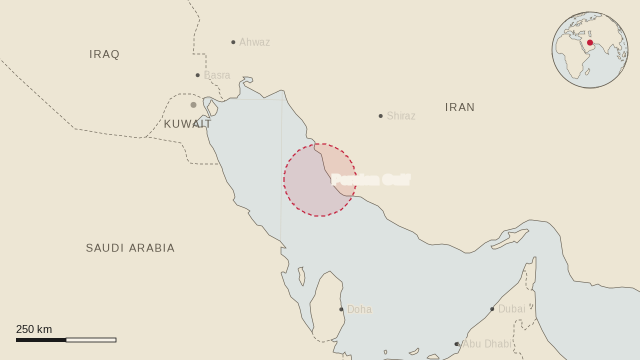
2020·Persian Gulf, off the coast of Iran
Iran.Persian Gulf · MQ-9 drones see objects on seven missions
Between July and November 2020, crews from a U.S. Air Force MQ-9 drone squadron recorded objects they could not identify on seven surveillance missions over the Persian Gulf. On six of them, the objects were seen at night or at dusk, and most reports say only that the video sensor picked up an unidentified object. Two give more detail: on August 27, a formation moved along the Iranian coast near Bushehr until it was lost in clouds, and on the 31st, a pilot saw a much faster object overtake the one he was tracking. The reports were published in 2026, with no video and no explanation.
Tier S · SolidWhat do they mean? →
Strong evidence: a contemporary instrumental record (radar, sensor, film or photo of known provenance) that corroborates several independent witnesses.
What it was
36%ordinary cause, unidentified
No explanation reaches half.
- 36% ordinary cause, unidentified
- 30% other earthly causes
- 34% no known cause
See the split across the six explanations
Earthly origin (human or natural)66%
No known cause34%
Why no ordinary cause is identified
What happened
In 2020, the U.S. Air Force's 482nd Attack Squadron, which flies MQ-9 Reaper drones, was flying surveillance missions of about twenty hours over the Persian Gulf from Ali Al Salem Air Base in Kuwait. The missions supported Central Command's naval forces: they had to locate vessels of Iran's navy and Revolutionary Guard, watch drone activity in the area and establish their routines. Each mission ended with a report, and between July and November, on seven of them, the crew noted objects it could not identify.
The first of those missions was on July 16. Its report notes three times, in the same terse phrase, that the video sensor picked up "an unidentified aerial phenomenon," between 18:30 and 23:45 UTC, after dark over the Gulf. The first was off Bushehr and the other two farther north. The report describes none of them, and the section summarizing the surveillance work, which details the Iranian vessels the crew believed it recognized, does not mention them.
On August 8, at 07:26 UTC, the drone's video sensor picked up "1X UAP," an unidentified object, in transit over the central Gulf. The mission report describes it no further and adds that it had no impact on the mission. That day, according to the same report, dense cloud intermittently interrupted the video collection, although the observation entry notes that weather was not a factor.
On August 27, another of the squadron's missions had been in the area for almost fifteen hours. In the morning, Iranian air defense had called it on the emergency frequency with a routine warning, as on August 8, and the crew answered routinely. At 15:27 UTC, at dusk (7:57 p.m. in Iran), the sensor picked up "a formation of flying objects" moving "NE-NW" along the coast of Bushehr, where there is an airport and an Iranian air base. The crew tracked it for about two minutes, until it lost the formation in light cloud and could not find it again. The other things the sensor picked up on that mission, a vessel in the port of Greater Tunb, a probable cargo plane on Abu Musa island and a boat next to a merchant ship, were identified.
On August 31, at dusk, a pilot from the squadron saw an object cross his screen and began tracking it. According to the form he filled out afterward, the object was flying at about 18,000 feet, on a heading of 150 and a speed of 230, with no unit given, and at a constant altitude. Another object of the same size and shape overtook it at much higher speed, and at one point there were three on the screen at once, moving among each other. On the form he checked "other shape" and "apparent propulsion," and left blank the number of objects in the group and whether there was a stable track.
In the following months, three more reports from the squadron repeated the entry with very little detail. On September 16, at 17:32 UTC, after dark, the video sensor picked up "a UAP" off Bushehr, in the same area as the August 27 formation. On October 2, also at night, the crew logged "1X UAP" and referred to an observation entry that appears on none of the eight pages of the published report; that day, heavy haze prevented analysis of the imagery.
On the night of November 2, in the central Gulf north of Qatar, the crew saw an object at 21:43 UTC whose altitude the report gives as unknown and, five minutes later, another moving northwest. Both sightings came while the drone was searching open water for an unmanned underwater vehicle; according to the report, it did not find one, and haze prevented the collection of imagery.
Central Command declassified the seven documents between January and March 2026 and handed them to AARO, the Pentagon's office for these phenomena. The Department of War published them in the first release of its PURSUE program.
Where it happened
Why it matters
The seven records come from the same source, a drone squadron on routine missions: six mission reports and a pilot's form, all with dates and, except for the October one, the military grid reference of the sighting. They are not hearsay: the objects were picked up by the aircraft's sensor and the people operating it left an official record. The video has not been published, so what is known is what they wrote.
The Department of War published the August 31 form under the title "Range Fouler Debrief, Japan, 2023." The document itself says otherwise: the form's date is August 31, 2020, the squadron operates in Central Command's area, and the grid of the first contact, 39R WL, falls in the central Persian Gulf, the same area as the August 8 object. It was also declassified by Central Command's chief of staff, whose area does not include Japan. The file title is a cataloging error.
None of the reports proposes what the objects were, and five of the seven only note that the sensor picked up something unidentified; in October and November, haze also prevented the analysis or collection of imagery. The August 27 mission was tasked, among other things, with watching drone activity, and even so the report calls the objects unknown. There are obvious ordinary readings that no one ruled out: the August 27 formation was seen at dusk over a coast with an airport and an air base, and the August 31 object flew at a constant altitude at a speed that, if in knots, is that of an ordinary aircraft. Clouds cut off the tracking on the 27th, and none of the seven documents gives distance or size, so the pilot's recorded speed cannot be checked, nor the faster object's measured.
The case resembles the 2025 reports from other MQ-9 crews in the region ↗ Middle East: objects seen only on the sensor, unidentified and published without analysis.
Documents and sources
Primary documents
Mission report of August 8, 2020 (DOW-UAP-D60)
Six-page mission report from the 482nd Attack Squadron on a surveillance flight of about twenty hours over the Persian Gulf. At 07:26 universal time, the sensor video picked up an unidentified object in transit in grid 39R WL, with no impact on the mission; the report notes dense cloud that intermittently interrupted collection.
U.S. Central Command, via Department of War (PURSUE, Release 01) · Public domain · US Government work · open original
Mission report of August 26 to 27, 2020 (DOW-UAP-D61)
Seven-page mission report from the same squadron. It records the routine call from Iranian air defense at 05:32 UTC and, from 15:27 to 15:29, a formation of flying objects moving along the coast near Bushehr, in grid 39R VM, until light cloud prevented further tracking.
U.S. Central Command, via Department of War (PURSUE, Release 01) · Public domain · US Government work · open original
Pilot's form of August 31, 2020 (DOW-UAP-D42, published as "Japan, 2023")
One-page "Range Fouler Debrief" form filled out by a 482nd Attack Squadron pilot: August 31, 2020, at dusk, surveillance mission, contact at 18,000 feet, first contact in grid 39R WL. It describes an object overtaken by another identical, faster one, and up to three at once on the screen. The Department of War published it under the title "Japan, 2023," which does not match its content.
U.S. Central Command, via Department of War (PURSUE, Release 01) · Public domain · US Government work · open original
Mission report of July 16 to 17, 2020 (DOW-UAP-D65)
Eight-page mission report from the 482nd Attack Squadron, scanned without a text layer and published as "Mission Report, Persian Gulf, July 2020."
Read more
It records three video sightings of "an unidentified aerial phenomenon," at 18:30, 19:20 and 23:45 UTC, the first off Bushehr and the other two in the northern Gulf, without describing the objects. The drone position logged for the first sighting, more than 180 km from the object, does not fit the rest of the report. It was declassified on March 16, 2026, by Central Command's chief of staff.
U.S. Central Command, via Department of War (PURSUE, Release 01) · Public domain · US Government work · open original
Show the other 3 documents
Mission report of September 15 to 16, 2020 (DOW-UAP-D62)
Nine-page mission report from the 482nd Attack Squadron, published as "Mission Report, Strait of Hormuz, September 2020," although the object was seen in the northern Gulf, off Bushehr.
Read more
At 17:32 UTC on September 16, the sensor video picked up "a UAP," with no further description, and weather was not a factor. The report also logs three routine calls from Iranian air defense and, hours earlier, two losses of the drone's data link to interference of unknown type, which it treats as separate events. It was declassified on January 22, 2026, by Central Command's chief of staff.
U.S. Central Command, via Department of War (PURSUE, Release 01) · Public domain · US Government work · open document
Mission report of November 2 to 3, 2020 (DOW-UAP-D64)
Seven-page mission report from the 482nd Attack Squadron, published as "Mission Report, Iran, November 2020," although the sightings were in the central Gulf, north of Qatar.
Read more
At 21:43 UTC on November 2, it logs by video an object of unknown altitude and, at 21:48, another traveling northwest, while the drone was searching open water for an unmanned underwater vehicle it did not find; haze prevented the collection of imagery. It was declassified on March 16, 2026, by Central Command's chief of staff.
U.S. Central Command, via Department of War (PURSUE, Release 01) · Public domain · US Government work · open document
Mission report of October 1 to 2, 2020 (DOW-UAP-D63)
Eight-page mission report from the 482nd Attack Squadron, scanned without a text layer and published as "Mission Report, Strait of Hormuz, October 2020."
Read more
Its summary says that at 18:29 UTC on October 2 the crew observed "1X UAP" and refers to an observation entry that is on none of the eight pages, which are numbered without gaps, so the location is not recorded. It logs five routine radio calls from an air defense whose name is redacted, and heavy haze that prevented analysis of the imagery. It was declassified on March 16, 2026, by Central Command's chief of staff.
U.S. Central Command, via Department of War (PURSUE, Release 01) · Public domain · US Government work · open document
Documented evidence
- Mission report 4472514 from the 482nd Attack Squadron (DOW-UAP-D65), mission of July 16 to 17, 2020: three sightings by video, at 18:30Z (grid 39R VM, off Bushehr) and at 19:20Z and 23:45Z (39R UN, northern Gulf), each with the phrase "observed an unidentified aerial phenomenon" and "weather was not a factor"; the surveillance section, which lists the vessels seen, does not mention them.
- Mission report 4592219 from the 482nd Attack Squadron (DOW-UAP-D60), mission of August 8, 2020, from Ali Al Salem (Kuwait): at 07:26Z, "observed 1X UAP" in transit in grid 39R WL (39R VL in the observation entry, about 18 km away), by video, "no impact to mission" and, for that observation, "weather was not a factor."
- Mission report 4685903 from the same squadron (DOW-UAP-D61), mission of August 26 to 27, 2020: at 05:32Z, a routine call from Iranian air defense; from 15:27Z to 15:29Z, "a formation of flying objects traveling NE-NW along the coast" in grid 39R VM, on the Bushehr coast, lost in light cloud; it was 7:57 p.m. local time.
- "Range Fouler Debrief" form from a 482nd Attack Squadron pilot (DOW-UAP-D42), dated August 31, 2020, at dusk: contact at 18,000 feet and constant altitude, heading and speed 150/230, another identical and faster object overtakes it, up to three on screen at once; first contact in grid 39R WL.
- Mission reports 4782130, 4871281 and 5039166 from the same squadron (DOW-UAP-D62, D63 and D64): "observed a UAP" on September 16 at 17:32Z (39R VM); "observed 1X UAP" on October 2 at 18:29Z, without the observation entry it refers to; and on November 2, in 39R WK, an object with "altitude unknown" and "a bearing of 080 T" at 21:43Z and another "traveling NW" at 21:48Z. In October and November, haze prevented the analysis or collection of imagery.
Show 3 more facts
- All seven documents were declassified in 2026 by U.S. Central Command's chief of staff, Richard A. Harrison, and carry the note "Approved for Release to AARO."
- The Department of War published D42 under the title "Range Fouler Debrief, Japan, 2023," which contradicts the form's own date, command and grid.
- No report proposes what the objects were, and no video from any of the seven missions has been published.
Sources
- Department of War, PURSUE, first release: DOW-UAP-D60 and D61, "Mission Report, Persian Gulf, August 2020"; D65, "Mission Report, Persian Gulf, July 2020"; D62 and D63, "Mission Report, Strait of Hormuz," September and October 2020; D64, "Mission Report, Iran, November 2020"; and DOW-UAP-D42, "Range Fouler Debrief, Japan, 2023"; archive.org copy — Primary source: the six mission reports and the pilot's form, declassified by Central Command.
- AARO — Fiscal Year 2024 Consolidated Annual Report on UAP (Nov 14, 2024) — Base rate: the cases resolved in that period were resolved as ordinary objects.
- Wikipedia, "482nd Attack Squadron" — Identifies the squadron as an MQ-9 Reaper drone unit; the aircraft type is redacted in the reports.
Referenced by 1 case
Related cases
Cases this case cites and cases with the same likely cause.