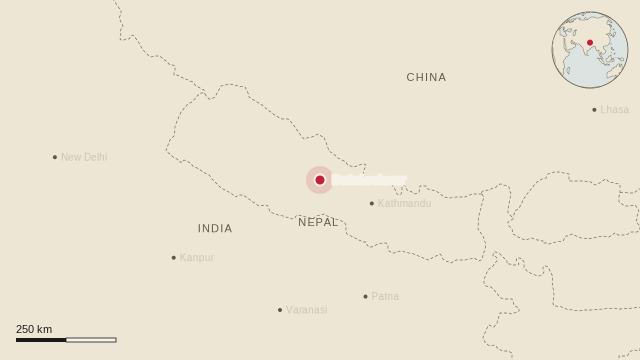
1968·Batulechaur, northeast of Pokhara, Kaski district, Nepal
Nepal.Pokhara · a fireball leaves metal debris in a field
On the night of March 25, 1968, a blazing, flashing object broke apart with loud booms over Kaski district, Nepal. The next day a metal piece turned up in a crater in a field at Batulechaur, near Pokhara, and debris was found in other villages. The CIA included it in a report on "unidentified flying objects" in the Himalayas. U.S. Defense technicians concluded it was not American and could be from the Soviet Kosmos-208, whose rocket stage reentered that same night.
Tier A · AcceptableWhat do they mean? →
Institutional evidence: several identified independent witnesses, or contemporary official documentation, without an instrumental record to corroborate them.
What it was
93%reentry
The most likely explanation.
- 93% reentry
- 4% other earthly causes
- 3% no known cause
See the split across the six explanations
Earthly origin (human or natural)97%
No known cause3%
Ordinary cause the sources propose: reentry
What happened
Between February 19 and March 25, 1968, several bright lights were seen over the Himalayas, in southern Ladakh, northeastern Nepal, northern Sikkim and western Bhutan. On February 19, between 9:00 and 9:15 p.m., a fast, long, thin object with red and green light crossed from northeast to southwest over Walungchung Gola and Ghunsa, in Nepal; it was bright enough to look like daylight, and a thunderclap followed a few seconds later. At the same time a similar light was seen at Lachung, Lachen and other places in Sikkim. On February 21, at 9:30 p.m., a silent bluish object passed at high speed over Thimphu, the capital of Bhutan. On March 4, at 1 p.m., a white light was seen in Ladakh, two blasts were heard and a reddish light appeared, followed by white smoke; the same day, near the Ane La pass, an object followed a circular path and left a trail of smoke.
There were two sightings on the night of March 25. In Ladakh, at 9:50 p.m., a rocket-like object with a white and yellow trail moved from north to south toward Demchok. In Nepal, a blazing object flashing on and off crossed from north to south over Kaski district and broke apart amid loud booms. The time the CIA gives for this one is blurred in the published copy and reads 8:15 or 9:15 p.m.; the Nepali press says around eight or a quarter past eight.
The next morning, in a field at Batulechaur, about 8 km northeast of Pokhara, a metal piece turned up inside a crater. The CIA describes it as a disc-shaped object about 6 feet across at the base and 4 feet high, and says parts of a similar object were found at Talakot and Turepasal. According to the Nepali press, which collected the story decades later, the field belonged to Kul Prasad Timilsina, then 27, who kept the piece in his buffalo shed for almost a month until, in the most repeated version, the zonal commissioner took it away. The descriptions of the piece do not match: a disc one inch thick in one article, a sheet about 2 by 1 meters with rounded corners in another.
On April 11, the CIA distributed a four-page report, not finally evaluated and with the source redacted, with a table of all the sightings. On June 25, a State Department memo said the Air Force's Foreign Technology Division believed the fragments "could have great value," whether they came from a Chinese missile test or a Soviet rocket, and would propose asking for access to Nepal for a small intelligence team.
On August 26, the ambassador, the military attaché and two Defense technicians presented a preliminary report on the objects, which were held by the Nepali government, to Nepal's foreign secretary, Khanal. The August 28 cable summarizes their findings, based on examining the pieces and on tracking data: the objects were not of U.S. origin, some pieces could be Soviet, "possibly Cosmos 208 which re-entered the earth's atmosphere on night of March 25, 1968," and some appeared to come from a different object that fell on a different date.
A definite identification required examination in a U.S. laboratory, because Soviet technology had influenced Chinese rockets. Khanal said India and China had asked to see the pieces and only took pictures of them, and that the Soviet Union had shown no interest at all. He again asked that the matter receive no publicity.
In August 1971, Foreign Secretary Bhandary agreed that the United States could cut a strip from one fragment on condition that it be returned "essentially intact." On March 1, 1972, a joint State and Defense cable, under the subject line "MOON DUST," the name of the space-debris recovery program, announced that the restored fragment was returning to Kathmandu on an embassy support flight around March 10. The report on the fragment was to follow separately and is not in the published file.
Where it happened
Why it matters
Jonathan McDowell's catalog of space objects confirms the date the embassy gave. Kosmos-208, a Soviet reconnaissance satellite, was launched on March 21, 1968. The third stage of the rocket that put it in orbit, a cylinder of about 3 tons, 9.4 meters long and 2.7 meters wide, reentered on March 25. Its orbit, inclined at 65 degrees, passed over Nepal's latitude. Its capsule returned to Earth on April 2. The catalog lists another reentry on that same March 25, a piece of the Kosmos-209 radar system, also in an orbit that crossed the Himalayas, which fits the warning that not all the pieces came from the same object.
The catalog gives the day, not the time or the place of the fall. The technicians used tracking data that has not been published, and no one has checked that night's trajectory independently. Even so, the Kaski accounts have the shape of a reentry: a fireball that moves in a straight line, flashes, breaks apart with booms and leaves metal pieces scattered over several villages. No document of the time proposes anything other than a rocket or a missile: the Air Force weighed a Chinese missile test against a Soviet rocket, and the Defense technicians pointed to the Soviet Union without ruling out China until a laboratory examination whose result is not on record.
The case shows how a UFO report took in what, for the technicians who examined the pieces, was probably rocket debris. The CIA titled its report "sightings of unidentified flying objects," and the report was published again in 2026 among the U.S. Government's UAP documents. The cables tell a different story: an intelligence service treating the debris as Soviet or Chinese material of technical value, and a government that wanted to know whose it was without the matter becoming public.
Not all the sightings in the report have the same explanation. For the light of February 19, which lit up northeastern Nepal and Sikkim like daylight and was followed by a thunderclap, the catalog lists no reentry that day; the next day the second stage of the Kosmos-196 rocket reentered, in an orbit that passed over Nepal, but without the time it can be neither confirmed nor ruled out. A bolide, a large meteor, also produces that brightness and that boom. For Ladakh, on March 4, the catalog gives the reentry of the second stage of the Kosmos-202 rocket on that same day. The Bhutan light has no published explanation.
Documents and sources
Primary documents
CIA report on sightings in Ladakh, Nepal, Sikkim and Bhutan (April 11, 1968)
Four-page CIA information report, not finally evaluated and with the source redacted, with the table of sightings from February 19 to March 25, 1968: date, local time, place, direction and description of each.
Read more
The last page describes the blazing object over Kaski and the metal piece found in a crater near Pokhara. The copy published in 2026 also includes a magazine clipping and an index sheet that are not reproduced here.
CIA, CIA-UAP-016 (PURSUE, Release 03), via archive.org · Public domain · US Government work · open original
State Department memo and cables on the Nepal debris (1968-1972)
Four U.S. National Archives documents published by the National Security Archive: the memo of June 25, 1968, on the Air Force's interest in the fragments; the cable of August 28, 1968, with the Defense technicians' findings ("possibly Cosmos 208"); the cable of August 12, 1971, in which Nepal agrees that a strip may be cut from a fragment; and the cable of March 1, 1972, announcing its return.
U.S. Department of State (NARA, RG 59), via National Security Archive · Public domain · US Government work · open original
Documented evidence
- CIA information report, distributed April 11, 1968, "Sightings of Unidentified Flying Objects in Ladakh, Nepal, Sikkim and Bhutan," not finally evaluated and with the source redacted: table of sightings from February 19 to March 25, 1968, with date, local time, place, direction and description.
- The same report, on Kaski on March 25: a blazing, flashing object with big thunder sounds that broke apart; a disc-shaped metal object with a six-foot base and four feet high found in a crater at "Baltichaur," five miles northeast of Pokhara, and parts of a similar one at Talakot and Turepasal.
- State Department memo of June 25, 1968 (Jerry C. Trippe): the Air Force's Foreign Technology Division sees "great value" in the fragments, whether they are "from a Chinese missile test or the Soviet launch vehicle venik."
- Kathmandu embassy cable of August 28, 1968, based on the examination and "collateral tracking data": the objects are not of U.S. origin; some pieces could be Soviet, "possibly Cosmos 208," which reentered on the night of March 25, 1968; some appear to come from another object that fell on a different date; India and China asked to see them.
- Cables of August 12, 1971, and March 1, 1972: Nepal agrees that a strip may be cut from a fragment if it is returned "essentially intact"; the restored fragment returns to Kathmandu around March 10, 1972; the report on it was to follow separately.
Show 2 more facts
- McDowell's GCAT catalog: 1968-022A, Kosmos-208, launched March 21, 1968, capsule returned to Earth April 2; 1968-022B, Voskhod Blok-I third stage, about 3 tons, 65-degree orbit, reentry March 25, 1968; 1968-023B, from Kosmos-209, also reentered that day.
- Nepali press (Kathmandu Post, 2020; Nepali Times, 2024): the field belonged to Kul Prasad Timilsina, then 27; the piece spent almost a month in his shed before the zonal commissioner took it.
Sources
- CIA, information report "Sightings of Unidentified Flying Objects in Ladakh, Nepal, Sikkim and Bhutan" (Apr 11, 1968), CIA-UAP-016, PURSUE, third release; archive.org mirror — Primary source: the table of sightings and the description of the piece found near Pokhara. The CIA reading room copy is CIA-RDP81R00560R000100070007-8.
- National Security Archive, "Scavenging Intelligence: U.S. Government's Secret Search for Foreign Objects During the Cold War" (Jan 31, 2018), documents 34A to 34D, "Space Debris in Nepal" — Memo of June 25, 1968, and cables of August 28, 1968, August 12, 1971, and March 1, 1972, from the U.S. National Archives (RG 59).
- U.S. Embassy Kathmandu, cable 4685 to the Secretary of State (Aug 28, 1968), National Security Archive document 34B — Findings of the Defense technicians: not of U.S. origin, possibly Cosmos 208.
- Jonathan McDowell, General Catalog of Artificial Space Objects (GCAT), satcat: 1968-022A/B/C and 1968-023B — Launch and reentry dates, mass, size and orbital inclination.
- Amish Raj Mulmi, "Close encounters of the terrestrial kind," The Kathmandu Post (Oct 15, 2020) — Collects Kul Prasad Timilsina's account and links the National Security Archive documents.
- Durga Rana Magar, "UFO over Pokhara," Nepali Times (Dec 7, 2024) — Local testimony collected decades later; describes the piece as a sheet about 2 by 1 meters.
Related cases
Cases with the same likely cause.
Reentry · Within 10 years
General Terán · residents see smoke and find a metal sphere
1967 · Tier A
Reentry · Within 10 years
Saudi Arabia · King Faisal keeps a fallen metal sphere
1967 · Tier A
Reentry · Within 10 years
Sisaket · an object “fallen from the sky” turns up in Thailand
1965 · Tier A
Reentry · Within 10 years
Upper Volta · two pieces of burned metal fall from the sky
1962 · Tier A