Caso Nº 260Case No. 260·ItaliaItaly
1933·Vergiate / Magenta, Lombardía, ItaliaVergiate / Magenta, Lombardy, Italy
ItaliaItaly.Gabinete RS/33 · MagentaCabinet RS/33 · Magenta
Según documentos difundidos desde el año 2000 por los ufólogos italianos Roberto Pinotti y Alfredo Lissoni, el 13 de junio de 1933 una nave no convencional se habría estrellado en el norte de Italia, y Mussolini habría creado un gabinete secreto, 'RS/33', bajo Guglielmo Marconi, para estudiarla, guardando los restos en hangares de SIAI Marchetti en Vergiate. Sería el 'primer Roswell', 14 años antes. Sin originales de archivo verificables.According to documents circulated since 2000 by Italian ufologists Roberto Pinotti and Alfredo Lissoni, on 13 June 1933 an unconventional craft allegedly crashed in northern Italy, and Mussolini supposedly created a secret cabinet, 'RS/33', under Guglielmo Marconi, to study it, storing the remains in SIAI Marchetti hangars at Vergiate. It would be the 'first Roswell', 14 years earlier. Without verifiable archival originals.
AñoYear
1933
TierTier
B
ProbabilidadProbability
14%
CategoríaCategory
IncidenteIncident
Evidencia limitada: testigo único, local o sin verificación primaria. Tres ejes independientes: el «tier» mide la fuerza de la evidencia; la «probabilidad» estima cuán genuinamente inexplicado está el caso —un fenómeno natural puede seguir sin explicación, así que no equivale a «no-prosaico»—; y la partición de explicaciones (abajo) dice qué fue más plausiblemente. Por eso un caso bien documentado puede tener como causa más plausible un posible fraude, y un Tier B no es, por eso, un fraude.Limited evidence: single-witness, local or without primary verification. Three independent axes: the «tier» measures the strength of the evidence; the «probability» estimates how genuinely unexplained the case is —a natural phenomenon can remain unexplained, so it does not equal «non-prosaic»—; and the partition of explanations (below) says what it most plausibly was. So a well-documented case can have a possible hoax as its most plausible cause, and a Tier B is not, for that reason, a hoax.
Documentos primarios · visorPrimary documents · viewer

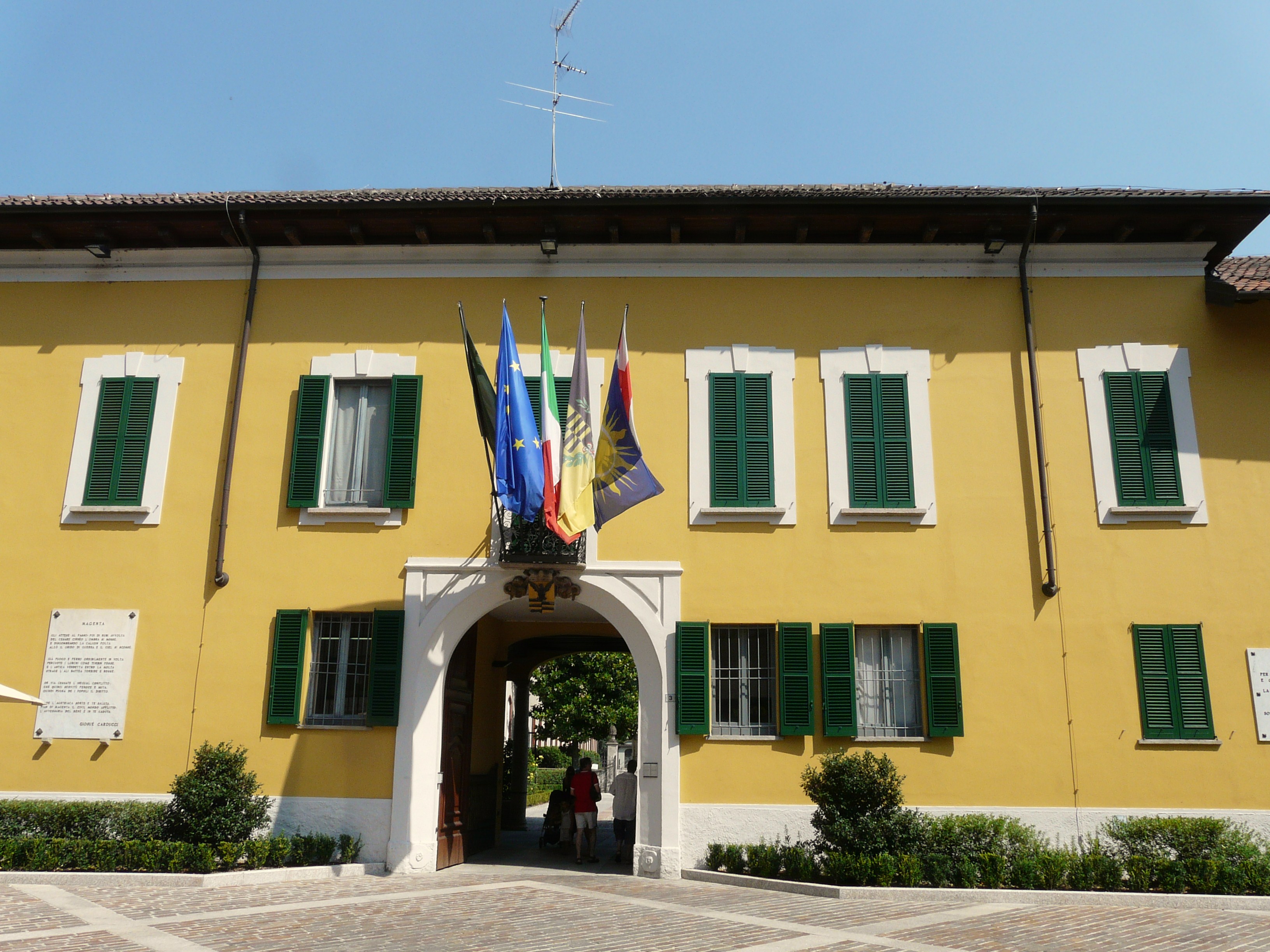
Contexto · Magenta (Lombardía, Italia)Context · Magenta (Lombardy, Italy)
Magenta-municipio1.jpg · Wikimedia Commons · CC BY-SA 3.0 · abrir originalopen original
Parte 01Part 01
La noche en cuestiónThe night in question
El caso del Gabinete RS/33 —también conocido como 'caso Magenta'— es la afirmación de que Italia vivió una recuperación de nave estrellada catorce años antes de Roswell. Según la narrativa, el 13 de junio de 1933 un objeto no convencional se estrelló o aterrizó en el norte de Italia, en una zona atribuida de forma variable a Magenta (Lombardía) o a las inmediaciones de Vergiate, cerca del lago Mayor. El régimen de Benito Mussolini habría impuesto un apagón informativo y creado una unidad secreta de inteligencia para estudiar el suceso: el Gabinetto RS/33 —'RS' por Ricerche Speciali (Investigaciones Especiales) y '33' por el año 1933—, supuestamente puesto bajo la dirección del Nobel de física Guglielmo Marconi. Los restos se habrían almacenado en los hangares de la fábrica aeronáutica SIAI Marchetti, en Vergiate.
“ por Ricerche Speciali (Investigaciones Especiales) y ”
La historia no procede de archivos oficiales abiertos, sino de un conjunto de documentos que los investigadores italianos Roberto Pinotti y Alfredo Lissoni empezaron a publicitar a partir del año 2000. Según su relato, recibieron esos 'documentos secretos originales' —telegramas, órdenes de silencio, un boceto del aparato— de una fuente anónima que decía haberlos heredado de un familiar vinculado al régimen fascista. Es decir, toda la base documental se remonta a una única fuente sin identificar.
La evaluación de la autenticidad es, por eso, el corazón del caso. Un perito forense examinó uno de los documentos, fechado en 1936, y concluyó que el papel y la tinta eran coherentes con esa época, lo que sus defensores esgrimen como respaldo. Sin embargo, el papel de época no prueba el contenido: un documento puede ser materialmente antiguo y, aun así, falso o malinterpretado. Ningún archivo independiente ha corroborado la existencia del Gabinete RS/33, no hay originales accesibles aceptados por los historiadores académicos, y la procedencia única y anónima impide la verificación. El consenso historiográfico mantiene el caso como no probado, mientras sus promotores lo presentan periódicamente —incluso ante medios internacionales— como el primer crash-retrieval documentado de la historia.
The Cabinet RS/33 case —also known as the 'Magenta case'— is the claim that Italy had a crashed-craft retrieval fourteen years before Roswell. By the narrative, on 13 June 1933 an unconventional object crashed or landed in northern Italy, in an area variably attributed to Magenta (Lombardy) or the vicinity of Vergiate, near Lake Maggiore. Benito Mussolini's regime supposedly imposed an information blackout and created a secret intelligence unit to study the event: the Gabinetto RS/33 —'RS' for Ricerche Speciali (Special Researches) and '33' for the year 1933— allegedly placed under the direction of physics Nobel laureate Guglielmo Marconi. The remains were said to be stored in the hangars of the SIAI Marchetti aircraft factory, at Vergiate.
The story comes not from open official archives but from a set of documents that Italian researchers Roberto Pinotti and Alfredo Lissoni began publicizing from the year 2000. By their account, they received those 'original secret documents' —telegrams, silence orders, a sketch of the craft— from an anonymous source who claimed to have inherited them from a relative tied to the Fascist regime. That is, the entire documentary basis traces back to a single unidentified source.
The assessment of authenticity is therefore the heart of the case. A forensic expert examined one of the documents, dated 1936, and concluded that the paper and ink were consistent with that period, which its defenders cite as support. However, period paper does not prove the content: a document can be materially old and still false or misinterpreted. No independent archive has corroborated the existence of Cabinet RS/33, there are no accessible originals accepted by academic historians, and the single, anonymous provenance precludes verification. The historiographic consensus holds the case as unproven, while its promoters periodically present it —even to international media— as the first documented crash-retrieval in history.
Parte 02Part 02
Por qué este caso movió la agujaWhy this case moved the needle
El caso RS/33 importa al corpus como el equivalente europeo y pre-Roswell de la narrativa de recuperación de naves, y como un caso de prueba sobre el valor —y los límites— de la evidencia documental de procedencia única. Su interés está en que tensa una distinción crucial que el corpus practica constantemente: la diferencia entre la autenticidad material de un papel y la veracidad de lo que ese papel afirma. Que la tinta sea de los años treinta no convierte en real un crash de 1933; solo desplaza la pregunta hacia quién escribió el documento, con qué intención y por qué nunca apareció en ningún archivo institucional.
Por eso el posterior carga sobre la narrativa mundano/natural en su variante de fabricación, con una porción reconocida para nohumano_encubierto y una indeterminación acotada. La estructura del caso reproduce casi punto por punto la de Aztec 1948: una afirmación extraordinaria de recuperación estatal que descansa sobre una sola fuente no verificable, sin originales de archivo aceptados ni corroboración independiente. La masa que se concede a nohumano_encubierto no premia la veracidad del relato, sino que reconoce que su contenido ES, por definición, esa narrativa, y que la opacidad de los archivos del régimen fascista impide cerrar un negativo absoluto. La indeterminación recoge ese margen documental. En el corpus, RS/33 es el caso que enseña a auditar la cadena de custodia antes que el contenido: el recordatorio de que un documento 'secreto' liberado por un canal no autorizado y de origen único es una hipótesis sobre su propia procedencia antes que una prueba sobre el cielo de 1933.
The RS/33 case matters to the corpus as the European, pre-Roswell equivalent of the craft-retrieval narrative, and as a test case on the value —and limits— of documentary evidence of single provenance. Its interest is that it stresses a crucial distinction the corpus constantly practices: the difference between the material authenticity of a paper and the truth of what that paper asserts. That the ink is from the 1930s does not make a 1933 crash real; it only shifts the question to who wrote the document, with what intent, and why it never appeared in any institutional archive.
That is why the posterior loads onto the mundane/natural narrative in its fabrication variant, with an acknowledged portion for nohumano_encubierto and a bounded indeterminacy. The case's structure reproduces almost point for point that of Aztec 1948: an extraordinary claim of state retrieval resting on a single unverifiable source, with no accepted archival originals or independent corroboration. The mass granted to nohumano_encubierto does not reward the account's veracity, but acknowledges that its content IS, by definition, that narrative, and that the opacity of the Fascist regime's archives prevents closing an absolute negative. Indeterminacy captures that documentary margin. In the corpus, RS/33 is the case that teaches one to audit the chain of custody before the content: the reminder that a 'secret' document released through an unauthorized channel and of single origin is a hypothesis about its own provenance before it is proof about the sky of 1933.
Parte 03Part 03
Lo que queda en papelWhat's left on paper
Evidencia documentadaDocumented evidence
- Documentos ('telegramas', órdenes de silencio, un boceto del aparato) difundidos por Roberto Pinotti y Alfredo Lissoni desde el año 2000Documents ('telegrams', silence orders, a sketch of the craft) circulated by Roberto Pinotti and Alfredo Lissoni since 2000
- Narrativa: crash del 13 de junio de 1933; Gabinete secreto RS/33 bajo Guglielmo Marconi; restos en SIAI Marchetti (Vergiate)Narrative: crash of 13 June 1933; secret Cabinet RS/33 under Guglielmo Marconi; remains at SIAI Marchetti (Vergiate)
- Procedencia única y anónima (un familiar vinculado al régimen fascista)Single, anonymous provenance (a relative tied to the Fascist regime)
- Análisis forense de un documento de 1936: papel y tinta coherentes con la época (no prueba el contenido)Forensic analysis of a 1936 document: paper and ink consistent with the period (does not prove the content)
- Ausencia de originales de archivo verificables y de corroboración por historiadores académicosAbsence of verifiable archival originals and of corroboration by academic historians
- Estructura paralela al caso Aztec (1948): recuperación estatal basada en una sola fuente no verificableStructure paralleling the Aztec case (1948): state retrieval based on a single unverifiable source
Patrones que exhibe (1)Patterns it exhibits (1)
UbicaciónLocation
Vergiate / Magenta, Lombardía, ItaliaVergiate / Magenta, Lombardy, Italy · 45.72°, 8.69°
Distribución de explicacionesDistribution of explanations
Este caso se clasifica entre las hipótesis del modelo: la barra reparte el 100% según cuánto pesa cada explicación (la incertidumbre se reparte entre las hipótesis que el caso apoya). Sumadas en todo el corpus producen la partición comparable. Es una pregunta distinta de la Probabilidad de arriba: aquella estima qué tan probable es que el caso sea un fenómeno genuinamente no explicado; esta reparte cuál sería la explicación.This case is classified among the model's hypotheses: the bar splits 100% by how much each explanation weighs (the uncertainty is spread across the hypotheses the case supports). Summed across the corpus they produce the comparable partition. It is a different question from the Probability above: that one estimates how likely the case is a genuinely unexplained phenomenon; this one splits which the explanation would be.
Hipótesis modalModal hypothesis: Posible fraudePossible hoax 86% · suma 100%sums to 100%
Juicio analítico estructurado, no frecuencia calibrada. Clasificación forzada: la masa que la evidencia no permite asignar se reparte entre las hipótesis que el caso sí apoya.Structured analytical judgment, not a calibrated frequency. Forced classification: the mass the evidence cannot assign is spread across the hypotheses the case does support.
Casos relacionadosRelated cases
1 patrón1 pattern
WikiLeaks Podesta CacheWikiLeaks Podesta Cache
2016 · Tier S · 72%
1 patrón1 pattern
Desaparición Gen. McCaslandGen. McCasland disappearance
2026 · Tier A · 75%
1 patrón1 pattern
Yemen — Orbe / Misil Hellfire (MQ-9, 2024)Yemen — Orb / Hellfire Missile Strike (MQ-9, 2024)
2024 · Tier A · 62%
1 patrón1 pattern
Globo de vigilancia chino · Montana → Carolina del SurChinese surveillance balloon · Montana → South Carolina
2023 · Tier S · 95%