1987·Vranov nad Dyjí reservoir · South Moravia
Czechoslovakia.Vranov nad Dyjí · Mi-24
On 12 July 1987, shortly after midday, the crew of a Czechoslovak 51st Regiment Mi-24 helicopter was guided by radar toward a target near the Austrian border and saw a dark, cylindrical, wingless object over the Vranov reservoir for about a minute. They were ordered to fire and did not, because of the bathers below; the pilots later estimated speeds of 60 to 2,700 km/h. The records were destroyed by order, and the account comes from a regimental history (1998) and an interview with the pilot (1999).
Tier B · IndicativeWhat do they mean? →
Limited evidence: a single witness, testimony gathered years later, or an account without contemporary primary documentation.
What it was
55%natural or human cause
Most likely an ordinary cause that no one has identified
See the split across the six explanations
Natural or human cause
No known cause
Read the full reasoning
The absence of a published analysis is not evidence against an ordinary cause: in its 2024 report AARO stated that 'all 174 cases have been finalized as resolved to prosaic objects including balloons, birds, UAS, satellites, and aircraft'. The same report adds that 'many other cases remain unresolved', so the figure is the rate among resolved cases, not among all cases.Context image (not a document from the case)
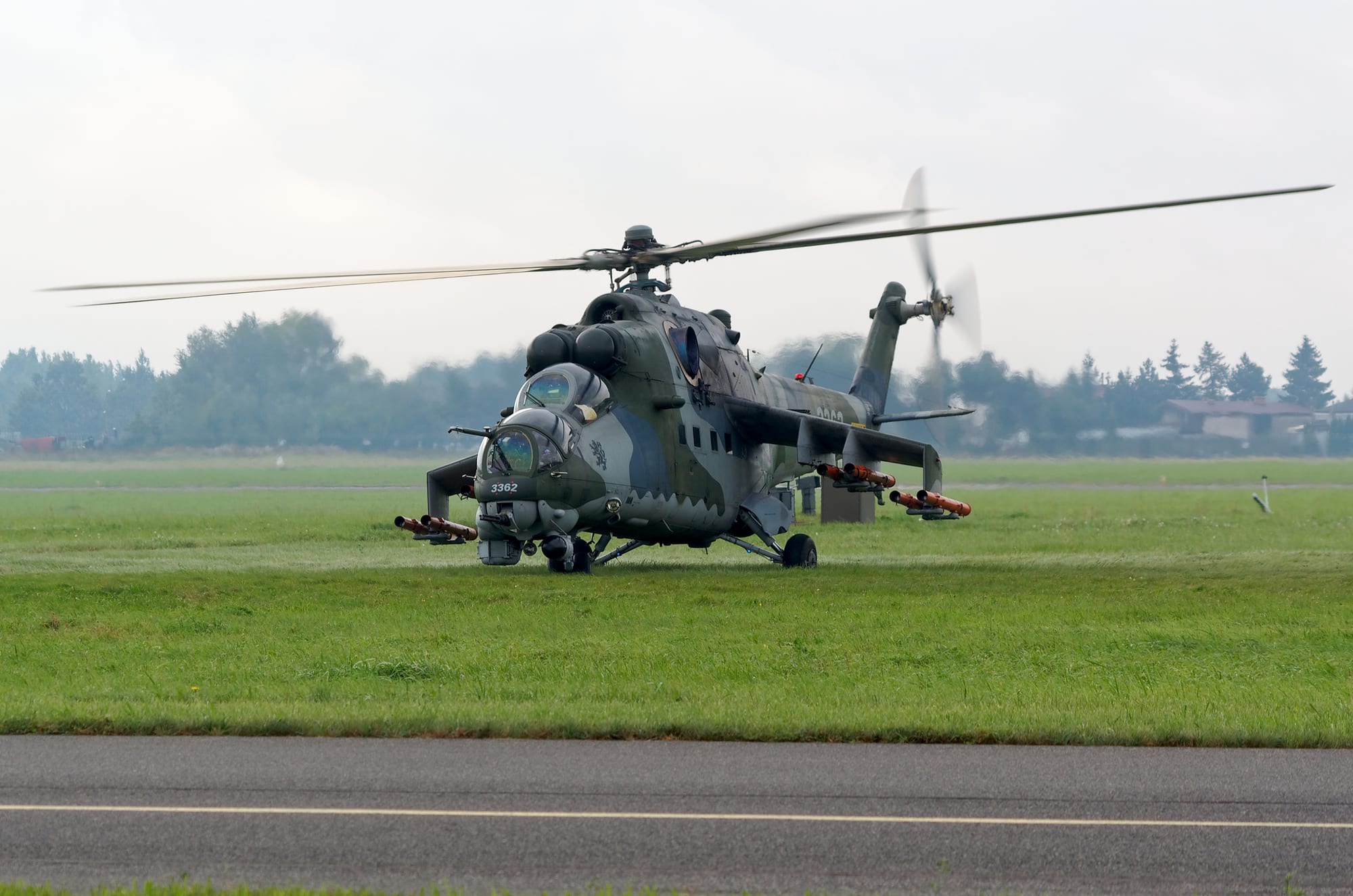
Context · a Mil Mi-24 helicopter, the type involved in the Vranov nad Dyjí incident
Czech Air Force Mil Mi-24 Hind 3362 - Radom Air Show - 20180825 0926 4675 DxO.jpg · Wikimedia Commons · CC BY-SA 4.0 · open original
The night in question
On 12 July 1987 (a summer Sunday with the Vranov nad Dyjí reservoir in South Moravia full of bathers) the crew of a Czechoslovak 51st Helicopter Regiment Mi-24 gunship, on air-defence standby at Božice, was ordered shortly after midday to take off toward Vranov. Once in the area, the ground intercept post told them of a radar target in Austria, close to the border, and ordered them to climb to 2,000 metres. The crew comprised Captain Čestmír Tesařík (pilot), Lieutenant Ivan Pospíchal (operator) and Lieutenant Š., the flight technician, named in later accounts as Milan Šero. The known account comes from two sources: a chapter of the regiment's history written by pilot Jaroslav Špaček, previewed in L+K magazine in June 1998, and an interview with Tesařík, by then a lieutenant colonel, recorded on 10 August 1999 for ČT-1's Fakta programme and transcribed by the Czech group Projekt Záře.
Control led the helicopter back and forth along the border between Vranov and Slavonice with calls that the target was closing at high speed, but among the cumulus, which ranged from 1,500 to over 4,000 metres, the crew saw nothing and at first thought the radar was tracking a cloud or a glider. When control called the target at 200 metres, by then above the clouds at about 3,500 metres, Pospíchal saw a dark, cigar-shaped object pass over them in the opposite direction; Tesařík turned, saw it too and reported to control that it looked like "an aeroplane without wings". According to the interview, they held it in the sight for about a minute ("not even two minutes, that's too long"): a cylindrical object 10 to 15 metres long, 500 to 1,000 metres away, that glinted in the sun "like aluminium or an aircraft cockpit" and always manoeuvred toward the sun, which made it impossible to aim at. The order to open fire came from the ground; they were over the reservoir full of people and, according to Tesařík, he and the operator decided not to shoot and to report that they had lost the target. Later, inside a cloud, control called the target head-on at their own altitude and then said it had passed them about 500 metres away. After about an hour and a half, ending over Dukovany, they returned to Božice for fuel; according to what the control post told them, radar followed the target toward Brno, Jaslovské Bohunice and Bratislava, and lost it there or, in Tesařík's version, already over Hungary.
After landing the crew received an order to destroy all records of radio communications and flight parameters. In 1999 Tesařík said that "fortunately" no document remains, and attributed the destruction to the controller having been hasty with the order to fire and, once it was clear the target was not an aeroplane, to a preference for erasing everything; he added that nothing further was investigated with them. On their own initiative, the pilots later calculated the target's speed by timing the distances control kept giving them, and arrived at a range of about 60 to 2,700 km/h. The case came out years later, mainly through the regimental history published in 1998 and the 1999 television interview, and has since been reconstructed by Czech media and websites from those two texts.
The evidence has limits. According to both sources the target was indeed tracked by ground radar, but no tracks, recordings or photographs survive, and the narrative rests on testimony gathered more than a decade later. The sighting was in daylight, with the object mostly against the sun or at a great distance: Tesařík himself said they could not make out details because it glinted, and that he could not say whether it had pointed ends or was barrel-like. The 60 and 2,700 km/h speeds are cockpit calculations from control's distance calls, not independent sensor measurements. Tesařík offered no explanation and said many sightings can be explained, but stressed that all three saw it, independently. Tesařík himself supplies two facts that weigh against the anomalous reading: the other standby crew, which was patrolling over Mikulov and recorded nothing, was at that moment escorting a helicopter flying along the border on the Austrian side; and three or four times control called the target at 500 metres without their seeing anything. No specific, consensus mundane explanation for this case has been found in the sceptical literature; a helicopter or light aircraft against the sun, or a radar return wrongly associated with what the crew saw, are candidates the sources neither rule out nor confirm.
Why it matters
According to accounts gathered more than a decade later, the case combines an intercept mission guided by air-defence radar, an order to fire that the crew did not carry out because of the bathers below, estimated speeds beyond a helicopter's reach, and a daylight visual sighting shared by all three crew members. The order to destroy the records is itself a data point about how the military apparatus of a socialist state handled an incident it did not control, although the pilot himself attributed it to a hasty order to fire rather than to anything anomalous about the object.
Calibration, however, must be sober about what this proves. The strength of the case is the witnesses' qualifications and the agreement between the 1998 history and the 1999 interview. The weakness is structural: not a single instrumental record survives, so the most striking kinematic figures (the 2,700 km/h) cannot be audited and are, strictly, calculations from radar calls relayed by radio; visual contact lasted about a minute, against the sun and among towering clouds; and the direct testimony in the sources is the pilot's, while that of the other two crew members comes through the regimental history. Add to that the pilot's own statement that a helicopter was flying along the border on the Austrian side and that radar several times called the target at 500 metres without their seeing anything, which makes confusion with conventional traffic more plausible. Overall, the case is modest support: coherent military testimony, orphaned of the instrumentation that would distinguish a genuine anomaly from a misidentified conventional aircraft or from an error in associating a radar return with what the crew saw.
What's left on paper
Documented evidence
- History of the 51st Helicopter Regiment by Jaroslav Špaček (L+K 6/1998; book 'Jednapadesátý', Votobia)
- Interview with Tesařík for ČT-1 (10 Aug 1999): target tracked by ground radar, visual contact of about a minute, order to fire not carried out
- Continuous guidance from the ground intercept post, with the target's range and bearing relayed by radio
- Order after landing to destroy the records of radio communications and flight parameters; according to the pilot no document remains
Sources
- Projekt Záře — 'Incident nad Vranovem': L+K 6/1998 text and transcript of the ČT-1 interview with Tesařík (10 Aug 1999) — Reproduces the regimental history's account and the unedited interview; the reader comments below are not a source.
- PraguePig — English translation of Špaček's chapter (secondary source) — 2018 translation; adds the crew members' full names.
- ArmyWeb — 'In 1987 a Czech army helicopter met a probable UFO' (secondary source) — 2022 press summary; gives a duration of two and a half hours that does not match the hour and a half the pilot stated.
- Aktuálně.cz — reconstruction of the Vranov incident (secondary source)
- AARO — Fiscal Year 2024 Consolidated Annual Report on UAP (Nov 14, 2024)