1998–2026·Spacewatch telescope, Kitt Peak (Arizona)
Near-Earth space · Spacewatch (Arizona).1998 KY26 · a tiny asteroid strays from its predicted orbit
1998 KY26 is a near-Earth asteroid about 11 meters across, spotted in May 1998 by the Spacewatch telescope in Arizona and due to be reached by Japan's Hayabusa2 probe in 2031. Its orbit strays slightly from the one gravity dictates, with no visible tail or dust. A 2025 study led from NASA's JPL attributes that push to sunlight and to the heat the asteroid gives off again. In May 2026, astrophysicist Avi Loeb and three coauthors proposed that it is the Soviet probe Phobos 1, lost in 1988, and in November Loeb said it is "not an asteroid."
Tier S · SolidWhat do they mean? →
Strong evidence: a contemporary instrumental record (radar, sensor, film or photo of known provenance) that corroborates several independent witnesses.
What it was
94%natural phenomenon
The most likely explanation.
- 94% natural phenomenon
- 6% no known cause
See the split across the six explanations
Earthly origin (human or natural)94%
No known cause6%
Ordinary cause the sources propose: natural phenomenon
What happened
On May 28, 1998, the Spacewatch telescope of the University of Arizona's Steward Observatory, on Kitt Peak, recorded a small object approaching Earth. The Minor Planet Center, the body that collects asteroid observations, announced it on June 1 under the designation 1998 KY26; two 2025 studies of the asteroid give June 1 as the discovery date. In June it passed at about twice the Moon's distance.
From June 6 to 8, 1998, NASA's Goldstone radar antenna in California bounced signals off it and recorded the echoes. From those echoes and its brightness, astronomer Steven Ostro and his team reported in 1999, in the journal Science, that the asteroid was about 30 meters across, turned once every 10.7 minutes, the fastest spin measured up to then, and had a composition similar to that of carbonaceous meteorites.
The Japan Aerospace Exploration Agency (JAXA) launched the Hayabusa2 spacecraft on December 3, 2014. The probe studied the asteroid Ryugu, about 900 meters across, in 2018 and 2019, and dropped a capsule of samples on Earth on December 6, 2020. With fuel to spare, JAXA sent it on an extended mission with 1998 KY26 as its final target. On July 5, 2026, the probe flew past the asteroid Torifune, a stop along the way, and its arrival at 1998 KY26 is scheduled for 2031; the 2025 studies specify July of that year. According to a 2025 study of the asteroid, it will be the first visit by a spacecraft to an asteroid only tens of meters across.
After 1998 the asteroid never again grew bright enough for anyone to study its surface. In 2020, positions measured by the VLT, the large telescope of the European Southern Observatory (ESO) in Chile, and by Japan's Subaru telescope in Hawaii showed that its orbit did not match gravity alone: fitting it required a small push out of the plane of the orbit, one that seemed incompatible with the pressure of sunlight. In 2023, astrophysicist Darryl Seligman and his team suggested the asteroid might be releasing gas even though no activity had ever been seen, and grouped it with other small asteroids as so-called "dark comets": bodies with such a push but without the tail or the cloud of gas and dust that gives it away in a comet.
In May and June 2024, 1998 KY26 passed close again, at about 12 times the Moon's distance. A team led by astronomer Toni Santana-Ros of the University of Alicante observed it with the VLT, the Gemini South telescope, the Gran Telescopio Canarias and others, and reanalyzed the 1998 radar echoes. Their study, published in Nature Communications on September 18, 2025, concluded that the asteroid spins once every 5.35 minutes, half the period published in 1999, and is 11 meters across, give or take 2, about a third of the earlier estimate. Its surface is very bright: its geometric albedo, a measure of how much light it reflects, is 0.52, a value the study links to Xe-type asteroids, which are rich in a mineral called enstatite.
The 2024 images showed no dust. The Santana-Ros team calculated that at most 0.03 to 0.3 kilograms of fine dust surrounded the asteroid, and wrote that this ruled out comet activity; grains a millimeter across, on the other hand, could add up to 100 to 500 kilograms and go unseen. Another team, led by astronomer Bryce Bolin, saw no dust either in images from the Keck telescope, and suggested the push comes from large grains that the fast spin throws off the surface. The 2024 positions also made the puzzle harder: according to the Santana-Ros study, even the out-of-plane push no longer reproduced the trajectory. The Santana-Ros study added that the new size, shape and spin axis made it possible to redo the calculation of the forces of light, and that a body this small is unlikely to release gas.
On October 24, 2025, a team led by Davide Farnocchia of NASA's Jet Propulsion Laboratory (JPL) published in The Astrophysical Journal Letters a model of the forces sunlight exerts on 1998 KY26. It starts from the shape, spin and brightness measured in 2024 and adds up two pushes from sunlight: the pressure of the light the asteroid reflects, and the recoil of the heat it absorbs and gives off again, known as the Yarkovsky effect. With that model, the 124 measurements from 1998 to 2024, 120 telescope positions and 4 radar measurements, fit far better than with the empirical three-push fit used before. The authors wrote that their model "does not require the contribution of undetected cometary activity," and that the density it implies, about 2.8 grams per cubic centimeter (between 1.8 and 4.4), matches the asteroid's type.
JPL's Small-Body Database lists the physical data from the Santana-Ros study (a diameter of 0.011 km, an albedo of 0.52 and a spin of 0.089 hours) and an orbit computed on May 7, 2024, from observations up to the day before, before the Farnocchia model was published. That orbit uses the empirical fit, with three non-gravitational push parameters: A1 pushes away from the Sun, A2 along the orbit and A3 perpendicular to it. A2 is −2.2 × 10⁻¹³ astronomical units per day squared, with an uncertainty of 4.9 × 10⁻¹⁴. On those figures, only A2 exceeds its uncertainty several times over (A1 and A3 stay below twice theirs), and it amounts to less than a billionth of the Sun's pull at Earth's distance. In that orbit the push that stands out runs along the orbit, not out of its plane, where the 2020 and 2025 studies had pointed.
On May 31, 2026, Adam Hibberd, Adam Crowl and Carlos Gómez de Olea Ballester of the Initiative for Interstellar Studies, a London-based group, and Harvard astrophysicist Avi Loeb posted on arXiv, a preprint server, the hypothesis that 1998 KY26 is the Soviet probe Phobos 1, launched toward Mars in July 1988 and lost two months later because of a faulty command. For the orbits of the probe and the asteroid to line up, their calculation needs two engine burns adding up to 1.9 kilometers per second: one just after the mission was lost and another in May 1996.
In September 2026, Hibberd, Crowl and Loeb added that a simple model of Phobos 1 reproduces eight light curves of the object, the measurements of how its brightness changes as it spins. They also calculated that treating the push as sunlight pressing on a cylinder or on solar panels cuts the mismatch with 260 measurements by 11%, by their own count, which is larger than the 124 in the 2025 study. They wrote that an investigation of this kind "cannot be conclusive," but that their results "add strong weight" to the hypothesis and that they found "no clear contradictory evidence."
The hypothesis reached television in November 2026. On the program Fox & Friends, NASA Administrator Jared Isaacman said: "I've not seen any evidence to suggest this is...anything other than an asteroid." Loeb answered him in an interview with Fox News Digital published on November 15: "It's not an asteroid because 1998 KY26 appears to have non-gravitational acceleration, meaning it's being pushed by some force other than gravity, and asteroids are just rocks." He predicted that when Hayabusa2 lands, instead of an iceberg it will find the label "Made in the USSR." Asked whether his theory would be over if the probe finds a rock or ice, he answered: "Yes." NASA told the same outlet that its 2025 analysis concluded that the asteroid's behavior is driven by solar radiation forces.
Why it matters
The version that circulated in November 2026 said that 1998 KY26 accelerates in a way gravity alone cannot explain. That is true, and astronomers have known it since the 2020 positions; what the line leaves out is that sunlight pushes rocks too. According to the Farnocchia study, the Yarkovsky effect has been detected on hundreds of asteroids, and these forces matter more the smaller the body, so on an 11-meter one they are large. That study's model shows that a rock with the measured shape and spin feels the observed push: a non-gravitational acceleration, on its own, does not tell a rock from a spacecraft. Nor is the object a newcomer: it has been cataloged since 1998, radar measured it that year, telescopes tracked it in 1998, 2020 and 2024, and even the hypothesis of Loeb and his coauthors makes it a 1988 object, the Phobos 1 probe.
Both explanations in dispute are earthly: a natural rock or a Soviet artifact, and none of the sources cited proposes a non-human origin. The Phobos 1 idea requires, in the solution its own authors found, the probe to fire its engine in May 1996, almost eight years after it was lost, and for now it exists only in preprints. The JPL model is peer-reviewed and rests on properties of the asteroid measured with telescopes and radar.
For Hayabusa2 the question is practical. According to the Farnocchia study, a model that needs no gas lowers the risk to the spacecraft when it flies close to the asteroid. The size, on the other hand, is not the same across JAXA's own texts: its June 2026 press release still described an asteroid about 30 meters across, the 1999 figure, while its mission page already gives the 11 of the Santana-Ros study. According to ESO astronomer Olivier Hainaut, a coauthor of the Santana-Ros study, the study shows that even the smallest hazardous asteroids can be characterized from the ground, such as the one that struck near Chelyabinsk, Russia, in 2013, barely larger than 1998 KY26.
As with ʻOumuamua ↗ ʻOumuamua, the first known interstellar object, whose tailless acceleration also led Loeb to propose a light sail, the debate turns on a small push with no visible gas. The difference is that a spacecraft will reach 1998 KY26: in 2031 the probe can check on site what with ʻOumuamua could only be argued from afar, and Loeb has accepted in advance that a rock or ice would end his hypothesis.
Documents and sources
Primary documents
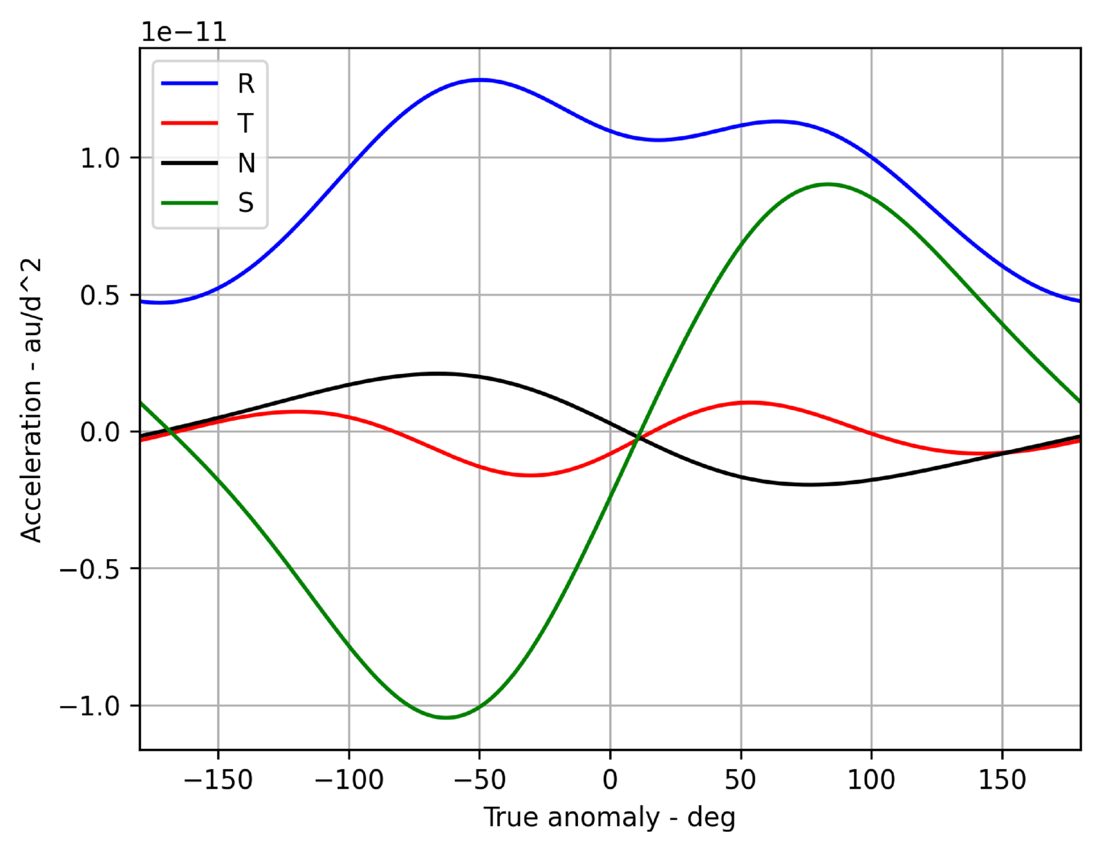
Sunlight's push on 1998 KY26 along its orbit, according to the JPL model (2025)
Figure 1 of the study by Farnocchia and colleagues (The Astrophysical Journal Letters, 2025): over one trip around the Sun, the four curves show the push that light pressure and heat emission exert on the asteroid according to the model: away from the Sun (R, blue), along the orbit (T, red), perpendicular to it (N, black) and along the spin axis (S, green). Values are in astronomical units per day squared, times 10⁻¹¹.
Farnocchia, D. et al., The Astrophysical Journal Letters 993, L9 (2025), figure 1 · CC BY 4.0 · open original
Documented evidence
- Minor Planet Center circular MPEC 1998-L02 (issued June 1, 1998): the first position, flagged as the discovery observation, was taken by Spacewatch on Kitt Peak on May 28, 1998.
- Ostro and colleagues, Science (1999): from the Goldstone radar (June 6 to 8, 1998) and photometry, a diameter of about 30 meters and a spin of 10.7 minutes.
- Santana-Ros and colleagues, Nature Communications (September 18, 2025): a spin of 5.3516 minutes (± 0.0001), a diameter of 11 ± 2 meters, a geometric albedo of 0.52 ± 0.08 and at most 0.03 to 0.3 kg of micron-sized dust around the asteroid.
- Farnocchia and colleagues, The Astrophysical Journal Letters (October 24, 2025): the light-pressure and thermal-emission model fits 124 measurements from 1998 to 2024 with a weighted error of 0.44, against 0.79 for the empirical three-push fit; density of 2.8 g/cm³ (between 1.8 and 4.4).
- JPL Small-Body Database (orbit 36, computed May 7, 2024): A1 = 3.655 × 10⁻¹¹ ± 3.867 × 10⁻¹¹, A2 = −2.196 × 10⁻¹³ ± 4.866 × 10⁻¹⁴ and A3 = 1.686 × 10⁻¹² ± 1.121 × 10⁻¹² astronomical units per day squared.
Show 3 more facts
- Hibberd, Crowl, Gómez de Olea Ballester and Loeb, arXiv (May 31, 2026): the Phobos 1 hypothesis requires two engine burns adding up to 1.9 km/s, the second in May 1996. Hibberd, Crowl and Loeb, arXiv (September 2026): an investigation of this kind "cannot be conclusive," but the results "add strong weight" to the hypothesis and find "no clear contradictory evidence."
- Fox News Digital (November 15, 2026): Isaacman says he has seen no evidence it is anything other than an asteroid; Loeb argues it is not one; NASA attributes its trajectory to solar radiation forces.
- JAXA (press release, June 9, 2026): Hayabusa2 will reach 1998 KY26 in 2031; the release gives it a diameter of about 30 meters.
Sources
- NASA/JPL · Small-Body Database (SBDB), 1998 KY26 record with physical and non-gravitational parameters — Orbit 36 by Davide Farnocchia (May 7, 2024; observations from May 31, 1998, to May 6, 2024): A1, A2 and A3 with their uncertainties; diameter, albedo and spin taken from Santana-Ros and colleagues (2025).
- Santana-Ros, T. et al. · "Hayabusa2 extended mission target asteroid 1998 KY26 is smaller and rotating faster than previously known," Nature Communications 16, 8275 (2025) — Spin, size, albedo, dust limit and discussion of the acceleration; gives June 1, 1998, as the discovery date.
- Farnocchia, D. et al. · "Radiation Forces and Trajectory of Hayabusa2♯ Target 1998 KY26," The Astrophysical Journal Letters 993, L9 (2025) — Light-pressure and thermal-emission model that explains the trajectory without comet activity; published October 24, 2025.
- Bolin, B. T. et al. · "Keck and Gemini characterization of Hayabusa2# rendezvous target 1998 KY26," The Astronomical Journal (2025) — Images from June 8 and 9, 2024, with no dust cloud; suggests the push comes from large grains the spin sheds from the surface.
- Hibberd, A., Crowl, A., Gómez de Olea Ballester, C. and Loeb, A. · "Is the Dark Comet 1998 KY26 the Spacecraft Phobos 1?," arXiv 2606.01288 (2026) — Preprint of May 31, 2026, with the Phobos 1 hypothesis.
- Hibberd, A., Crowl, A. and Loeb, A. · "Feasibility of the Phobos 1 Hypothesis for Dark Comet 1998 KY26," arXiv 2609.24283 (2026) — Preprint of September 2026: light curves and light pressure on a model of the probe; the authors write that it cannot be conclusive but that it adds "strong weight" to the hypothesis.
- Fox News Digital · "Harvard scientist pushes back on NASA chief over mystery space object: 'It's not an asteroid'" (November 15, 2026) — Quotes from Isaacman and Loeb, and NASA's statement on the 2025 study.
- JAXA · "The timing of the flyby of asteroid Torifune by asteroid explorer Hayabusa2" (June 9, 2026) — Arrival at 1998 KY26 in 2031; gives the asteroid about 30 meters.
- JAXA/ISAS · Hayabusa2 mission page — Launch (December 3, 2014), capsule return (December 6, 2020) and Torifune flyby (July 5, 2026); gives 1998 KY26 a diameter of about 11 meters and a 5-minute spin.
- Minor Planet Center · MPEC 1998-L02: 1998 KY26 (June 1, 1998) — Announcement circular, with the discovery position taken on May 28, 1998, by Spacewatch (code 691).
- ESO · "Can Hayabusa2 touchdown? New study reveals space mission’s target asteroid is tinier and faster than thought" (eso2515, September 18, 2025) — Press release on the Santana-Ros study, with Olivier Hainaut's statements.
Context (not images of the event)
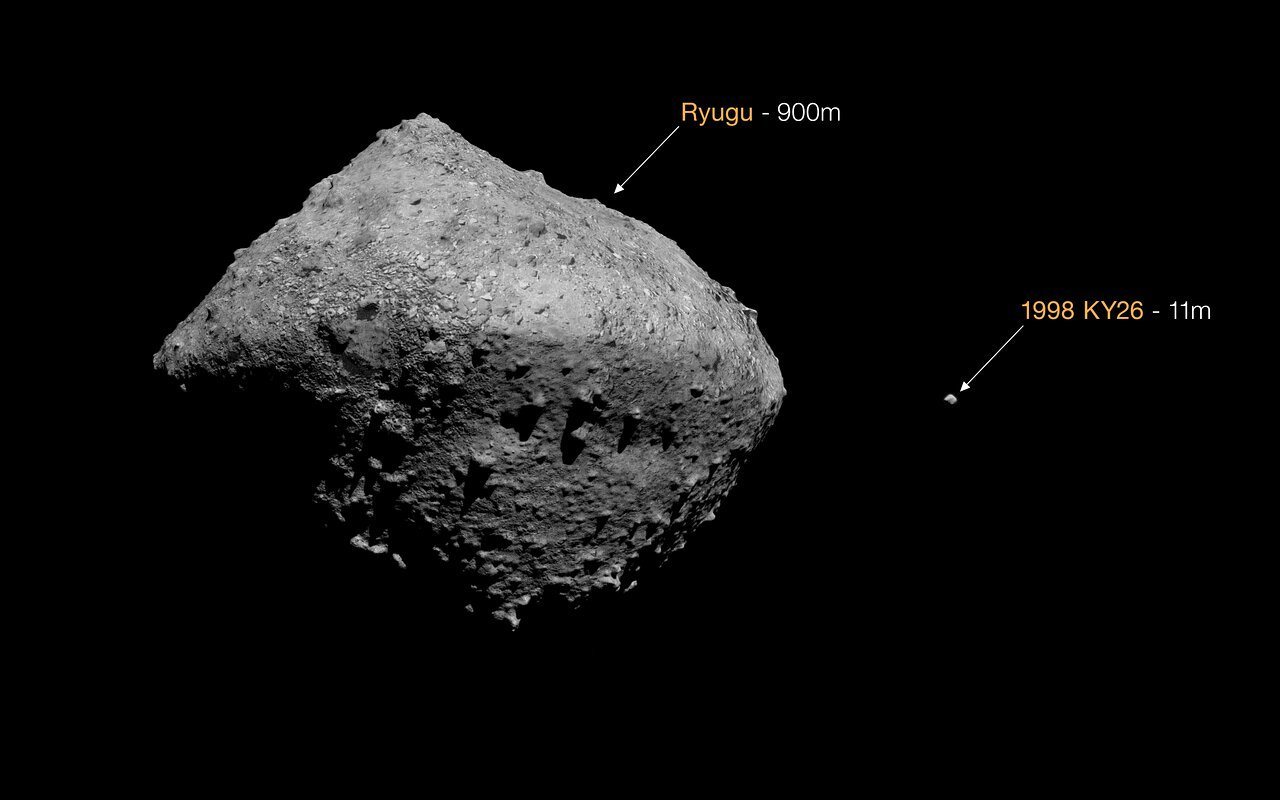
Ryugu (900 meters) and 1998 KY26 (11 meters) at the same scale
ESO illustration comparing Hayabusa2's two targets at the same scale, with the shape models of Ryugu (JAXA) and of 1998 KY26 (Santana-Ros and colleagues). It is a composite of models, not a photograph of the asteroid, which telescopes show only as a dot.
ESO/M. Kornmesser. Asteroid models: T. Santana-Ros, JAXA/University of Aizu/Kobe University (eso2515b) · CC BY 4.0 · open original
Related cases
Cases this case cites and cases with the same likely cause.
Cited in this case · Same country
ʻOumuamua · a Hawaii telescope spots an interstellar object
2017 · Tier S
Natural phenomenon · Same country
Val Johnson · a light rushes at his patrol car
1979 · Tier A
Natural phenomenon · Same country
Wow! signal · a radio telescope picks up a signal never repeated
1977 · Tier A
Natural phenomenon · Same country
The Dulce "mutilations" · ranchers find cattle missing organs
1975 · Tier A