2000·St. Clair County, Illinois (Lebanon / Shiloh / Millstadt)
United States.St. Clair Triangle · five Illinois police officers
In the early hours of January 5, 2000, between 4:00 and 4:40 a.m., a large, nearly silent object with brilliant white lights and a red one was seen by a civilian in Highland and at close range by three police officers from Lebanon, Shiloh and Millstadt, in St. Clair County, Illinois, near Scott Air Force Base; an officer in Dupo later saw a distant light.
Read the rest of the summary
The dispatch center recorded their radio transmissions, and a Polaroid shows only smears of light. Lambert's radar saw nothing. Venus, proposed by Philip Klass, rose around 4:23, after the object had left Lebanon, and fits only the light the Dupo officer saw to the east around 5:03.
Tier A · AcceptableWhat do they mean? →
Institutional evidence: several identified independent witnesses, or contemporary official documentation, without an instrumental record to corroborate them.
What it was
53%no known cause
The evidence is not enough to decide between the explanations
See the split across the six explanations
No known cause
Natural or human cause
Primary documents
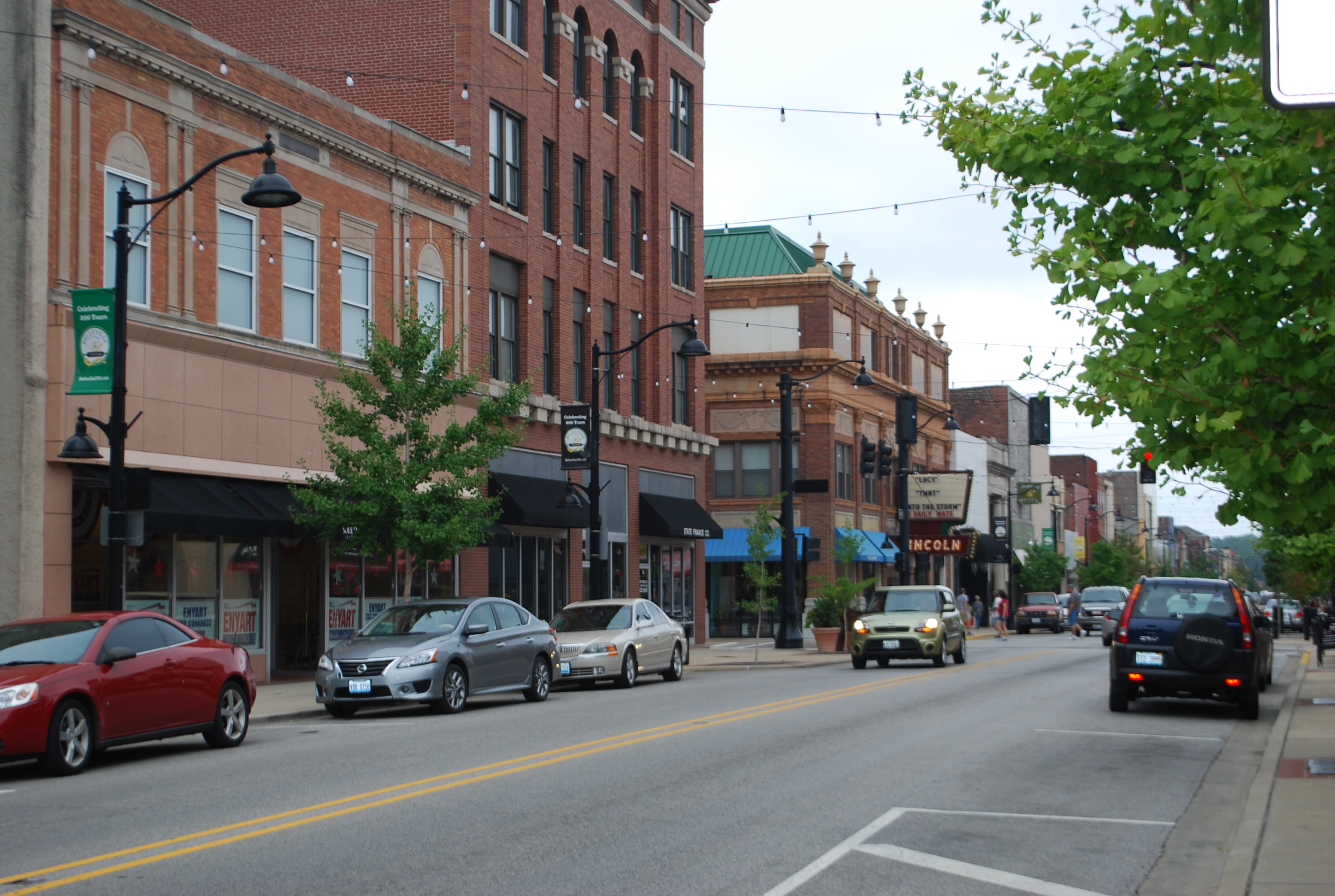
Context · Belleville (St. Clair County, Illinois)
Main Street, Belleville, IL.jpg · Wikimedia Commons · CC BY-SA 2.0 · open original
Time log of CENCOM, the St. Clair County dispatch centre (5 January 2000)
Sheet from the St. Clair County Emergency Services and Disaster Agency addressed to Darryl Barker, who obtained the tape through a freedom-of-information request (release form of 17 February 2000). It lists the radio transmissions between CENCOM and the Lebanon, Shiloh, Millstadt and Dupo police: at 4:11:55 CENCOM tells Lebanon that Highland has identified a UFO; at 4:23:06 the Lebanon officer reports it westbound near Scott; at 4:23:57 the Shiloh officer possibly identifies it; at 4:39:27 Millstadt sights it and at 5:03:36 Dupo. It is a county record with no open licence, so Barker's copy is linked.
Condado de St. Clair (Illinois), CENCOM, vía Darryl Barker · view source
The night in question
Shortly after 4:00 a.m. on January 5, 2000, Melvern Noll, a 66-year-old miniature-golf-course owner, stopped by his business in Highland, Illinois, to check that the pipes had not frozen in the cold. Stepping outside, he saw a light on the northeastern horizon that, according to Klass's summary of his NIDS interview, at first looked like 'a bright star… awful low for a star'; then it came closer and he saw a brightly lit object that he described as 'a flying house' two or three stories high, with red lights underneath, a headlight at the front and what looked like lit windows; in the dark he could not make out a triangular shape and drew it as a box. He called the police; the dispatcher relayed the report, and with that began a staggered tracking that crossed half a dozen towns in St. Clair County.
The county dispatch center, CENCOM, alerted Officer Ed Barton of Lebanon at 4:12, who at first thought it was a joke. Barton, who went out to look for it, first saw to the southeast two very bright lights close together, 'like the Japanese Rising Sun symbol on the horizon', which merged into one and came toward him. In the NIDS interview, as Klass quotes it, he also said that light 'was southeast of me' and 'stationary the entire time' for about five minutes; Lawhon places that first sighting around 4:10, with Venus some 2 degrees below the horizon. While Barton drove east, a Summerfield resident, according to Barker, watched for about two minutes a wide boomerang-shaped object at least twice the size of a C-5, some 900 feet up and 800 feet away, with bright lights around its perimeter, moving slowly toward Lebanon and making a slight sound he likened to a well-tuned V-8 engine at about 40 feet. As for Barton, per the timecode, the object shot away from him seconds before 4:23:06. He described an elongated triangle, at an altitude he estimated at 1,000 to 1,500 feet, with white lights at the corners and a blinking red light underneath. According to the NIDS summary, he shut off his engine, light bar and radio to listen, heard nothing, and watched the object rotate slowly and move off very fast toward Shiloh. On the open frequency, Officer David Martin of Shiloh heard him and, per the CENCOM timecode, reported at 4:23:57, 51 seconds after Barton announced the object was heading that way, that he saw something he could not identify: an arrowhead-shaped object with three bright lights. According to the NIDS summary, the object moved slowly, then gathered speed and flew four to five miles across the sky at a very high rate, silently, while Martin listened from his car with the windows down and the engine off. At 4:28 by his watch, Officer Craig Stevens of Millstadt saw it pass very slowly beside the village park, 500 to 1,000 feet up, heard a low-frequency buzz and took a Polaroid with the frozen camera, which recorded only four blurred smears of light; dispatch logged his call at 4:39:27. Later, around 5:03, when according to Barker he radioed it to Stevens, Officer Matt Jany of Dupo saw through binoculars a light to the east that on the tape he described as 'pretty far off in the distance', colored at first and then white, at '20 or 30,000' feet, 'about where planes usually are; it's not low at all'. He later told Barker that its lights were brighter than typical aircraft lights and that at one point he saw 'a large, red light glowing on the underside', with white lights 'sort of flashing' around the perimeter. The transmissions were recorded by the CENCOM system, and filmmaker Darryl Barker later obtained the dispatch timecode log through a freedom-of-information request. In 2002 Barker also interviewed Detective Mark Lopinot of O'Fallon, who said that between 4:00 and 4:30 he had seen five silent amber lights fixed relative to one another, 200 to 300 feet up, without making out a shape; he did not note the time or report it at the time. Barker also records a teacher, Stephen Winnacott, who at 6:50, at dawn, saw from an overpass in Centerville a huge, triangular, stationary object with two very bright white lights and many smaller ones.
The path passed a few kilometers from Scott Air Force Base, headquarters of Air Mobility Command. When Lambert called Jany to ask if he still saw it, it told him there was nothing on radar in his area; Scott told the press it had no active radar on the base, relied on Lambert's control and had no one in its tower at that hour, a version local police officers questioned. Robert Bigelow's National Institute for Discovery Science (NIDS) received Stevens's call some two hours after the sighting and sent two investigators: they interviewed the officers and civilians, two Air Force Office of Special Investigations officers at Scott told them nothing had flown from the base between 4:00 and 5:00, Boeing St. Louis denied any night test flights and, according to Klass's newsletter, a check showed that no B-2 bombers had been airborne. NIDS added to the sequence a sighting the previous night at Lake Forest, north of Chicago, and spoke of a flight of nearly nine hours; Klass objected that this report came after the publicity and that NIDS assumed all the witnesses had seen the same object. NIDS reached no conclusion. In 2002 it published an aircraft designer's hypothesis that the object was a lighter-than-air Department of Defense craft, and noted that the large-triangle sightings in its database clustered near Air Mobility Command and Materiel Command bases; in 2004, as quoted by Barker, it added that their behavior did not conform to previous patterns of covert deployment of unacknowledged aircraft. According to Barker, the FAA attributed it to an advertising blimp; NIDS judged the acceleration Martin described, with little if any wind, 'inconsistent with the behavior of a blimp', and had ruled out a secret blimp resembling the Aereon prototype, which according to its maker never went past proof of principle. In March 2000 Philip Klass proposed the planet Venus, which 'by curious coincidence' was rising in the southeast, and cited Allan Hendry's study in which 94% of the UFOs reported by law-enforcement officers turned out to be identified objects. NIDS astrophysicist Eric Davis replied that Venus was still below the horizon when the object was first seen, did not rise until 4:25 and would initially have been hard to see because of the surrounding trees, rolling hills and structures. According to an ephemeris calculation, Venus rose at 4:23 at Lebanon and 4:24 at Millstadt, in the east-southeast, when per the timecode the object had already left Barton, and while Stevens watched it stayed under 3 degrees up. In May Klass conceded as much for the first witness: the Highland log put Noll's report around 4:10, with Venus 2.4 degrees below the horizon, and although he noted that a very bright body can be seen a few degrees below the horizon depending on refraction, he wrote that if Noll saw the object in the northeast 'this would rule out Venus' as the explanation of his UFO. He headed that note 'which Illinois UFO reports were triggered by Venus is uncertain', but maintained that none of the officers reported separately seeing a very bright Venus, which some of them would have had low in the southeast. Richard Hall, in the MUFON UFO Journal, suggested it for the first bright light Barton saw east of town, but that light predates the planet's rising. Hall also warned that people who hear of a sighting in progress often look up, see a brilliant Venus and assume it is the same thing; Jany went looking for the object after hearing the radio. Where Venus does fit is the light Jany saw to the east around 5:03: the planet was about 6 degrees above the east-southeast horizon, at magnitude -3.9; Hendry, as cited by Klass, describes how near the horizon a planet's light breaks into colors, and Lambert had no aircraft on radar in his area. Against it stand Jany's height estimate and the large red light he described later. Klass also attributed the 6:50 sighting to Venus, though he placed it in the southwest sky and the planet was in the southeast. There was no federal investigation; the reconstruction rests on the interviews, the officers' reports and sketches, and the dispatch audio.
Why it matters
With no radar, the St. Clair Triangle rests on multiple institutional testimony, dated by an independent record. Its core is three on-duty police officers, from different departments, who did not share an observation point and who described at close range, within a few minutes, a large, slow, nearly silent object with white lights and a red one, a chain the dispatch records date to the second. Its limits must be stated. Each officer went looking for the object after hearing the previous one on the radio, so the observations are not fully independent; the descriptions of the shape vary (Noll's box with windows, Barton's elongated triangle, Martin's and Stevens's arrowhead), and David Marler, MUFON's Illinois director, also noted 'radical differences in the lighting configuration', though he attributed them mainly to the perspective of stationary and moving witnesses watching an object that changed speed and direction; Hall warned that the witnesses' altitude guesstimates 'are almost worthless'; the photo shows nothing identifiable; and the fourth police witness, Jany, described on the tape a distant light to the east, colored and then white, in the direction where Venus had just risen, which should not be counted as the same object. Even so, the agreement on size, silence with engines off, low altitude and path between Lebanon, Shiloh and Millstadt is not explained by the planetary hypothesis because Venus had not risen when Noll and Barton saw the object and was right at the horizon when Martin saw it pass over Shiloh.
The proximity to Scott AFB opens two readings. On one hand, it puts on the table the hypothesis of a classified craft (the 1990s and 2000s are full of 'black triangle' sightings that many analysts attribute to unacknowledged military platforms) operating near its base. On the other hand, the base's answer (no radar of its own, no one in the tower and, according to its special investigations officers, nothing airborne between 4:00 and 5:00) leaves the explanation incomplete: if it was a domestic craft, it went unacknowledged; if it was not, something of the described size passed beside an air-mobility command without any system registering it. Nor can a prosaic reading be ruled out any better than the record allows, an aircraft or an airship seen at night by witnesses primed by the radio, because there is no radar, no useful photo and no published flight log. There are no physical data, and no official version takes responsibility for what they saw.
What's left on paper
Documented evidence
- Initial report by a civilian witness (Melvern Noll, Highland, shortly after 4:00): brightly lit object 'like a flying house' with windows, drawn as a box
- Officer Ed Barton (Lebanon, before 4:23:06 per the timecode): first two very bright lights to the southeast that merged and came toward him; then a triangle 'longer than it was wide,' 1,000-1,500 ft up, white lights at the corners and a red one; he shut off engine and radio and heard nothing
- Officer David Martin (Shiloh, 4:23:57 per the CENCOM timecode): arrowhead-shaped object with three bright lights that, per NIDS, gathered speed and flew four to five miles across the sky silently
- Officer Craig Stevens (Millstadt, 4:28 by his watch, call logged at 4:39:27): slow pass at 500-1,000 ft, low-frequency buzz and a Polaroid showing only smears of light
- Officer Matt Jany (Dupo, ~5:03): on tape, a distant light to the east at '20 or 30,000' feet, 'about where planes usually are'; to Barker he described 'a large, red light glowing on the underside' and white lights 'sort of flashing' around the perimeter; Lambert had no aircraft on radar in his area
Show 3 more items
- Ephemerides: Venus rose at 4:23-4:25 in the east-southeast, stayed under 3 degrees while Stevens watched and was about 6 degrees up around 5:03, so it does not explain Noll, Barton or Martin but is compatible with Jany's light; Klass, who had proposed it, conceded in May 2000 that he did not know which reports it had triggered
- Lambert reported nothing on radar in the area; Scott AFB said it had no active radar and an empty tower, and two of its Office of Special Investigations officers told NIDS nothing took off between 4:00 and 5:00
- NIDS rapid-response investigation (January 2000), its 2002 hypothesis of a lighter-than-air military craft and its 2004 caveat that the behavior did not fit covert-deployment patterns
Sources
- Darryl Barker, «The Illinois Triangle: Do We Have the Technology?», análisis del caso (2002, actualizado en 2018) — Analysis by the filmmaker who interviewed the witnesses: sequence with the CENCOM timecode obtained through a freedom-of-information request, the officers' sketches, Stevens's Polaroid, the Lopinot interview and Scott AFB's response
- National Institute for Discovery Science, «Hypothesis: The Illinois Flying Triangle is A Department of Defense, Not An ET Craft» (julio de 2002) — Summarizes the NIDS investigation and sets out the lighter-than-air military craft hypothesis
- National Institute for Discovery Science, resumen del informe sobre el avistamiento de Illinois (enero de 2000), copia en UFO Evidence — NIDS text copied by an aggregator (the original report at nidsci.org is no longer online): time of the call, summary of the testimony, the inquiries to the Office of Special Investigations at Scott and to Boeing St. Louis
- Philip J. Klass, «1970s Data Helps Identify January 5th Illinois UFO As Extraterrestrial», Skeptics UFO Newsletter no. 62 (March 2000) — Original text of the Venus proposal: cites Allan Hendry's statistics (94% of law-enforcement UFO reports turned out to be IFOs), excerpts of the NIDS interviews and the check that no B-2s were airborne
- Philip J. Klass, «Which Illinois UFO Reports Were Triggered By Venus Is Uncertain», Skeptics UFO Newsletter no. 63 (May 2000) — Klass qualifies his proposal: the Highland log puts Noll's report around 4:10, with Venus 2.4 degrees below the southeastern horizon, and if Noll saw the object in the northeast 'this would rule out Venus'; also reports Marler's and Richard Hall's (MUFON) objections
- Loy Lawhon, «When Planets Attack», About.com, 6 de marzo de 2000 (copia en UFO Evidence) — Secondary source: transcribes excerpts of the dispatch recording, including the exchange between Jany and Stevens, and Stevens's report as posted by the Millstadt police
- Patrick Huyghe, «NIDS and the Illinois UFO sighting», Space.com, 15 de marzo de 2000 (copia en UFO Evidence) — How the case reached NIDS: Craig Stevens's call to its hotline
- Registros de CENCOM, central de despacho del condado de St. Clair (5 de enero de 2000) — Time-stamped audio and reports that fix the sequence of the tracking
Related cases