2004·Pacific, off Baja California
United States.USS Nimitz Tic-Tac
In November 2004, the cruiser USS Princeton's SPY-1 radar repeatedly detected contacts descending very rapidly from high altitude; on 14 November, Cmdr. David Fravor and three other crew in two F/A-18Fs saw a white Tic-Tac-shaped object up close over a disturbance in the water, and hours later another crew recorded the FLIR1 infrared video, which the Pentagon released in 2020 as 'unidentified'. Its file also records doubts from its own witnesses.
Tier S · SolidWhat do they mean? →
Strong evidence: a contemporary instrumental record (radar, sensor, film or photo of known provenance) that corroborates several independent witnesses.
What it was
56%no known cause
The evidence is not enough to decide between the explanations
See the split across the six explanations
No known cause
Natural or human cause
Primary documents
ATFLIR 'FLIR1' video — the Tic-Tac object and its abrupt final lateral acceleration, captured by Lt. Chad Underwood
US Navy, oficialmente desclasificado por el Pentágono (abril 2020), vía DVIDS · Public domain · US Government work · open original
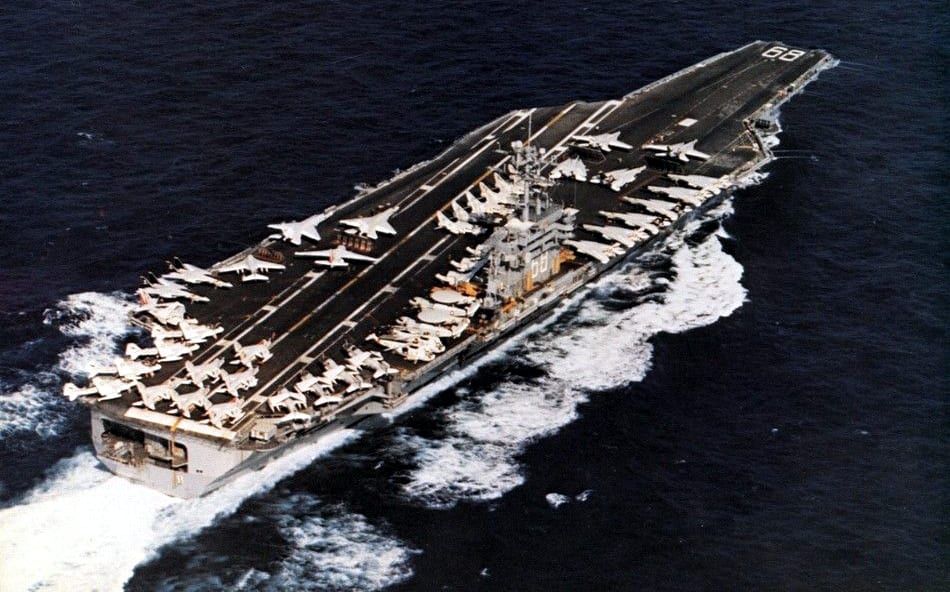
Context · the aircraft carrier USS Nimitz (CVN-68), whose battle group tracked the Tic-Tac object in 2004
USS Nimitz (CVN-68) underway at sea, circa in 1978.jpg · Wikimedia Commons · Public domain · open original
The night in question
Between 10 and 16 November 2004, the USS Nimitz carrier strike group (Carrier Strike Group 11) was conducting pre-deployment workups in the SOCAL operating area, off California and Mexico. The guided-missile cruiser USS Princeton (CG-59), the first of its class with the upgraded AN/SPY-1B radar, on several occasions detected contacts the crew labeled 'Anomalous Aerial Vehicles' (AAVs). The case's executive summary, an unsigned, undated document attributed to the Pentagon's AATIP program and made public in 2018, records the account of a senior chief with 17 years on Aegis cruisers: the AAVs would descend "very rapidly" from about 60,000 feet to about 50 feet "in a matter of seconds", hover for a time and depart at high velocity; they were detected three times that week. The same document notes that the radar was set up for air intercept, never obtained an accurate track and dropped the contacts as clutter, and that the Princeton's meteorological officer briefed the crew on a high-altitude ice-crystal phenomenon the SPY-1 can detect. Princeton operator Kevin Day has said in later interviews that he re-checked the system repeatedly before becoming convinced the tracks were real; in his 2023 statement, Fravor summarized what the controller told him: objects coming down from above 80,000 feet to 20,000, staying for hours and going back up.
On 14 November, two F/A-18Fs from squadron VFA-41 'Black Aces', airborne for an air-to-air training exercise, were diverted by the Princeton toward a contact. In the lead aircraft were Commander David Fravor, the squadron's commanding officer, and his weapons-systems officer (WSO); in the other, then-Lieutenant Alex Dietrich and her WSO. According to the executive summary, the spot was around 31° 20' N, 117° 10' W, about 70 nautical miles south of the border and 30 off the Baja California coast. All four crew saw an area of white water on the sea and, above it, a smooth white Tic-Tac-shaped object with no wings, rotors or visible control surfaces, moving abruptly; in the executive summary Fravor puts its length at about 46 feet (14 m). Fravor's WSO described the object flying level at 500–1,000 feet and about 500 knots, an account the document flags as differing from the pilot's. As Fravor spiraled down, the object aligned its axis with the aircraft and climbed; at half a mile, according to his 2023 testimony to Congress, it accelerated and disappeared, and the disturbance in the water vanished as well. The controller then reported that the contact had reappeared on the SPY-1 radar at the flight's rendezvous (CAP) point, some 60 miles away, in under a minute. At the same hearing, Fravor stated that they did not see any object under the water, only something causing the foam. The commanding officer of Marine squadron VMFA-232, flying nearby in an F/A-18C, saw the disturbance from about 15,000 feet, round and 50 to 100 meters across, with no object associated with it; it reminded him of something rapidly submerging, though also, the document says, of swell breaking over a shoal.
Around 3 pm, another VFA-41 crew launched after being briefed by Fravor's. The executive summary and the 2010 BAASS report identify Lieutenant Chad Underwood as the WSO operating the radar and the ATFLIR infrared sensor. The radar detected a contact 30–40 miles to the south and could not lock it: the target appeared, the radar began building its vector and then dropped it. Underwood told the investigators there were no jamming cues ("the radar couldn't hack it"); in 2023 Fravor instead spoke of significant jamming of that crew's APG-73 radar. The ATFLIR showed an apparently stationary object, at the aircraft's altitude or somewhat below, which moved out of the field of view to the left; according to the same document, Underwood made no attempt to slew the sensor and lost the contact, and he could not confirm it was the same object the first section had seen. That recording is the video known as FLIR1, about 76 seconds long in the official version. Copies of the tapes went to the intelligence section, and a mission report e-mailed to Third Fleet intelligence went no further and was likely deleted. The Department of Defense authorized its release on 27 April 2020, after unauthorized releases in 2007 and 2017, and stated that the phenomena in the videos "remain characterized as 'unidentified'".
Why it matters
Nimitz brings together an ATFLIR video released by the Department of Defense as 'unidentified', four crew who saw the object at short range from two aircraft, a third pilot who saw the disturbance in the water, Princeton radar contacts recorded on several occasions, and Fravor's sworn testimony to Congress (July 2023). The AATIP executive summary concluded that the object was no known aircraft in the inventory of the United States or any foreign nation and credited it with "advanced low observable characteristics" at multiple radar bands, its own assessment, sitting alongside tracks that never stabilized; the "Ballistic Missile Characteristics" that also appear in it are the Princeton senior chief's opinion, not a conclusion of the document; and the strike group's operations officer stated he had no knowledge of weapons tests or experimental aircraft in the area. It was a direct catalyst for the AATIP/UAPTF/AARO program and for the 2022-2023 UAP transparency legislation.
In 2026, amid the disclosure cycle, journalist Ross Coulthart publicly argued that the Tic-Tac was a classified Lockheed Martin program, not technology of non-human origin. David Fravor rejected this in public appearances ("it makes no scientific sense"), though with a caveat: he cannot categorically assert it is not, only that he has no evidence that it is. The dispute is journalistic and without primary documentation: it does not change the case's evidential core but illustrates its open question.
Several observation modalities converge at Nimitz: a ship's radar, the visual observation of two pilots and their systems officers from two aircraft, and the infrared record of a third aircraft's sensor. The file itself, however, shows its limits. The Princeton's tracks never stabilized and no preserved records are known; the E-2C controlling the flight recorded nothing and saw only a faint return, which it took for a wave, once the Princeton pointed it out; the Princeton at first put the target at 15,000–20,000 feet; the FLIR crew saw a stationary object that left the frame when the sensor did not follow it, and could not link it to Fravor's; Fravor's WSO gave a different account of its motion, and the group's intelligence chief thought of a counter-drug operation. Skeptics have proposed that FLIR1 shows a distant aircraft and that the descriptions of extreme performance have grown stronger through years of retelling; proponents reply that four crew saw the object at under a mile in good visibility and that the radar reappearance 60 miles away is not explained by a single artifact. On balance: the visual witnesses are four identified crew and the FLIR1 video survives, but the radar data are fragmentary, the nature of the object remains unresolved, and what the case robustly establishes is that indeterminacy.
What's left on paper
Documented evidence
- ATFLIR 'FLIR1' video released by the Department of Defense on 27 April 2020, after leaks in 2007 and 2017; the phenomena 'remain characterized as unidentified'
- USS Princeton SPY-1B radar contacts on three occasions during the week, described as 'very rapid' descents from high altitude; the radar never obtained an accurate track and no preserved records are known
- Visual observation of the object by all four crew of two VFA-41 F/A-18Fs (14 Nov 2004), at half a mile according to Fravor
- Circular disturbance in the water, 50 to 100 m across, also seen by the VMFA-232 commanding officer with no object associated with it
- Executive summary attributed to AATIP (made public in 2018) and BAASS report (23 Nov 2010): the object 'was no known aircraft' of the United States or any foreign nation; they also record the meteorological officer's ice-crystal hypothesis, the absence of jamming cues according to Underwood, and the loss of the object when the sensor was not slewed
- Written statement and sworn testimony by Fravor before the House Oversight subcommittee (26 Jul 2023)
Sources
- Department of Defense — Statement on the Release of Historical Navy Videos (27 Apr 2020), copy at The Black Vault — Full text of the statement: authorized release after leaks in 2007 and 2017; the phenomena 'remain characterized as unidentified'. The defense.gov original is not reachable from here.
- DVIDS — official 'FLIR1' video (Pentagon mirror) — Video embedded in this case's viewer.
- Executive summary of the Nimitz strike group incident (attributed to AATIP, made public in 2018), copy at The Black Vault — Primary source: 13 unsigned, undated pages with the accounts of the Princeton, the E-2C, VMFA-232, both VFA-41 sections, USS Louisville and the intelligence chain. Includes the ice-crystal hypothesis and Underwood's testimony of no jamming cues.
- BAASS — Summary Report on BAASS UAP Analysis Capabilities (23 Nov 2010), copy at The Black Vault — Report by the AAWSAP program contractor with the unredacted version of the accounts (identifies Underwood as the WSO) and the velocity and acceleration analysis.
- David Fravor — written statement to the House Oversight Committee (Jul 2023) — First-person account of 14 November 2004; states the incident was never investigated and the tapes were never collected.
- House Oversight — transcript of the 'Unidentified Anomalous Phenomena' hearing (26 Jul 2023) — Fravor's sworn testimony, including his statement that they did not see any object under the water.
- Kean, L. — NYT 'Glowing Auras and Black Money' (dic 2017)
- Coulthart vs. Fravor — dispute over Tic-Tac attribution (2026) — Journalistic claim (Lockheed Martin program) and Fravor's public rejection; a single-line, contested source with no primary documentation.
- Knuth, Powell and Reali (2019), "Estimating Flight Characteristics of Anomalous Unidentified Aerial Vehicles", Entropy 21(10) — Peer-reviewed paper estimating lower bounds on acceleration for the 2004 Nimitz group encounters from the published testimony and data; it concludes the observations are either fabricated or seriously in error, or the craft show technology far beyond any known, and leans toward the latter given the number and quality of witnesses.
Related cases
same country · same period
Tinley Park Lights · mass wave investigated by MUFON (USA, 2004)
2004 · Tier A
same country · same period
Nuccetelli · the Vandenberg «Red Square»
2003 · Tier B
same country · same period
O'Hare International
2006 · Tier A
same country · same period
Chris Bledsoe (Cape Fear River)
2007 · Tier B
Associated actors (10)
 Ryan GravesInsiders / whistleblowers
 David FravorInsiders / whistleblowersAlex DietrichInsiders / whistleblowersLeslie KeanInvestigative journalistsRalph BlumenthalInvestigative journalistsRobert PowellForensic UAP analysis (SCU)
 Tim GallaudetInstitutional whistleblower (US Navy / NOAA)
 Mick WestScientific researchersKevin H. KnuthScientific researchersKevin DayMilitary witness (US Navy · radar)