1986·Over Alaska
Alaska, U.S..JAL 1628
On 17 November 1986, the crew of Japan Airlines cargo flight 1628 followed two groups of lights over Alaska for about 45 minutes and, according to the captain, the silhouette of an object "two times" larger than an aircraft carrier. Anchorage controllers and military radar logged intermittent primary returns near the aircraft, but the FAA, after reviewing its data, attributed them to a split return from the 747 itself and said it was unable to confirm the event.
Tier S · SolidWhat do they mean? →
Strong evidence: a contemporary instrumental record (radar, sensor, film or photo of known provenance) that corroborates several independent witnesses.
What it was
59%natural or human cause
Most likely explanation: astronomical object
See the split across the six explanations
Natural or human cause
No known cause
Primary documents
FAA, Alaskan Region · release, radio transcript and radar analysis of JAL flight 1628 (extract)
Ten pages of the file the FAA Public Affairs Office in Anchorage released on 5 March 1987: the contents page; release 87-09, in which the agency says it was "unable to confirm the event" and that the second target was a split radar return from the 747 itself, seen by the United flight whose pilots saw nothing else; the seven pages of the selected transcript of communications between JAL 1628, Anchorage Center, the military ROCC, United 69 and the C-130, with UTC times; and the 25 February 1987 analysis of the radar data, which found no abnormalities.
FAA, Región de Alaska — «Selected Material Relative to the FAA Investigation of Japan Air Lines flight 1628» (5 mar 1987), copia en NICAP · pp. 41-49 y 53 del PDF · Public domain · US Government work · open original
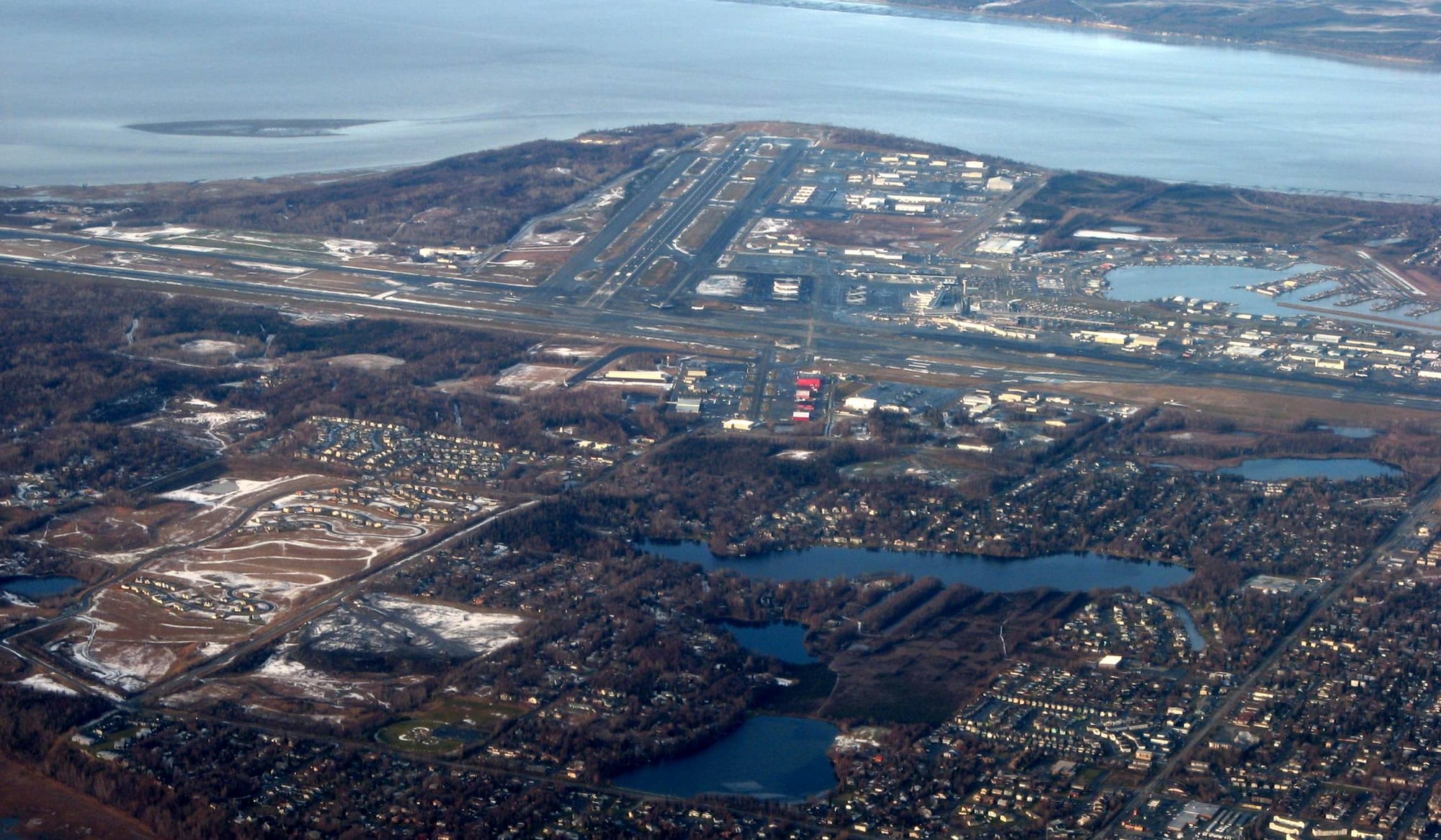
Context · Anchorage airport (Alaska), destination of JAL flight 1628
Anchorage International Airport and Cook Inlet.jpg · Wikimedia Commons · CC BY 2.0 · open original
The night in question
On 17 November 1986, Japan Airlines cargo flight 1628 (a Boeing 747-200F) was crossing eastern Alaska en route from Reykjavik to Anchorage with a cargo of French wine. Captain Kenju Terauchi, first officer Takanori Tamefuji and flight engineer Yoshio Tsukuba reported, shortly after 17:00 local time and already after dark, lights ahead of the aircraft that stayed with them for about 45 minutes. In the FAA interview held that same night after landing, the three said they saw two sets of yellow, amber and green lights, that at no time could they see a craft, and that the onboard weather radar showed a return at about seven miles. According to Agent Ronald Mickle's notes of that same interview, Terauchi said the two sets appeared to be joined together, as fixed to one object, which from his visual sighting and the radar he judged equal in size to a 747, possibly larger; in flight he had already described it to control as "very quite big ah, plane" (02:30:56 UTC).
The lights stayed ahead of the aircraft for about twelve minutes and then moved to its left. In the longer interview of 2 January 1987, Terauchi also described a third, enormous object, seen as a silhouette seven or eight miles away, which he estimated at "two times" the size of an aircraft carrier; that scale is not in his statements on the night, which already spoke of a large object, and the silhouette rests on his account, and the flight engineer told the FAA that the lights of that second phase were hard to see and that he was not sure whether they were a distant town or a strange object, although he insisted the first ones were not town lights. The Anchorage Air Route Traffic Control Center (ARTCC) saw intermittent primary returns where the pilot reported traffic and checked with the military Regional Operations Control Center (ROCC) at Elmendorf, which answered that it had "a primary target" in the same position, called it "an unknown" and later "a flight size of two" around the 747. Controllers vectored a United Airlines flight and a military C-130 toward the Japanese aircraft; the United pilot saw the 747 silhouetted against the light sky with its contrail "but I sure don't see any other airplanes", and the C-130 had no contact either. JAL 1628 flew a 360-degree turn near Fairbanks and lost sight of the lights around 17:53, before landing at Anchorage.
A point critical to interpretation is what those returns are worth. FAA technicians reviewed the radar recordings at the agency's technical centre in Atlantic City and concluded that the second target near the flight was not another aircraft but a split return from the 747 itself, an "uncorrelated primary and beacon target". The 5 March 1987 release, issued by spokesman Paul Steucke, says the agency was "unable to confirm" the event and planned no further investigation; the file was titled "Unidentified Traffic Sighting", but at no point did the FAA rule that an unidentified object had been present. Its own staff's statements cut both ways: controller Carl Henley clarified in January that he had seen tentative and radar-only targets, and that the traffic staying with the flight through turns was what the pilot told him; the area supervisor at no time saw data that conclusively indicated traffic; and two specialists who reviewed the recorded data found no targets in the areas reported. On the other side, that same night the NORAD duty officer told an FAA agent that they too showed two targets, one of them the JAL, and the ROCC kept them as unknowns while the tracking lasted.
The most-cited sceptical explanation was advanced by Philip J. Klass (Aviation Week, CSICOP) in January 1987: the lights were Jupiter and Mars. Computing positions supports it only in part: around 17:15 a very bright Jupiter (magnitude −2.4) stood about 10 degrees high at azimuth 140, and a much fainter Mars about 7 degrees; with the aircraft heading south-west, Jupiter sat roughly 70 degrees and Mars about 55 degrees left of the nose, according to a letter from astronomer Walter Webb included in the file, which fits the phase when the lights were off the left side but not the twelve minutes when they were ahead. Klass later revised his hypothesis and attributed the forward lights to a reflection of the full moon on clouds; the pilot, however, reported clear conditions to the controller, and the crew mentioned only thin, spotty clouds below the aircraft, near the mountains. On 11 January 1987 Terauchi reported another sighting in the same general area, which the FAA's 5 March release records; according to Bruce Maccabee's analysis included in the file, after landing the captain himself attributed it to village lights seen through ice crystals, and the FAA agreed with him. According to later accounts, which are not in the FAA file, JAL temporarily removed Terauchi from cockpit duty after his public interviews, a fact sceptics read as a sign of the testimony's fragility and proponents as institutional pressure.
John Callahan, then chief of the FAA's Accidents, Evaluations and Investigations Division in Washington, kept copies of the radar and voice tapes. In his testimony for the Disclosure Project (2001) and later at the Citizen Hearing on Disclosure (2013), a private event with no legal standing, he said he presented the data at a meeting with representatives of the FBI, the CIA and a scientific team from the Reagan administration, and that a CIA participant told them the meeting "never took place" and the incident "was never recorded". That account does not appear in the file the FAA released in 1987 and rests on his word; the file does show that the FAA regional director reported to the agency's administrator and discussed the case with Air Force officers.
Why it matters
JAL 1628 brings together elements documented in primary sources: testimony from a professional crew taken that same night, recordings of the communications with air traffic control, civil and military radar returns in real time, and a file of nearly 300 pages that the FAA made public in 1987. The agency itself handled it as an "unidentified traffic sighting" while looking for an unreported aircraft that might endanger traffic.
Two things have to be held at once. First, that the instrument record does not bear out the popular version: the FAA attributed its returns to a split echo from the 747, two reviews of its recorded data found no targets, two aircraft sent to look saw nothing, the silhouette the size of two aircraft carriers rests on the captain's later account, and he attributed a second sighting in the same area weeks later to village lights, and the astronomical hypothesis explains well the phase in which the lights were off to the left.
Second, that the FAA's split echo does not by itself explain the primary targets that military radar reported in real time and kept as unknowns, the onboard radar return, or the twelve minutes of lights ahead of the aircraft that Jupiter does not cover, on a night the pilot described as clear. Procedurally, the case shows how a civilian agency documented a UAP event and closed it without resolving it, and the thesis of a later cover-up depends on Callahan's testimony, not on the file. There is no conclusive sensor signature.
What's left on paper
Documented evidence
- FAA transcript of the communications between JAL 1628, Anchorage ARTCC and the military ROCC, with UTC times
- FAA agents' notes from the night of 17 November: lights with no visible craft, a return at about seven miles on the onboard radar and, per Mickle, an object the captain judged the size of a 747 or larger
- Statements by seven ARTCC specialists: intermittent primary returns for some; no conclusive data or no target for others
- FAA release of 5 March 1987: split return from the 747, "unable to confirm" the event
- FAA interviews with Terauchi (2 Jan 1987), Tamefuji and Tsukuba, with the captain's drawings
- John Callahan's testimony (Disclosure Project 2001, Citizen Hearing 2013) about a meeting with the CIA, not documented in the file
Sources
- FAA Alaskan Region — public file on JAL 1628 (1987), compiled by NICAP — 377-page PDF: 5 Mar 1987 release, ATC transcript, controller statements, agents' notes and crew interviews, plus clippings and analyses added by researchers.
- NICAP — JAL 1628 case page (secondary source) — Directory with links to the FAA file, the list of released documents and Bruce Maccabee's report.
- Disclosure Project — John Callahan's testimony (2001), reproduced on UFO Evidence — Later testimony by the former FAA division chief; his claims about the CIA meeting are not in the 1987 file.
Related cases
Associated actors (2)
