1976·Seoul (Gangbuk / Cheong Wa Dae)
South Korea.Seoul · air defense fires over the Blue House
At dusk on October 14, 1976, according to witnesses interviewed in 2020, many Seoul residents saw more than a dozen lights in formation over the city, and air defenses opened fire over the Blue House. US telegrams record two shootings: over 1,000 rounds at 18:13 at a Northwest freighter, misrouted by Gimpo air traffic control, and about 700 at 18:32 at a suspected unidentified propeller aircraft.
Read the rest of the summary
The injured were 21 according to Defense the next day, and one dead and 32 injured a week later according to the Seoul press. The official explanation was the freighter; a 2020 SBS special judged it hard to identify the lights with it.
Tier A · AcceptableWhat do they mean? →
Institutional evidence: several identified independent witnesses, or contemporary official documentation, without an instrumental record to corroborate them.
What it was
60%natural or human cause
Most likely explanation: airplane
See the split across the six explanations
Natural or human cause
No known cause
Primary documents
US State Department cables on the anti-aircraft fire over Seoul (14 and 15 October 1976)
Full text of two telegrams declassified in 2004. Washington's (STATE 255220, 14 October) relays the Korean government's report: at 18:13 Northwest cargo flight 902, taking off from Kimpo for Tokyo, entered the restricted area at 8,000 feet and was fired on with over 1,000 rounds without being hit, and at 18:32 the capital's forces fired about 700 rounds at "a suspected unidentified propeller driven aircraft". The embassy's (SEOUL 8287, 15 October) quotes the Defense Ministry statement (a Boeing 707 off course through a navigational error, bound for Osaka), cites 21 injured, 8 seriously, and no deaths reported.
US Department of State, Central Foreign Policy Files 1973–79 (NARA RG 59), telegramas 1976STATE255220 y 1976SEOUL08287; texto tomado de WikiLeaks PlusD · Public domain · US Government work · open original
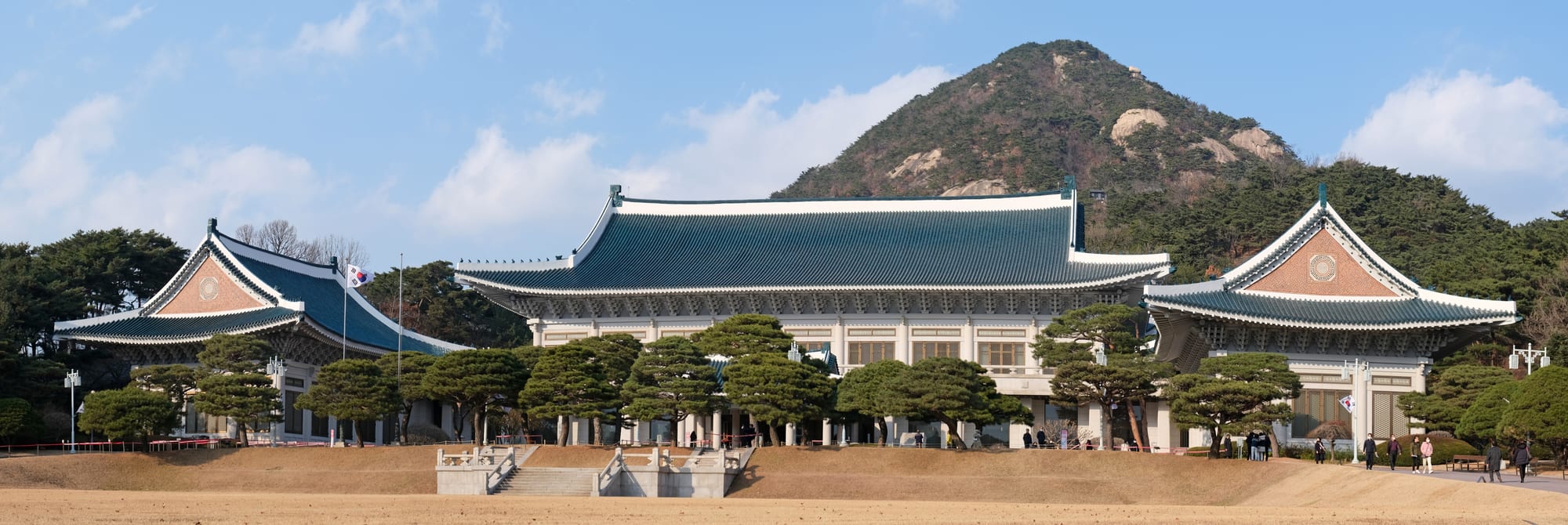
Context · the Blue House (Cheong Wa Dae), Seoul
Blue House Seoul 3.jpg · Wikimedia Commons · CC BY-SA 4.0 · open original
The night in question
On the afternoon of October 14, 1976, between six and eight, dusk was falling over Seoul when thousands of residents of the Gangbuk area, north of the Han River, began pointing at the sky. More than a dozen luminous objects (described as bright lights moving at constant speed, in a semicircular or wedge formation) advanced slowly southward over the city.
The trajectory carried the formation toward the restricted airspace protecting the Blue House (Cheong Wa Dae), the residence and office of the president, then Park Chung-hee, one of the strictest exclusion zones in the country. In 1976 Seoul's defenses were at maximum tension: barely two months earlier, the Panmunjom axe murder incident had brought the peninsula to the brink of war, and the anti-aircraft systems ringing the capital were primed to answer any intrusion from the north. According to those witnesses, when the group of lights penetrated the restricted zone, several batteries opened fire. The report the Korean government passed to Washington, which the State Department repeated that night to callers (telegram STATE 255220), distinguishes two shootings: at 18:13 Northwest cargo flight 902, just after taking off from Kimpo, entered the restricted area at 8,000 feet and the capital security forces fired over 1,000 rounds at it without hitting it; at 18:32 they fired about 700 more at "a suspected unidentified propeller driven aircraft"; the same text says no US aircraft were involved in that shooting. The Ministry of Defense statement the next day speaks only of warning fire around 18:19 at an unknown aircraft, later identified as Boeing 707 number 902, and does not mention the second target. The ordnance that went up came back down over the neighborhoods, including the US embassy compound and the UN Command residence areas. On October 15 Vice Minister of Defense Yi Min-u told the National Assembly defense committee that 21 people had been injured, 8 seriously, and the embassy noted that no deaths had been reported so far (telegram SEOUL 8287). On October 22 the embassy reported that the Seoul press now gave the death of one of the injured and a total of 32 injured, and that the Seoul city government would pay compensation for the deceased and medical expenses for the others (telegram SEOUL 8478). The casualties were caused by the military response itself, and the ministry expressed regret and promised compensation.
The explanation offered at the time was that the 'Blue House UFO' had been a U.S. cargo plane that had strayed into the exclusion zone. The ministry attributed the incident to a chartered Northwest Airlines Boeing 707 freighter that had taken off from Gimpo for Osaka and violated prohibited zone P-73 through a navigational error; the State Department telegram gives Tokyo as the destination and says the plane landed there without being hit and that the crew stated they were not aware they had been fired upon; asked whether the plane was inside the area, the Department answered that it could not confirm this precisely at that time. The ministry's investigation, as informally reported to the UN Command, found that Kimpo air traffic control had given the plane an incorrect routing, corrected only when it had neared, or possibly entered, the prohibited airspace. The embassy added that this did not relieve the pilot, since visibility was adequate to see the high-intensity strobe lights surrounding the city. The control records SBS showed in 2020 point the same way: around 18:04 the controller warned it that it might enter the zone, the plane entered three minutes later and kept its course for about 30 minutes. But witnesses described a dozen lights in formation, and the programme judged it hard to identify them with that plane; the telegrams say nothing of lights in formation, and the 18:32 target remains unidentified in them. That night, moreover, presenter Lee Soo-man described the sighting live on MBC's radio show 'Byeoli bichnaneun bame'. The shooting was not secret (the ministry announced it, the Assembly took it up and the State Department fielded a considerable number of calls), but the reading of the lights as a UFO stayed out of public discussion for decades, in a country under an authoritarian regime with strict press control, and only returned to it when SBS's investigative program 'Geuseosi Algo Sipda' (I Want to Know It) devoted a special to it for the network's 30th anniversary, aired on November 7, 2020, gathering testimony and period clippings.
Why it matters
In Seoul 1976 the air defenses opened live fire over the capital, with 21 injured according to the Vice Minister of Defense the next day and, a week later, one dead and 32 injured according to the Seoul press cited by the US embassy. The peninsula in October 1976, weeks after the Panmunjom axe murder incident, was exactly the setting where an unidentified intrusion was read as an imminent threat from the north.
The adversary narrative (a North Korean or Soviet reconnaissance incursion over Seoul) is the first operational hypothesis and the one that explains the reaction, but it collides with the reported morphology: a dozen lights in a semicircular formation at constant speed does not match the profile of a combat aircraft or a drone of the era. And the official explanation (a strayed U.S. freighter) has support in the control records and in the State Department telegrams, which also show that firing on planes straying into the zone had been routine since the North Korean raid of January 1968, and that Washington was concerned about the gunners' quick trigger and the lack of coordination with Kimpo control. But that explanation covers the first shooting, not the second, at a suspected propeller aircraft the telegrams leave unidentified, nor the dozen lights in formation the witnesses describe in 2020. The SBS team said it found no record of the event in any Korean agency; the US telegrams, declassified in 2004, preserve the report Seoul passed to Washington at the time. Seoul 1976 was rescued from the silence of the authoritarian era by investigative journalism four decades later.
What's left on paper
Documented evidence
- Mass sighting by thousands of Seoul residents (Gangbuk area) at dusk, according to the witnesses gathered by SBS in 2020: more than a dozen lights in a semicircular formation at constant speed
- Entry of the formation into the restricted airspace over the Blue House (Cheong Wa Dae), the presidential residence, according to the same witnesses; the 1976 telegrams place the Northwest freighter and the suspected propeller aircraft in the zone
- Two shootings according to the Korean report relayed by the State Department: over 1,000 rounds at 18:13 at Northwest cargo flight 902, without hitting it, and about 700 at 18:32 at "a suspected unidentified propeller driven aircraft"; the Ministry of Defense statement speaks only of warning fire around 18:19 at the freighter
- Casualties from falling ordnance: 21 injured, 8 seriously, and no deaths reported according to the Vice Minister of Defense on October 15; on October 22 the Seoul press, as cited by the embassy (SEOUL 8478), already gave the death of one of the injured and 32 injured in total, the same figure as the 2021 press summary. Fragments fell in the US embassy compound
- Context of maximum tension (Panmunjom axe murder incident, August 1976) favoring a hostile-intrusion reading
Show 2 more items
- Official explanation: a Northwest Boeing 707 freighter, Gimpo to Osaka according to the ministry (to Tokyo according to the State Department), which violated zone P-73 through a navigational error after Kimpo air traffic control gave it an incorrect routing; the crew were not aware they had been fired upon. The telegrams say nothing of lights in formation, and SBS judged it hard to identify the plane with the witnesses' lights
- Public recovery of the case in SBS's 'I Want to Know It' special (November 7, 2020)
Sources
- US Department of State — telegram 1976STATE255220, Washington to Embassy Seoul (14 Oct 1976) — Primary source, declassified in 2004. Korean report: over 1,000 rounds at 18:13 at Northwest cargo flight 902, bound for Tokyo, without hitting it; about 700 at 18:32 at a suspected unidentified propeller-driven aircraft.
- US Embassy Seoul — telegram 1976SEOUL08287 (15 Oct 1976) — Primary source, declassified in 2004. Transcribes the Ministry of Defense statement (Boeing 707 bound for Osaka, navigational error), cites 21 injured, 8 seriously, no deaths reported, and the incorrect routing given by Kimpo control.
- US Embassy Seoul · telegrams 1976SEOUL08301 (16 Oct 1976) and 1976SEOUL08478 (22 Oct 1976) — Primary source, declassified in 2004. SEOUL 8301: the embassy expresses concern at the air defense over-reaction in firing on two occasions that evening and notes the Assembly criticized the government. SEOUL 8478: the Seoul press reports the death of one of the injured and 32 injured in total; according to informal indications, authority to fire the city guns was returned from gun commanders to higher-level officers.
- SBS — «Geuseosi Algo Sipda» (I Want to Know It), especial del 7 de noviembre de 2020 — Journalistic investigation gathering testimony and period press on the Casa Azul incident
- Prensa surcoreana de octubre de 1976 sobre el fuego antiaéreo en Seúl — Records the shots, the victims and the official «American freighter» explanation
- Compilaciones documentales del incidente de la Casa Azul (1976) — Reconstruct the formation, the exclusion zone and the contradiction in the official version
- Asia Time — «[역사속 오늘] 서울 청와대 상공에 나타난 UFO» (14 oct 2021) — Press summary: the Ministry of Defense statement of 15 October 1976 (two bursts of warning fire around 18:19, the Northwest freighter from Gimpo to Osaka), one dead and 31 injured (the same figure the Seoul press gave on 22 October 1976 according to telegram SEOUL 8478; the 15 October telegram, SEOUL 8287, still gave 21 injured and no deaths), Lee Soo-man's MBC Radio broadcast and what SBS showed in 2020.
- News1 en Financial News — «청와대 상공 UFO의 진실…"12개의 불빛, 일정한 간격 포진"» (8 nov 2020) — Report on the SBS special: testimony from witnesses and an injured person; twelve lights at regular intervals.
- Choi Eun-young — «Anti-aircraft fire over Seoul skies… Witnesses recount the 'Cheongwadae UFO' incident», The Asia Business Daily (8 Nov 2020)
Related cases
same object · same period
Kōfu Incident · occupant encounter and physical traces (Japan, 1975)
1975 · Tier B
same object · same period
Hudson Valley Boomerang
1983 · Tier A
same object · same period
Papua New Guinea · high-altitude aircraft and contrails (DoS cable, 1985)
1985 · Tier B
same object · same period
Jos · the flashing light a missionary pilot saw (1966)
1966 · Tier B