2007·Sea west of Alderney, Channel Islands
Guernsey (Alderney).Alderney · two pilots see yellow objects over the sea
On April 23, 2007, a pilot radioed a very bright yellow, cigar-shaped object over the sea of the Channel Islands. It was 14:09 UTC and Captain Ray Bowyer of Aurigny was flying from Southampton to Alderney at 4,000 feet. Minutes later he saw a second, identical one. Several passengers saw them, and from another aircraft Captain Patrick Patterson made out a yellow smudge in the same area. No instrument recorded them clearly. An independent investigation in 2008 found no satisfactory explanation.
Tier A · AcceptableWhat do they mean? →
Institutional evidence: several identified independent witnesses, or contemporary official documentation, without an instrumental record to corroborate them.
What it was
50%optical phenomenon
The most likely explanation.
- 50% optical phenomenon
- 5% other earthly causes
- 45% no known cause
See the split across the six explanations
Earthly origin (human or natural)55%
No known cause45%
Ordinary cause the sources propose: optical
What happened
On the afternoon of Monday, April 23, 2007, Captain Ray Bowyer was flying a Trislander, a three-engine passenger plane, for the airline Aurigny on the route from Southampton to Alderney, one of the Channel Islands. He was alone on the flight deck, with the passengers in an open cabin right behind him, at 4,000 feet (flight level 40) on airway R41, north of the islands. He had been a professional pilot for 18 years and had flown this route for 8 and a half years. According to the 2008 report, a layer of haze lay below the aircraft at about 2,000 feet, but the horizon ahead was clear and Alderney and Guernsey were visible. The times in this account are UTC; in the islands it was one hour later.
At about 14:06 he saw a very bright light near the horizon, almost straight ahead and a few degrees to the right of the nose. His first thought was the sun reflecting off the large glasshouses on Guernsey, an effect he knew from other trips and that lasts only seconds. This light did not vanish. With the autopilot on, he looked at it through binoculars. It was a yellow-orange object shaped like a thin cigar lying on its side, with very sharp edges and pointed ends. A dark graphite-gray band ran about two thirds of the way along it. It seemed to give off its own light, brilliant but not dazzling. His first impression was of an object the size of a Boeing 737 or larger, no more than about 15 miles away.
At 14:09:32 he called the control center for the islands, in Jersey, and asked whether there was traffic at his 12 o'clock, at his level. The controller, Paul Kelly, said there was not. At 14:09:54 Bowyer described an "extremely bright yellow, orange object, straight ahead" with a "very flat platform." Kelly then saw a "very faint primary contact," a signal the radar picks up on its own to the left, around 11 o'clock and about 4 miles away. At 14:11 the signal was at 10 o'clock and 3 miles. Kelly added that "we sometimes get anaprop," the name for false signals that appear when the atmosphere bends the radar beam. Bowyer insisted he had "a definite contact" ahead, and Kelly answered that there was nothing there.
At 14:12:36 Bowyer reported that "now all the passengers can see this." By Bowyer's count, between five and nine passengers saw the lights, and at least three noticed them on their own. A man seated right behind him looked through the pilot's binoculars and saw both objects; the couple in the next row saw all or part of the event. Until the 2008 report, none of the three had agreed to be named.
At 14:12 Kelly asked the Blue Islands Jetstream 32, flying from the Isle of Man to Jersey, to look toward the object. At 14:13:33 he asked the same of a FlyBe BAe 146 flying from Guernsey to London. The Jetstream's captain, Patrick Patterson, had heard Bowyer's description and at 14:13 said he saw nothing. He switched to the Jersey Approach frequency and at 14:14:43 reported that he had "something about 8 o'clock resembling the description," about 2,000 feet lower and at a distance similar to Alderney's. In his letter the next day he described it as something yellow-beige, northwest of Alderney, visible for about a minute, with poor visibility because of the haze. He was looking back through the left-hand window.
At 14:14:04 Bowyer reported that "a second one" had appeared "behind the first one." It was identical, with the same dark band, but looked smaller, slightly less bright and farther away. At 14:14:23 Kelly said he had a single primary contact, a "blob if you like," about 8 miles west of Alderney near the Casquets, a group of rocky islets. Bowyer answered that it could match the second object. At 14:14:58 Kelly told the BAe 146 pilot that signal was a mile to his right. He saw nothing, then or at 14:17:32. According to Bowyer, that aircraft was flying at 6,000 to 8,000 feet.
At 14:15:36 Bowyer asked to descend toward Alderney and said the objects, identical and cylindrical, were "very plain to see" without binoculars. At 14:16:49 he estimated the farther one at about 10 miles and the nearer at 4 to 7, and said they were "the size of 737, something like that." At 14:17:09 he said, "Both stationary," and five seconds later put them at 1,500 to 2,000 feet. In his account, the second object went from appearing slightly to the right of the first to lining up above it around 14:16 and, at the end, 2 or 3 degrees to its left. At 14:18:02 he said he had lost them "in the haze" during the descent.
Kate Russell, a few rows behind the pilot, saw nothing until the plane dipped its nose to descend, shortly after 14:15:30. Then she saw, below the horizon, two "cigar"-shaped lights. They looked to her "like the sun reflecting off glass"; the second time she thought of light reflecting from a ship. She put the nearer one at about 10 to 15 miles, said neither was as large as later reported and said "there was no solid outline to it." She suspects it was "something natural but unexplainable." Her husband, John, saw only an elongated oval, bright orange, smaller than the merchant ships they had passed; he said it was a lot brighter than a sun reflection, though the sun was in position to bounce its rays off something.
At 14:18:35 Kelly said he had alerted Guernsey, and Guernsey had alerted Alderney, "about, er, whatever that is." Over the next hour he asked other aircraft to look. Those that answered, between 14:32 and 14:46, saw nothing. Bowyer wrote an air safety report that same day, number 720, with a drawing of the object, and the British civil aviation authority (CAA) logged it as a mandatory occurrence, number 200703486. Kelly's report, faxed on April 25, puts the second object at 14:16, a time that does not match the recording (14:14:04). A handwritten note by an Alderney operations official, after talking with Bowyer, says 14:10.
On April 30, an internal e-mail at the UK Ministry of Defence (MoD) closed the matter. It said the position was outside UK air-defense radar coverage and inside the area France covers for its air defense, that France had not reported the object seen or detected on radar, that the contact had been described as stationary, which makes radar detection unlikely, and that there was no threat and no further investigation. According to its reply to the authors of the 2008 report, there were no military exercises in the Channel that day.
The French network logged no unidentified aircraft or phenomenon between 14:09 and 14:18, but its data are erased after a few weeks. On the civilian Jersey radar, the first two contacts fell behind and had no link to what Bowyer saw. The "blob" near the Casquets, which Kelly described as unstable, "ragged" and probably not a solid target, lies near a slow track. The Jersey engineers, "99% certain," attributed that track and another like it to ships, but Guernsey harbor records did not account for one of the two. The radar's filter removes anything standing still and the raw data are not kept, so the authors warned that the lack of a signal does not prove nothing was there.
On April 27, the press quoted Bowyer saying he had thought the object was about 10 miles away, that he later calculated it was about 40 and that it could be "as much as a mile wide." According to the 2008 report, the stories of an object a mile wide detected by radar rested on speculation and misunderstandings; Kelly himself told the press that nothing appeared on his radar. In December 2007, Patterson told David Clarke, one of the report's authors, that what he saw was not "a mile wide." He put it at 150 to 250 feet and half a nautical mile at most. It was a color in the haze, with no sharp edges and no light of its own, that reflected light and did not move, and he could not say it was an object. Neither his passengers nor his co-pilot saw it. His guesses: something atmospheric, a balloon or airship, guano-covered rocks or a secret military test.
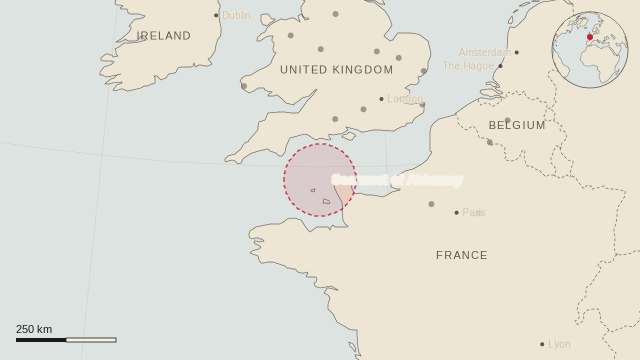
Where it happened
Why it matters
Two professional pilots, in different aircraft, and an air traffic controller put the event on record in writing over the following days, and Bowyer's description was recorded on the control frequency as it happened. Bowyer's report, the CAA record, Kelly's report and the Ministry of Defence list agree on a bright yellow object with a dark zone and a second, identical one. Patterson's letter describes only a yellowish smudge.
There is no clear instrument record. The signal near the Casquets was unstable and may have been a ship, though shipping records did not account for the second slow track. Patterson describes a diffuse smudge in the haze, seen when he already knew what to look for, and he hesitates to call it an object. According to the authors, he saw nothing at first, his height estimate was independent of Bowyer's and his position matches Bowyer's lines of sight. On size, Bowyer's geometry implies about 460 to 560 meters, far above the "737" of the radio call, while Patterson gave 900 meters at most and the Russells saw something smaller still. That the apparent size grew about 2.6 times while the distance changed 2.8 times is what a fixed object would show.
The February 2008 report by Jean-François Baure, David Clarke, Paul Fuller and Martin Shough scored 16 hypotheses from 0 to 5. Only two reached 3, "somewhat plausible": sunlight reflected off Guernsey's glasshouses and scattered by a haze layer, and earthquake lights, a glow attributed to stress in rocks that is poorly established, with circumstantial support in the Alderney-Ushant fault and a Kent earthquake days later. Neither explains well the very sharp edges or the same dark band on both objects. In favor of the haze, according to the same authors' 2008 article in the Journal of Scientific Exploration, light scattering would explain the apparent crossing of the two images naturally, as parallax from the aircraft's motion, and a fainter glint seen from the south would be what Patterson saw.
Sun dogs (patches of light beside the sun) were ruled out: there were no ice crystals in the line of sight, because the freezing level was about 6,000 ft above the aircraft. According to Jonathan McDowell's satellite catalog, no cataloged object is listed as re-entering on April 23, 2007. A mirage of the sun on the sea scored 2, mainly because no known mechanism explains the two objects crossing each other horizontally over about six minutes. The authors conclude there is no satisfactory explanation without discounting significant features of the accounts, and judge Bowyer's to have been careful and reliable. They are not convinced the witnesses were mistaken, though they accept that this can never be ruled out by an objective test.
Still open is the crossing of the two objects, which only Bowyer described in detail. Also open is the full analysis of the Jersey radar data, which the authors could not open for lack of the software: of the signals they could see, they say none matches the calculated positions, but that this "is inconclusive." They expected a study by the French agency GEIPAN, which by their informal understanding had found no significant echoes. In 2023 a technical commission of the French aeronautical association 3AF said it had extracted the plot files of the Jersey and Guernsey radars and recognized three sequences of interest in the pilots' observation areas. The text gives no conclusion: the analysis was still under way.
Documents and sources
Primary documents
UK Ministry of Defence list of UFO reports for 2007 (first page)
First page of the UK Ministry of Defence table "UFO Reports 2007." The entry for April 23, 2007 at 14:09, "In the air nr Alderney," Channel Islands, lists the reporters as "Two Pilots, different planes"
Read more
(column "Occupation of reporter") and summarizes the case: "First object was bright orange/yellow. There was a gap in light or darker area. Second object was identical." It is the line the list uses to summarize the case; according to the 2008 report (p. 121), around May 20, 2007 the ministry also published the full case file, with the witnesses' papers. The full table has 7 pages.
UK Ministry of Defence, “UFO reports in the UK” (GOV.UK), p. 1 of 7 · Open Government Licence v3.0 (Crown copyright, Ministry of Defence) · open original
Baure, Clarke, Fuller and Shough: report on aerial phenomena near the Channel Islands, April 23, 2007 (181 pp.)
Independent 181-page report from February 2008. It holds the transcript of the Jersey control recordings, the reconstruction of the sighting geometry, the radar analysis, the weather study, the scoring of 16 hypotheses and, in the appendices, the papers of the time (Bowyer's air safety report, Kelly's report, Patterson's letter, the MoD e-mail) and the witness interviews. Its authors do not allow reproduction, which is why it is only linked here.
Baure, Clarke, Fuller and Shough, February 2008 (nicap.org) · view source
Documented evidence
- Transcript of the Jersey air traffic control recordings, made by Baure and colleagues from audio files supplied by Jersey: Bowyer's call at 14:09:32, his description at 14:09:54, "very faint primary contact" at 14:10:10, "we sometimes get anaprop" at 14:11:11, the second object at 14:14:04, "Both stationary" at 14:17:09 and the objects lost "in the haze" at 14:18:02. The original recordings have not been published.
- Bowyer's air safety report number 720, April 23, 2007, with a drawing: a bright light he took for the sun reflecting off glass on Guernsey; through binoculars, a bright yellow shape with a dark area toward the right, stationary; a second identical, more distant object; several passengers saw it.
- CAA mandatory occurrence report 200703486, quoted in its letter of May 10, 2007: the crew saw "a stationary bright light ahead, thought to be a reflection from the ground" and, through binoculars, "a shape, similar to a B737 fuselage," bright yellow with a dark area near one end.
- Four-page report by controller Paul Kelly, faxed on April 25: from 14:09 to 14:18, nine minutes; nothing on radar except anaprop "possibly related to one object," because stationary objects are filtered from the display; distance of about 25 miles at first and 7 to 8 at the end. It puts the second object at 14:16, a time that does not match the recording.
- Letter from Patterson to Jersey air traffic control, April 24, 2007: at about 14:15, near Sark, "something fitting the description," yellow-beige, at 8 o'clock, slightly northwest of Alderney and about 2,000 feet below, with visibility "fairly poor" because of haze, visible for about a minute. He had reported it by radio at 14:14:43.
Show 3 more facts
- Internal Ministry of Defence e-mail, April 30, 2007: position outside UK radar coverage and inside the area France covers for its air defense, no French reports of radar detection, no threat and no further investigation. The ministry's 2007 UFO report list carries the event at 14:09.
- Radar: the reconstruction of the French network between 14:09 and 14:18 found no unidentified aircraft or phenomenon; on the Jersey radar, the signal near the Casquets was ragged and the two slow tracks in the area were attributed to ships; the weather radar gave a single 60-second pass, with no unambiguous signal at the calculated position of the objects.
- Other aircraft Kelly asked to look: the FlyBe BAe 146 (14:14:55 and 14:17:32, nothing), an aircraft passing east of Alderney (14:32, "nothing"), Jersey 511 (14:40, "not seen anything yet") and another aircraft (14:46, "nothing observed").
Sources
- Baure, Clarke, Fuller and Shough: "Report on Aerial Phenomena Observed near the Channel Islands, UK, April 23 2007" (February 2008, 181 pp.) — Independent research, not an official document. It reproduces the papers of the time: the transcript of the Jersey control recordings (pp. 14-24), Bowyer's safety report, Kelly's report, Patterson's letter and the MoD letter (Appendix A, pp. 120-129) and the interviews (Appendix B, from p. 130). The radar analysis is on pp. 38-49 and the hypotheses on pp. 60-110. Its authors do not allow reproduction, so it is only linked.
- UK Ministry of Defence: "UFO reports in the UK," list "UFO Reports 2007" (GOV.UK) — Official table of UFO reports received in 2007. The April 23, 14:09 entry, "nr Alderney," records "Two Pilots, different planes." Published under the Open Government Licence v3.0.
- The Register: "UK airline pilots spot giant UFO" (April 27, 2007) — Press of the time, quoting Bowyer and Kelly from This Is Guernsey. Used only for what was said in those days (ten miles, then forty, up to a mile wide; nothing on radar), not as the basis of any fact.
- Baure, Clarke, Fuller and Shough, "Unusual Atmospheric Phenomena Observed Near Channel Islands, UK, 23 April 2007," Journal of Scientific Exploration 22(3), 2008 — 18-page PDF. Reconstructs the event from Jersey's radio and radar recordings, CAA documents and witness interviews, and rates 16 hypotheses. It is not an official investigation.
- Jonathan McDowell, GCAT satellite catalog (re-entry dates) — Public catalog. No cataloged object is listed as re-entering on April 23, 2007; the only one from April 22 to 24 re-entered on the 24th.
- 3AF, SIGMA2 technical commission · "Dossier: Les phénomènes aérospatiaux non identifiés (PAN)," 3AF Letter no. 1-2023 — Letter from a French aeronautical association, not a peer-reviewed report. It says it extracted the plot files of the Jersey and Guernsey ELVIRA radar and recognized three sequences of interest in the pilots' observation areas; it ends with "the analysis continues" and no conclusion.
Related cases
Cases with the same likely cause.
Optical
Noia · a military radar tracks a near-motionless signal all night
1989 · Tier A
Optical
Ingolstadt · police officers see star-shaped lights
1979 · Tier A
Optical
Bardenas Reales · soldiers on guard see lights over the range
1975 · Tier B
Optical
Becerreá · a driver sees a lit-up object on a hillside
1969 · Tier B