1947·Hungary; the rumors reached Budapest
Hungary.Budapest · rumors of "silver balls" flashing across the sky
In June 1947, rumors reached Budapest of "silver balls" flashing across the sky, according to the case's card in Project Blue Book, the U.S. Air Force archive on UFOs. The rumors described a spherical, silver, very fast object; the card names no witness and gives no time or exact place. The astronomer J. Allen Hynek, who evaluated the case for the Air Force in 1949, judged it extremely unlikely that the objects were meteorites and placed it among the cases that cannot be explained for lack of evidence. The card concludes "insufficient data for evaluation."
Tier B · IndicativeWhat do they mean? →
Limited evidence: it falls short of what Tier A requires. Any one of these is enough: a single testimony (or several witnesses who saw it together), testimony gathered years later, or an account without contemporary primary documentation.
What it was
70%ordinary cause, unidentified
The most likely explanation.
- 70% ordinary cause, unidentified
- 7% other earthly causes
- 23% no known cause
See the split across the six explanations
Earthly origin (human or natural)77%
No known cause23%
Why no ordinary cause is identified
What happened
Around June 10, 1947, rumors were circulating in Hungary of "silver balls" crossing the sky. The official record of them is three sheets the U.S. Air Force kept in the archive of Project Blue Book, the project through which it studied UFOs from 1952 to 1969. The first sheet is the case's summary card, which begins: "Rumors were drifting into Budapest of 'silver balls' flashing across the sky." Further down it adds: "Rumers were that the object was sphere shape and silver in color, traveling at high speed."
The card gives no other details about the event. The location box says only "Hungary": the rumors were reaching Budapest, but the card does not say from which city or region. The source is "Civilian," and the type of observation is "Ground-Visual (Assumed)," a naked-eye sighting from the ground that the card takes for granted. The number of objects, the length of the observation and the course are all "Not Reported," and there were no photos and no physical evidence. The card first speaks of "balls," plural, and then of "the object," singular. None of the three sheets names a witness, gives a time or says who passed the rumors on to the Americans.
The date comes in two versions. The card gives "10 June 1947," with no time. The second sheet, the evaluation by the astronomer J. Allen Hynek, heads the case "Incident #38 -- Hungary -- around 10 June 1947": around June 10, not that exact day. The card is typed on a form of the Air Force's Foreign Technology Division (FTD) dated September 1963, so it was filled out no earlier than 1963. Hynek's 1949 evaluation is therefore the older record. Either way, the rumors predate June 24, 1947, the day pilot Kenneth Arnold saw nine objects near Mount Rainier (↗ Kenneth Arnold) and the American wave of "flying saucers" began.
In 1947 Project Blue Book did not exist. The case appears as number 38 on the list of incidents the Air Force studied in 1948 and 1949 under its earlier projects, Sign and Grudge. Hynek, then a professor at Ohio State University, was under Air Force contract from December 16, 1948, to April 30, 1949, to review those incidents from an astronomer's point of view, and his final report, under Project 364, the name of his contract, became an appendix to the Project Grudge report of August 1949. The Hynek page on incident 38 in the Blue Book file matches, line for line, the one in the U.S. National Archives copy of the Grudge report. The third sheet in the file is Hynek's index, "extracted from Project Grudge report," which sorts the incidents into categories.
Hynek's evaluation runs four lines: "It is extremely unlikely that the objects observed in Hungary were meteorites, unless the meager description given here is quite inaccurate. Without knowledge of the speed and trajectory of the objects, nothing definite can be said."
In his index, incident 38 heads category 3.a: nonastronomical cases "with no explanation evident" in which "Lack of evidence precludes explanation." The original text of the rumor, the description Hynek had in front of him and calls meager, is not among the three sheets. The card, written years later, concludes "INSUFFICIENT DATA FOR EVALUATION" and adds "Report to brief for a firm evaluation": the report was too short for a firm evaluation, with "to" typed for "too."
Where it happened
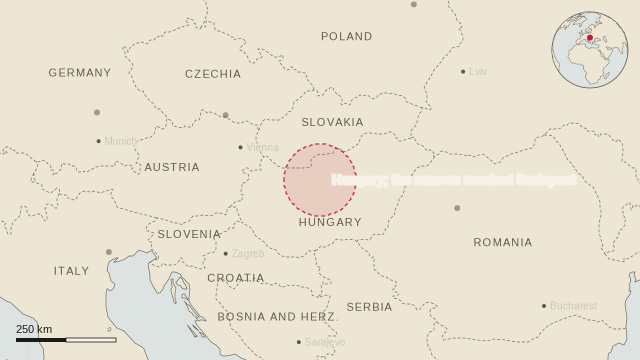
Why it matters
The Budapest case shows what could make it onto the official list in the early years: a rumor with no witness, no time and no location beyond a country became a numbered incident alongside reports from pilots and military personnel. Hynek did not call it unexplained because the evidence pointed to something strange. He placed it among the cases that cannot be explained because information is missing, not in category 3.b, the cases in which "Evidence offered suggests no explanation."
The only cause the file mentions is meteorites, and Hynek ruled it out on one condition: that the description was accurate. He did not say which feature of the description made a meteorite unlikely, and the data he asked for to decide, speed and trajectory, appear on none of the three sheets. Nor can anyone check what was in the sky: working out the position of the Moon, the planets or a meteor shower requires a time and a place, and the card gives neither. In 1947 there were no artificial satellites yet to be mistaken for an object.
Later books add details that the three sheets do not contain. The American researcher Ted Bloecher, in his Report on the UFO Wave of 1947 (1967), counted six reports in the Air Force files between June 1 and 23 not counting one he mentions separately, "a foreign report describing objects seen over Budapest on June 10," without further detail. The authors Ion Hobana and Julien Weverbergh picked it up in 1976, citing Bloecher. According to the chronology compiled by the Belgian researcher Godelieve Van Overmeire, Michael David Hall's book UFOs: A Century of Sightings (1999) names a witness, Gyorik Ference, who supposedly saw four yellowish-red, plate-shaped objects over Budapest, and in the next sentence describes the objects as spherical and silver.
Hall's details do not appear in the Blue Book file: the card names no witness, leaves the number of objects unreported and describes them as silver, not yellowish red. The chronology does not say where Hall found that witness. The exact date of June 10 that Bloecher gives is the card's, not Hynek's approximate one, which suggests he worked from the card or its source; but the card speaks of rumors reaching Budapest, not of objects seen over the city. A year earlier, Sweden had received a flood of reports of "ghost rockets" crossing its skies (↗ Ghost rockets); the three sheets on Hungary do not mention those cases.
Documents and sources
Primary documents
Project Blue Book file on Hungary, June 1947 (3 pp.): case card, Hynek's evaluation and incident index
The three pages of the Blue Book file on the rumors of "silver balls" in Hungary. The first is the "Project 10073 Record" card, on an FTD form of September 1963: date June 10, 1947, location "Hungary," civilian source, number of objects, length and course not reported, conclusion "INSUFFICIENT DATA FOR EVALUATION"; its summary has "to" for "too" and "Rumers" for "Rumors."
Read more
The second is the evaluation by the astronomer J. Allen Hynek, "Incident #38 -- Hungary -- around 10 June 1947," with two blacked-out strips at the top and bottom and a handwritten note in the right margin. The third is his incident index, "extracted from Project Grudge report," where No. 38 opens category 3.a. Grayscale copy.
U.S. Air Force, Project Blue Book (archive.org copy) · Public domain · US Government work · open original
Documented evidence
- Project Blue Book record card (FTD form of September 1963): date "10 June 1947," no time; location "Hungary"; civilian source; ground-visual observation "(Assumed)"; number of objects, length of observation and course not reported; no photos or physical evidence; conclusion "INSUFFICIENT DATA FOR EVALUATION."
- Summary on the same card: "Rumors were drifting into Budapest of 'silver balls' flashing across the sky. Report to brief for a firm evaluation." and "Rumers were that the object was sphere shape and silver in color, traveling at high speed."
- J. Allen Hynek's evaluation, "Incident #38 -- Hungary -- around 10 June 1947," from his Project 364 final report (1949), included in the Project Grudge report of August 1949: extremely unlikely to be meteorites unless the description was quite inaccurate; without speed and trajectory, "nothing definite can be said."
- Hynek's incident index, "extracted from Project Grudge report": No. 38 opens category 3.a, "Lack of evidence precludes explanation," among the nonastronomical cases with no explanation evident.
- Ted Bloecher, Report on the UFO Wave of 1947 (1967), section 1: six reports in the Air Force files between June 1 and 23, 1947; the foreign one from Budapest on June 10 is left out of the study.
Sources
- Project Blue Book, file 1947-06-9668691, Hungary (archive.org, project-blue-book collection), 3 pp. — Primary source, embedded in the viewer: p. 1, the case card; p. 2, Hynek's evaluation of incident 38; p. 3, Hynek's incident index extracted from the Project Grudge report.
- U.S. Air Force, Project Grudge report (August 1949), U.S. National Archives copy, part 2 (archive.org) — PDF p. 36: the same Hynek page on incident 38. Part 1 (foreword) gives the dates of his contract, December 16, 1948, to April 30, 1949, and lists his final report as Appendix B.
- Ted Bloecher, Report on the UFO Wave of 1947 (1967), section 1, transcription on RR0 — Secondary source: it mentions the Budapest report of June 10, describes it as foreign and leaves it out, with no further detail.
- Godelieve Van Overmeire, 1947 chronology (English translation, ufo_data repository on GitHub), entry "1947, June 10, HUNGARY, Budapest" — Secondary source: it cites Hobana and Weverbergh (1976, p. 246) and Michael David Hall, UFOs: A Century of Sightings (1999, p. 33), which gives the witness Gyorik Ference and four yellowish-red objects; neither book was consulted directly. Citing the magazine Phenomena (No. 35, 1997), the same chronology lists another event in Budapest on May 14, 1947, around 8:30 p.m.: several witnesses saw a spherical, very fast object cross the sky, apparently burning and leaving a trail.
- AARO, Fiscal Year 2024 Consolidated Annual Report on UAP (November 14, 2024) — Base rate (p. 3): the 174 closed cases were resolved to prosaic objects; many others remain unresolved.
Related cases
Cases this case cites and cases with the same likely cause.