1947·Phoenix, Arizona
United States.Phoenix · two photos of a gray object circling
At 4:00 p.m. on July 7, 1947, with a thunderstorm just past, a Phoenix resident named Rhodes saw an elliptical gray object, 20 to 30 feet across, that spiraled down to about 2,000 feet and climbed into the clouds. He photographed it twice with a box camera. The U.S. Air Force analyzed the photos until 1954: four expert photographers agreed the image is photographic, though they disagreed on whether it could have been taken that way; the chemist Irving Langmuir attributed the object to paper swept up by the wind, and in 1952 the technical intelligence center concluded they were "probably not authentic."
Tier A · AcceptableWhat do they mean? →
Institutional evidence: several identified independent witnesses, or contemporary official documentation, without an instrumental record to corroborate them.
What it was
72%possible hoax
The most likely explanation.
- 72% possible hoax
- 5% other earthly causes
- 23% no known cause
See the split across the six explanations
Earthly origin (human or natural)77%
No known cause23%
Ordinary cause the sources propose: possible hoax
Record of the event
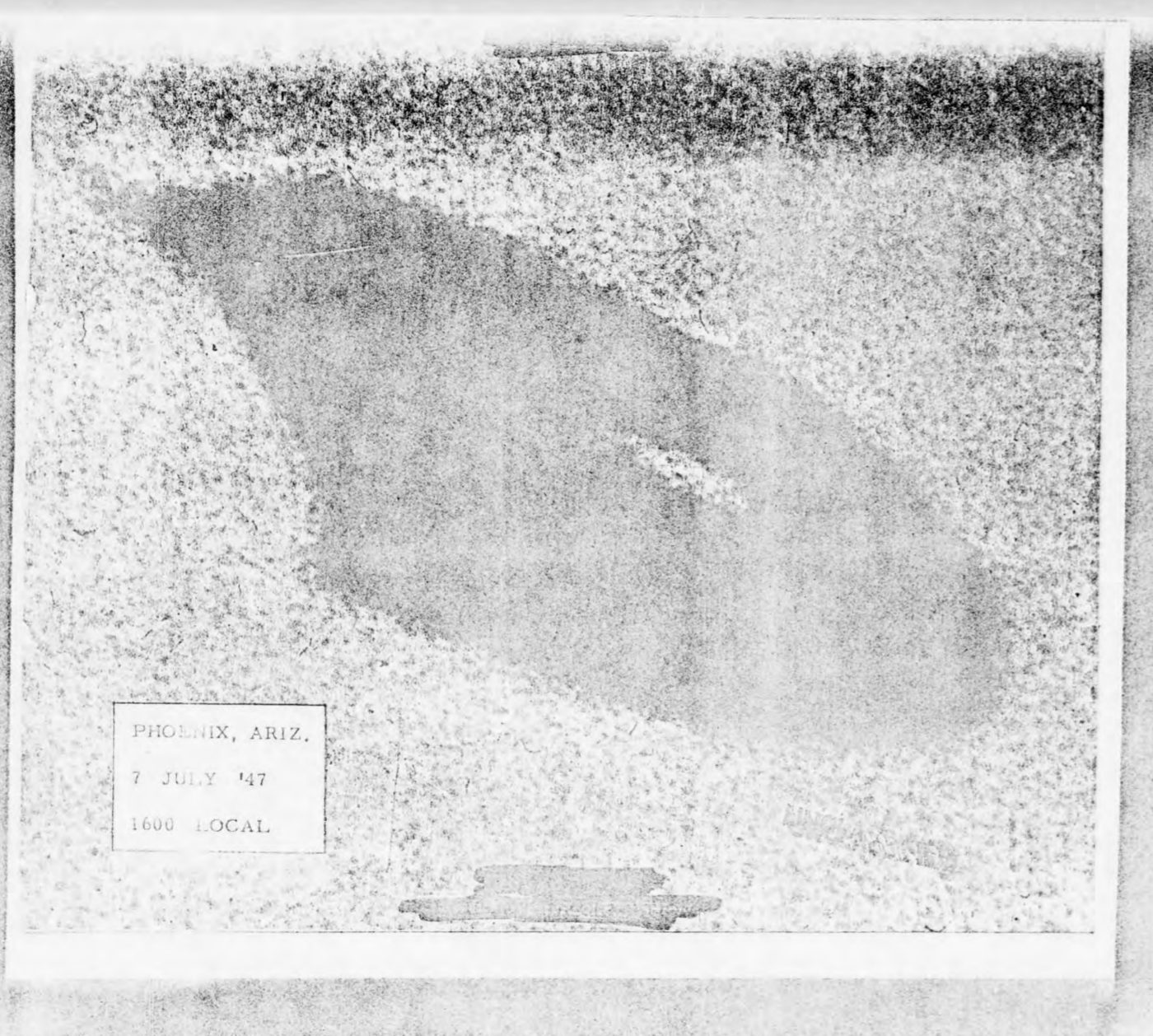
Enlargement of one of the two Phoenix photos, July 7, 1947
Enlargement of one of the two photos Rhodes took on July 7, 1947, as it appears in the Blue Book file, with the label "PHOENIX, ARIZ. 7 JULY '47 1600 LOCAL." It shows a long dark smudge, rounded at one end and sharper at the other, with a lighter area near the center. The image is badly degraded: it is the file's reproduction, not the negative.
U.S. National Archives / Project Blue Book (via archive.org) · Public domain · US Government work · open original
What happened
At 4:00 p.m. on July 7, 1947, according to the Air Force form, with a thunderstorm just past, Rhodes was walking from his house to his workshop, about 100 feet behind it. He heard a noise from the east like a jet airplane, possibly a P-80. He looked and saw nothing for several seconds. Then an elliptical gray object appeared from the northeast, 20 to 30 feet (6 to 9 meters) across. By Rhodes's estimate it was flying at about 5,000 feet and 400 to 600 miles per hour. Its gray color blended into the clouds and made it hard to see at a distance. The wind was blowing at 10 to 15 miles per hour.
The object spiraled down to about 2,000 feet, made two left-to-right circles with a radius of a quarter to half a mile, and climbed at 45 degrees toward the west until it disappeared into the clouds, at about 5,000 feet. It was in view for about a minute. Rhodes said the jet-like noise came before he saw it and that he heard nothing while it was in view, possibly because of the wind in the trees. He saw something like a cockpit canopy in the center, no landing gear and no propellers, and a tail with two points. His first thought was the Navy's new "Flapjack" airplane, which he had seen on the cover of the May issue of Mechanix Illustrated. He dropped the idea because that airplane had landing gear and propellers.
As soon as the object began its first spiral, Rhodes ran for his camera, a Kodak box camera that he kept loaded inside the workshop door for family snapshots, and called to his wife, who was in the house. When he came back with the camera, the object had finished one circle and started a second. His wife reached the yard after it had disappeared. Rhodes took one photograph with the object at its lowest point, about 2,000 feet, and another as it came out of the second spiral and started to climb. The second photo includes some treetops and a telephone pole. He developed the negatives himself; on August 29 he still had the negative of the first but could not find the second.
The next day, special agent Lynn Aldrich of the Army Air Forces Counter Intelligence Corps (CIC) at Williams Field received the two photos from the managing editor of the Arizona Republic and sent them in with a report dated July 14. That report places the event "at sunset," with three circles at about 1,000 feet. On August 29, CIC agent George Fugate interviewed Rhodes at his home, with an FBI agent from Phoenix present. Fugate's report, dated September 2, gives the account above, with two circles and 2,000 feet.
In May 1948, Lt. Col. James Beam and Alfred Loedding of technical intelligence at the Air Materiel Command (AMC) traveled to Phoenix to interview Rhodes. Their report describes him as "completely sincere," a piano player in a night club whose main interest was a small laboratory behind his house. Rhodes said he had been an aircraft recognition instructor during the war, that in his opinion the object "definitely was not a wind-blown object," and that it was not less than 2,000 feet away, and not much more, unless he had greatly underestimated its size. He added that as it turned away he saw a large opening across the whole trailing edge. He also mentioned another series of photographs by another Phoenix civilian, taken on about the same day, and let the AMC take his camera to Wright-Patterson Air Force Base.
The AMC examined the photos in two notes, from February 1948 and March 1949. The first concluded that the image is genuinely photographic, not a flaw in the emulsion or the development, and put the object's diagonal at 44 to 55 feet, depending on the camera's focal length, taking Rhodes's 2,000 feet as the distance. The second, answering a request for clarification, said the long tail is a "quite probable" effect of a box camera's rotary shutter on a moving object, and explained why the object comes out nearly black when Rhodes saw it as gray: longer development and a high-contrast paper raise the contrast, and the underside of the object, in shadow, would reflect less light than the clouds.
An Air Force summary of the case, from 1949, records that four expert photographers agreed the image is photographic but disagreed on whether such a picture could be taken under the conditions described: a gray object at 2,000 feet should not come out jet black. It adds that the negative was carelessly cut, badly developed and covered with streaks, and had faded noticeably in six months. The chemist Irving Langmuir studied the photos and, on learning that a thunderstorm had just passed, dismissed the object as paper swept up by the wind. The summary closes with an unsigned note of opinion: "in view of the apparent character of the witness," Langmuir's conclusion "seems entirely probable."
An undated analysis in the same file says it doubts the story: with a fixed-focus box camera and a shutter speed of about 1/25 of a second, it would be unreasonable to get sharp outlines of an object at 2,000 feet traveling 400 to 600 miles per hour. Two undated handwritten notes read "Prob Hoax" and "Evaluation - Hoax."
That same year, at the request of the technical center at Wright-Patterson, the Office of Special Investigations (OSI) looked into Rhodes's reputation and business dealings. A letter from him published in Amazing Stories early in 1949 said that two federal agents had kept his pictures, and asked how to sue the government. The Better Business Bureau, the Chamber of Commerce and the Arizona Corporation Commission had no record of him or of the laboratory he named. The report adds that he devised that name to impress people and conducted no business under it.
Informants described him as truthful, loyal and dependable, and neighbors as a good neighbor, high-strung and egotistical, and a genius at radio and electronics; he was a musician by trade and spent his time on electronics, astronomy and photography.
In June 1952 the Air Force's public information office proposed declassifying the photos and returning the negatives to Rhodes, who had asked for them. On June 11, Lt. E. J. Ruppelt of the Air Technical Intelligence Center (ATIC) replied that the center had no negatives, only "rather poor quality prints," and that "we have concluded that these photos were probably not authentic." He added that Rhodes seemed to be trying to get on the "picture selling band wagon" and that, if he could prove he had sent in the negatives, it "may lead to a touchy situation." In August 1952 the historian of the 28th Air Division (Defense) sent negatives of the Phoenix "flying saucers" to the Defense Department's public information office, and in January 1954 the Air Force's Directorate of Intelligence forwarded them to ATIC.
Where it happened
Why it matters
The photos exist and four experts judged them photographic, but the Air Force never established what was in front of the camera. Over the years the technical intelligence center came to treat them as probably not authentic. All of it happened about two weeks after ↗ Kenneth Arnold, when flying discs had just reached the press.
An unsigned astronomical evaluation, which the file itself groups under the heading "Dr. Hynek's evaluations," singles out the case for the photos and for their resemblance to Arnold's drawings (incident 17): two independent cases, separated by a little more than two weeks, that agree on the shape of the object and its maneuverability. The same evaluation admits there remains a "strong possibility" that the whole incident is spurious and the invention of "an excitable mind," and asks for the investigation to be reopened: examine the camera, preserve the negatives, and establish the altitude and azimuth the camera was pointed at and the interval between the two exposures, data "absolutely essential" for any physical explanation. It also regrets that no competent investigator was sent at once to reenact the scene with the witness.
What remains unresolved is concrete. The whole account rests on one person: his wife did not see the object. The two 1947 reports disagree on the time (sunset in Aldrich's report; the Air Force form and the photo label say 4:00 p.m.), the number of circles (three or two) and the height (1,000 or 2,000 feet). The size of 44 to 55 feet comes from the distance the witness himself estimated, with no other reference point, and exceeds the 20 to 30 feet he gave. And the incident form gives coordinates, 37°27′ N and 112°3′ W, that fall in southern Utah, not Phoenix, which is at 33°27′ N; the longitude is Phoenix's own, so a transcription error is likely.
Langmuir's explanation and the 1952 conclusion rest on the thunderstorm, the quality of the negative and the witness's character, not on proof of a fabrication. The paper hypothesis accounts for the smudge in the photo; in 1948 Rhodes rejected it before the AMC investigators, who found him sincere, and the circles and the 45-degree climb he describes rest on his word alone.
Documents and sources
Primary documents
Blue Book file on Phoenix, July 7, 1947 (extract)
Extract of 25 of the 55 pages of the Project Blue Book file on the Phoenix event, from the U.S. National Archives microfilm and published on archive.org.
Read more
It gathers the 1947 reports by agents Aldrich and Fugate, the case form, the report of the 1948 visit, the photographic notes and the 1949 summary with the opinion on Langmuir, the skeptical analysis, the "Hoax" notes, the unsigned astronomical evaluation, the OSI report on the witness, the 1952 to 1954 correspondence about the negatives and the enlargements of the photos. Names are blacked out in the original, except the surname Rhodes in Fugate's report.
U.S. National Archives / Project Blue Book (via archive.org) · Public domain · US Government work · open original
Documented evidence
- Report by CIC agent George Fugate, September 2, 1947: interview with Rhodes on August 29, with an FBI agent from Phoenix present. Elliptical gray object 20 to 30 feet across, two circles, a spiral descent from 5,000 to 2,000 feet and a 45-degree climb; jet-like noise before he saw it and none while it was in view. His wife did not see it.
- Report by CIC agent Lynn Aldrich, Williams Field, July 14, 1947: on July 8 he received the two photos from the managing editor of the Arizona Republic. Places the event at sunset on July 7, with three circles and an estimated height of 1,000 feet.
- "Check-List - Unidentified Flying Objects" form, case number 40 on the Air Force's list: July 7, 1947, 4:00 p.m., a single elliptical gray object 20 to 30 feet across, at 2,000 to 5,000 feet and 400 to 600 miles per hour, with cumulus clouds and two photos. The printed coordinates (37°27′ N, 112°3′ W) fall in Utah, not Phoenix.
- Air Materiel Command photographic notes, February 19, 1948 and March 21, 1949: genuine photographic image; object diagonal of 44 to 55 feet if at 2,000 feet; the tail is a "quite probable" effect of a box camera's rotary shutter; the high contrast is explained by development and paper.
- Report of the Air Materiel Command visit to Rhodes, May 1948 (Lt. Col. James Beam, with Alfred Loedding): Rhodes appeared "completely sincere"; in his opinion the object "definitely was not a wind-blown object"; he mentions another series of photos by another Phoenix civilian.
Show 3 more facts
- Air Force summary of the case, 1949: four expert photographers agree the image is photographic and disagree on whether it could have been taken as described; the badly cut and developed negative had faded in six months; Langmuir attributes it to paper swept up by the wind after the storm. An undated analysis doubts the story and two handwritten notes read "Hoax."
- OSI report, Kirtland base, August 17, 1949: Rhodes, described as truthful and loyal by informants and as high-strung and egotistical by neighbors; a musician by trade with no steady job. The Better Business Bureau, the Chamber of Commerce and the Arizona Corporation Commission had no record of him or of the laboratory he named.
- Message from Lt. E. J. Ruppelt (ATIC) to Capt. Fournet, June 11, 1952: the center has no negatives, only "rather poor quality prints," and "we have concluded that these photos were probably not authentic."
Sources
- Project Blue Book, file "Phoenix, Arizona," July 7, 1947 (archive.org) — Primary source, 55-page public-domain copy: 1947 counterintelligence reports (Aldrich and Fugate), the 1949 photographic analysis and summary, the OSI report on the witness and 1952 to 1954 correspondence about the negatives. Witness names are blacked out, except the surname Rhodes in Fugate's report.
Related cases
Cases this case cites and cases with the same likely cause.
Cited in this case · Same country · Within 10 years
Kenneth Arnold · nine bright objects near Mount Rainier
1947 · Tier B
Possible hoax · Same country · Within 10 years
Maury Island · a boatman says an object dropped slag
1947 · Tier B
Possible hoax · Same country · Within 10 years
Aztec · the alleged crash of a saucer with 16 bodies
1948 · Tier B
Possible hoax · Same country · Within 10 years
McMinnville · the Trent disc photographs
1950 · Tier A