Case No. 391·Dinamarca · oleada europea
Developing2025–2026·Copenhagen Airport + some ten NATO countries
Dinamarca · oleada europea.European drone incursion wave
Between September and December 2025, unidentified aerial incursions closed airports and overflew nuclear bases across some ten NATO countries: Kleine Brogel, Volkel —where the military opened fire— and Île Longue. Not a single craft was recovered or identified. In June 2026 Danish police closed the Copenhagen investigation unable to confirm or rule out that drones had been there.
Year
2025–2026
Tier
A
Probability
40%
Category
Incident
Institutional evidence: multiple verifiable witnesses or official documentation. Three independent axes: the «tier» measures the strength of the evidence; the «probability» estimates how genuinely unexplained the case is —a natural phenomenon can remain unexplained, so it does not equal «non-prosaic»—; and the partition of explanations (below) says what it most plausibly was. So a well-documented case can have a possible hoax as its most plausible cause, and a Tier B is not, for that reason, a hoax.
Primary documents · viewer
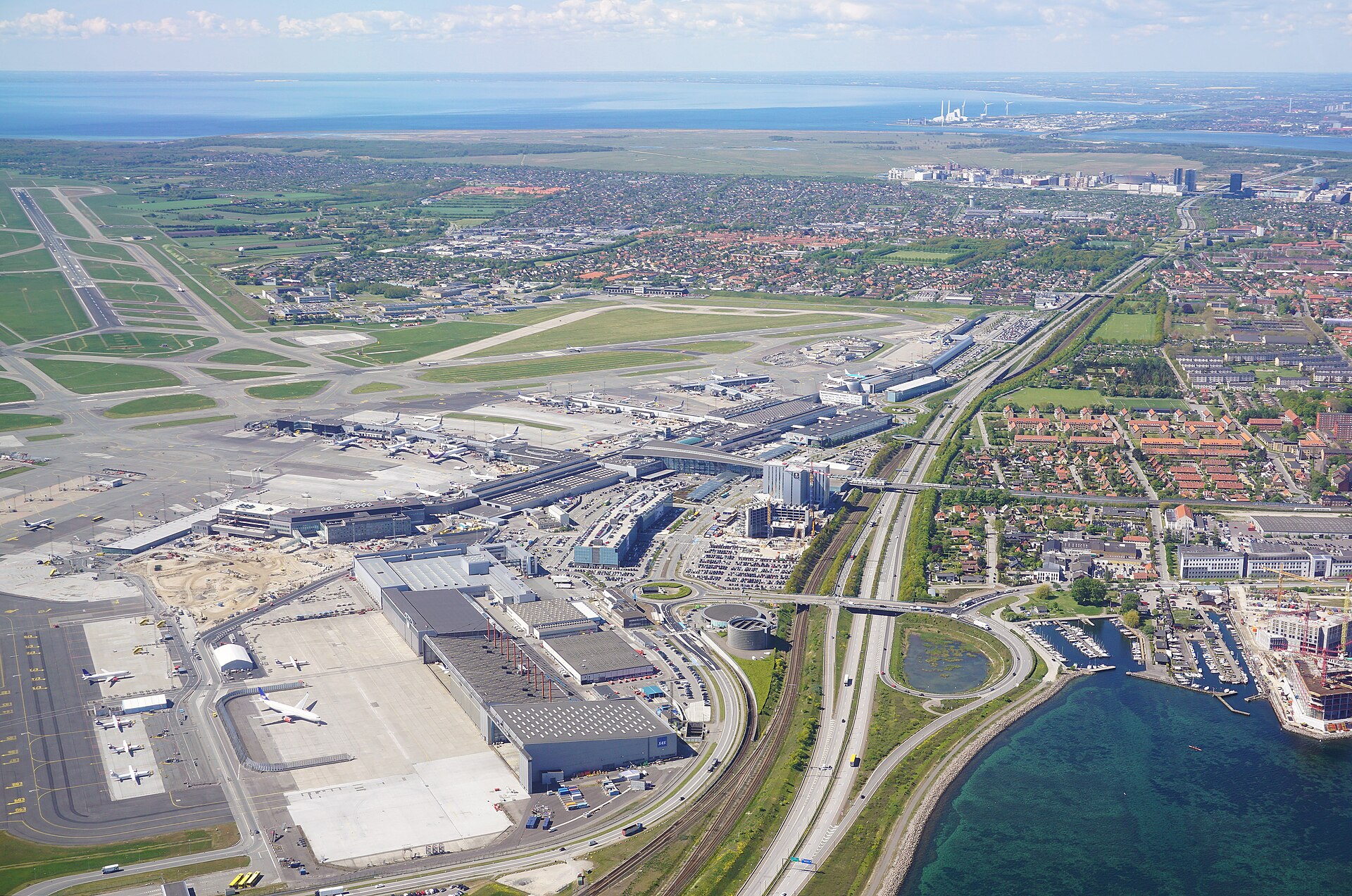
Context · Copenhagen Airport (Kastrup), closed on the night of 22 September 2025
Copenhagen airport from air.jpg · Kallerna · Wikimedia Commons · CC BY-SA 4.0 · open original
Part 01
The years in question
Between 22 September and 4 December 2025, a sequence of unidentified aerial incursions swept through some ten NATO countries, closing civilian airports and overflying military and nuclear installations. It began on the night of 22 September: Copenhagen Airport suspended operations for close to four hours after 'two or three large drones' were sighted inside its controlled airspace, and Oslo-Gardermoen closed briefly the same night. Copenhagen's police chief, Jens Jespersen, described sophisticated flight patterns and suggested the control site might be 'on a ship'. Danish Prime Minister Mette Frederiksen called it the most serious attack the country's critical infrastructure had suffered to date.
The pattern repeated for eleven weeks. In Denmark, Aalborg and Billund closed and there were sightings beside the Skrydstrup and Karup bases. In Germany, an internal Schleswig-Holstein government memo documented drone formations over ThyssenKrupp's marine division, Kiel's university hospital, the Kiel Fjord, power stations and the regional parliament; the state interior minister cited eight-metre wingspans, and the federal government counted 172 drone-related air traffic disruptions in 2025 alone. Munich closed twice within twenty-four hours in early October, Berlin Brandenburg and Bremen in the following weeks. In Norway there were sightings over Ørland air station, and police in Brønnøysund filmed five to six possible drones simultaneously in restricted airspace.
Belgium concentrated the most delicate phase. On 2 November several craft were observed over Kleine Brogel —the base that sustained reporting holds to store U.S. tactical nuclear weapons— a helicopter was scrambled and the objects moved off towards the Netherlands; the same day there were overflights at Leopoldsburg and Marche-en-Famenne. On 9 November Liège Airport closed and three drones were seen over the Doel nuclear power station; the United Kingdom, France and Germany announced support with personnel and equipment. On 22 November Dutch military personnel opened fire on craft over Volkel air base, a nuclear weapons storage site, and no wreckage was recovered. On 4 December five unidentified drones overflew Île Longue, the operating base of France's ballistic-missile submarines; a jammer was used, none was brought down and no operators were identified.
The institutional frame was already in place: on 12 September, after Poland invoked Article 4 over an incursion by Russian drones, NATO had launched Operation Eastern Sentry to reinforce surveillance of the eastern flank. The dominant attribution, never proven, pointed to Russia and a hybrid-warfare campaign. And the fact running through the whole sequence is a negative one: in eleven weeks and ten countries, not a single craft was recovered, identified or confirmably brought down.
On 25 June 2026, nine months later, Danish police closed the Copenhagen investigation with no suspects. Chief Inspector Søren Thomassen summed up the result in a sentence worth quoting whole: 'We cannot confirm that there has been drone activity in and around the airport. At the same time, we cannot rule out the possibility that there has been drone activity.' Investigators had reviewed witness statements, photographs, videos, CCTV footage, radar data and extensive air and maritime traffic records. Their conclusion was that there had been unexplained activity in the airspace that night, but that nothing they had gathered demonstrated the objects were drones.
Part 02
Why this case moved the needle
This file enters the corpus for an inversion that can rarely be documented. The 2025 European sequence is the most adversary-loaded case in the whole corpus alongside the 2023 Chinese balloon (↗), but with the difference that makes it interesting: that one ended with the object shot down, recovered and analysed, and this one ended without a single fragment. Eleven weeks, ten countries, fire opened at Volkel, a jammer used at Île Longue, and not one piece of wreckage. Attributing it to Russia is the reasonable reading from context —there is a war under way, Poland invoked Article 4, NATO deployed Eastern Sentry— but it remains inference from circumstance, not identification.
The Danish finding of June 2026 is what forces the case to be weighed carefully, and it cuts against intuition. A Western police force spent nine months trying to establish the mundane explanation —that what was seen were drones— cross-checking testimony, photographs, video, CCTV, radar and air and maritime traffic records, and could neither demonstrate nor rule it out. The result is structurally identical to an AARO 'unresolved' case, but reached from the opposite end: they did not start from an anomalous phenomenon and try to reduce it to something known, but from something known they could not confirm. That a national airport closure, with a prime minister speaking of an attack on critical infrastructure, should end in 'we cannot confirm nor rule out' is the cleanest reminder the corpus offers of how much certainty is lost between the headline and the file.
The contrast with ↗ is the file's second reason. The same phenomenology —unidentified objects over sensitive installations, airports closed, authorities unable to identify them— received a UAP framing in the United States and a hybrid-warfare framing in Europe, and the difference came not from the evidence but from the political context available to interpret it. Recording both cases makes visible that the explanatory frame is chosen before the object is known.
That is why the posterior loads onto the adversary narrative without approaching the certainty of the Chinese balloon, leaves appreciable mass on the mundane —the Copenhagen finding demands it— and keeps broad indeterminacy, with the non-human component effectively at zero: nothing in the sequence points that way and the file will not manufacture ambiguity where there is none. One morphological detail deserves separate note: the Schleswig-Holstein memo describes formations with a 'mother drone', that is, the configuration of a larger object accompanied by smaller craft that the corpus has catalogued as pattern 8b since cases like Cressy in 1960. Here it reappears in an unambiguously technological register and written by a regional government, which suggests the morphology describes a recurring engineering solution rather than an exotic signature.
Part 03
What's left on paper
Documented evidence
- Documented closures at Copenhagen, Oslo-Gardermoen, Aalborg, Billund, Munich (twice in 24 h), Berlin Brandenburg, Bremen, Gothenburg, Brussels, Liège and Dublin
- Overflights of nuclear installations: Kleine Brogel (2 Nov), Doel power station (9 Nov), Volkel (22 Nov, fire opened with no wreckage recovered), Île Longue (4 Dec, jammer used with no craft downed)
- Internal Schleswig-Holstein government memo: formations with a 'mother drone', eight-metre wingspans, over shipyards, power stations and the regional parliament
- 172 German air traffic disruptions attributed to drones in 2025 alone (federal government)
- Police footage at Brønnøysund (Norway): five to six possible drones simultaneously in restricted airspace
- NATO's Operation Eastern Sentry (12 Sep 2025), after Poland invoked Article 4
- No craft recovered, identified or confirmably brought down in eleven weeks across ten countries
- Closure of the Danish investigation (25 Jun 2026) with no suspects, after reviewing testimony, photographs, video, CCTV, radar and air and maritime traffic records
Sources
- Wikipedia — '2025 European drone sightings' — Aggregated chronology with dates, sites and official responses country by country.
- Reuters / US News — 'Danish Police Find No Proof Drones Caused Copenhagen Airport Shutdown' (25 jun 2026) — Closure of the investigation and the statement by Chief Inspector Søren Thomassen: drone activity can be neither confirmed nor ruled out.
- DroneLife — 'Danish Investigation Finds No Proof Drones Caused Copenhagen Airport Shutdown' (25 jun 2026) — Detail of the material reviewed over the nine months of investigation.
- Wikipedia — 'Operation Eastern Sentry' — Frame of NATO's response, launched 12 Sep 2025 after Poland invoked Article 4.
- Al Jazeera — 'Copenhagen airport shut after sighting of unidentified drones' (22 sep 2025) — Coverage of the initial episode, with the statements by Frederiksen and police chief Jespersen.
- Euronews — 'Explained: How drone incursions in Europe went from rarity to reality' (2 jun 2026) — Retrospective synthesis of the full arc and the state of attribution.
Patterns it exhibits (3)
Location
Copenhagen Airport + some ten NATO countries · 55.62°, 12.66°
Distribution of explanations
This case is classified among the model's hypotheses: the bar splits 100% by how much each explanation weighs (the uncertainty is spread across the hypotheses the case supports). Summed across the corpus they produce the comparable partition. It is a different question from the Probability above: that one estimates how likely the case is a genuinely unexplained phenomenon; this one splits which the explanation would be.
Modal hypothesis: Adversary technology 52% · sums to 100%
Structured analytical judgment, not a calibrated frequency. Forced classification: the mass the evidence cannot assign is spread across the hypotheses the case does support.
Related cases