1990·Bay of Greifswald, near the Lubmin nuclear plant
Germany.Greifswald · mass lights + 6 videos (East Germany)
On the night of August 24, 1990, months before German reunification, dozens of witnesses in Greifswald, Lubmin, Rügen, Usedom and neighboring towns saw, mostly between 20:00 and 21:00, successive formations of about seven yellowish or orange lights that seemed to hang over the Baltic, off Greifswald Bay and the Lubmin nuclear power plant; each formation lasted a few minutes and the next appeared at another spot. It was captured in several simultaneous videos and photos. The most-discussed explanation is illumination bombs with parachute flares dropped in the Warsaw Pact air firing zone over the Baltic.
Tier A · AcceptableWhat do they mean? →
Institutional evidence: several identified independent witnesses, or contemporary official documentation, without an instrumental record to corroborate them.
What it was
85%natural or human cause
Most likely explanation: flare or fireworks
See the split across the six explanations
Natural or human cause
No known cause
Primary documents
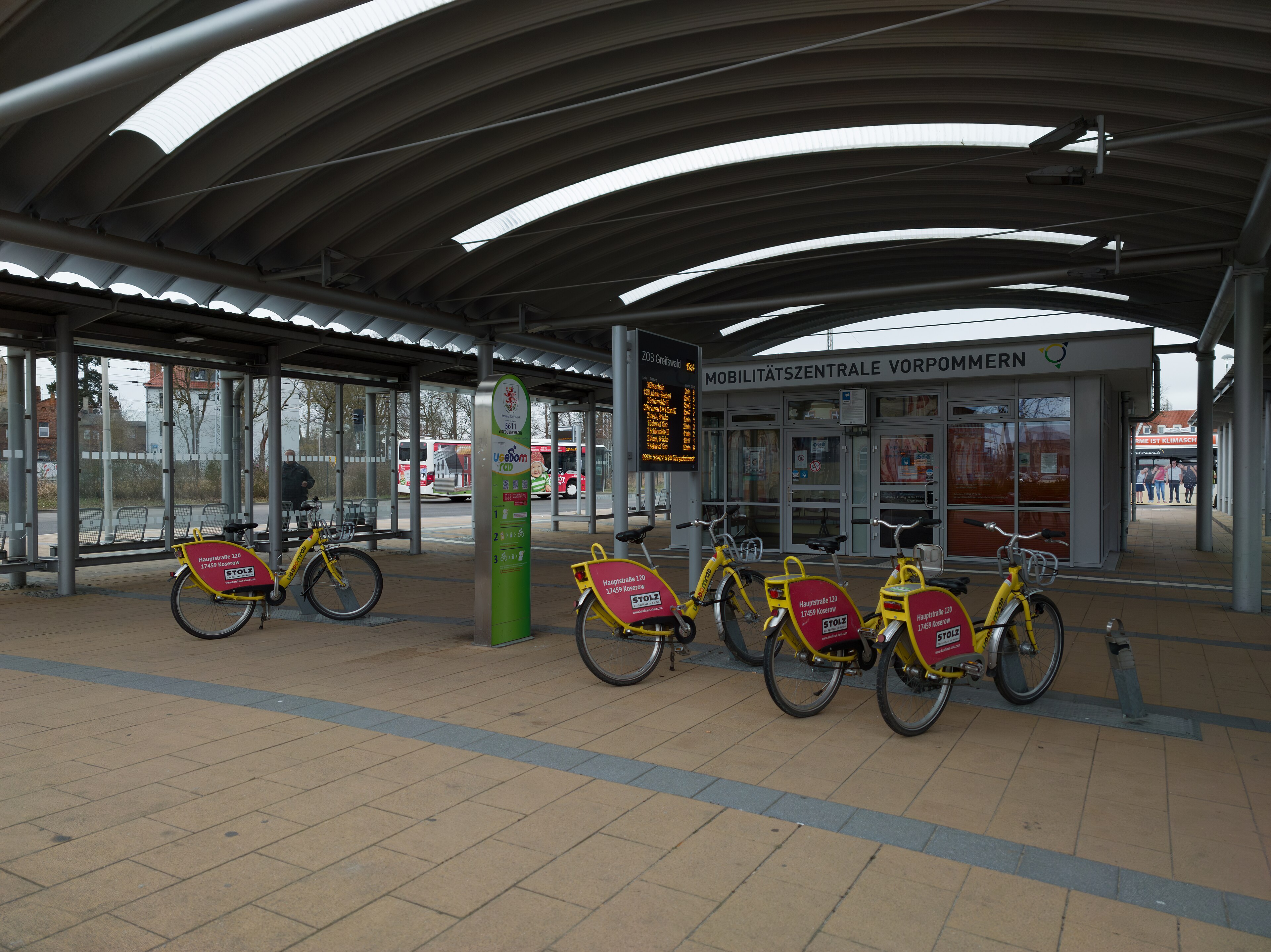
Context · Greifswald (Germany), by whose bay the 1990 lights were seen
Mobilitaetszentrale, Greifswald (LRM 20220319 153434).jpg · Wikimedia Commons · CC BY-SA · open original
Letters from the Federal Office of Defence Technology (14 Nov 1994) and the Swedish embassy (8 Nov 1994) to Werner Walter, reproduced in Dennis Kirstein's report, pp. 17-18
Kirstein's report (August 2014 version) reproduces in facsimile two official replies to the researcher Werner Walter of CENAP. The Federal Office of Defence Technology and Procurement (BWB), in a letter of 14 November 1994 signed on its behalf by a Mr. Müller, answers his query about lights over the Baltic in the Greifswald/Rügen area on 24 August 1990 that "as our enquiries showed, corresponding tests were carried out on that day" and that it can therefore confirm his observations and explanations. The Swedish naval and air attaché in Bonn, on 8 November, rules out the Swedish forces and says there were exercises with missiles, probably Russian, east of Rügen, possibly with infrared target flares. Copyrighted report: it is linked.
Dennis Kirstein, «Die Greifswaldlichter» (ufo-information.de, 2014), pp. 17-18 · view source
The night in question
On the night of August 24, 1990, in the final weeks of the German Democratic Republic (reunification would be consummated just over a month later, on October 3) dozens of witnesses in Greifswald, Lubmin, Wolgast, Rügen, Usedom and other Baltic-coast towns of Western Pomerania watched a luminous phenomenon over Greifswald Bay, close to the Lubmin nuclear power plant (the largest atomic plant in the former GDR). Most witnesses and the videos place it between 20:00 and 21:00, and a holidaymaker on Usedom said he saw lights as early as 17:00. What was seen were formations of six or seven yellowish or orange lights that appeared to hang, sometimes aligned, sometimes regrouping, over the sea. According to the testimony gathered by researcher Dennis Kirstein, each formation lasted a few minutes, went out light by light and a similar one reappeared at another spot; the whole lasted close to an hour. A witness from Stralsund who saw it from Rügen wrote in 1993 that he watched it for some three to five minutes, that it faded and that it reappeared, "brighter and larger", for another ten minutes.
What sets the case apart is the volume of visual record. Several people filmed the phenomenon from different vantage points, and photographs were taken, a level of camera documentation uncommon for a mass sighting of the late 1980s, when home camcorders were only beginning to spread. The convergence of records from separate angles is precisely what gives the episode its weight: a phenomenon observed and filmed simultaneously by a broad population. Civilian investigators later analyzed the footage, among them Illobrand von Ludwiger's MUFON-CES association, which in a 1995 letter acknowledged the smoke visible in the recordings, and the case entered European ufological literature as 'the Greifswald incident' (Greifswalder Vorkommnis). Proximity to a nuclear facility amplified public attention and fueled, as so often happens, the hypothesis of an unknown object's interest in sensitive infrastructure.
The most recurrent, plausible and discussed explanation is the dropping of parachute flares during a military exercise over the Baltic, a densely militarized area in the twilight of the Cold War, where the so-called air firing zone II, under Soviet control, was used by Warsaw Pact air forces to practise with air-to-air missiles against luminous targets. Military historian Manfred Kanetzki wrote in 1994 that the zone was in use for exercises from August 11, 1990, and a photo of a control-room board of the time, published in a 1992 book, marks it closed on August 22 from 15:00 to 23:00. Illumination flares hang from a small parachute and burn as they descend slowly over several minutes, producing exactly such clusters of yellowish or orange hanging lights that appear to hold formation and then go out in sequence: a visual picture practically indistinguishable from the one described by witnesses. In 2012 researcher Dennis Kirstein published a final report he himself called provisional, which makes that reading concrete: SAB-type illumination bombs, 'each fitted with seven pyrotechnic flares', dropped from about ten kilometres during a Czechoslovak air force exercise in the air firing zone over the Baltic, which, according to Kirstein, former GDR air force members confirmed independently. A former controller at the Putgarten station on Rügen told him that on a night he dated tentatively to 24 August ("24.08. könnte stimmen", "24.08 could be right"), around 22:00, later than the 20:00-21:00 window of almost all the witnesses, he was alerted to some ten to fifteen very bright "stars" to the east, that his command post confirmed the firing zone was active, and that the unusual thing was seeing so many at once, since the usual practice was to fire at one illumination bomb until it burned out. The same report acknowledges that the German military archive holds no note confirming an exercise and that the Czech defense attaché told him the archives of that period had been destroyed, but it reproduces in facsimile two official letters of November 1994 addressed to the researcher Werner Walter of CENAP. The Federal Office of Defence Technology and Procurement (BWB) replied on 14 November that "as our enquiries showed, corresponding tests were carried out on that day", that it could therefore confirm his observations and the related explanations, and that it held no further information; the letter does not say what tests they were or who carried them out. The naval and air attaché at the Swedish embassy in Bonn wrote on 8 November that the Swedish forces could be ruled out, that there was information about air force exercises, probably Russian, east of Rügen, with missiles, and that the lights could have been infrared target flares, in a direction that matched his witnesses' fairly well; in the same letter, the Swedish armed forces research institute proposed another explanation, a rocket stage re-entering the atmosphere, which Kirstein dismisses. The Swedish letter speaks of probably Russian forces, not of the Czechoslovak air force Kirstein points to. Marius Kettmann, vice-chair of the DEGUFO association, published a rebuttal arguing that the only pointers to a military origin are the superficial resemblance to illumination munitions and the possible position of the lights over the firing zone, and that no witness heard aircraft noise nor do the videos show any aircraft; Kirstein replied that the zone lay some 30 km offshore and the bombs were released at about 10 km altitude. Another statement Kirstein himself reproduces, taken from the MUFON-CES report, points partly the other way: forty pupils and teachers camping at Mukran, on Rügen, said the spheres in each group moved independently and exchanged smaller luminous objects, and that they were below the clouds, which lay between 2,500 and 6,000 metres, which does not fit bombs released at around 10 km; the same statement adds that the groups seemed to move with the wind toward the southwest, and Kirstein objects that it is unknown how those testimonies were taken. The same annex carries two further MUFON-CES accounts that point to an anomaly: a pilot, Gerald D., saw another luminous object enter the group on a straight horizontal path at great speed and stop in it, and a family in Trassenheide saw small objects leave the group and come back. It also carries others that point the other way: at 20:47 several witnesses filmed a flash at the height of the lights whose fading, within an eighth of a second, resembled a missile's, and several coastal witnesses recognised military flares at the time; a doctor and former National People's Army officer sailing on the bay said he saw them launched from the sea and used as missile targets, although Kirstein disputes that detail, and the skipper of a ferry said such flares hanging from parachutes had always been seen there. Those who argue for an anomaly object that no military archive records an exercise on that specific night and that some lights made sharp turns or displacements incompatible with free-falling flares; the exercise's operational record is not known, and the Czech attaché considers it destroyed, but the two official letters of 1994 state that there were tests or air exercises over the Baltic that day, and Kirstein argues that the testimony collected by CENAP and MUFON-CES describes the behavior expected of flares drifting with the wind and going out one by one. What matters in the case is therefore not the object's nature but the institutionally useful fact of a mass, multi-witness, multi-camera sighting, documented and debated in the European public record.
Why it matters
It was documented on camera: several independent videos and dozens of witnesses over a bay next to the largest nuclear plant of the former GDR, at the precise historical moment of reunification. That density of record (simultaneous, multi-witness and from different angles) is exactly the kind of evidence that holds up against individual error.
But the quality of the record says nothing about the nature of the phenomenon. The most-discussed explanation is parachute flares from a military exercise over the Baltic, a scenario that reproduces the observed picture. That night's exercise appears in no known operational record, but two official letters of 1994 do assert it: the German federal office of defence technology confirms tests on that day without saying of what kind or by whom, and the Swedish attaché in Bonn speaks of air exercises, probably Russian, east of Rügen. That is why Greifswald is included on the same criterion as Morocco 1976 or the 2018 Irish wave: what it contributes is the methodological value of a well-documented mass sighting, not the elevation of the object to the rank of anomaly. It also serves as a calibrating counterweight: it shows that a phenomenon can be at once spectacularly well filmed and have a mundane explanation. The number of witnesses and cameras certifies that something was seen; it does not certify what it was.
What's left on paper
Documented evidence
- Dozens of witnesses in Greifswald, Lubmin, Rügen and Usedom; successive formations of about seven lights, mostly between 20:00 and 21:00 (Aug 24, 1990).
- Several independent videos and photos; MUFON-CES acknowledged in 1995 the smoke visible in the recordings.
- The lights were over the Baltic, off the bay and the Lubmin plant, within air firing zone II according to the sight lines Kirstein reconstructed.
- A former controller at Putgarten (Rügen) stated that his command post confirmed the firing zone was active on a night he tentatively dated to 24 August, around 22:00.
- Dennis Kirstein's report (2012): SAB illumination bombs with seven flares each, dropped in a Czechoslovak air force exercise over the Baltic
Show 3 more items
- Kirstein's report is provisional; the German military archive does not record the exercise and Marius Kettmann (DEGUFO) disputes the explanation
- Two official letters of November 1994 reproduced by Kirstein (pp. 17-18): the German BWB replies that "corresponding tests were carried out on that day", without saying which or by whom; the Swedish attaché in Bonn speaks of air exercises with missiles, probably Russian, east of Rügen, and of possible infrared flares.
- According to MUFON-CES, forty pupils and teachers at Mukran saw spheres moving independently below clouds lying between 2,500 and 6,000 m, against bombs released at about 10 km.
Sources
- Wikipedia — Greifswald lights (Greifswalder Vorkommnis, 24 ago 1990) — Secondary source (encyclopedia).
- GWUP — 'Greifswald-Ufo: Case closed' (25 nov 2012) — Summarizes Dennis Kirstein's report (ufo-information.de) attributing the lights to SAB illumination bombs.
- ufo-information.de — 'Greifswald Bericht löst Reaktionen aus' (2 dic 2012) — Kirstein's answer to Marius Kettmann's (DEGUFO) rebuttal; calls his report provisional and details the testimony of former GDR air force members.
- Dennis Kirstein, «Die Greifswaldlichter» (ufo-information.de, informe con anexos de testimonios del CENAP y MUFON-CES, versión ago 2014) — Investigation report with witness letters, defense attachés' replies and testimony from former GDR military personnel; pp. 17-18 reproduce in facsimile the letters from the BWB (14 Nov 1994) and the Swedish embassy in Bonn (8 Nov 1994) to Werner Walter.
Related cases
same object · same period
Usagre · the 'craft' that was a wedding (1993)
1993 · Tier B
same object · same period
Byelokoroviche · UFO over Soviet missile base
1982 · Tier A
same explanation · same period
Knowles Family · Nullarbor Plain
1988 · Tier A
same explanation · same period
Ilkley Moor 1987 · the policeman, the green humanoid and the blurry photo
1987 · Tier B