2026·Upper atmosphere over Niger, West Africa
Niger.Niger · an astronaut photographs a fireball from orbit
On the night of April 27, 2026, NASA astronaut Chris Williams was looking out from the International Space Station for an incoming Russian cargo ship when, by his own account, he saw a bright object directly below streak through the upper atmosphere over West Africa and break into a shower of fragments. His photos show it from 22:39:47 to 22:41:16 UTC, as the station passed from Benin over Niger. NASA described it as unidentified space junk and did not rule out a meteor. The catalog kept by astrophysicist Jonathan McDowell puts the fall of the stage of the rocket that launched the cargo ship at 22:41 UTC, over Niger.
Tier S · SolidWhat do they mean? →
Strong evidence: a contemporary instrumental record (radar, sensor, film or photo of known provenance) that corroborates several independent witnesses.
What it was
96%reentry
The most likely explanation.
- 96% reentry
- 2% other earthly causes
- 2% no known cause
See the split across the six explanations
Earthly origin (human or natural)98%
No known cause2%
Ordinary cause the sources propose: reentry
Record of the event
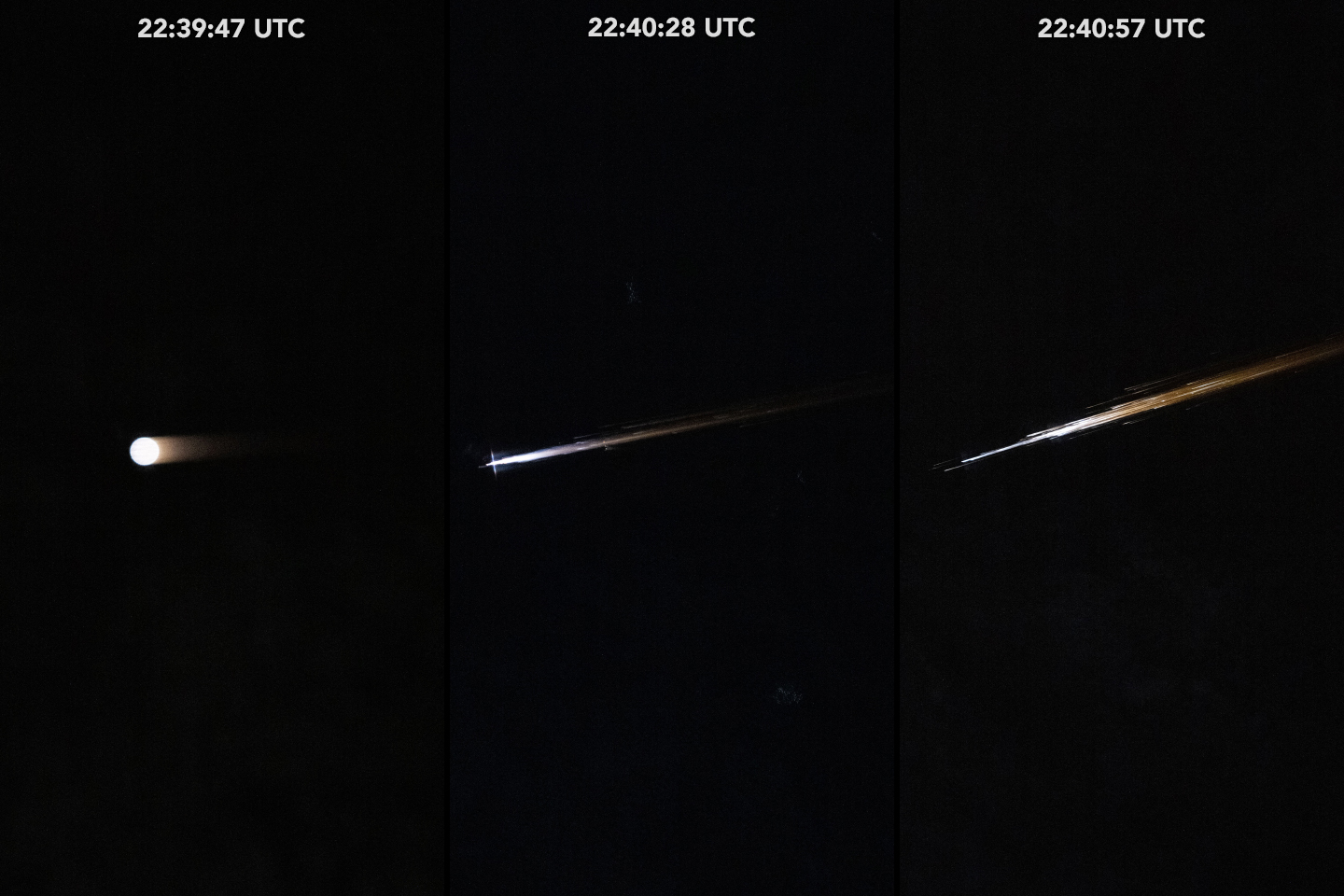
Three photos of the object breaking up, 22:39:47 to 22:40:57 UTC (Apr 27, 2026)
Three photos taken from the International Space Station's Cupola over 70 seconds: at 22:39:47 UTC, a ball of white light with an orange tail; at 22:40:28 and 22:40:57, a trail breaking up into fragments. A NASA Earth Observatory composite (Lauren Dauphin) of photos ISS074-E-540109 to ISS074-E-540179; NASA cropped the images, enhanced their contrast and removed lens artifacts. The printed times are the camera's.
NASA Earth Observatory, "Great Balls of Fire" (May 18, 2026) · Public domain (NASA) · open original
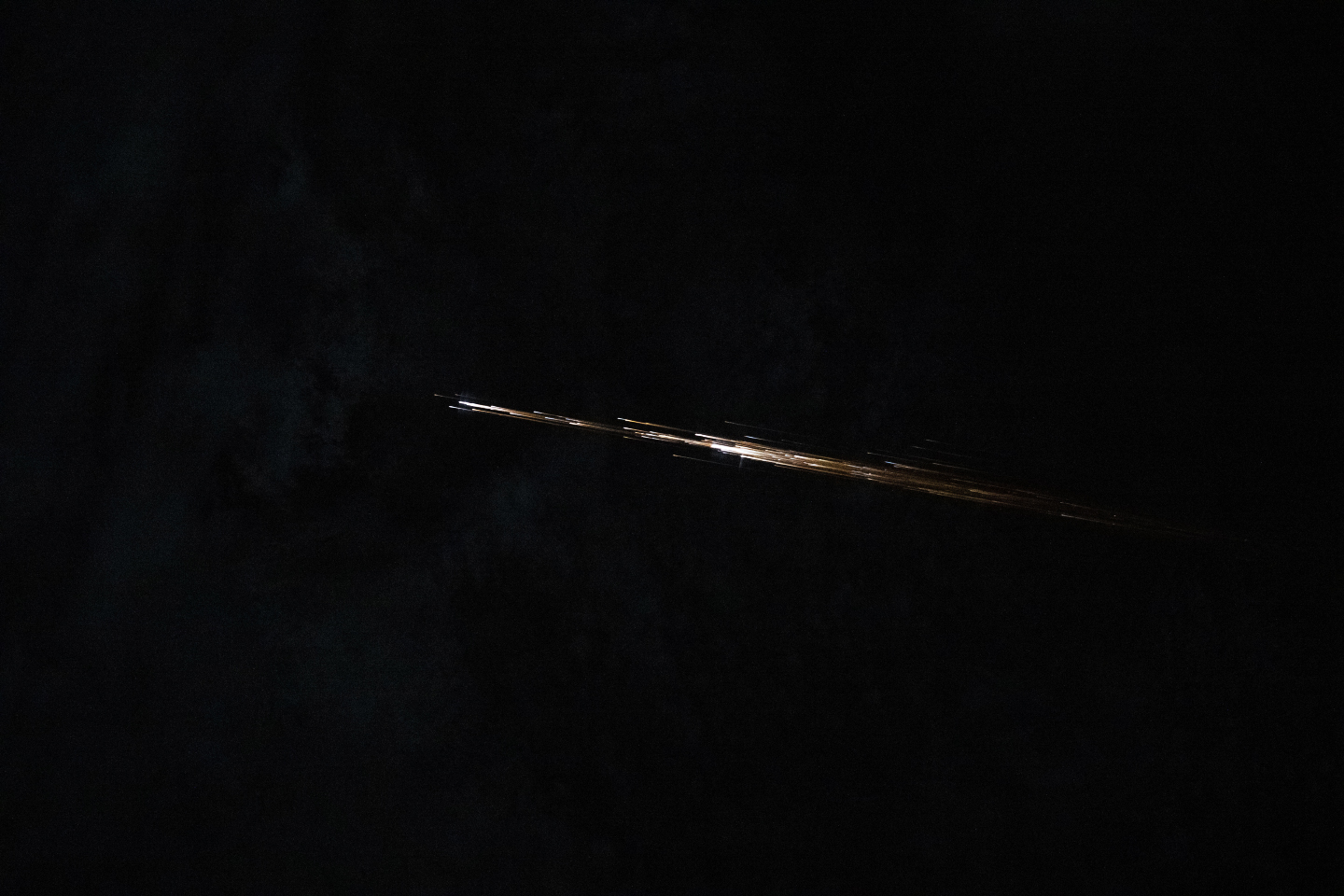
ISS074-E-540214 · the shower of fragments at 22:41:16 UTC (Apr 27, 2026)
The main photo in NASA's Earth Observatory article: a trail of orange fragments crossing the upper atmosphere, at night, at 22:41:16 UTC.
Read more
According to NASA's database of astronaut photos, the station was then flying 413 km above western Niger (14.9° N, 4.6° E). Taken with a Nikon Z9 and a 200 mm lens by an Expedition 74 crew member; NASA credits another photo in the same series, ISS074-E-540224, to Chris Williams. NASA cropped the image, enhanced its contrast and removed lens artifacts.
NASA Earth Observatory · astronaut photo ISS074-E-540214 · Public domain (NASA) · open original
What happened
On Saturday, April 25, 2026, at 22:21 UTC, a Russian Soyuz-2.1a rocket lifted off from the Baikonur Cosmodrome in Kazakhstan carrying the Progress MS-34 cargo ship, which NASA calls Progress 95, bound for the International Space Station. According to the catalog of space objects kept by astrophysicist Jonathan McDowell, the rocket's third stage, called the Blok-I, separated from the ship nine minutes later. It was a cylinder 6.7 meters long weighing 2,350 kilograms, and it was left in a low orbit at almost the same inclination as the station, 51.6 degrees. The air kept slowing it down: by April 27, according to the catalog, the lowest point of its orbit was already just 157 kilometers up and the highest 169, and it fell that same day.
On Monday, April 27, the Progress was closing in on the station to dock. NASA astronaut Chris Williams, on his first mission and aboard since November 27, 2025, was in the Cupola, the module of windows that faces the Earth, trying to spot the ship. As he told it days later on Instagram and X, "at about 10:40 PM GMT" (22:40 UTC), as the station was passing over West Africa, he saw a bright object "directly below us" streaking through the upper atmosphere. "I saw its tail grow and then split apart into a shower of smaller pieces," he wrote. He thought it was a piece of space junk or a satellite breaking up as it entered the atmosphere, and he summed it up: "It was quite a light show!"
Williams photographed it with a handheld Nikon Z9 camera and a 200 millimeter lens. NASA's database of astronaut photos stores each image with the camera's time and the point on Earth directly below the station, and it lists the whole series, from ISS074-E-540106 to ISS074-E-540252, between 22:39:47 and 22:41:31 UTC; the object is visible alight up to the 22:41:16 photo. NASA's Earth Observatory published three of those photos in sequence, taken at 22:39:47, 22:40:28 and 22:40:57 UTC. The first shows a ball of white light with an orange tail; the other two show a trail breaking up into many fragments. A fourth photo, from 22:41:16, shows only the shower of orange fragments.
At 22:41:16, according to the same database, the station was flying 413 kilometers up over western Niger, and the Sun was far below the horizon at that point. It was deep night below: the light in the photos came from the object itself as it heated up in the air, not from the Sun. The Progress was not the cause, according to the Earth Observatory: it docked with the station safely on April 27, as planned. McDowell's catalog puts the docking at 00:00 UTC on April 28; in the United States it was still the evening of the 27th.
Williams posted three photos and a short video on X on Thursday, April 30, according to Space.com. NASA released another photo from the series, ISS074-E-540224, on its website under the title "A piece of unidentified space debris is pictured from the International Space Station," with a caption describing it burning up over Africa. On May 18, the Earth Observatory made the 22:41:16 photo its Image of the Day, under the title "Great Balls of Fire."
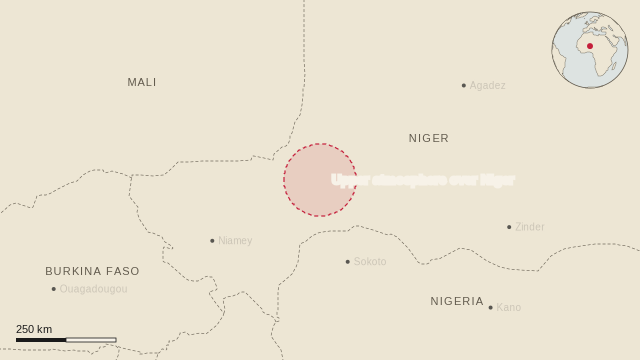
Where it happened
Why it matters
NASA did not identify the object. Its page for photo ISS074-E-540224 speaks of unidentified space debris, and the Earth Observatory widened the possibilities: the astronaut may have seen the reentry and breakup of the rocket that launched the Progress, of another rocket body, a satellite or other space junk, and it was also possible that meteoric material produced the light. A scientist with the station's Earth-observation office (Crew Earth Observations) added that, without knowing exactly where the camera Williams was holding was pointed, it is hard to determine the source. The photo database leaves blank the point on Earth each image looks at: it only gives the point directly below the station.
The specific hypothesis came from Space.com. In his May 3 article, Mike Wall wrote that the upper stage of the Soyuz that launched the Progress "apparently reentered at the right time and place to generate the sky show," and linked a post by an X user as support. McDowell's catalog gives that stage a fall at 22:41 UTC on April 27, in central Niger: the same minute as the 22:41:16 photo.
The place fits as well. By a calculation made for this case from the catalog's coordinates and those in the photo database, that point lies about 280 kilometers from the spot below the station at 22:41:16, almost in the direction the station was heading. Because it was launched to reach the station, the stage circled Earth in an orbit tilted almost like the station's, which makes it plausible that it fell beneath the station's path. Two limits weigh on this match: the catalog rounds the point to the nearest degree, a margin of tens of kilometers, and it does not say where the time and place come from. Whether they are independent of the photos themselves remains to be seen.
The duration points the same way. The photos with the object alight span at least 89 seconds, from 22:39:47 to 22:41:16. A meteor burns far more briefly: according to the Australian Desert Fireball Network's report on another Soyuz reentry, a typical fireball lasts about six seconds, while that stage, which came in almost horizontally from a low orbit, was followed for 68 seconds by two of the network's cameras (↗ Melbourne). The event also shows how far a good photo can go: a time to the second, a named witness and the exact position of the photographer were not enough for NASA to say what it was. The closest answer comes from the catalog of objects in orbit.
Documents and sources
Documented evidence
- NASA's database of astronaut photos (Gateway to Astronaut Photography of Earth): photos ISS074-E-540106 to ISS074-E-540252, taken on April 27, 2026, between 22:39:47 and 22:41:31 UTC with a Nikon Z9 and a 200 mm lens. ISS074-E-540214, from 22:41:16, has the point below the station at 14.9° N, 4.6° E, at an altitude of 413 km, with the Sun 58 degrees below the horizon.
- NASA Earth Observatory, "Great Balls of Fire" (May 18, 2026): three photos taken at 22:39:47, 22:40:28 and 22:40:57 UTC show an object breaking up in the atmosphere; the 22:41:16 photo shows the shower of fragments. They were taken by "a member of the Expedition 74 crew" who was looking for Progress 95.
- The same Earth Observatory article leaves the cause open: the reentry of the rocket that launched the Progress, another rocket body, a satellite, other space junk or meteoric material; and it reports that, according to a Crew Earth Observations scientist, without knowing where the camera was pointed it is hard to determine the source.
- Chris Williams, post on Instagram (cited by NASA) and on X on April 30, 2026 (cited by Space.com): at about 22:40 GMT on April 27, over West Africa, he saw a bright object directly below whose tail grew and split into fragments; he thought it was space junk or a satellite breaking up.
- NASA, image page for ISS074-E-540224 (credit NASA/Chris Williams): "A piece of unidentified space debris is pictured from the International Space Station as it reenters Earth's atmosphere and burns up over Africa." According to the astronaut photo database, it was taken at 22:41:18 UTC.
Show 2 more facts
- Jonathan McDowell's GCAT catalog: the Blok-I stage of the Soyuz-2-1a that launched Progress MS-34 (designation 2026-093B) separated on April 25, 2026, at 22:30:32 UTC, was in a 157 by 169 km orbit inclined 51.65 degrees on April 27, and reentered that day at 22:41 UTC, near 6° E, 17° N.
- Space.com, article by Mike Wall (May 3, 2026): the upper stage of the Soyuz that carried Progress 95 to orbit "apparently reentered at the right time and place to generate the sky show."
Sources
- NASA Earth Observatory, "Great Balls of Fire," Image of the Day (May 18, 2026) — Primary source: the photos with their times, the camera, the lens, the search for Progress 95 and the possible causes NASA leaves open. It does not name the crew member.
- NASA, "A piece of unidentified space debris is pictured from the International Space Station" (image ISS074-E-540224) — Primary source: credits the photo to Chris Williams and quotes his full account posted on Instagram.
- NASA, Gateway to Astronaut Photography of Earth, photo ISS074-E-540214 — Primary source: the time of the photo, the point on Earth below the station, the altitude and the Sun's elevation. The pages for the other photos in the series (540106 to 540252) give the same data.
- Jonathan McDowell, General Catalog of Artificial Space Objects (GCAT), satellite catalog, object S68838 "Soyuz-2-1a Blok-I" (2026-093B) — Reference catalog: the stage's separation, orbit, mass, dimensions and the time and place of its reentry, and the docking of Progress MS-34. The catalog does not state where the reentry time and place come from.
- Jonathan McDowell, GCAT, launch log, 2026-093 — Reference catalog: the launch time (22:21:47 UTC on April 25, 2026) and the pad, at Baikonur.
- Mike Wall, "'It was quite a light show!' NASA astronaut spies dramatic fireball from the International Space Station (photos)," Space.com (May 3, 2026) — Press: Williams's April 30 account on X, his arrival at the station and the Soyuz stage hypothesis, based on a post by the @_starbase_ account on X.
- Chris Williams (@Astro_ChrisW), post on X (Apr 30, 2026) — Primary source: the astronaut's account with three photos and a video. Its text is known from Space.com and from NASA's page, which quotes the same text as posted on Instagram.
- Harry Baker, "'Quite a light show': NASA astronaut snaps atmospheric fireball as Russian rocket explodes over West Africa," Live Science (Nov 3, 2026) — Press: treats the Soyuz identification as fact, citing Space.com. It attributes the fireball to the rocket's fairing and booster, which fall during the ascent; McDowell's catalog gives the reentry of the third stage. It also says NASA judged the rocket the more likely cause, which the Earth Observatory article it links to does not say.
Related cases
Cases this case cites and cases with the same likely cause.
Cited in this case · Within 10 years
Melbourne · residents see a fireball and hear a sonic boom
2023 · Tier S
Reentry · Within 10 years
Malaysia · residents in several states film a fireball
2026 · Tier A
Reentry
Yukon · 22 witnesses see a huge row of lights
1996 · Tier B
Reentry
Cosford · RAF police see two lights during a nationwide wave
1993 · Tier A