2026·West coast of Peninsular Malaysia, across from Sumatra
Malaysia.Malaysia · residents in several states film a fireball
On the night of Wednesday, November 4, 2026, at around 8:39 p.m. Malaysia time, residents in several states of the peninsula saw a fireball cross the sky, filmed it, and talk spread of a meteor or a shooting star. At that same moment, according to the U.S. Space Force, NASA's Neil Gehrels Swift Observatory, launched in 2004, was reentering the atmosphere over northern Sumatra, Indonesia, across the Strait of Malacca. Malaysia's science ministry attributed the sightings to that reentry and said it had no official reports of debris.
Tier A · AcceptableWhat do they mean? →
Institutional evidence: several identified independent witnesses, or contemporary official documentation, without an instrumental record to corroborate them.
What it was
93%reentry
The most likely explanation.
- 93% reentry
- 2% other earthly causes
- 5% no known cause
See the split across the six explanations
Earthly origin (human or natural)95%
No known cause5%
Ordinary cause the sources propose: reentry
What happened
NASA's Neil Gehrels Swift Observatory lifted off from Cape Canaveral on November 20, 2004, to study gamma-ray bursts, the most powerful explosions known. It was built for a two-year mission and worked for almost twenty-two. It weighed about 1,450 kilograms, circled in a low orbit tilted about 20.5 degrees from the equator and had no engine to raise it. Like every satellite in low orbit, it was slowly dragged down by the thin upper atmosphere, and according to NASA the solar activity of recent years, which heats and expands those layers, sped up its fall.
To save it, NASA hired Katalyst Space, a company based in Flagstaff, Arizona, in September 2025 to build within a year a satellite that could reach Swift, grab it and raise its orbit. That spacecraft, called LINK, lifted off in July 2026 from Kwajalein Atoll in the Marshall Islands aboard a Pegasus XL rocket. According to NASA, after its first checkouts it began losing contact at times and had trouble controlling its orientation. The two sides agreed to scale back the mission: LINK would no longer try to grab or boost Swift and would only run technology tests. It came within 12 to 15 kilometers of the observatory, which it photographed as a streak of light. NASA ended its involvement on September 3, and LINK reentered the atmosphere on September 25.
Swift, which had stopped observing in mid-February to reduce drag, resumed in late August; that increased the drag and sped up its fall again. On October 20 it dropped to 275 kilometers, could no longer make up for the braking and went into safe mode; the operations team at Penn State sent the command that ended the mission. In the days that followed, the U.S. Space Force issued ever more precise predictions of the fall. One of the first gave 08:30 UTC on November 4, with a margin of eleven hours; one of the last, a window from 11:42 to 13:42 UTC. NASA had put the risk that a piece would hurt someone on the ground at 1 in 2,100.
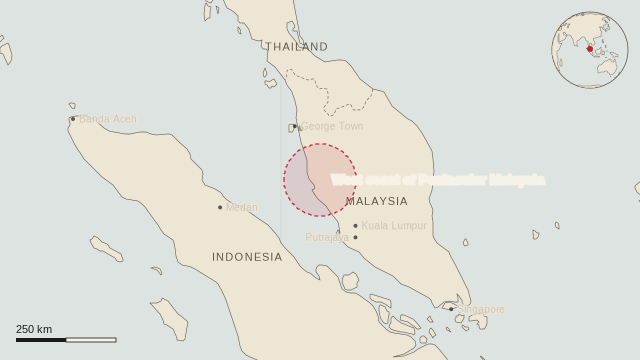
The Space Force placed the reentry at 12:39 UTC on Wednesday, November 4, over the province of North Sumatra, Indonesia, near 3.4 degrees north latitude and 98.6 degrees east longitude. It was 7:39 p.m. there and 8:39 p.m. in Malaysia. According to aerospace engineer Muhammad Hanafi Azami, of the International Islamic University Malaysia, quoted by the New Straits Times, the sightings were reported between 8:35 and 8:45 p.m. Users of the Threads network posted videos recorded in Pahang, Johor, Terengganu and Kedah, and talk spread of a meteor or a shooting star. Hanafi told the newspaper Harian Metro that the fireball could be seen across the Strait of Malacca from Penang, Kedah, Perak and Selangor. A fireball with a long tail was also seen from Singapore, at around 8:40 p.m., according to the news site Mothership.
In Indonesia, many people posted videos of the object burning up in the sky, the same site reported. By a calculation made for this case, the Space Force coordinates lie about 20 kilometers from Medan, the capital of North Sumatra.
The next day, the director general of the Malaysian Space Agency (MYSA), Azlikamil Napiah, told the New Straits Times that the lights came from two events of those days: the reentry of the NASA telescope and the peak of the Southern Taurids meteor shower, which his agency's calendar placed between Wednesday night and early Thursday, at about five meteors an hour. He also said NASA had controlled the reentry and, according to the paper, that the debris had already fallen in the ocean, "within the African continent." Both clash with the record: the fall was uncontrolled, and the Space Force placed it over Sumatra. The paper also gathered reports from Kuantan, Kluang, Kota Tinggi and Kota Kinabalu, in Sabah, and noted that it was not clear they were all the same phenomenon.
On November 6, Malaysia's Ministry of Science, Technology and Innovation (MOSTI), through its Space Authority Division, confirmed it had received reports of bright lights over several areas on Wednesday night and linked them to Swift's reentry. "So far, there are no official reports on the discovery of any suspected space object debris, such as rockets, on land or in Malaysian waters," the ministry said, asking people not to touch any suspicious object and not to speculate. NASA, for its part, expected most of the satellite to burn up but warned that some parts may have reached the ground. As of the sources consulted, no one had reported finding any debris.
Where it happened
Why it matters
What people in Malaysia saw fits the fall of a satellite, not of a rock. A meteor enters the atmosphere at 11 to 72 kilometers per second and usually fades within one to three seconds, Hanafi explained; a reentering satellite moves more slowly, at its orbital speed of almost 8 kilometers per second, and can stay visible for up to two minutes. As it breaks up, its panels, metal parts and antennas can form several points of light along the same line, and the videos from Kuantan and Johor showed several fiery objects streaking across the sky, according to the New Straits Times. And the timing fits: the Malaysian reports run from 8:35 to 8:45 p.m., and the Space Force put the reentry at 8:39 p.m. Malaysia time.
By a calculation made for this case with Swift's last published orbit (from 21:22 UTC on November 3), at 12:39 UTC the satellite was heading southeast: it came in from the Indian Ocean over Aceh's west coast and crossed northern Sumatra toward the Strait of Malacca. The point the Space Force gave lies about 300 kilometers from Penang, Ipoh and Klang. For an object 80 to 100 kilometers up, where satellites break apart, that puts it 13 to 17 degrees above the horizon, to the west or southwest. The glowing stretch, which came earlier from Aceh, was farther away and lower. From Kuantan and Kluang, 530 to 550 kilometers away, it sat 6 to 8 degrees up, very low but visible under a clear sky.
Kota Kinabalu is almost 2,000 kilometers away: from there the point lay below the horizon, so the Sabah reports, if they were from that night, belong to something else.
The same calculation puts the Sun about 25 degrees below the horizon on Malaysia's west coast: it was full night, and nothing below about 640 kilometers above the coast was getting sunlight. The light people saw came from the heat of the satellite itself as it tore through the air, not from a reflection.
One alternative, raised by MYSA itself, remains: the Southern Taurids peaked that same night, and its calendar expected about five meteors an hour. A Taurid fireball could account for a stray report. But the reports fall in the same ten-minute window as the reentry of a 1,450-kilogram object a few hundred kilometers away, and the light was seen in the direction of Swift's path; that points to the satellite for the sightings from the peninsula and Singapore. Only the Sabah reports lie beyond its reach. No outlet has independently verified the videos, and no scientific camera recorded the fall.
The case also shows how a light in the sky gets resolved today: the Space Force released the time and place, NASA published them the same day and the Malaysian government responded within two days. Swift fell uncontrolled with a calculated risk of 1 in 2,100, higher than the 1 in 10,000 limit that the 2019 U.S. standards set for uncontrolled reentries, according to The Aerospace Corporation; a satellite like it, launched today, would likely have to plan its end under much stricter rules.
Documents and sources
Documented evidence
- NASA, in its Swift blog updated on November 4, 2026: the U.S. Space Force confirmed that the observatory "re-entered Earth's atmosphere at 7:39 a.m. EST Wednesday over the North Sumatra region of Indonesia, at approximately 3.4 degrees north latitude and 98.6 degrees east longitude" (12:39 UTC).
- NASA, October 23, 2026: Swift dropped to 275 kilometers on October 20, went into safe mode and the Penn State team sent the command that ended its operations; on September 28, NASA explained that Katalyst's rescue mission "concluded without raising the spacecraft's orbit."
- Malaysia's MOSTI ministry, in a November 6 statement reported by Bernama: it received reports of bright lights over several areas on the night of November 4, linked them to Swift's reentry and had no official reports of debris on land or in Malaysian waters.
- New Straits Times, November 5: according to Muhammad Hanafi Azami (International Islamic University Malaysia), the reports were placed between 8:35 and 8:45 p.m. Malaysia time; videos posted on Threads showed the light in Pahang, Johor, Terengganu and Kedah, and according to him it was seen across the Strait of Malacca from Penang, Kedah, Perak and Selangor.
- MYSA director general Azlikamil Napiah, to the New Straits Times on November 5: the lights came from the reentry of the NASA telescope and the peak of the Southern Taurids; the paper left open whether the reports from Kota Kinabalu (Sabah) were the same phenomenon.
Show 2 more facts
- The CelesTrak and Jonathan McDowell (GCAT) catalogs list Swift as 2004-047A (NORAD 28485), launched November 20, 2004, with an inclination of about 20.5 degrees; CelesTrak gives November 4, 2026, as its decay date.
- By a calculation made for this case with Swift's last orbit (November 3, 21:22 UTC), at 12:39 UTC on November 4 the satellite was heading southeast over northern Sumatra, about 300 kilometers from Malaysia's west coast, with the Sun about 25 degrees below the horizon.
Sources
- NASA, "NASA's Swift Observatory Re-Entered Atmosphere," Swift blog, by Alise Fisher (Nov 2, 2026, updated Nov 4, 2026) — Primary source: the time and place of the reentry confirmed by the U.S. Space Force.
- NASA, "NASA's Swift Mission Ends Ahead of Re-Entry," by Jeanette Kazmierczak (Oct 23, 2026) — Primary source: the end of operations on October 20 at an altitude of 275 kilometers.
- NASA, "NASA Highlights Lessons Learned from Swift Boost Mission" (Sep 28, 2026) — Primary source: the Katalyst contract, LINK's launch, its failures and the end of the rescue mission.
- Bernama, "MOSTI Confirms Bright Light Sighting, No Space Debris Found" (Nov 6, 2026) — Malaysia's state news agency: carries the MOSTI statement, with direct quotes.
- The Star, "QuickCheck: Was a bright light spotted streaking across Malaysian skies recently?" (Nov 6, 2026) — Press: a fact check summarizing the same MOSTI statement.
- New Straits Times, "Nasa satellite likely behind glowing object over Malaysian skies" (Nov 5, 2026) — Press: the times of the reports, the states where the light was filmed and Muhammad Hanafi Azami's remarks to Harian Metro.
- New Straits Times, "MYSA: Mysterious lights over Malaysia were NASA space debris, meteor shower" (Nov 5, 2026) — Press: remarks by MYSA's director general and reports from Kuantan, Johor and Sabah.
- Mothership, "'Meteor' seen from S'pore actually a NASA space telescope burning up over Sumatra during re-entry" (Nov 2026) — Press: the fireball seen from Singapore.
- Reuters, in The Star, "22-year-old Nasa satellite telescope falls from orbit in fiery finale" (Nov 6, 2026) — Press: the reentry time in GMT, the rescue being abandoned in mid-August and the 1 in 2,100 risk.
- ABC7, "A 3,200-pound NASA observatory plunged back to Earth: Here's what to know" (Nov 4, 2026) — Press: NASA's calculated risk and the 1 in 10,000 limit cited by The Aerospace Corporation.
- Nature World News, "NASA's Swift Telescope Burns Up Over Sumatra After Robotic Rescue Fell Short" (Nov 6, 2026) — Press: the Space Force's early prediction (3:30 a.m. EST, 08:30 UTC) with its eleven-hour margin, and the unverified videos.
- KeepTrack, "NASA's Swift Reenters After Failed Rescue" (Nov 5, 2026) — Tracking site, secondary source: the window of the Space Force's last prediction (11:42 to 13:42 UTC).
- CelesTrak, satellite catalog record for SWIFT (NORAD 28485) — Catalog: the decay date (Nov 4, 2026) and the inclination of the last orbit (20.54 degrees).
- Jonathan McDowell, General Catalog of Artificial Space Objects (GCAT), satellite catalog, object 2004-047A "Swift" — Catalog: the launch date, the mass (1,470 kilograms) and the initial inclination; the November 15, 2026, version did not yet record the decay.
Related cases
Cases with the same likely cause.
Reentry · Within 10 years
Niger · an astronaut photographs a fireball from orbit
2026 · Tier S
Reentry · Within 10 years
Melbourne · residents see a fireball and hear a sonic boom
2023 · Tier S
Reentry
Yukon · 22 witnesses see a huge row of lights
1996 · Tier B
Reentry
Cosford · RAF police see two lights during a nationwide wave
1993 · Tier A